The 6mm ARC Ballistics Chart is a comprehensive reference table that tracks the trajectory, velocity, kinetic energy, and wind drift of the 6mm Advanced Rifle Cartridge over various distances. By reviewing this chart, you can understand exactly how a specific bullet behaves from the moment it leaves the barrel of your rifle until it strikes a target hundreds of yards downrange. It provides critical data points such as how much the bullet drops at five hundred yards or how much kinetic energy it retains for ethical hunting applications.
Shooters, hunters, reloaders, and long range enthusiasts use a 6mm ARC Ballistics Chart to make informed decisions about their ammunition choices. Developed specifically by Hornady to maximize the long-range performance of the standard AR 15 platform, this cartridge bridges the gap between traditional small caliber rounds and larger short-action rifle cartridges. By knowing the precise drop and energy retention of a particular load, a hunter can ensure they are within the ethical killing range of a game animal like a whitetail deer or coyote. A competitive target shooter relies on this data to dial their rifle scope turrets accurately for extreme distances during precision rifle matches. Reloaders study these numbers to optimize their powder charges and bullet seating depths for maximum performance. In this comprehensive guide, you will learn how to interpret ballistics data, choose the right bullet weight, select the optimal zero distance, and understand exactly how the 6mm Advanced Rifle Cartridge performs in the real world compared to other popular calibers.
6mm ARC Ballistics Chart
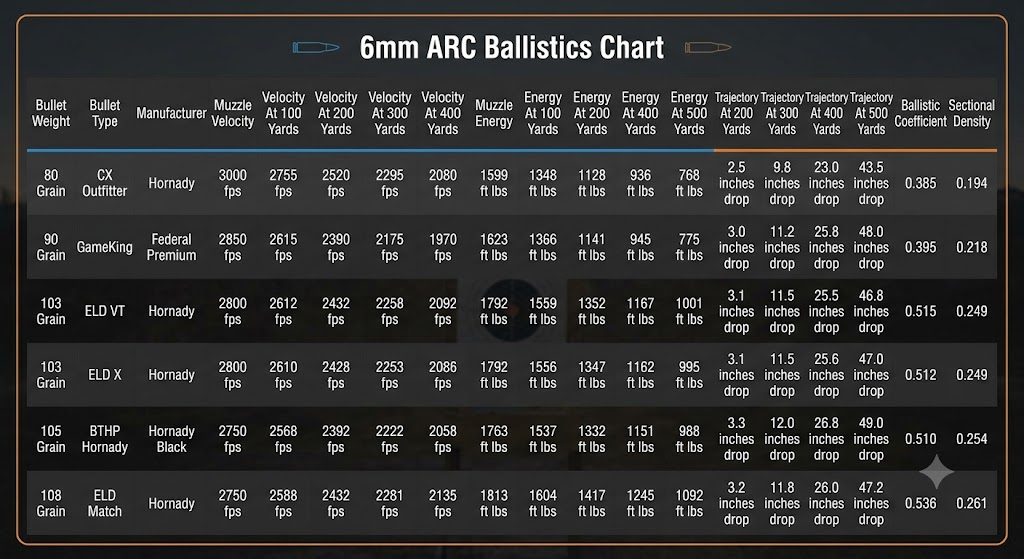
Below is a detailed ballistics table featuring popular commercial factory ammunition and representative match loads available today. The data represents a standard twenty four inch test barrel and assumes a one hundred yard zero. Atmospheric conditions are based on standard sea level metrics.
| Bullet Weight | Bullet Type | Manufacturer | Muzzle Velocity | Velocity At 100 Yards | Velocity At 200 Yards | Velocity At 300 Yards | Velocity At 400 Yards | Velocity At 500 Yards | Muzzle Energy | Energy At 100 Yards | Energy At 200 Yards | Energy At 300 Yards | Energy At 400 Yards | Energy At 500 Yards | Trajectory At 100 Yards | Trajectory At 200 Yards | Trajectory At 300 Yards | Trajectory At 400 Yards | Trajectory At 500 Yards | Ballistic Coefficient | Sectional Density |
| 80 Grain | CX Outfitter | Hornady | 3000 fps | 2755 fps | 2520 fps | 2295 fps | 2080 fps | 1880 fps | 1599 ft lbs | 1348 ft lbs | 1128 ft lbs | 936 ft lbs | 768 ft lbs | 628 ft lbs | 0 inches | 2.5 inches drop | 9.8 inches drop | 23.0 inches drop | 43.5 inches drop | 0.385 | 0.194 |
| 90 Grain | GameKing | Federal Premium | 2850 fps | 2615 fps | 2390 fps | 2175 fps | 1970 fps | 1780 fps | 1623 ft lbs | 1366 ft lbs | 1141 ft lbs | 945 ft lbs | 775 ft lbs | 633 ft lbs | 0 inches | 3.0 inches drop | 11.2 inches drop | 25.8 inches drop | 48.0 inches drop | 0.395 | 0.218 |
| 103 Grain | ELD VT | Hornady | 2800 fps | 2612 fps | 2432 fps | 2258 fps | 2092 fps | 1932 fps | 1792 ft lbs | 1559 ft lbs | 1352 ft lbs | 1167 ft lbs | 1001 ft lbs | 853 ft lbs | 0 inches | 3.1 inches drop | 11.5 inches drop | 25.5 inches drop | 46.8 inches drop | 0.515 | 0.249 |
| 103 Grain | ELD X | Hornady | 2800 fps | 2610 fps | 2428 fps | 2253 fps | 2086 fps | 1926 fps | 1792 ft lbs | 1556 ft lbs | 1347 ft lbs | 1162 ft lbs | 995 ft lbs | 848 ft lbs | 0 inches | 3.1 inches drop | 11.5 inches drop | 25.6 inches drop | 47.0 inches drop | 0.512 | 0.249 |
| 105 Grain | BTHP Hornady | Hornady Black | 2750 fps | 2568 fps | 2392 fps | 2222 fps | 2058 fps | 1902 fps | 1763 ft lbs | 1537 ft lbs | 1332 ft lbs | 1151 ft lbs | 988 ft lbs | 842 ft lbs | 0 inches | 3.3 inches drop | 12.0 inches drop | 26.8 inches drop | 49.0 inches drop | 0.510 | 0.254 |
| 108 Grain | ELD Match | Hornady | 2750 fps | 2588 fps | 2432 fps | 2281 fps | 2135 fps | 1994 fps | 1813 ft lbs | 1604 ft lbs | 1417 ft lbs | 1245 ft lbs | 1092 ft lbs | 953 ft lbs | 0 inches | 3.2 inches drop | 11.8 inches drop | 26.0 inches drop | 47.2 inches drop | 0.536 | 0.261 |
Understanding The Chart
A ballistics chart can look overwhelming at first glance due to the sheer amount of data presented in each row. However, once you break down each individual column, the numbers paint a clear picture of how a specific load will perform in the field. Understanding these metrics is crucial for maximizing your success whether you are hunting medium game or shooting steel targets at extreme distances.
Muzzle Velocity
Muzzle velocity is the speed at which the bullet exits the barrel of the firearm, measured in feet per second. The 6mm Advanced Rifle Cartridge is designed to push heavy, highly aerodynamic six millimeter bullets at optimal speeds while maintaining reliable feeding in standard AR 15 magazines. This measurement forms the absolute baseline for all downrange ballistic calculations.
Retained Velocity
Retained velocity refers to the speed of the bullet at specific distances downrange, such as one hundred or five hundred yards. Air resistance constantly slows the bullet down as it travels through the atmosphere. Retained velocity is critical for hunters because expanding hunting bullets require a minimum threshold velocity to open up reliably upon impact. Because this cartridge utilizes exceptionally aerodynamic projectiles, it retains its speed far better than standard small-bore cartridges.
Kinetic Energy
Kinetic energy is the amount of destructive physical force the bullet carries, measured in foot pounds. It is calculated using the weight of the bullet and its velocity at any given distance. Hunters pay close attention to this metric on any 6mm ARC Energy Chart to ensure they have enough power to ethically harvest game animals. Generally, one thousand foot pounds of energy is recommended for deer size game, a threshold this cartridge maintains out to extended medium-range distances.
Trajectory
Trajectory indicates the actual physical path the bullet takes as it flies through the air, factoring in the constant downward pull of gravity. The 6mm ARC Trajectory Chart displays bullet drop in inches at various yardages relative to a one hundred yard zero line of sight. By knowing the exact trajectory curve, shooters can adjust their aim or dial their scope turrets to hit targets at long range without guessing.
Ballistic Coefficient
The Ballistic Coefficient is a numerical value that represents how efficiently a bullet cuts through the air. A higher number means the bullet is more aerodynamic and will retain its velocity and energy far better over long distances. High Ballistic Coefficient bullets also resist wind drift much better than lower-rated projectiles, making them ideal for long-range precision shooting in open country.
Sectional Density
Sectional density is the ratio of a bullet weight compared directly to its diameter. This metric is a strong indicator of how deeply a bullet will penetrate into a target. A higher sectional density generally results in deeper penetration. Because this cartridge fires slender six millimeter projectiles, weights above 100 grains possess solid sectional density values for penetrating tough muscle and bone on medium game.
Common 6mm ARC Bullet Weights
The 6mm Advanced Rifle Cartridge is versatile, largely due to the variety of premium bullet weights it can fire accurately from standard fast-twist barrels. Selecting the proper weight is the most important decision a shooter can make for a specific application.
80 Grain
The 80 grain bullet is among the lighter practical options for this cartridge. It offers high muzzle velocities that approach three thousand feet per second. This weight is primarily used for varmint hunting, predator control, or medium game hunting where flat trajectories inside three hundred yards are preferred over heavy momentum retention.
90 Grain
The 90 grain bullet category bridges the gap between lightweight varmint rounds and heavy match projectiles. It offers a great balance of velocity and kinetic energy, making it an excellent choice for hunting coyotes, hogs, and whitetail deer at moderate distances.
103 Grain
The 103 grain weight represents the flagship hunting and match balance for this caliber. Bullets like the Hornady ELD X and ELD VT in this class feature high aerodynamic profiles that maintain lethal velocity downrange while providing reliable controlled expansion on medium game animals like deer and pronghorn.
105 to 108 Grain
The 105 to 108 grain weight range includes heavy match projectiles like the Hornady ELD Match and BTHP. These heavy match grade bullets feature exceptionally high Ballistic Coefficients. They are explicitly engineered to cut through crosswinds, maintain supersonic flight at extreme ranges, and deliver match-grade accuracy for precision rifle competitions.
Effective Hunting Range
The 6mm ARC Effective Range is impressive for a cartridge that functions within the small-frame AR 15 platform. Understanding the practical limitations of the cartridge ensures ethical hunting practices in the field.
Whitetail Deer and Antelope
For whitetail deer and antelope, this cartridge is effective out to three hundred to four hundred yards when using proper expanding ammunition in the 100 to 103 grain class. Within this window, the bullet retains sufficient kinetic energy and impact velocity to expand properly and deliver an ethical harvest.
Wild Hogs
Wild hogs possess a dense cartilage shield over their shoulders that demands deep penetration. The 6mm ARC is a capable hog cartridge out to three hundred yards when using solid copper monolithic bullets or bonded lead-core projectiles.
Coyotes and Predators
When hunting coyotes and predators across windy plains, the 6mm ARC shines. Using lighter 80 grain bullets or high-BC match rounds, hunters can accurately engage predators out to five hundred yards with minimal wind drift compared to standard .22 caliber centerfire rounds.
Target and Precision Rifle Shooting
For recreational steel target shooting and precision rifle matches, the 6mm ARC is one of the most capable cartridges available in the AR 15 platform. The low felt recoil allows shooters to spot their own impacts, while heavy 108 grain match bullets easily reach out to eight hundred yards and beyond.
Factors That Affect 6mm ARC Ballistics
Ballistics figures are influenced by mechanical and environmental variables.
Barrel Length
Barrel length directly impacts final muzzle velocity. While factory charts often utilize a twenty four inch barrel to display maximum potential, many shooters use eighteen or twenty inch barrels on hunting or tactical rifles. Shortening the barrel typically results in a loss of roughly 20 to 25 feet per second per inch removed.
Bullet Weight and BC
The choice between light, fast bullets and heavy, high-BC projectiles dictates downrange performance. Light bullets start fast and shoot flat at close range but lose momentum quickly. Heavy high-BC bullets launch slower but overtake lighter bullets in velocity retention, wind drift resistance, and kinetic energy past three hundred yards.
Altitude and Temperature
Thin mountain air at high altitudes reduces drag on the bullet, resulting in flatter trajectories and less drop compared to sea-level metrics. Conversely, freezing temperatures increase air density and slow powder burn rates, increasing overall bullet drop.
Twist Rate
To stabilize long, aerodynamic 100+ grain projectiles, rifles chambered in 6mm ARC require a fast barrel twist rate, typically 1 in 7.5 inches or 1 in 8 inches. Slow twist rates will fail to stabilize heavy match bullets, causing keyholing and severe loss of accuracy.
Best Zero Distance
Selecting the optimal zero distance depends on scope setup and field application.
100 Yard Zero
A 100 yard zero is the preferred baseline for precision marksmen and long-range shooters who dial scope turrets. It provides a clean, predictable reference point where all long-range adjustments are dialed upward.
200 Yard Zero
A 200 yard zero is ideal for general big game and predator hunting using a maximum point-blank range strategy. Zeroed at two hundred yards, a 103 grain hunting bullet will impact roughly 1.5 to 2 inches high at one hundred yards and drop only a few inches at two hundred and fifty yards, enabling dead-center aiming without holdover adjustments.
6mm ARC Ballistics Compared To Other Cartridges
Below is a comparison table showcasing how the 6mm ARC evaluates against establish intermediate and short-action hunting cartridges at 500 yards under standard sea level conditions.
| Cartridge | Muzzle Velocity | Muzzle Energy | Trajectory At 500 Yards | Recoil | Effective Range | Platform |
| 6mm ARC | 2750 fps | 1813 ft lbs | 47.2 inches drop | Light | 800 Yards | AR 15 / Bolt |
| 223 Remington | 3240 fps | 1282 ft lbs | 48.2 inches drop | Very Light | 400 Yards | AR 15 / Bolt |
| 6.5 Grendel | 2580 fps | 1818 ft lbs | 64.3 inches drop | Very Light | 800 Yards | AR 15 / Bolt |
| 243 Winchester | 2960 fps | 1945 ft lbs | 58.5 inches drop | Light-Moderate | 800 Yards | Short Action Bolt |
| 6mm Creedmoor | 3050 fps | 2416 ft lbs | 39.5 inches drop | Moderate | 1000 Yards | Short Action Bolt |
Compared to the standard .223 Remington, the 6mm ARC delivers substantially more energy retention, bucking the wind far better with heavier, sleeker projectiles. Against its parent platform sibling, the 6.5 Grendel, the 6mm ARC trades a small amount of bullet mass for higher velocity and a flatter overall trajectory. While short-action bolt cartridges like the .243 Winchester and 6mm Creedmoor produce higher velocities, the 6mm ARC accomplishes its performance inside the smaller, lighter AR 15 platform.
Frequently Asked Questions
What is a 6mm ARC Ballistics Chart?
It is a data reference table outlining velocity, kinetic energy, trajectory drop, and wind resistance metrics for the 6mm Advanced Rifle Cartridge over distance.
How far is the 6mm ARC effective for hunting deer?
When using quality 100 to 103 grain expanding hunting bullets, it is effective on whitetail deer out to three hundred to four hundred yards while maintaining sufficient kinetic energy and velocity for reliable expansion.
What barrel twist rate is required for 6mm ARC?
To stabilize heavy 100+ grain high-BC projectiles, rifles require a fast barrel twist rate of 1 in 7.5 inches or 1 in 8 inches.
Can 6mm ARC fit in a standard AR 15?
Yes, the 6mm ARC was specifically engineered to function in standard small-frame AR 15 rifles using 6.5 Grendel pattern magazines and bolt faces.
How much does a 6mm ARC drop at 500 yards?
With a 100 yard zero, a typical 108 grain match load drops approximately 47 inches at 500 yards under standard sea-level conditions.
Conclusion
A 6mm ARC Ballistics Chart highlights the capabilities of this modern intermediate cartridge. By pairing high-BC six millimeter projectiles with efficient case geometry designed for the AR 15 platform, the 6mm ARC delivers flat trajectories, excellent wind resistance, and energy retention that outpaces traditional small-frame calibers. Understanding its velocity curves, energy retention, and trajectory characteristics allows shooters and hunters to optimize their rifle setups for both hunting and long-range target engagements.