The 400 Legend Ballistics Chart is an incredibly detailed and highly comprehensive reference table that tracks the velocity, kinetic energy, and trajectory curve of the 400 Legend cartridge over various distances. By carefully reviewing this specific chart, you can visualize exactly how your heavy straight walled bullet will behave from the precise moment it leaves your barrel until it strikes a target hundreds of yards downrange. This critical data allows you to accurately predict bullet drop, compensate for wind drift, and verify that your heavy projectile retains enough energy for an ethical kill on game animals in dense brush or across open agricultural fields.
Shooters, hunters, reloaders, and modern sporting rifle enthusiasts use a 400 Legend Ballistics Chart to unlock the absolute true potential of this modern powerhouse hunting cartridge. Introduced recently by Winchester to dominate states with restrictive hunting regulations, this caliber completely revolutionized the straight walled firearms industry by perfectly bridging the performance gap between the popular 350 Legend and the massive 450 Bushmaster. By studying the numbers today, a dedicated woodland hunter can confidently take a challenging shot on a whitetail deer knowing exactly how their polymer tipped bullet will perform. A recreational marksman uses the trajectory data to understand exactly how much to adjust their optic for hitting steel targets at extended distances. In this comprehensive guide, you will learn how to analyze ballistics data, choose the absolute best bullet weight for your specific needs, determine the ideal zero distance, and see exactly how this modern straight walled cartridge absolutely dominates the hunting woods today.
400 Legend Ballistics Chart
Below is a detailed ballistics table featuring ten of the most popular and proven factory ammunition loads available today. The data represents a standard twenty inch test barrel commonly found on modern bolt action rifles and assumes a one hundred yard zero. Atmospheric conditions are based on standard sea level metrics. Because this cartridge features a relatively blunt straight walled design, the aerodynamic performance drops significantly at extended distances past two hundred yards.
| Bullet Weight | Bullet Type | Manufacturer | Muzzle Velocity | Velocity At 100 Yards | Velocity At 200 Yards | Velocity At 300 Yards | Velocity At 400 Yards | Velocity At 500 Yards | Muzzle Energy | Energy At 100 Yards | Energy At 200 Yards | Energy At 300 Yards | Energy At 400 Yards | Energy At 500 Yards | Trajectory At 100 Yards | Trajectory At 200 Yards | Trajectory At 300 Yards | Trajectory At 400 Yards | Trajectory At 500 Yards | Ballistic Coefficient | Sectional Density |
| 190 Grain | Deer Season XP | Winchester | 2400 fps | 1992 fps | 1631 fps | 1330 fps | 1116 fps | 989 fps | 2430 ft lbs | 1673 ft lbs | 1122 ft lbs | 747 ft lbs | 525 ft lbs | 413 ft lbs | 0 inches | 8.0 inches drop | 31.9 inches drop | 80.0 inches drop | 160.0 inches drop | 0.198 | 0.169 |
| 190 Grain | InterLock | Hornady | 2400 fps | 1992 fps | 1631 fps | 1330 fps | 1116 fps | 989 fps | 2430 ft lbs | 1673 ft lbs | 1122 ft lbs | 747 ft lbs | 525 ft lbs | 413 ft lbs | 0 inches | 8.0 inches drop | 31.9 inches drop | 80.0 inches drop | 160.0 inches drop | 0.198 | 0.169 |
| 200 Grain | Copper Solid | Barnes | 2300 fps | 1920 fps | 1580 fps | 1290 fps | 1090 fps | 970 fps | 2349 ft lbs | 1637 ft lbs | 1109 ft lbs | 739 ft lbs | 528 ft lbs | 418 ft lbs | 0 inches | 8.3 inches drop | 33.5 inches drop | 83.0 inches drop | 165.0 inches drop | 0.200 | 0.178 |
| 210 Grain | Power Shok | Federal Premium | 2250 fps | 1885 fps | 1555 fps | 1285 fps | 1090 fps | 965 fps | 2361 ft lbs | 1657 ft lbs | 1128 ft lbs | 770 ft lbs | 554 ft lbs | 434 ft lbs | 0 inches | 8.5 inches drop | 35.0 inches drop | 86.0 inches drop | 170.0 inches drop | 0.205 | 0.187 |
| 210 Grain | Core Lokt | Remington | 2250 fps | 1885 fps | 1555 fps | 1285 fps | 1090 fps | 965 fps | 2361 ft lbs | 1657 ft lbs | 1128 ft lbs | 770 ft lbs | 554 ft lbs | 434 ft lbs | 0 inches | 8.5 inches drop | 35.0 inches drop | 86.0 inches drop | 170.0 inches drop | 0.205 | 0.187 |
| 210 Grain | Fusion | Federal Premium | 2250 fps | 1885 fps | 1555 fps | 1285 fps | 1090 fps | 965 fps | 2361 ft lbs | 1657 ft lbs | 1128 ft lbs | 770 ft lbs | 554 ft lbs | 434 ft lbs | 0 inches | 8.5 inches drop | 35.0 inches drop | 86.0 inches drop | 170.0 inches drop | 0.205 | 0.187 |
| 215 Grain | Power Point | Winchester | 2250 fps | 1872 fps | 1540 fps | 1270 fps | 1080 fps | 960 fps | 2416 ft lbs | 1675 ft lbs | 1132 ft lbs | 770 ft lbs | 550 ft lbs | 440 ft lbs | 0 inches | 8.6 inches drop | 36.0 inches drop | 88.0 inches drop | 175.0 inches drop | 0.208 | 0.191 |
| 215 Grain | Core Lokt Tipped | Remington | 2250 fps | 1890 fps | 1560 fps | 1290 fps | 1100 fps | 975 fps | 2416 ft lbs | 1705 ft lbs | 1162 ft lbs | 794 ft lbs | 578 ft lbs | 454 ft lbs | 0 inches | 8.4 inches drop | 35.2 inches drop | 85.0 inches drop | 168.0 inches drop | 0.220 | 0.191 |
| 300 Grain | Super Suppressed | Winchester | 1060 fps | 989 fps | 934 fps | 890 fps | 850 fps | 810 fps | 748 ft lbs | 651 ft lbs | 581 ft lbs | 527 ft lbs | 481 ft lbs | 437 ft lbs | 0 inches | 36.0 inches drop | 105.0 inches drop | 220.0 inches drop | 380.0 inches drop | 0.280 | 0.267 |
| 300 Grain | Sub X | Hornady | 1050 fps | 980 fps | 925 fps | 880 fps | 840 fps | 800 fps | 734 ft lbs | 640 ft lbs | 570 ft lbs | 516 ft lbs | 470 ft lbs | 426 ft lbs | 0 inches | 37.0 inches drop | 108.0 inches drop | 225.0 inches drop | 390.0 inches drop | 0.280 | 0.267 |
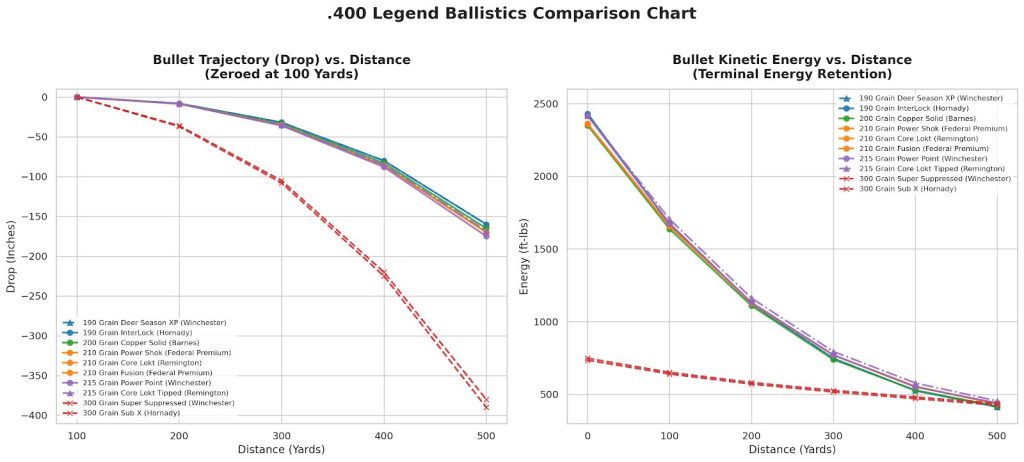
Understanding The Chart
A ballistics chart can look overwhelming at first glance due to the sheer amount of data presented in each row. However, once you break down each individual column, the numbers paint a brilliantly clear picture of how a specific load will perform in the field. Understanding these distinct metrics is absolutely crucial for maximizing your success when utilizing this modern hunting cartridge.
Muzzle Velocity
Muzzle velocity is the exact speed at which the bullet exits the barrel of the firearm. It is measured in feet per second. This cartridge was meticulously engineered to provide an impressively high muzzle velocity for a straight walled case by forcing a specialized powder charge behind a heavy forty caliber projectile. A higher muzzle velocity directly results in a flatter trajectory because gravity has significantly less time to pull the bullet downward before it reaches the intended target. The fast speed of this cartridge allows it to be fired from modern bolt action rifles while delivering massive terminal shock.
Retained Velocity
Retained velocity refers to the speed of the bullet at specific distances downrange, such as one hundred or five hundred yards. Air resistance constantly slows the bullet down as it travels through the atmosphere. Retained velocity is incredibly important for hunters because expanding soft point bullets require a specific minimum velocity to open up properly upon impact. Because this modern cartridge utilizes relatively blunt bullets, it sheds its velocity extremely fast. Once it passes two hundred yards, the velocity plummets rapidly.
Kinetic Energy
Kinetic energy is the amount of destructive physical force the bullet carries, measured in foot pounds. It is calculated by utilizing the weight of the bullet and its velocity at any given distance. Hunters must pay close attention to this specific metric on a 400 Legend Energy Chart to ensure they have enough power to ethically harvest game animals. The cartridge generates highly respectable kinetic energy at close ranges, hitting with over two thousand four hundred foot pounds of force at the muzzle. This makes it an absolute powerhouse in dense woods.
Trajectory
Trajectory indicates the actual physical path the bullet takes as it flies through the air, factoring in the constant downward pull of gravity. The 400 Legend Trajectory Chart displays the bullet drop in inches at various yardages relative to your line of sight through the optic. By knowing the exact trajectory curve, shooters can adjust their aim to hit targets precisely without guessing. This cartridge experiences incredibly steep bullet drop past two hundred yards, which means precise distance estimation is absolutely critical for field success.
Ballistic Coefficient
The Ballistic Coefficient is a numerical value that represents how efficiently a bullet cuts through the air. A higher number means the bullet is much more aerodynamic and will retain its velocity and energy far better over long distances. High Ballistic Coefficient bullets also resist wind drift significantly better than bullets with a lower rating. The traditional flat point bullets used in this cartridge have exceptionally poor aerodynamic ratings. However, modern polymer tipped bullets have slightly improved the aerodynamic efficiency of this caliber.
Sectional Density
Sectional density is the ratio of a bullet weight compared directly to its diameter. This metric is a fantastic indicator of how deeply a bullet will penetrate into a target. A higher sectional density generally results in much deeper penetration. Because this cartridge fires relatively heavy bullets for its wide forty caliber diameter, the sectional density is adequate for medium game. These heavy bullets are meant to penetrate deeply through thick muscle on large deer, ensuring a clean and rapid harvest.
Common 400 Legend Bullet Weights
The cartridge is highly unique because the vast majority of commercial factory ammunition is loaded specifically to comply with straight walled hunting regulations. Selecting the proper bullet weight is a critical decision for anyone looking to maximize the potential of this modern rifle caliber in the hunting woods.
190 Grain
The 190 grain bullet is the lightest option practically available for this cartridge, and it is primarily utilized by hunters seeking maximum velocity and the flattest possible trajectory. It offers incredibly fast muzzle velocities that easily reach two thousand four hundred feet per second. This weight is primarily used for dedicated deer hunting across open agricultural fields where flat trajectories are preferred. It provides devastating terminal performance and massive energy transfer upon impact, dropping large bucks instantly.
200 Grain
The 200 grain bullet is heavily dominated by solid copper monolithic bullets. Because solid copper is lighter than traditional lead, these bullets are naturally longer and retain nearly one hundred percent of their weight upon impact. They provide incredibly deep penetration on medium game while shooting remarkably flat. They are the ideal choice for hunting tough feral hogs or for hunters operating in jurisdictions that legally mandate lead free ammunition.
210 Grain
The 210 grain bullet is a standard weight for this specific caliber. Almost all commercial factory ammunition manufacturers offer a high quality 210 grain bullet. Traditional soft point designs like the Federal Power Shok and Remington Core Lokt are utilized heavily for deer and black bear hunting across North America. For the average sportsman hunting whitetail deer in the dense woods, a high quality 210 grain soft point bullet is the most reliable choice available. It balances velocity, kinetic energy, and deep penetration perfectly.
215 Grain
The 215 grain bullet represents the classic heavy premium option for this cartridge. Famous bullets like the Winchester Power Point are often loaded in this exact weight. They provide incredibly deep penetration on tough game while shooting remarkably flat. They are the ideal choice for hunting tough feral hogs or large whitetail deer where maximum weight retention and deep wound channels are absolutely mandatory for success.
300 Grain
The 300 grain bullet marks the transition into heavy subsonic performance. Bullets like the Winchester Super Suppressed are specifically engineered to travel at velocities well under the speed of sound. This is the premier choice for tactical shooters and hunters who want to remain perfectly silent while ethically harvesting medium game with a sound suppressor attached to their rifle. The massive weight provides deep penetration despite the very slow velocity.
Effective Hunting Range
The 400 Legend Effective Range is heavily dictated by its straight walled design and blunt bullet profiles. It was engineered from the ground up to be a phenomenal close quarters hunting cartridge that complies with strict state hunting regulations. Knowing the strict capabilities of the cartridge ensures ethical hunting practices in the field and prevents wounded game.
Whitetail Deer
For whitetail deer, this cartridge is highly effective out to two hundred and fifty yards when using proper expanding ammunition. The cartridge was specifically born to dominate the deer woods in states that restrict traditional bottleneck cartridges. It delivers devastating hydrostatic shock and provides excellent knockdown power on medium game animals in dense woodland environments. The heavy bullets ensure that the projectile expands reliably, creating massive wound channels that anchor deer quickly.
Elk
Hunting elk with this cartridge requires extreme caution and perfect shot placement. Elk are massive heavily boned animals that require incredibly deep penetration and massive kinetic energy transfer. While a perfectly placed heavy 215 grain premium bullet can harvest an elk at close range, the cartridge operates near the minimum acceptable threshold for such large game. Hunters must restrict their shots to incredibly close ranges under one hundred yards and guarantee absolutely perfect broadside presentations.
Black Bear
Black bears share similar anatomy and toughness to wild hogs and large deer. A quality 215 grain premium soft point bullet will deliver devastating results on a black bear inside one hundred and fifty yards. The cartridge provides plenty of bone crushing penetration to reach the vital organs of a bear quickly and ethically, making it an absolute favorite among spot and stalk hunters or hunters utilizing blinds in rugged woodland environments where shots are remarkably close and fast.
Wild Hogs
Feral hogs are extremely tough creatures wrapped in a thick shield of gristle and cartilage. A modern bolt action or semi automatic rifle paired with this heavy hitting straight walled cartridge is widely considered one of the absolute best combinations for wild hog eradication. The heavy forty caliber bullets smash completely through the tough shoulder shield of a large boar with immense authority, anchoring the animals exactly where they stand.
Coyotes
When hunting coyotes in dense brush, this cartridge performs flawlessly and is often considered a fantastic utility tool for farmers and ranchers. With its fast handling rifle platforms, it hits predators with spectacular authority at close ranges. Using standard 190 grain polymer tipped bullets, you can accurately harvest coyotes out to two hundred and fifty yards. The immense energy transfer ensures instant ethical kills on fast moving predators.
Target Shooting
For general steel target shooting and range practice, the cartridge is incredibly fun and wildly popular among traditional firearms enthusiasts. The remarkably moderate recoil makes it an absolute joy to shoot during long training sessions. The short effective range makes it highly economical for shooters who want to ring steel plates at standard distances without needing to constantly calculate complex holdover math for extreme long range engagements.
Long Range Shooting
Long range precision shooting with this cartridge is completely outside the scope of its fundamental design. The straight walled casing and blunt bullets have terrible aerodynamic efficiency, causing them to lose velocity instantly and drift terribly in heavy crosswinds. The bullets drop several feet once they pass the three hundred yard mark. This cartridge is explicitly designed for close quarters hunting inside two hundred and fifty yards.
Factors That Affect 400 Legend Ballistics
Ballistics numbers are never completely static. The exact data provided in any velocity chart will change constantly based on environmental conditions and the physical characteristics of your specific firearm setup. Understanding these distinct variables is the key to achieving true precision in the hunting woods.
Barrel Length
Barrel length has a major direct impact on your final muzzle velocity. Most factory ballistics charts use a twenty inch barrel. However, utilizing this cartridge in longer twenty four inch rifle barrels will provide a noticeable increase in velocity and slightly flatten the trajectory curve. Conversely, shooting from an extremely short sixteen inch carbine barrel will result in a severe velocity loss and generate a loud distracting muzzle flash.
Bullet Weight
The specific bullet weight you select dictates your entire trajectory arc. Lighter bullets launch faster and fly slightly flatter at close range, but they lose their velocity rapidly due to severe wind resistance acting against their blunt noses. Heavy 300 grain subsonic bullets start out incredibly slow and drop like a stone, making precise distance estimation absolutely vital. You must choose your ammunition based entirely on your specific hunting environment and target size.
Bullet Design
The physical shape of your bullet matters just as much as its weight. Modern flexible polymer tipped bullets provide vastly superior aerodynamic efficiency compared to traditional flat soft point designs. These sleek polymer tips allow the bullet to retain its velocity and kinetic energy much further downrange, extending the maximum ethical hunting distance across open agricultural fields.
Altitude
Shooting at high elevations slightly improves your ballistic performance. Thin mountain air provides much less atmospheric resistance against the bullet. If you zero your rifle near sea level and travel to the high country for a backcountry hunt, your bullet will shoot marginally flatter. However, because this is primarily a short range cartridge, the actual physical difference in bullet drop inside one hundred and fifty yards is virtually impossible to notice with the naked eye.
Temperature
Temperature shifts impact both the density of the air and the internal pressure of your cartridge chamber. Cold air is dense and creates more drag on the blunt bullet. Freezing temperatures also slow down the burn rate of your gunpowder. Both of these factors combine to reduce velocity and slightly increase your overall bullet drop in cold weather environments. Hunters operating in freezing winter conditions should always verify their rifle zero before heading into the woods.
Humidity
Humidity is often completely misunderstood by novice shooters. Humid air is actually less dense than dry air because water vapor is lighter than atmospheric nitrogen and oxygen molecules. Shooting in high humidity provides slightly less resistance for the bullet. However, for a short range caliber like this, the aerodynamic effect is entirely negligible and will not alter your hunting success in any measurable way.
Wind
Wind deflection is a massive challenge for this specific caliber when shooting across open agricultural fields. A heavy crosswind will literally push your blunt projectile sideways off its intended path with terrifying ease. Because traditional factory bullets lack high aerodynamic efficiency, they are highly susceptible to severe wind drift. Shooters must learn to read the wind perfectly when attempting shots on game animals past one hundred and fifty yards.
Twist Rate
The twist rate of a rifle barrel determines how fast the bullet spins in flight. The modern rifles chambered for this cartridge utilize a standard twist rate, usually one turn in sixteen inches, that is perfectly optimized to stabilize the heavy 215 grain and 300 grain projectiles. Because the caliber is highly standardized by manufacturers, shooters rarely need to worry about twist rate unless they are building a custom barrel for a highly specialized application.
Zero Distance
Your selected zero distance establishes the mathematical foundation for your entire trajectory data table. If you zero at one hundred yards, all of your adjustments will be calculated from that exact point. Choosing a different zero distance completely shifts the arc of your bullet flight path relative to your line of sight. Shooters must thoroughly understand their specific zero data to succeed in the field and prevent shooting entirely over the back of a deer.
Best Zero Distance
Selecting the optimal zero distance depends entirely on how you plan to use your firearm in the field. Different applications require different zero strategies to maximize your success and minimize complicated mental math during stressful hunting situations.
25 Yard Zero
A twenty five yard zero is occasionally used by shooters who operate exclusively in extremely dense brush where visibility is limited to a few dozen yards. Because the line of sight through the scope is mounted above the bore, zeroing at such a close distance allows for highly rapid target acquisition on moving game. However, it causes the bullet to impact slightly high at intermediate ranges, making precise shot placement somewhat confusing if an animal steps out further away.
50 Yard Zero
A fifty yard zero is highly practical for hunters operating heavy subsonic ammunition equipped with a sound suppressor. It keeps the heavy arcing trajectory incredibly tight to the line of sight at close ranges. This is widely considered an excellent zero distance for dedicated wild hog eradication in dense swamps where engagements are guaranteed to happen at very close distances incredibly fast.
100 Yard Zero
The one hundred yard zero is the absolute gold standard for recreational shooters and woodland hunters. Factory ballistics data is almost exclusively calculated using this specific distance. It provides a clean and perfect mathematical baseline, allowing the shooter to easily understand the severe bullet drop that occurs once the bullet travels past this exact distance. For hunters utilizing optics across woodland clearings, the one hundred yard zero provides the absolute highest level of confidence.
200 Yard Zero
A two hundred yard zero is rarely recommended for this specific cartridge when utilizing traditional flat point ammunition. Because the bullet drops so severely, zeroing at two hundred yards forces the bullet into a massive upward arc. This causes the bullet to impact several inches too high at one hundred yards, guaranteeing missed shots over the top of a deer in the heat of the moment. However, if a hunter is utilizing modern aerodynamic polymer tipped bullets, a zero distance of one hundred and fifty yards provides an outstanding maximum point blank range.
300 Yard Zero
A three hundred yard zero is absolutely never used with this cartridge under any practical hunting circumstances. The bullet lacks the velocity and aerodynamic efficiency to reliably hit targets at this distance without utilizing extreme mortar style holdovers. Attempting a three hundred yard zero will result in complete failure and massive frustration on the shooting range.
For most traditional shooters utilizing this modern cartridge in the dense woods, the one hundred yard zero is heavily recommended due to its unparalleled reliability and massive forgiveness in the field.
400 Legend Ballistics Compared To Other Cartridges
To truly appreciate the brilliant engineering behind this modern hunting cartridge, we must compare it directly against its closest competitors in the woodland hunting world. Below is a detailed comparison table outlining performance at standard hunting ranges.
| Cartridge | Muzzle Velocity | Muzzle Energy | Trajectory At 200 Yards | Recoil | Effective Range | Long Range Performance | Hunting Performance |
| 400 Legend | 2250 fps | 2416 ft lbs | 8.6 inches drop | Moderate | 250 Yards | Poor | Exceptional |
| 350 Legend | 2250 fps | 1800 ft lbs | 8.0 inches drop | Light | 200 Yards | Poor | Excellent |
| 450 Bushmaster | 2200 fps | 2686 ft lbs | 12.0 inches drop | Heavy | 250 Yards | Poor | Exceptional |
| 360 Buckhammer | 2400 fps | 2300 ft lbs | 7.8 inches drop | Moderate | 200 Yards | Poor | Excellent |
| 30 30 Winchester | 2390 fps | 1902 ft lbs | 7.5 inches drop | Moderate | 200 Yards | Poor | Excellent |
When comparing the modern 400 Legend to the highly popular 350 Legend, the terminal performance differences become apparent. Both cartridges are straight walled and operate at similar velocities. However, the forty caliber option generates roughly six hundred more foot pounds of kinetic energy at the muzzle because it utilizes a significantly wider and heavier bullet. The extra power provides vastly superior kinetic energy transfer upon impact, dropping large deer incredibly fast.
Against the massive 450 Bushmaster, the smaller forty caliber cartridge completely wins the recoil battle. The 450 Bushmaster fires an incredibly massive bullet that generates punishing recoil, making it highly unpleasant for young shooters or long practice sessions. The 400 Legend delivers incredibly pleasant recoil levels similar to a traditional woodland carbine while still providing energy levels that rival the massive forty five caliber option.
When stacked against the lever action specific 360 Buckhammer, the modern bolt action cartridge offers completely different rifle platform advantages. The 360 Buckhammer features a rimmed case specifically designed to function flawlessly in classic lever action rifles. The 400 Legend features a rimless case explicitly designed to feed flawlessly from standard box magazines in modern bolt action and semi automatic rifles, serving as the perfect modern platform for deer hunters.
Comparing it to the legendary 30 30 Winchester highlights the immense hunting options available today. The historic thirty caliber cartridge fires highly effective bullets, but the bottlenecked design makes it completely illegal for deer hunting in several midwestern states. The 400 Legend provides vastly superior kinetic energy transfer and deeper wound channels while remaining perfectly legal in straight walled restricted hunting zones.
Frequently Asked Questions
What is a 400 Legend Ballistics Chart?
It is a highly comprehensive reference table that tracks the velocity, kinetic energy, and trajectory curve of the cartridge over various distances. Shooters heavily rely on this specific data to precisely calculate exactly how much their blunt bullet will drop and drift in the wind, allowing for highly accurate elevation adjustments during short range woodland hunting engagements.
How far is a 400 Legend effective on deer?
This cartridge is highly effective on medium game out to two hundred and fifty yards when in the hands of a skilled marksman utilizing proper expanding ammunition. The heavy blunt projectiles lose massive amounts of speed rapidly, preventing ethical hunting at vastly extended ranges across open plains.
How much does a 400 Legend bullet drop at 200 yards?
With a standard one hundred yard zero, a typical 215 grain premium soft point bullet will drop roughly eight and a half inches at two hundred yards. The exact drop depends heavily on your specific muzzle velocity, bullet design, barrel length, and local atmospheric conditions during your hunting session.
Is the 400 Legend better than the 350 Legend?
It is absolutely considered better by hunters who prioritize heavy knockdown power and deep penetration on large game animals like massive whitetail deer and black bears. The forty caliber bullets provide vastly superior kinetic energy transfer upon impact compared to the lighter projectiles found in the thirty five caliber option.
Is the 400 Legend suitable for elk hunting?
While legally permitted in many jurisdictions, the vast majority of professional hunting guides consider it extremely marginal and severely underpowered for modern elk hunting across open terrain. The blunt bullets lack the massive kinetic energy required to penetrate deeply through heavy bone at extended distances. If utilized for elk, hunters must restrict shots to incredibly close ranges with absolutely perfect broadside presentations.
What is the best bullet weight for deer hunting?
The best bullet weight for general deer hunting falls exclusively on the 190 grain and 215 grain standards. Bullets in this specific weight class offer a brilliant balance of high muzzle velocity, reliable feeding, highly manageable recoil, and rapid expansion when utilizing premium soft point designs explicitly created for hunting applications.
What is the best zero distance for this cartridge?
For recreational shooters and woodland hunters who want to aim directly at the center of the vital zone without constantly adjusting their sights, the one hundred yard zero is heavily recommended. It provides a highly simplified and perfectly clean mathematical baseline for maximizing the point blank range of this modern caliber in heavy timber.
Can it accurately reach 300 yards?
While it is mathematically possible to hit a target at three hundred yards, it is not recommended for practical or reliable hunting applications. The traditional slow blunt bullets lack the high aerodynamic efficiency required to reach three hundred yards effectively without extreme bullet drop. Attempting to shoot game animals at three hundred yards requires massive holdovers and invites tragedy.
Does barrel length affect velocity?
Yes, barrel length has a massive direct impact on muzzle velocity for this specific cartridge. Because it was heavily optimized for a twenty inch or twenty two inch bolt action barrel, firing it from an extremely short sixteen inch carbine barrel will result in a severe velocity loss and generate a massive distracting muzzle blast.
What is the fastest factory loaded ammunition?
The fastest factory options are the premium lightweight 190 grain flexible polymer tipped loads, which easily leave a twenty inch barrel at phenomenal speeds reaching two thousand four hundred feet per second. These specific modern loads provide the absolute flattest possible trajectory for dedicated open woods hunters.
Conclusion
Understanding a 400 Legend Ballistics Chart is absolutely essential for any shooter who wants to extract the absolute maximum performance from this incredibly modern and fascinating woodland hunting cartridge. Whether you are analyzing a trajectory table to prepare for a dense brush wild hog hunt or studying an energy chart to ensure you have enough explosive stopping power for a massive whitetail buck, this exact data provides the critical foundation for your success in the field. The numbers clearly demonstrate exactly why this phenomenal straight walled cartridge has rapidly gained a fiercely loyal following among American hunters across the midwest.
By thoroughly mastering your data, learning exactly how the standard heavy bullet weights perform at short distances, and selecting the absolute optimal zero distance, you eliminate all guesswork from your shooting routine entirely. The effective range of this cartridge is strictly limited by physics, making it the perfect moderate recoil tool for heavy timber brush hunting and recreational target shooting. With highly manageable recoil, flawless bolt action and semi automatic reliability, and devastating terminal performance on medium game, the 400 Legend continues to prove that it is one of the absolute greatest brush hunting rifle cartridges ever designed.