The main difference between the .300 Winchester Magnum and the .308 Winchester is their design goal: the .300 Win Mag is a high-capacity magnum engineered for maximum velocity, flatter trajectories, and long-range energy retention, whereas the .308 Winchester is an efficient, short-action cartridge optimized for accuracy, manageable recoil, and versatile performance at moderate distances. While both use the same .30-caliber bullet diameter, the .300 Win Mag offers significantly more “horsepower” for large game and extended-range shots, whereas the .308 Winchester provides a more practical, lower-recoil experience for standard hunting and target shooting. Understanding the trade-offs in this 300 win mag vs 308 ballistics chart comparison is crucial for selecting the right tool for your specific hunting or shooting application.
Table of Contents [Click to open]
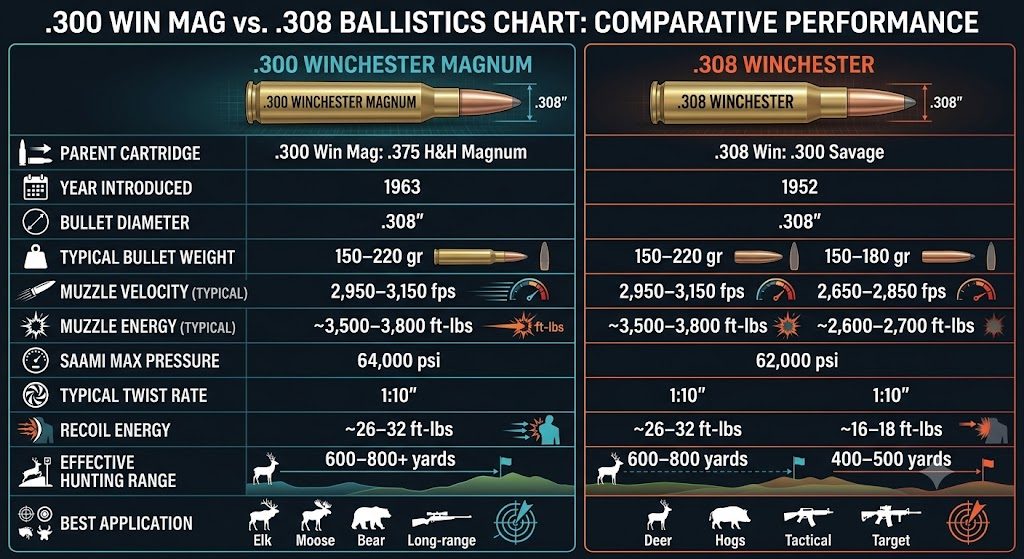
300 Win Mag vs 308 Ballistics Chart
| Feature | .300 Winchester Magnum | .308 Winchester |
| Parent Cartridge | .375 H&H Magnum | .300 Savage |
| Year Introduced | 1963 | 1952 |
| Bullet Diameter | .308″ | .308″ |
| Typical Bullet Weight | 150–220 gr | 150–180 gr |
| Muzzle Velocity (Typical) | 2,950–3,150 fps | 2,650–2,850 fps |
| Muzzle Energy (Typical) | ~3,500–3,800 ft-lbs | ~2,600–2,700 ft-lbs |
| SAAMI Max Pressure | 64,000 psi | 62,000 psi |
| Typical Twist Rate | 1:10″ | 1:10″ |
| Recoil Energy | ~26–32 ft-lbs | ~16–18 ft-lbs |
| Effective Hunting Range | 600–800+ yards | 400–500 yards |
| Best Application | Elk, Moose, Bear, ELR | Deer, Hogs, Tactical, Target |
Muzzle Velocity Comparison
The .300 Win Mag consistently outperforms the .308 Winchester in raw speed, typically launching 150-grain bullets 300 to 450 fps faster than the .308. While the .308 Winchester is highly capable for most North American hunting, the extra powder capacity of the .300 Win Mag allows it to maintain higher velocity, which is essential for consistent bullet expansion at extreme distances compared with the .308.
Muzzle Energy Comparison
There is a stark difference in power output, with the .300 Win Mag generating upwards of 3,800 ft-lbs of energy compared to the roughly 2,600 ft-lbs of the .308 Winchester. On the other hand, the .308 Winchester’s energy is more than sufficient for whitetail deer and even elk at responsible ranges. However, for those pursuing larger or dangerous game, the .300 Win Mag delivers a significantly higher margin of terminal energy compared to the .308.
Downrange Energy Comparison
As distance increases, the .300 Win Mag’s ability to push heavier, high-ballistic-coefficient (BC) bullets at high speeds allows it to retain energy much better than the .308. At 500 yards, the .300 Win Mag remains effective on large game, whereas the .308 Winchester energy levels drop into a range that makes deep penetration on large animals more challenging compared with the magnum.
Bullet Drop and Trajectory
The .300 Win Mag produces a significantly flatter trajectory, requiring less holdover for long-range shots compared with the .308 Winchester. At 500 yards, the .300 Win Mag can have 10 or more inches less drop than the .308, depending on the load. While the .308 Winchester is predictable and easy to learn at moderate ranges, the .300 Win Mag is superior for hunting in wide-open Western terrain where long shots are common.
Recoil Comparison
Recoil is the primary “price” paid for the .300 Win Mag’s performance. The .300 Win Mag generates nearly double the recoil energy of the .308 Winchester, which can lead to shooter fatigue and a potential flinch. In contrast, the .308 Winchester is renowned for its mild, manageable recoil, making it much easier to practice with extensively compared with the heavy-hitting .300 Win Mag.
Ammunition and Barrel Life
The .308 Winchester is generally more affordable to shoot and offers a longer barrel life—often two to three times that of a .300 Win Mag—due to lower pressures and smaller powder charges. While both are widely available, the .308 Winchester is a clear favorite for high-volume practice compared with the more specialized, ammunition-heavy .300 Win Mag.
Which Is Better?
The .308 Winchester is better for the vast majority of deer hunters, tactical shooters, and those who prioritize practice and efficiency. Its manageable recoil, barrel longevity, and lower cost make it an ideal choice for hunting whitetails, hogs, or medium game at distances under 400 yards.
The .300 Win Mag is better for the dedicated Western or backcountry hunter who regularly takes shots beyond 400 yards on elk, moose, or large bear. It provides the necessary terminal energy and wind-bucking capability that are vital for long-range precision, provided the shooter is capable of handling the increased recoil and cost associated with the magnum platform.
FAQ
Is .300 Win Mag too much for deer?
Many shooters consider the .300 Win Mag to be overkill for standard whitetail hunting, as it can cause excessive meat damage compared to the efficient, lower-recoil .308 Winchester.
Which is better for target shooting?
For high-volume target shooting, the .308 Winchester is widely preferred due to cheaper ammunition, less barrel wear, and reduced recoil, which allows for better fundamental marksmanship training.
Is .308 enough for elk?
Yes, the .308 Winchester is fully capable of taking elk at moderate, ethical hunting ranges with proper shot placement, although it lacks the long-range energy margin of the .300 Win Mag.
Why is .300 Win Mag popular for snipers?
The .300 Win Mag was adopted by various military and law enforcement agencies for its superior long-range reach, flat trajectory, and high terminal energy, which provide a clear advantage over the .308 Winchester at distances exceeding 800 yards.