Whether you are hitting the range for a weekend session or running tactical drills, understanding the trajectory of your ammunition is essential. A 5.56 ballistic chart shows exactly how a bullet behaves from the moment it leaves the muzzle out to long distances. Shooters rely on ballistic charts to predict bullet drop, account for wind drift, and understand retained energy at various yardages.
Below is a comprehensive trajectory chart for the widely popular 5.56 NATO M193 (55 gr FMJ) factory load. Keep in mind that real-world ballistic performance will always vary depending on your specific barrel length, ammunition brand, twist rate, and current environmental conditions like altitude and temperature.
5.56 Ballistic Chart
5.56 NATO M193 – 55 gr FMJ
(Calculated using a 16-inch barrel, 100-yard zero, 1.5-inch sight height, and a G1 Ballistic Coefficient of 0.243)
| Range (yards) | Velocity (fps) | Energy (ft-lbs) | Bullet Drop (inches) | Bullet Drop (MOA) | Bullet Drop (MIL) | Wind Drift (10 mph Crosswind) | Time of Flight (seconds) | Remaining Energy (%) |
| 0 | 3,165 | 1,223 | -1.5 | 0.0 | 0.0 | 0.0 | 0.00 | 100% |
| 100 | 2,795 | 955 | 0.0 | 0.0 | 0.0 | 1.0″ | 0.10 | 78% |
| 200 | 2,465 | 740 | -2.8 | -1.3 | -0.4 | 4.2″ | 0.21 | 60% |
| 300 | 2,155 | 565 | -11.5 | -3.7 | -1.1 | 10.3″ | 0.34 | 46% |
| 400 | 1,870 | 425 | -28.0 | -6.7 | -1.9 | 20.0″ | 0.49 | 35% |
| 500 | 1,605 | 315 | -55.0 | -10.5 | -3.1 | 34.0″ | 0.66 | 26% |
| 600 | 1,365 | 227 | -97.0 | -15.4 | -4.5 | 54.0″ | 0.86 | 18% |
| 700 | 1,165 | 165 | -161.0 | -22.0 | -6.4 | 80.0″ | 1.10 | 13% |
| 800 | 1,025 | 128 | -255.0 | -30.4 | -8.8 | 112.0″ | 1.37 | 10% |
| 900 | 930 | 105 | -385.0 | -40.8 | -11.9 | 147.0″ | 1.68 | 8% |
| 1000 | 860 | 90 | -555.0 | -53.0 | -15.4 | 185.0″ | 2.01 | 7% |
5.56 Ballistic Chart Image
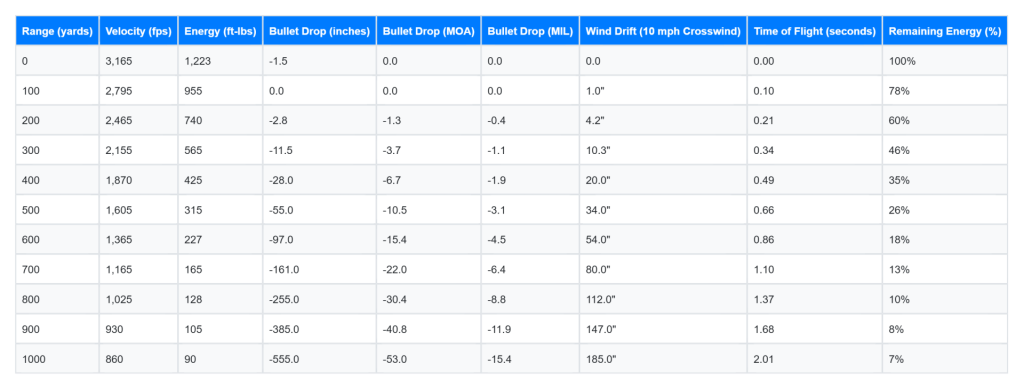
How to Read the 5.56 Ballistic Chart
Understanding the 5.56 trajectory chart requires looking at how each variable works together as distance increases:
- Range (yards): The distance from the muzzle to the target.
- Velocity (fps): The speed of the bullet in feet per second.
- Energy (ft-lbs): The striking force the bullet carries, measured in foot-pounds.
- Bullet Drop (inches): How far gravity pulls the bullet down below the line of sight.
- Bullet Drop (MOA & MIL): Angular measurements used to adjust your rifle scope’s turrets or reticle holdovers.
- Wind Drift: How far a 10 mph crosswind pushes the bullet horizontally.
- Time of Flight: How long it takes for the bullet to reach the target, measured in seconds.
- Remaining Energy (%): The percentage of muzzle energy the bullet retains at a specific distance.
Velocity Performance
Muzzle velocity is the speed at which the bullet exits the barrel. The 5.56 NATO is a high-velocity cartridge, with lightweight 55-grain bullets often exceeding 3,100 fps.
Retained velocity is how much speed the bullet maintains as it travels downrange. Because the 55 gr M193 has a relatively low ballistic coefficient, it bleeds speed rapidly. By 400 yards, the bullet has lost nearly 40% of its initial velocity. It generally transitions from supersonic to transonic flight (where accuracy can become unpredictable) right around 700 to 750 yards, eventually dropping below the speed of sound entirely.
Energy Performance
The 5.56 NATO produces modest muzzle energy compared to full-power rifle cartridges—typically around 1,200 to 1,300 ft-lbs.
However, because its bullets are so light, retained energy drops significantly at range. By 500 yards, the 55-grain bullet only carries around 315 ft-lbs of energy (roughly 26% of its original power).
- Target shooting: Adequate out to 800+ yards, though ringing steel is the primary goal.
- Varmint hunting: Excellent energy and terminal performance inside 300 yards.
- Predator hunting: Very capable out to 250–300 yards with proper expanding ammunition.
- Defensive use: Highly effective within 200 yards, particularly when utilizing loads that fragment or expand reliably.
Bullet Drop
Trajectory is the arc the bullet travels on its way to the target. While the 5.56 velocity chart shows that it shoots extremely flat out to 200 yards, the rapid loss of speed causes gravity to take a massive toll past 400 yards.
If you are dialing for distance, understanding MOA (Minute of Angle) or MIL (Milliradian) is essential. A drop of -55 inches at 500 yards requires an adjustment of roughly 10.5 MOA or 3.1 MIL on your optic. The bullet drop increases dramatically after 500 yards because the bullet is flying much slower, meaning gravity has more time to pull it toward the earth.
Wind Drift
Wind drift is often the hardest variable to master. A standard 10 mph crosswind will only push a 55-grain bullet about 1 inch off course at 100 yards.
However, lighter bullets with lower ballistic coefficients are highly susceptible to wind at longer ranges. At 500 yards, that same 10 mph wind will blow the bullet 34 inches horizontally. Heavier bullets, like the 77 grain 5.56 ballistics loads, boast a higher ballistic coefficient (BC) and resist wind drift much more efficiently than 55 gr or 62 gr options.
Time of Flight
Time of flight simply tells you how long the bullet is in the air. While it only takes 0.10 seconds to reach 100 yards, it takes a full two seconds to reach 1,000 yards.
Longer flight times directly increase the effects of both gravity and wind drift. The longer the bullet is exposed to the elements, the further it will deviate from its original path.
Effective Range
The 5.56 NATO is incredibly versatile, but it is not a magical long-range caliber. Here is a realistic look at the cartridge’s practical applications:
| Application | Practical Effective Range |
| Home defense | 0 – 100 yards |
| Varmint hunting | 0 – 300 yards |
| Predator hunting | 0 – 300 yards |
| Recreational / Steel shooting | 0 – 600 yards |
| Precision Competition (Heavy bullets) | 0 – 800 yards |
Long-Range Performance
The 5.56 NATO was designed as a mid-range infantry cartridge, not a dedicated sniper round.
- Supersonic range: Standard 55-grain loads go subsonic between 700 and 800 yards, while heavy 77-grain match bullets can stay supersonic past 850 yards.
- Accuracy potential: Superb within 500 yards.
- Limitations: Beyond 600 yards, the 5.56 energy chart shows terminal ballistics are severely lacking.
- Bullet stability: Once a bullet hits the transonic zone (around Mach 1.2), turbulence can destabilize it, causing accuracy to suffer.
- Wind sensitivity: The 5.56 bullet drop chart makes elevation easy to calculate, but reading wind at 800 yards with a lightweight bullet is incredibly difficult.
Best Factory Loads for 5.56 NATO
Different shooting tasks require different bullets. Here is how some of the most popular factory loads stack up:
| Manufacturer | Bullet | Bullet Weight (gr) | Ballistic Coefficient (G1) | Muzzle Velocity (fps) | Primary Use |
| Winchester | FMJ (M193) | 55 gr | 0.243 | 3,180 fps | Target / Plinking |
| Federal | Green Tip (M855) | 62 gr | 0.304 | 3,020 fps | Target / General Duty |
| Black Hills | OTM (Mk 262) | 77 gr | 0.372 | 2,750 fps | Precision / Competition |
| Hornady | BTHP Match | 75 gr | 0.395 | 2,910 fps | Target / Competition |
| PMC | X-TAC FMJ | 55 gr | 0.243 | 3,120 fps | Practice / Training |
| Barnes | TSX Solid Copper | 62 gr | 0.287 | 3,000 fps | Hunting / Defense |
| Nosler | Ballistic Tip | 55 gr | 0.267 | 3,100 fps | Varmint Hunting |
| Fiocchi | V-MAX | 50 gr | 0.227 | 3,300 fps | Varmint Hunting |
Factors That Affect 5.56 Ballistics
The 5.56 trajectory chart provided is a baseline. Real-world ballistics shift constantly based on several internal and external factors:
- Barrel length: A 20″ barrel produces much higher velocities than a 10.5″ or 14.5″ barrel. Shorter barrels mean slower speeds, steeper drop, and less retained energy.
- Twist rate: Rifles with a 1:7 twist stabilize heavy 77-grain bullets perfectly, while a 1:9 twist is better suited for 55-grain to 62-grain rounds.
- Bullet weight & BC: Heavier, aerodynamic bullets (high BC) fly slower initially but retain velocity better and cut through the wind more effectively.
- Environmental conditions: Altitude, temperature, humidity, and air pressure drastically alter air density. Bullets fly faster and flatter in thin, warm, high-altitude air.
- Zero distance: A 50-yard zero will yield a completely different mid-range trajectory compared to a 100-yard zero.
Frequently Asked Questions
How far is 5.56 effective?
For target shooting, it can stretch to 800 yards with heavy match ammo. For ethical hunting or defense, the effective range is realistically capped at around 300 to 400 yards, depending on the bullet design.
What is the best zero for 5.56?
The 50/200 yard zero is highly popular for AR-15 rifles because it keeps the bullet’s flight path within a tight 2-inch window above or below the line of sight from 0 to 250 yards. The 100-yard zero is the standard for precision shooting.
Is 5.56 accurate at 500 yards?
Yes. With a quality rifle, a good optic, and match-grade ammunition (like a 77-grain OTM), ringing steel at 500 yards is highly repeatable for an experienced shooter.
What bullet weight has the flattest trajectory?
Lightweight 40-grain to 55-grain bullets have the flattest trajectory out to 300 yards due to their blistering muzzle velocities. However, past 400 yards, heavier 75-grain and 77-grain bullets shoot flatter because they retain velocity far better.
How much does wind affect 5.56?
Significantly. Due to its light mass, a 5.56 NATO round is highly susceptible to wind drift. A 10 mph crosswind can push a 55-grain bullet nearly three feet off target at 500 yards.
Is 5.56 Good for Long-Range Shooting?
The answer depends entirely on your definition of “long range.” If your goal is to learn the fundamentals of wind reading, elevation dial-ins, and positional shooting out to 600 or 700 yards, the 5.56 NATO is an excellent, cost-effective teacher.
It offers incredibly low recoil, high accuracy potential, and unmatched ammunition availability. However, it lacks the kinetic energy and heavy mass required to reliably buck the wind or spot impacts at 1,000 yards. For serious long-range competition or long-range hunting, scaling up to a 6.5 Creedmoor or .308 Winchester is highly recommended. But for practical application, the AR-15 ballistics of the 5.56 make it one of the most capable and well-rounded cartridges in the world.