When Hornady introduced the .17 Hornady Magnum Rimfire (.17 HMR) in 2002, followed by the .17 Hornady Mach 2 (.17 HM2) in 2004, it revolutionized the rimfire world. Before these cartridges, shooters relying on the .22 LR or .22 WMR had to accept looping trajectories and limited effective ranges.
By necking down existing .22 caliber cases to accept a tiny, aerodynamic .17 caliber bullet, Hornady created cartridges that shoot incredibly flat, travel at blistering speeds, and deliver devastating terminal performance on small varmints. Understanding the ballistics of these rounds is key to maximizing their potential in the field or on the range.
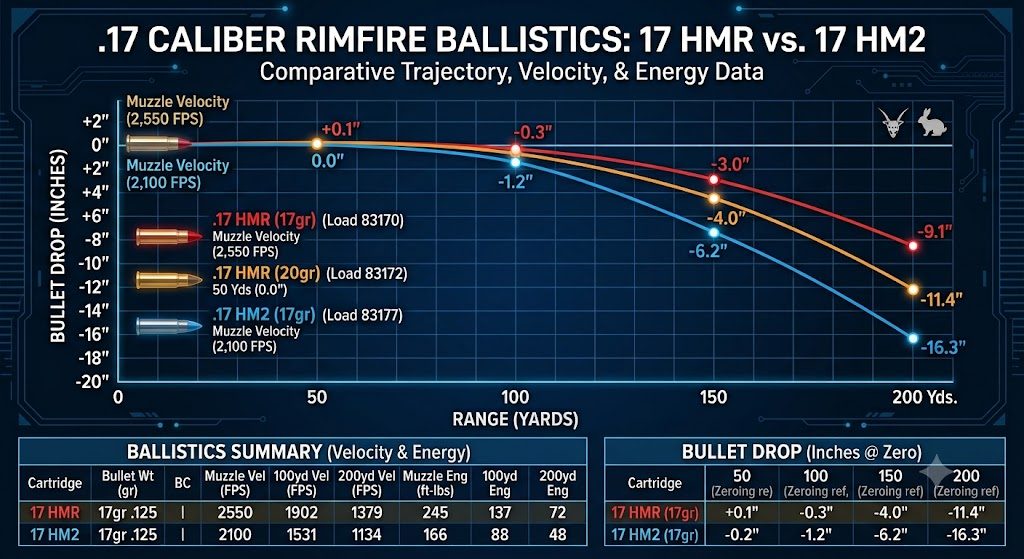
Below is the consolidated ballistics data for Hornady’s .17 HM2 and .17 HMR loads, followed by a detailed breakdown of how to read and interpret these numbers.
Hornady .17 Caliber Ballistics Chart
Note: Drop values represent inches of bullet drop at given yardages based on the rifle’s zero. Due to variations in the provided data, drop columns have been sequentially aligned to the primary yardage markers.
| Cartridge / Load Identity | Bullet Wt (gr) | B.C. | Muzzle Vel (fps) | 100 Yds Vel | 200 Yds Vel | Muzzle Eng (ft-lbs) | 100 Yds Eng | 200 Yds Eng | Drop (50 Yds) | Drop (100 Yds) | Drop (150 Yds) | Drop (200 Yds) |
| .17 HM2 / 83177 | 17 | .125 | 2,100 | 1,531 | 1,134 | 166 | 88 | 48 | -0.2″ | -1.2″ | -6.2″ | -16.3″ |
| .17 HM2 / 83176 | 15.5 | .115 | 2,050 | 1,450 | 1,070 | 145 | 72 | 39 | -0.3″ | -1.4″ | -7.1″ | -18.5″ |
| .17 HMR / 83172 | 20 | .125 | 2,375 | 1,755 | 1,274 | 250 | 137 | 72 | 0.0″ | -0.6″ | -4.0″ | -11.4″ |
| .17 HMR / 83170 | 17 | .125 | 2,550 | 1,902 | 1,379 | 245 | 137 | 72 | +0.1″ | -0.3″ | -3.0″ | -9.1″ |
| .17 HMR / 83171 | 15.5 | .115 | 2,525 | 1,830 | 1,291 | 219 | 115 | 57 | +0.1″ | -0.4″ | -3.4″ | -10.1″ |
Detailed Explanation of Ballistic Stats
Looking at a ballistics chart can feel like reading a spreadsheet in a foreign language. Here is a breakdown of what each column means and how it impacts your shooting.
1. Bullet Weight (Grains)
A “grain” is a tiny unit of measurement used exclusively in the firearms world (there are 7,000 grains in a pound).
- The .17 Caliber Range: These bullets are incredibly light, ranging from 15.5 to 20 grains.
- Practical Impact: Lighter bullets (like the 15.5gr) usually achieve higher muzzle velocities. However, slightly heavier bullets (like the 20gr HMR) carry their momentum better over long distances, resulting in more energy on target at 200 yards and slightly less wind deflection.
2. Ballistic Coefficient (B.C.)
Ballistic Coefficient is a mathematical representation of how aerodynamic a bullet is. The higher the number, the better the bullet cuts through the air.
- The .17 Caliber Range: Rimfire bullets generally have very low B.C. numbers compared to centerfire rifle rounds. The .17 caliber bullets in this chart hover around .115 to .125.
- Practical Impact: A bullet with a B.C. of .125 will retain its speed and energy better—and drift less in the wind—than a bullet with a B.C. of .115.
3. Velocity (Fps – Feet Per Second)
Velocity measures the speed of the bullet at the moment it leaves the barrel (Muzzle) and at specific distances downrange (100 and 200 yards).
- The .17 Caliber Range: This is where the .17 family shines. The .17 HMR pushes a 17-grain bullet at a blistering 2,550 fps out of the muzzle—nearly twice as fast as a standard .22 LR.
- Practical Impact: High velocity does two things: it makes the bullet shoot incredibly flat (meaning you don’t have to aim high to compensate for bullet drop at a distance), and it ensures explosive terminal expansion on small targets. Notice how quickly the velocity drops off by 200 yards; this is due to the low Ballistic Coefficient.
4. Energy (Ft. lbs. – Foot-Pounds)
Energy is the amount of destructive force the bullet delivers to the target. It is calculated using a combination of the bullet’s weight and its velocity.
- The .17 Caliber Range: The .17 HMR generates up to 250 ft-lbs of energy at the muzzle. For context, a standard .22 LR generates around 130 ft-lbs.
- Practical Impact: Energy dictates lethality. Varmint hunters rely on high energy transfer to ensure ethical, instant kills. Looking at the chart, the 20-grain .17 HMR retains 72 ft-lbs of energy at 200 yards, which is still plenty for dispatching small pests, whereas the .17 HM2 starts running out of steam much sooner.
5. Bullet Drop (Inches)
Gravity begins pulling a bullet down the exact millisecond it leaves the barrel. The “Drop” columns show how far the bullet will fall beneath your line of sight at given distances, assuming you are sighted in (zeroed) at a specific range (usually 50 or 100 yards for rimfires).
- The .17 Caliber Range: The numbers in the chart (e.g., -3.0″, -9.1″) indicate inches below the crosshairs.
- Practical Impact: The .17 HMR 17-grain load only drops 3 inches at 150 yards. This is essentially a “laser beam” trajectory for a rimfire. It allows a shooter to aim dead-center on a prairie dog from 50 yards all the way out to about 125 yards without having to guess how high to hold the crosshairs.