The .30-06 Springfield is a versatile rifle cartridge known for its combination of muzzle velocity, retained energy and effective performance across a wide range of hunting distances. Its ballistics vary depending on bullet weight, bullet design, muzzle velocity, barrel length and zero distance.
This 30-06 ballistics guide includes detailed charts for 125-grain, 150-grain, 165-grain and 180-grain bullets, along with velocity, energy, trajectory, bullet drop and barrel-length comparisons. The tables use the supplied reference data, so actual results may vary by ammunition brand, rifle and environmental conditions.
Table of Contents [Click to minimize]
30-06 Ballistics Chart
The following .30-06 Springfield ballistics chart uses a reference 165-grain polymer-tip, boat-tail bullet with a muzzle velocity of 2,800 FPS, a G1 ballistic coefficient of .447 and a 200-yard zero. The reference sight height is 1.5 inches above the bore.
| Range (Yards) | Velocity (FPS) | Energy (ft-lbs) | Trajectory (Inches) | 10 MPH Wind Drift (Inches) | Time of Flight (Seconds) |
|---|---|---|---|---|---|
| 0 | 2,800 | 2,872 | -1.50 | 0.00 | 0.000 |
| 50 | 2,693 | 2,657 | +0.76 | 0.22 | 0.055 |
| 100 | 2,590 | 2,458 | +1.78 | 0.88 | 0.112 |
| 150 | 2,489 | 2,270 | +1.56 | 2.01 | 0.171 |
| 200 | 2,391 | 2,094 | 0.00 | 3.64 | 0.233 |
| 250 | 2,295 | 1,930 | -2.92 | 5.79 | 0.297 |
| 300 | 2,201 | 1,775 | -7.34 | 8.50 | 0.364 |
| 400 | 2,020 | 1,495 | -21.41 | 15.68 | 0.506 |
| 500 | 1,848 | 1,251 | -43.20 | 25.46 | 0.662 |
The chart shows how velocity and kinetic energy decrease as the bullet travels downrange. Trajectory describes the bullet’s position relative to the line of sight. Positive values indicate a position above the line of sight, while negative values indicate a position below it.
Wind drift increases with distance because the bullet remains exposed to crosswind for longer. The values shown are estimates based on the supplied reference data rather than guaranteed results for every rifle and ammunition combination.
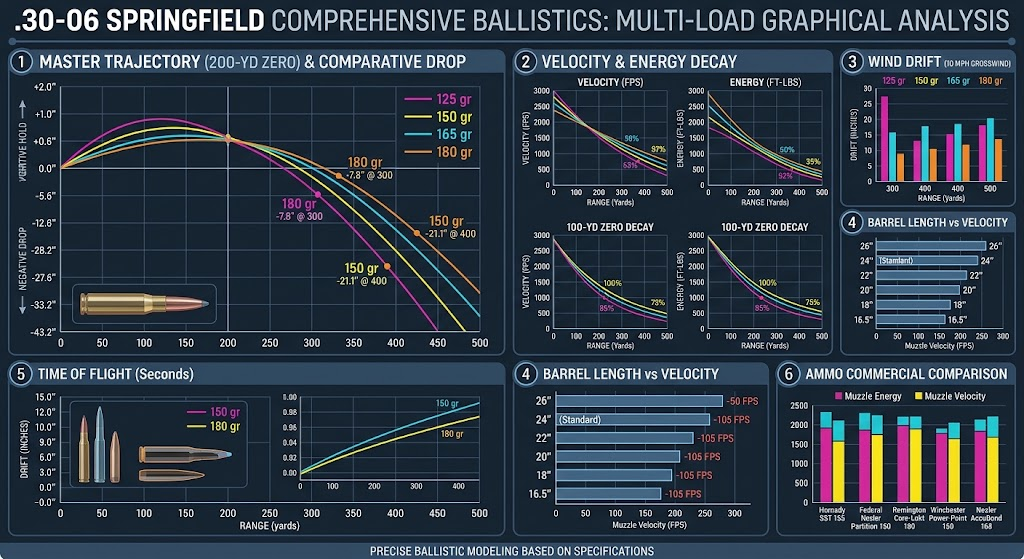
30-06 Bullet Drop Chart
The 30-06 bullet drop chart shows the estimated vertical position of the bullet relative to the line of sight at different distances. This reference uses a 165-grain bullet with a muzzle velocity of 2,800 FPS and a 200-yard zero.
| Range (Yards) | Bullet Drop or Trajectory (Inches) |
|---|---|
| 0 | -1.50 |
| 50 | +0.76 |
| 100 | +1.78 |
| 150 | +1.56 |
| 200 | 0.00 |
| 250 | -2.92 |
| 300 | -7.34 |
| 400 | -21.41 |
| 500 | -43.20 |
At the muzzle, the bullet begins below the line of sight because the sights are positioned above the bore. It rises relative to the sight line as it travels toward the 200-yard zero. Beyond that point, gravity causes the bullet to move progressively farther below the line of sight.
Bullet drop figures depend on the selected zero distance, ammunition specifications, sight height and environmental conditions. A chart based on a 200-yard zero will not produce the same trajectory values as a chart based on a 100-yard zero.
30 06 Trajectory
The 30 06 trajectory describes the bullet’s path relative to the rifle’s line of sight as it travels downrange. Trajectory depends on muzzle velocity, bullet weight, ballistic coefficient, sight height, zero distance and atmospheric conditions.
With the reference 165-grain load, the bullet reaches its highest listed trajectory point of +1.78 inches at 100 yards. It then moves toward the line of sight and reaches the 200-yard zero point.
Beyond 200 yards, the bullet travels progressively below the line of sight. The supplied reference chart shows a trajectory of -7.34 inches at 300 yards, -21.41 inches at 400 yards and -43.20 inches at 500 yards.
These figures describe one specific reference load. Different .30-06 ammunition can produce different trajectories, even when the bullet weights are identical.
30 06 Trajectory Chart
The following 30 06 trajectory chart presents the reference 165-grain load at common distances. It uses a 200-yard zero and includes velocity to show how the bullet slows as it travels.
| Range (Yards) | Velocity (FPS) | Trajectory (Inches) |
|---|---|---|
| 0 | 2,800 | -1.50 |
| 50 | 2,693 | +0.76 |
| 100 | 2,590 | +1.78 |
| 150 | 2,489 | +1.56 |
| 200 | 2,391 | 0.00 |
| 250 | 2,295 | -2.92 |
| 300 | 2,201 | -7.34 |
| 400 | 2,020 | -21.41 |
| 500 | 1,848 | -43.20 |
The trajectory curve is influenced by the bullet’s initial speed and aerodynamic efficiency. Bullets with higher ballistic coefficients generally retain velocity more efficiently, although the exact difference depends on the bullet design and launch conditions.
.30-06 Springfield Cartridge Specifications
The .30-06 Springfield was introduced for military use in the early twentieth century and later became widely used for hunting and sporting rifles. Its broad selection of bullet weights and commercial ammunition makes it adaptable to different shooting applications.
| Specification | .30-06 Springfield |
|---|---|
| Bullet diameter | .308 inch |
| Common bullet weights | 125, 150, 165, 180 and 220 grains |
| Typical muzzle velocity | Approximately 2,400 to 3,200 FPS, depending on the load |
| Typical muzzle energy | Approximately 2,700 to 3,000 ft-lbs for many common hunting loads |
| Common uses | Hunting and sporting applications |
| Common zero distances | 100 and 200 yards |
These specifications are general reference values. Exact performance depends on the ammunition selected, and published manufacturer figures may be measured using a different barrel length than the rifle being used.
30-06 Ammo Ballistics: 150-Grain vs. 180-Grain Loads
The 150-grain and 180-grain bullets are two common choices for the .30-06 Springfield. A 150-grain load typically starts at a higher velocity, while a 180-grain load is heavier and may retain more energy at certain distances.
The comparison below uses the supplied reference values with a 100-yard zero.
| Range (Yards) | 150-Grain Velocity (FPS) | 150-Grain Energy (ft-lbs) | 150-Grain Trajectory (Inches) | 180-Grain Velocity (FPS) | 180-Grain Energy (ft-lbs) | 180-Grain Trajectory (Inches) |
|---|---|---|---|---|---|---|
| 0 | 2,910 | 2,820 | -1.50 | 2,700 | 2,913 | -1.50 |
| 100 | 2,685 | 2,401 | 0.00 | 2,504 | 2,506 | 0.00 |
| 200 | 2,471 | 2,033 | -3.51 | 2,316 | 2,144 | -4.80 |
| 300 | 2,267 | 1,711 | -12.98 | 2,136 | 1,823 | -18.30 |
| 400 | 2,072 | 1,430 | -29.81 | 1,963 | 1,540 | -43.40 |
| 500 | 1,887 | 1,186 | -55.62 | 1,798 | 1,292 | -81.20 |
In this comparison, the 150-grain bullet maintains a flatter trajectory at the listed distances. The 180-grain load begins with more muzzle energy in the supplied figures and retains more energy at some of the listed ranges.
The results are not universal for every 150-grain or 180-grain cartridge. Bullet construction, ballistic coefficient and manufacturer loading specifications can change the comparison substantially.
30-06 Ballistics 150 Grain
The 150-grain bullet is a popular .30-06 option because it commonly combines relatively high muzzle velocity with a comparatively flat trajectory. It is available in different bullet designs, including soft-point, polymer-tip and partition-style hunting bullets.
The following chart uses the supplied reference values for a 150-grain bullet with a muzzle velocity of 2,910 FPS, muzzle energy of 2,820 ft-lbs, a G1 ballistic coefficient of .415 and a 200-yard zero.
| Range (Yards) | Velocity (FPS) | Energy (ft-lbs) | Trajectory (Inches) | 10 MPH Wind Drift (Inches) | Time of Flight (Seconds) |
|---|---|---|---|---|---|
| 0 | 2,910 | 2,820 | -1.50 | 0.00 | 0.000 |
| 50 | 2,793 | 2,598 | +0.65 | 0.24 | 0.053 |
| 100 | 2,680 | 2,392 | +1.61 | 0.95 | 0.108 |
| 150 | 2,570 | 2,199 | +1.44 | 2.17 | 0.165 |
| 200 | 2,463 | 2,020 | 0.00 | 3.94 | 0.224 |
| 250 | 2,359 | 1,853 | -2.78 | 6.27 | 0.286 |
| 300 | 2,258 | 1,698 | -7.11 | 9.21 | 0.351 |
| 400 | 2,063 | 1,417 | -21.14 | 16.98 | 0.490 |
The 150-grain reference load retains approximately 2,258 FPS and 1,698 ft-lbs of energy at 300 yards in this dataset. Its trajectory is listed at -7.11 inches at that distance with a 200-yard zero.
Different 150-grain ammunition can have different velocities and ballistic coefficients. For a meaningful comparison, use the specific load’s manufacturer data rather than relying on bullet weight alone.
30-06 Ballistics 180 Grain
The 180-grain bullet is another common .30-06 option. Its heavier projectile can provide useful retained energy, depending on its design and ballistic coefficient. Many 180-grain loads are designed for hunting applications, but bullet construction is just as important as weight when evaluating performance.
This chart uses the supplied reference values for a 180-grain bullet with a muzzle velocity of 2,700 FPS, muzzle energy of 2,913 ft-lbs, a G1 ballistic coefficient of .475 and a 200-yard zero.
| Range (Yards) | Velocity (FPS) | Energy (ft-lbs) | Trajectory (Inches) | 10 MPH Wind Drift (Inches) | Time of Flight (Seconds) |
|---|---|---|---|---|---|
| 0 | 2,700 | 2,913 | -1.50 | 0.00 | 0.000 |
| 50 | 2,598 | 2,697 | +0.90 | 0.22 | 0.057 |
| 100 | 2,499 | 2,495 | +2.01 | 0.88 | 0.116 |
| 150 | 2,401 | 2,304 | +1.72 | 2.01 | 0.177 |
| 200 | 2,306 | 2,125 | 0.00 | 3.63 | 0.241 |
| 250 | 2,213 | 1,957 | -3.12 | 5.76 | 0.307 |
| 300 | 2,122 | 1,799 | -7.82 | 8.44 | 0.376 |
| 400 | 1,947 | 1,515 | -22.75 | 15.51 | 0.524 |
In the supplied chart, the 180-grain bullet retains approximately 1,799 ft-lbs of energy at 300 yards and 1,515 ft-lbs at 400 yards. Its trajectory falls below the line of sight after the 200-yard zero.
Actual results will vary with bullet design and the ammunition’s published specifications. The chart should be treated as a reference rather than a substitute for verified data for a particular load.
.30-06 Ballistics by Bullet Weight
Bullet weight affects muzzle velocity, energy, trajectory and retained performance. However, bullet weight alone does not determine how a cartridge will perform. Bullet shape, ballistic coefficient and construction also influence the results.
| Bullet Weight | Reference Muzzle Velocity (FPS) | Reference Muzzle Energy (ft-lbs) | Reference Energy at 200 Yards (ft-lbs) |
|---|---|---|---|
| 125 grains | 3,140 | 2,736 | 1,758 |
| 150 grains | 2,910 | 2,820 | 2,020 |
| 165 grains | 2,800 | 2,872 | 2,094 |
| 180 grains | 2,700 | 2,913 | 2,125 |
| 220 grains | 2,400 | 2,813 | 1,842 |
The lighter 125-grain reference load has the highest listed muzzle velocity, while the 180-grain load has the highest listed muzzle energy. These figures illustrate how a heavier bullet can carry more energy despite having a lower initial velocity.
The 220-grain figures are broad reference values and are not accompanied by a full trajectory table here. Confirm the exact ammunition specifications before using them to assess performance.
125 Grain 30-06 Ballistics
A 125-grain .30-06 load generally starts at a higher velocity than heavier bullets. The actual trajectory and retained energy depend on the specific bullet design, ballistic coefficient and muzzle velocity.
The following reference chart uses a muzzle velocity of 3,140 FPS, muzzle energy of 2,736 ft-lbs, a G1 ballistic coefficient of .268 and a 200-yard zero.
| Range (Yards) | Velocity (FPS) | Energy (ft-lbs) | Trajectory (Inches) | 10 MPH Wind Drift (Inches) | Time of Flight (Seconds) |
|---|---|---|---|---|---|
| 0 | 3,140 | 2,736 | -1.50 | 0.00 | 0.000 |
| 50 | 2,975 | 2,456 | +0.48 | 0.33 | 0.049 |
| 100 | 2,817 | 2,202 | +1.38 | 1.35 | 0.101 |
| 150 | 2,664 | 1,970 | +1.30 | 3.12 | 0.156 |
| 200 | 2,517 | 1,758 | 0.00 | 5.73 | 0.214 |
| 250 | 2,374 | 1,564 | -2.71 | 9.24 | 0.275 |
| 300 | 2,236 | 1,388 | -7.14 | 13.72 | 0.340 |
| 400 | 1,972 | 1,079 | -22.38 | 25.86 | 0.483 |
The reference load remains above 2,200 FPS at 300 yards in the supplied data, but its relatively low listed ballistic coefficient means it experiences more wind drift than some higher-BC bullets under comparable conditions.
This is an example of why muzzle velocity alone is not enough to evaluate long-range ballistics. A bullet’s aerodynamic characteristics affect how well it retains speed and how much it drifts in the wind.
30-06 Ballistics 165 Grain
The 165-grain bullet is a common middle-weight option for the .30-06 Springfield. It sits between the 150-grain and 180-grain options and is available in several hunting bullet designs.
The following chart repeats the reference 165-grain data using a muzzle velocity of 2,800 FPS, muzzle energy of 2,872 ft-lbs, a G1 ballistic coefficient of .447 and a 200-yard zero.
| Range (Yards) | Velocity (FPS) | Energy (ft-lbs) | Trajectory (Inches) | 10 MPH Wind Drift (Inches) | Time of Flight (Seconds) |
|---|---|---|---|---|---|
| 0 | 2,800 | 2,872 | -1.50 | 0.00 | 0.000 |
| 50 | 2,693 | 2,657 | +0.76 | 0.22 | 0.055 |
| 100 | 2,590 | 2,458 | +1.78 | 0.88 | 0.112 |
| 150 | 2,489 | 2,270 | +1.56 | 2.01 | 0.171 |
| 200 | 2,391 | 2,094 | 0.00 | 3.64 | 0.233 |
| 250 | 2,295 | 1,930 | -2.92 | 5.79 | 0.297 |
| 300 | 2,201 | 1,775 | -7.34 | 8.50 | 0.364 |
| 400 | 2,020 | 1,495 | -21.41 | 15.68 | 0.506 |
| 500 | 1,848 | 1,251 | -43.20 | 25.46 | 0.662 |
The 165-grain reference bullet retains 2,201 FPS at 300 yards and 1,848 FPS at 500 yards. The table also shows how its estimated trajectory changes after the 200-yard zero.
The figures are specific to this reference load. A different 165-grain bullet can have a different ballistic coefficient, muzzle velocity and trajectory.
30-06 Ballistics Chart 100 Yard Zero
A 100-yard zero means the rifle’s sights are adjusted so the bullet’s path intersects the line of sight at 100 yards. The trajectory will differ from a 200-yard-zero chart, even when the same ammunition is used.
The following chart uses the supplied 165-grain reference data adjusted for a 100-yard zero.
| Range (Yards) | Velocity (FPS) | Energy (ft-lbs) | Trajectory (Inches) | 10 MPH Wind Drift (Inches) | Time of Flight (Seconds) |
|---|---|---|---|---|---|
| 0 | 2,800 | 2,872 | -1.50 | 0.00 | 0.000 |
| 50 | 2,693 | 2,657 | -0.13 | 0.22 | 0.055 |
| 100 | 2,590 | 2,458 | 0.00 | 0.88 | 0.112 |
| 150 | 2,489 | 2,270 | -1.11 | 2.01 | 0.171 |
| 200 | 2,391 | 2,094 | -3.56 | 3.64 | 0.233 |
| 250 | 2,295 | 1,930 | -7.37 | 5.79 | 0.297 |
| 300 | 2,201 | 1,775 | -12.68 | 8.50 | 0.364 |
| 400 | 2,020 | 1,495 | -28.53 | 15.68 | 0.506 |
| 500 | 1,848 | 1,251 | -52.10 | 25.46 | 0.662 |
With this 100-yard-zero reference, the bullet reaches the line of sight at 100 yards and falls below it at longer distances. At 300 yards, the listed trajectory is -12.68 inches, compared with -7.34 inches in the supplied 200-yard-zero chart.
Zero distance changes the trajectory relative to the sight line. It does not change the bullet’s underlying muzzle velocity or energy.
30-06 Barrel Length vs. Muzzle Velocity
Barrel length can affect muzzle velocity because expanding propellant gases accelerate the bullet as it travels through the barrel. The amount of velocity gained or lost depends on the cartridge, ammunition, barrel characteristics and other factors.
The following reference comparison uses a 180-grain .30-06 load.
| Barrel Length | Muzzle Velocity (FPS) | Velocity Difference from 24-Inch Barrel | Muzzle Energy (ft-lbs) |
|---|---|---|---|
| 26 inches | 2,750 | +50 FPS | 3,022 |
| 24 inches | 2,700 | Baseline | 2,913 |
| 22 inches | 2,650 | -50 FPS | 2,806 |
| 20 inches | 2,595 | -105 FPS | 2,691 |
| 18 inches | 2,535 | -165 FPS | 2,568 |
| 16.5 inches | 2,480 | -220 FPS | 2,458 |
In this reference dataset, the 26-inch barrel produces the highest listed muzzle velocity, while the 16.5-inch barrel produces the lowest. A shorter barrel may be easier to handle, but it can produce a lower muzzle velocity with the same ammunition.
These values are estimates and should not be treated as a universal velocity loss per inch. Actual results can differ between rifles and ammunition lots. Chronograph measurements provide a better estimate of the performance of a specific rifle and load.
Commercial .30-06 Ammunition Ballistics
Commercial .30-06 ammunition is available with different bullet weights and designs. The following supplied reference values illustrate how several familiar load types compare.
| Ammunition | Bullet Weight and Type | Muzzle Velocity (FPS) | Muzzle Energy (ft-lbs) | Reference Velocity at 200 Yards (FPS) | Reference Energy at 200 Yards (ft-lbs) | Reported 300-Yard Drop with 200-Yard Zero (Inches) |
|---|---|---|---|---|---|---|
| Hornady Superformance | 165-grain SST | 2,950 | 3,188 | 2,544 | 2,370 | -6.3 |
| Federal Vital-Shok | 150-grain Nosler Partition | 2,910 | 2,820 | 2,467 | 2,027 | -6.9 |
| Remington Core-Lokt | 180-grain PSP | 2,700 | 2,913 | 2,279 | 2,076 | -8.1 |
| Winchester Power-Point | 150-grain | 2,920 | 2,840 | 2,434 | 1,973 | -7.1 |
| Nosler Trophy Grade | 168-grain AccuBond Long Range | 2,800 | 2,923 | 2,462 | 2,261 | -6.2 |
These figures are supplied reference values, not a verified current manufacturer specification sheet. Some loads may have different published velocities depending on the test barrel and product version. Check the exact ammunition box or manufacturer’s ballistic data before comparing loads or relying on trajectory figures.
The listed bullet types also differ in construction. A soft-point, partition-style or polymer-tip bullet may behave differently on impact even if two loads have similar muzzle velocity and energy.
What Affects .30-06 Ballistics?
Several factors determine how a .30-06 bullet travels and how much velocity and energy it retains.
Bullet Weight
Heavier bullets generally leave the muzzle at lower velocities than lighter bullets when comparing similar load types. However, they may retain more energy at certain distances. The outcome depends on bullet shape, construction and ballistic coefficient.
Ballistic Coefficient
Ballistic coefficient describes a bullet’s ability to overcome air resistance under a specified model. A higher coefficient often indicates better velocity retention, but comparisons should use the same coefficient system and appropriate bullet data.
Barrel Length
A change in barrel length can change muzzle velocity. The effect is ammunition- and rifle-dependent, so published velocity figures should be checked against the barrel length used in testing.
Zero Distance
A 100-yard zero and a 200-yard zero produce different trajectory charts. The zero distance changes the bullet’s position relative to the line of sight, not its underlying velocity or kinetic energy.
Wind and Atmospheric Conditions
Crosswind can move a bullet away from its intended path. Air density, temperature, elevation and other atmospheric conditions can also affect the trajectory. Real-world results may differ from a chart produced under assumed conditions.
Frequently Asked Questions
What is the typical muzzle velocity of a .30-06 Springfield?
Muzzle velocity depends on the ammunition and bullet weight. The supplied reference loads range from 2,400 FPS for a 220-grain bullet to 3,140 FPS for a 125-grain bullet. Always check the specifications for the exact load.
How much energy does a .30-06 have at the muzzle?
In the supplied examples, muzzle energy ranges from approximately 2,736 ft-lbs for the 125-grain reference load to 2,913 ft-lbs for the 180-grain load. Actual values vary by ammunition.
What is the difference between 150-grain and 180-grain .30-06 ammunition?
A 150-grain load generally has a higher muzzle velocity in comparable reference examples. A 180-grain load is heavier and may retain more energy at certain distances. Bullet construction and ballistic coefficient are also important.
What is the trajectory of a 165-grain .30-06 bullet at 300 yards?
In the supplied 165-grain reference chart with a 200-yard zero, the listed trajectory at 300 yards is -7.34 inches. A different load or zero distance can produce a different value.
How much does a .30-06 bullet drop at 500 yards?
The supplied 165-grain reference chart with a 200-yard zero lists -43.20 inches at 500 yards. With the supplied 100-yard-zero chart, the value is -52.10 inches. These are estimated values for the reference load, not universal figures.
Is a 100-yard zero different from a 200-yard zero?
Yes. The zero distance determines where the bullet’s path intersects the line of sight. A 100-yard zero generally produces different trajectory values at intermediate and longer distances than a 200-yard zero.
Does barrel length affect .30-06 velocity?
Yes. Barrel length can affect the velocity produced by a given ammunition load. The size of the difference varies by rifle and ammunition, so a general estimate should not replace measurements or verified manufacturer data.
What does ballistic coefficient mean?
Ballistic coefficient is a measure used to describe a bullet’s aerodynamic performance relative to a reference model. It helps estimate how quickly a bullet loses velocity and how its trajectory changes downrange.
Does a heavier .30-06 bullet always have more energy?
No. Energy depends on both bullet mass and velocity. A heavier bullet can have more energy despite travelling more slowly, but the result depends on the specific loads being compared.
Are .30-06 ballistics charts exact?
No. Ballistics charts are estimates based on stated assumptions such as muzzle velocity, bullet characteristics, zero distance, sight height and atmospheric conditions. Actual results can vary with the rifle, ammunition and environment. Use verified data for the exact load and confirm results at a suitable range.