The .308 Winchester is the undisputed workhorse of the precision rifle world. From military sniper teams to backcountry hunters and competitive target shooters, its consistency is legendary. But extracting that famous accuracy requires more than just good marksmanship, it requires flawless data.
If you are setting up a .308, the first major decision you make is your zero distance. While some hunters prefer a 200-yard zero to extend their “point-blank” range, precision shooters almost universally rely on the 100-yard zero.
Here is exactly why the 100-yard zero is the gold standard for the .308 Winchester, alongside a comprehensive ballistics chart to help you dial your impacts all the way out to 1,000 yards.
The .308 Ballistics Chart (100-Yard Zero)
To give you the most accurate baseline, this chart is built using the industry-standard match load for the .308 Winchester: a 168-grain Boat Tail Hollow Point (BTHP).
The Setup:
- Bullet: 168gr BTHP (e.g., Federal Gold Medal Match)
- Muzzle Velocity: 2,650 fps
- Scope Height: 1.5 inches over bore
- Atmosphere: Sea level, 59°F (Standard Day)
- Wind: 10 mph Full-Value Crosswind
| Distance (Yards) | Velocity (fps) | Energy (ft-lbs) | Drop (Inches) | Drop (MOA) | Drop (MIL) | Wind Drift (Inches) |
| 100 | 2460 | 2250 | 0.0 | 0.0 | 0.0 | 0.7 |
| 200 | 2275 | 1930 | -4.5 | -2.2 | -0.6 | 3.1 |
| 300 | 2100 | 1640 | -15.2 | -4.8 | -1.4 | 7.6 |
| 400 | 1930 | 1390 | -33.6 | -8.0 | -2.3 | 14.5 |
| 500 | 1770 | 1170 | -60.8 | -11.6 | -3.4 | 24.3 |
| 600 | 1620 | 980 | -98.6 | -15.7 | -4.6 | 37.4 |
| 700 | 1485 | 820 | -149.5 | -20.4 | -5.9 | 54.4 |
| 800 | 1365 | 695 | -216.5 | -25.8 | -7.5 | 76.0 |
| 900 | 1255 | 588 | -302.8 | -32.1 | -9.3 | 103.0 |
| 1000 | 1165 | 506 | -412.5 | -39.4 | -11.5 | 136.5 |
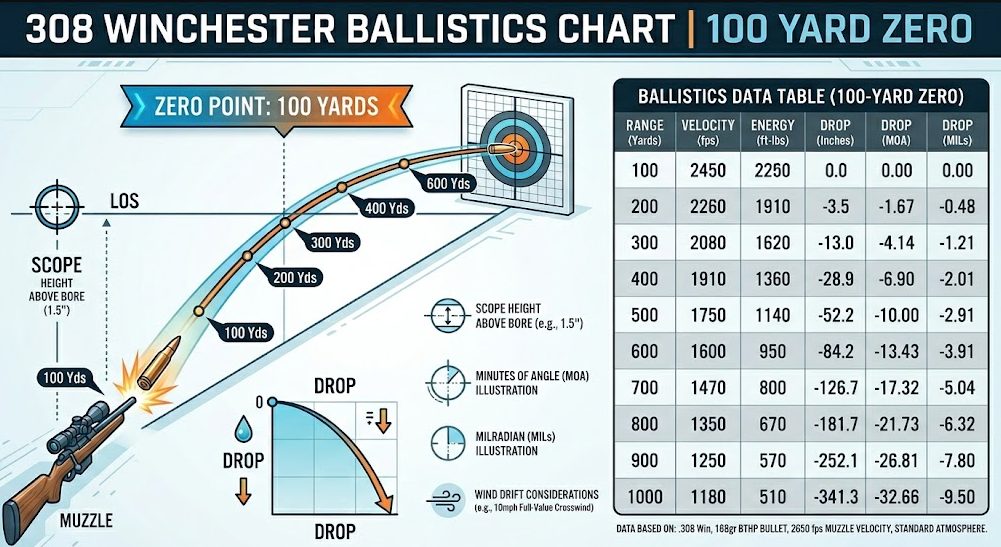
Why Choose a 100-Yard Zero?
Setting your scope to hit dead-center at 100 yards offers three massive advantages for long-range and tactical shooting:
- You Only Dial One Way: With a 100-yard zero, your bullet never rises above your line of sight after it meets the crosshairs. Because gravity is pulling the bullet down from that point forward, all of your scope adjustments (or reticle holds) will be “up.” There is no guessing whether you need to hold low or high—you always hold high.
- Environmental Baseline: At 100 yards, wind drift and environmental factors (like temperature and humidity) have minimal effect on the heavy .308 bullet. This ensures your zero is a true mechanical reflection of your rifle and optic, untainted by a gust of wind.
- Optic Compatibility: Almost all modern precision scopes and ballistic apps are engineered around a 100-yard baseline. Turrets with “zero stops” are designed to bottom out at this distance.
Analyzing the 100-Yard Zero Data
When you look at the chart, a few critical performance thresholds for the .308 become clear.
The Hunting Cutoff (500 Yards)
If you are using this rifle for hunting mid-sized game like whitetail deer, the universally accepted minimum energy threshold for an ethical kill is 1,000 ft-lbs. Looking at the energy column, the 168gr .308 dips below 1,000 ft-lbs right around the 600-yard mark. Therefore, even if you can ring steel further out, 500 yards is your maximum ethical hunting distance with this specific load.
The Wind Wake-Up Call (400 Yards)
Notice the wind drift column. Inside of 300 yards, a 10 mph crosswind only pushes the bullet a few inches—often still a hit on a standard IPSC silhouette. But by 400 yards, the wind drift doubles to over 14 inches. This is where the .308 demands that you learn to read the wind.
Transonic Turbulence (900–1000 Yards)
The .308 is famous for reaching out to 1,000 yards, but it works hard to get there. Notice that at 1,000 yards, the velocity has dropped to 1,165 fps. The speed of sound is roughly 1,125 fps. This means right around 1,000 yards, the bullet is entering the transonic zone. As a bullet breaks back through the sound barrier, it experiences destabilizing turbulence, which can open up your shot groups significantly.
Validating Your Data
This chart is a highly accurate mathematical baseline, but your rifle is an individual machine. Variations in your specific barrel length, your exact scope height, and the local barometric pressure will change these numbers slightly.
The process of confirming this chart is called truing your DOPE. Take this chart to the range, zero your rifle perfectly at 100 yards, and then shoot targets at 300, 500, and 800 yards. Note the exact MOA or MIL adjustments it actually took to hit dead center, and update your personal logbook.