The main difference between the cartridges is that the .41 Magnum utilizes a slightly narrower and lighter projectile to deliver a flatter trajectory and deeper sectional penetration with slightly less recoil, whereas the .44 Magnum relies on wider and heavier bullets to generate massive kinetic energy and immense momentum. Both cartridges were developed in the mid-twentieth century to maximize the potential of large-frame revolvers for law enforcement and hunting.
The .41 Magnum was specifically engineered to be the ultimate police duty cartridge, offering more power than the .357 Magnum but remaining more controllable than the punishing .44 Magnum. The .44 Magnum was designed to push the physical limits of handguns entirely, favoring brute force and extreme terminal tissue damage. While the .44 Magnum went on to become a global commercial phenomenon, the .41 Magnum developed a loyal cult following among experienced handgun hunters who appreciate its highly efficient ballistic profile. Do not make unsupported claims; the physical reality of these two cartridges demonstrates that both are capable of taking any big game animal in North America when paired with the correct bullet construction.
41 Magnum vs 44 Magnum Comparison
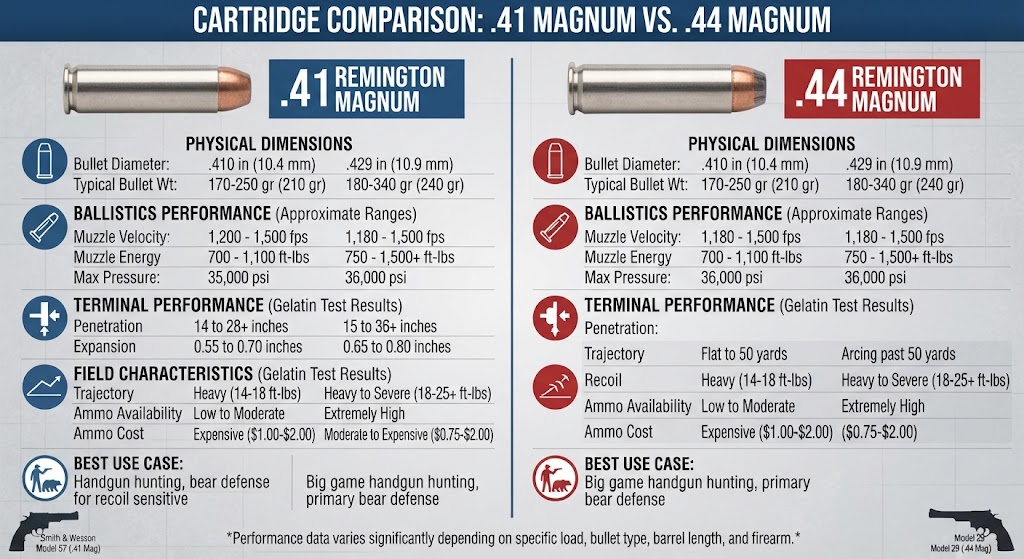
| Feature | .41 Magnum | .44 Magnum |
| Bullet Diameter | 0.410 in (10.4 mm) | 0.429 in (10.9 mm) |
| Typical Bullet Weight | 170 gr to 250 gr (typically 210 gr) | 180 gr to 340 gr (typically 240 gr) |
| Muzzle Velocity | 1,200 to 1,500 fps (4 to 6-inch barrel) | 1,180 to 1,500 fps (4 to 6-inch barrel) |
| Muzzle Energy | 700 to 1,100 ft-lbs | 750 to 1,500+ ft-lbs |
| Momentum | 36.9 to 51.0 lb-fps | 41.5 to 69.2 lb-fps |
| Maximum Pressure | 35,000 psi (SAAMI) | 36,000 psi (SAAMI) |
| Ballistic Coefficient | Low (0.140 to 0.180) | Low (0.150 to 0.205) |
| Penetration | 14 to 28+ inches (Gelatin) | 15 to 36+ inches (Gelatin) |
| Expansion | 0.55 to 0.70 inches | 0.65 to 0.80 inches |
| Trajectory | Flat out to 50 yards | Arcing past 50 yards |
| Recoil | Heavy (14 to 18 ft-lbs) | Heavy to Severe (18 to 25+ ft-lbs) |
| Effective Range | 50 to 100 yards (Handgun Hunting) | 50 to 100 yards (Handgun Hunting) |
| Ammo Availability | Low to Moderate (Specialty runs) | Extremely High (Global revolver standard) |
| Ammo Cost | Expensive ($1.00 to $2.00 per round) | Moderate to Expensive ($0.75 to $2.00 per round) |
| Best Use | Handgun hunting, bear defense for recoil sensitive | Big game handgun hunting, primary bear defense |
The comparison table above outlines the foundational differences between two of the most respected big-bore revolver cartridges in the firearms industry. The .44 Remington Magnum was introduced to the public in 1956 following years of wildcat experimentation by the legendary firearms writer Elmer Keith. Keith had been overloading .44 Special brass cases to achieve higher velocities. Remington and Smith & Wesson collaborated to lengthen the case slightly to prevent these high-pressure rounds from being chambered in older, weaker .44 Special revolvers. The result was a cartridge that operated at a maximum average pressure of 36,000 psi according to the Sporting Arms and Ammunition Manufacturers Institute (SAAMI). It quickly became the gold standard for handgun hunting and protection against dangerous predators.
The .41 Remington Magnum followed closely behind in 1964. Firearms experts Bill Jordan and Skeeter Skelton believed that law enforcement officers needed a caliber that hit harder than the standard .357 Magnum but was easier to control in rapid double-action fire than the heavy-recoiling .44 Magnum. Remington agreed and developed the .41 Magnum to operate at a SAAMI maximum pressure of 35,000 psi. Unfortunately for the designers, the police load they envisioned was released alongside a full-power magnum hunting load. Police departments found the magnum loads too difficult to shoot and the firearms too heavy for daily belt carry. Consequently, the .41 Magnum failed as a police cartridge but thrived in the civilian hunting market as a highly efficient alternative to the .44 Magnum.
41 Magnum vs 44 Magnum Ballistics
To objectively evaluate the ballistic capabilities of the .41 Magnum against the .44 Magnum, we must examine real-world factory ammunition across their most common defensive and hunting applications. Ammunition selection dictates performance, and comparing high-quality modern loads from standardized test barrels is the only way to ensure a fair representation. Manufacturer-rated data is generally captured under controlled atmospheric conditions using vented test barrels that simulate the cylinder gap of a standard revolver.
For this highly researched comparison, we will examine standard commercial hunting loads and specialized heavy hard-cast loads designed for dangerous game defense.
- Load A (.41 Magnum Standard Hunting): Federal Premium 210-grain Power-Shok Jacketed Hollow Point (JHP). Tested from a 4-inch vented barrel. Muzzle velocity is 1,230 feet per second. Muzzle energy is 705 foot-pounds.
- Load B (.41 Magnum Heavy Bear Defense): Buffalo Bore 265-grain Hard Cast Lead Flat Nose. Tested from a 6-inch revolver barrel. Muzzle velocity is 1,350 feet per second.Muzzle energy is 1,075 foot-pounds.
- Load C (.44 Magnum Standard Defense): Federal Premium 240-grain Hydra-Shok Jacketed Hollow Point (JHP). Tested from a 4-inch vented barrel. Muzzle velocity is 1,210 feet per second.Muzzle energy is 780 foot-pounds.
- Load D (.44 Magnum Heavy Bear Defense): Buffalo Bore 340-grain +P+ Heavy Hard Cast Lead Flat Nose. Tested from a 5.5-inch revolver barrel. Muzzle velocity is 1,401 feet per second. Muzzle energy exceeds 1,480 foot-pounds.
It is vital to distinguish manufacturer data from independent testing. The heavy Buffalo Bore loads represent the absolute maximum capability of these cartridges. The 340-grain .44 Magnum load is specifically rated only for heavily reinforced firearms like the Ruger Super Redhawk, as firing it in older revolvers can cause catastrophic failure. We cannot use one load to represent every possible load, but examining both standard and maximum pressure variants provides a complete picture of the ballistic envelope.
41 Magnum vs 44 Magnum Velocity
Velocity is a critical metric for handgun ammunition because it dictates how flat a projectile shoots across distances and how effectively expanding bullets open upon impacting soft tissue. High initial velocity also drastically reduces the time of flight to the target.
When analyzing velocity across standard commercial hunting ammunition, the .41 Magnum often holds a slight advantage. Because the .41 Magnum utilizes a 210-grain bullet (which is 30 grains lighter than the standard 240-grain bullet of the .44 Magnum), it can be pushed to faster speeds without exceeding the 35,000 psi pressure limit. A standard 210-grain .41 Magnum bullet will comfortably exit a 4-inch barrel at 1,230 feet per second. Some boutique loads utilizing lighter 170-grain or 180-grain bullets can push velocities well past 1,450 feet per second from standard handguns. This high velocity ensures rapid and violent expansion when striking a game animal.
The .44 Magnum is not a slow cartridge by any means. A standard 240-grain Federal Hydra-Shok will exit a 4-inch barrel at 1,210 feet per second. The .44 Magnum utilizes a massive brass case that holds a substantial volume of slow-burning magnum powder. When fired from a longer 6-inch or 8-inch barrel, the powder has more time to combust, pushing 240-grain bullets to 1,350 or even 1,400 feet per second. However, when comparing equal barrel lengths using standard ammunition, the .41 Magnum generally launches its projectiles 50 to 100 feet per second faster than the heavier .44 Magnum projectiles.
41 Magnum vs 44 Magnum Muzzle Energy
Muzzle energy represents the kinetic work capacity of a projectile. The kinetic energy generated by a cartridge is a direct reflection of both the speed of the bullet and its physical mass. Because the .44 Magnum utilizes significantly heavier bullets and operates at a slightly higher maximum pressure limit, it holds a distinct advantage in raw kinetic energy output.
A standard 210-grain .41 Magnum hunting load produces roughly 705 foot-pounds of energy at the muzzle. When stepping up to heavier 265-grain custom hard-cast loads, the kinetic energy climbs dramatically to roughly 1,075 foot-pounds. This is an exceptional amount of energy that easily exceeds standard defensive semi-automatic pistol cartridges like the 9mm Luger or the .45 ACP. It is fully capable of humanely harvesting medium game animals like whitetail deer and wild hogs.
The .44 Magnum is an absolute powerhouse. A standard 240-grain defensive or hunting load produces roughly 780 to 970 foot-pounds of energy at the muzzle. However, the true potential of the .44 Magnum is unlocked when utilizing heavy custom ammunition designed for large predators. The Buffalo Bore 340-grain +P+ load generates over 1,500 foot-pounds of energy when fired from a long revolver barrel. The .44 Magnum generates hundreds of additional foot-pounds of kinetic energy compared to the .41 Magnum at the absolute top end of the power spectrum. This massive disparity in raw power is the primary reason professional guides in bear country overwhelmingly favor the .44 Magnum over the .41 Magnum. When you need to deliver devastating blunt force trauma to a massive charging animal, there is no substitute for heavy bullet weight.
41 Magnum vs 44 Magnum Momentum
Momentum is a linear measurement calculating mass in motion. In terminal ballistics, high momentum correlates closely with the ability of a bullet to crush through dense bone, heavy winter hides, structural barriers, and thick muscle without being deflected or stopping prematurely.
Because momentum relies equally on bullet weight and velocity, the heavier .44 Magnum completely outclasses the .41 Magnum in this category.
A 210-grain bullet traveling at 1,230 feet per second (representing the standard commercial .41 Magnum) yields approximately 36.9 pound-feet per second of linear momentum.
A 240-grain bullet traveling at 1,210 feet per second (representing the standard commercial .44 Magnum) yields approximately 41.5 pound-feet per second of linear momentum.
If a shooter utilizes the extreme heavy 340-grain .44 Magnum bullet traveling at 1,425 feet per second, the momentum jumps to roughly 69.2 pound-feet per second. This dramatic difference in momentum translates directly to terminal performance in the field. If a hunter takes a quartering-away shot on a large feral hog or a bear, the bullet must travel through several feet of dense tissue and bone before reaching the vital cardiovascular organs. The massive .44 Magnum bullet possesses the driving force necessary to reliably track straight through that heavy resistance. The .41 Magnum possesses excellent momentum, but it mathematically cannot match the crushing force of a 300-grain or 340-grain bullet.
41 Magnum vs 44 Magnum Trajectory
Understanding external ballistics and bullet drop is critical for any handgun hunter attempting to hit targets beyond 50 yards. The trajectory of a bullet is dictated by its initial velocity, gravity, and the aerodynamic efficiency of the projectile as it cuts through the atmosphere. Aerodynamic efficiency is measured as a Ballistic Coefficient. Handgun bullets are ballistically blunt, possessing poor ballistic coefficients, which means they shed velocity very quickly.
The calculations below assume a standard high-profile iron sight height of 0.75 inches above the bore and a clearly stated zero distance of 50 yards. A 50-yard zero is the standard configuration for modern big-bore hunting revolvers. We will compare the Federal 210-grain .41 Magnum load against the Federal 240-grain .44 Magnum load to demonstrate their flight paths.
| Distance | .41 Magnum (210 gr at 1,230 fps) Drop | .44 Magnum (240 gr at 1,210 fps) Drop |
| Muzzle | -0.75 inches | -0.75 inches |
| 25 Yards | +0.6 inches | +0.7 inches |
| 50 Yards | 0.0 inches (Zero) | 0.0 inches (Zero) |
| 75 Yards | -1.8 inches | -2.0 inches |
| 100 Yards | -5.2 inches | -5.6 inches |
The data confirms that both cartridges are highly capable intermediate-range hunting tools. The .41 Magnum shoots slightly flatter out to 100 yards because it begins its flight at a higher initial velocity. The difference in drop at 100 yards is less than half an inch. In a practical hunting scenario utilizing open iron sights, a difference of half an inch is completely imperceptible to a human shooter. Both cartridges shoot flat enough to allow a hunter to hold their sights directly in the center of the vital zone of a deer out to 75 yards without needing to calculate complex elevation holdovers.
41 Magnum vs 44 Magnum Recoil
Recoil management is a major factor in rapid and accurate shooting. The physical recoil generated by a firearm is heavily influenced by the weight of the handgun, the mass of the powder charge, and the weight of the bullet. A shooter who flinches in anticipation of heavy recoil will never achieve their maximum accuracy potential.
The .41 Magnum was intentionally engineered to provide magnum performance with less punishment than its larger brother. Fired from a standard 40-ounce double-action revolver, a typical 210-grain hunting load generates roughly 14 to 15 foot-pounds of free recoil energy. This is a stout recoil impulse that requires a firm grip, but it is noticeably smoother than a full-power .44 Magnum. It allows an experienced shooter to quickly reacquire their sights and deliver a second shot if necessary.
The .44 Magnum is globally recognized as a heavy-recoiling cartridge. Fired from a similar 40-ounce revolver, a full-power 240-grain load generates approximately 18 to 22 foot-pounds of free recoil energy. This represents roughly a 30 percent increase in free recoil energy over the .41 Magnum. If a shooter steps up to the heavy 340-grain +P+ bear defense loads, the recoil becomes violently severe, easily exceeding 25 foot-pounds of recoil energy. Without proper technique and a heavy revolver frame, the .44 Magnum delivers a punishing, sharp upward whip to the wrist that will quickly induce shooter fatigue and flinching during an extended practice session. For many casual shooters, the recoil of the .44 Magnum is simply too harsh to master effectively.
41 Magnum vs 44 Magnum Penetration
Terminal penetration is rigorously evaluated to ensure the ethical harvesting of game animals. A bullet must penetrate deep enough into soft tissue to reach critical cardiovascular structures regardless of the physical angle the target presents.
The .41 Magnum utilizes slightly narrower bullets with excellent sectional density. Sectional density is the ratio of a bullet mass to its physical diameter. High sectional density allows a lighter bullet to penetrate much deeper than expected. When utilizing premium hard-cast lead hunting bullets that do not deform upon impact, the .41 Magnum will reliably penetrate 24 to 28 inches or more in dense tissue and ballistic gelatin. This deep, straight-line penetration is absolutely perfect for broadside shots on elk or quartering shots on large feral hogs.
The .44 Magnum is an undisputed penetration monster. Because it utilizes massive 240-grain to 340-grain bullets, it retains its immense forward momentum through the toughest barriers nature can provide. A premium 300-grain or 340-grain hard-cast lead bullet fired from a .44 Magnum will easily shatter the heavy shoulder bones of a grizzly bear and continue pushing deep into the vital cavity. Penetration depths of 36 to 40 inches or more are incredibly common with heavy flat-nosed hunting loads, guaranteeing a complete pass-through and an exit wound on almost any North American game animal.
41 Magnum vs 44 Magnum Expansion
Bullet expansion dictates the diameter of the permanent wound channel inside the target. Wide expansion increases the likelihood of severing major arteries and causing rapid incapacitation through catastrophic blood loss.
Striking a target at over 1,200 feet per second generates immense hydraulic pressure on the nose of a jacketed hollow point bullet. This intense pressure forces the lead core and copper jacket to peel back violently into a classic mushroom shape.
A standard 210-grain expanding bullet fired from a .41 Magnum will typically open to roughly 0.55 to 0.70 inches in diameter depending on the exact design and impact velocity. This represents excellent performance that will easily double the original caliber size.
A massive 240-grain jacketed hollow point bullet fired from a .44 Magnum starts at a wider 0.429-inch diameter and contains far more lead mass to peel back. Upon impact at high velocities, these heavy bullets frequently expand to 0.65 to 0.80 inches in diameter. The combination of a wider expanded diameter and higher kinetic energy means the .44 Magnum creates a significantly larger permanent crush cavity inside the animal. This leads to faster ethical kills on heavy game, as the wider projectile damages more tissue on its path through the vitals.
41 Magnum vs 44 Magnum Effective Range
The effective range of a cartridge is determined by the intersection of velocity retention, bullet drop predictability, and the mechanical accuracy of the firearm platform. Both cartridges are highly accurate, but handgun shooting introduces immense human error variables.
For ethical handgun hunting applications, the effective range is limited by the minimum velocity required for bullet expansion and the visual limitations of the shooter using iron sights.
The .41 Magnum maintains excellent trajectory characteristics out to 100 yards. A skilled marksman utilizing a scoped revolver can confidently take a whitetail deer at 100 yards with a 210-grain bullet, as it retains enough energy to ensure complete penetration and rapid expansion.
The .44 Magnum shares an identical effective range. While the bullet drops slightly more at 100 yards due to its heavier weight, it retains massive kinetic energy. In the hands of a highly skilled handgun hunter shooting from a stable rest, the .44 Magnum delivers the necessary payload to harvest deer or feral hogs out to 100 yards ethically. However, for dangerous predator defense where adrenaline is high and the target is moving rapidly, the practical effective range of both cartridges is realistically limited to 25 yards or less.
41 Magnum vs 44 Magnum Self Defense
When discussing self defense with high-powered big-bore revolver cartridges, the conversation revolves around defensive applications in the wilderness rather than urban concealed carry environments.
Neither the .41 Magnum nor the .44 Magnum is ideal for standard urban home defense against human intruders. Firing a full-power magnum revolver inside a residential hallway without hearing protection will cause immediate and permanent hearing damage due to the catastrophic concussive muzzle blast. Furthermore, both commercial hunting bullets and heavy hard-cast bullets will effortlessly pass through a human intruder, multiple interior drywall partitions, exterior walls, and continue flying into neighboring properties. The danger posed to innocent bystanders in a suburban environment is extreme and totally unacceptable.
If utilized for wilderness defense against dangerous four-legged predators, both cartridges are highly lethal. The .41 Magnum is heavily favored by hikers and fishermen who want a reliable bear defense handgun that is light enough to carry comfortably on a hip holster all day long without dragging the belt down. The .44 Magnum is the global gold standard for grizzly and brown bear defense. Professional guides in Alaska overwhelmingly prefer the .44 Magnum loaded with heavy 300-grain or 340-grain hard-cast projectiles because it offers the absolute highest probability of stopping a charging 1000-pound predator before it reaches the shooter.
41 Magnum vs 44 Magnum Concealed Carry
Concealed carry with either the .41 Magnum or the .44 Magnum is physically impractical for the vast majority of citizens. Both of these cartridges require massive, heavy steel revolver frames to safely contain their operating pressures and mitigate their punishing recoil. Typical firearms chambered in these calibers include the Smith & Wesson Model 57 or the Model 29, and the Ruger Redhawk or Super Blackhawk. These large-frame revolvers often feature barrel lengths between 4 and 6 inches and weigh over 40 ounces fully loaded.
While some manufacturers produce short-barreled snub-nose variants (such as the Ruger Alaskan), they are still immensely thick and heavy. Concealing a heavy steel N-frame revolver under a standard t-shirt is nearly impossible without severe printing. Furthermore, the extreme muzzle blast generated by firing a magnum cartridge out of a 2.5-inch barrel will blind the shooter in low light conditions. For traditional everyday concealed carry against two-legged threats, modern micro-compact semi-automatic pistols chambered in 9mm Luger are vastly superior to any large-frame magnum revolver.
Which Has More Stopping Power: 41 Magnum or 44 Magnum?
Stopping power is an ambiguous term generally used to describe the ability of a cartridge to quickly incapacitate a biological target without requiring long tracking jobs into the brush.
When comparing commercial hunting ammunition, the .44 Magnum possesses significantly more practical stopping power on massive biological targets. While the .41 Magnum is a highly efficient and ethical killer on medium game animals like whitetail deer, it cannot match the sheer blunt force trauma delivered by a wider, heavier .44 caliber bullet. Striking an animal with nearly 1,000 foot-pounds of kinetic energy and a heavy 240-grain or 300-grain bullet creates a massive wound channel that induces rapid hydrostatic shock and central nervous system failure. For animals larger than mule deer, the .44 Magnum anchors targets with unparalleled authority and provides vastly superior physical stopping power.
Which Is More Powerful: 41 Magnum or 44 Magnum?
Power is defined quantitatively by kinetic energy and linear momentum. Based on the laws of physics and the raw ballistic data, the .44 Magnum is vastly more powerful than the .41 Magnum.
The .44 Magnum generates between 780 and 1,500 foot-pounds of muzzle energy depending on the specific load and barrel length. The .41 Magnum generates roughly 700 to 1,100 foot-pounds of muzzle energy. The .44 Magnum delivers hundreds of additional foot-pounds of kinetic energy to the target and boasts a massive advantage in linear momentum. The sheer volume of powder housed inside the larger .44 Magnum case guarantees a higher power output in every measurable ballistic category.
.41 Magnum Pros and Cons
Pros
- Exceptional sectional density provides remarkably deep straight-line penetration on medium to large game animals
- Operates with noticeably less recoil than a .44 Magnum, allowing for faster and more accurate follow-up shots in defensive scenarios
- Extremely flat trajectory out to 100 yards makes aiming without holdovers effortless for handgun hunters
- Provides more terminal energy than a .357 Magnum while remaining highly controllable in a standard revolver frame
Cons
- Ammunition is notoriously difficult to find on local retail shelves, often requiring hunters to place specialty online orders
- Ammunition costs are high due to limited commercial production runs
- Lacks the extreme heavy bullet weights (300+ grains) required for the absolute maximum penetration on the largest apex predators
- Firearms chambered in .41 Magnum are produced in much smaller quantities than their .44 Magnum counterparts
.44 Magnum Pros and Cons
Pros
- Unbelievable kinetic energy and momentum generation for taking the absolute largest big game in the world
- Global ubiquitous availability ensures hunters can find ammunition in almost any gun shop or hardware store on the planet
- Vast selection of bullet weights ranging from 180 grains for deer to 340 grains for dangerous game defense
- Proven half-century track record of reliability in the harshest hunting environments on earth
Cons
- Generates severe, punishing recoil that requires a heavy revolver or an aggressive grip technique to manage comfortably
- Muzzle blast and concussive shockwave can be highly disruptive to the shooter and nearby bystanders
- Heavy recoil can easily induce severe flinching habits in novice or intermediate shooters
- Massive over-penetration risks make it completely unsafe for urban home defense applications
Final Comparison
| Category | Winner | Reason |
| Velocity | .41 Magnum | Lighter projectiles can be pushed slightly faster from identical barrel lengths |
| Muzzle Energy | .44 Magnum | Larger case capacity and heavier bullets yield much higher kinetic energy |
| Momentum | .44 Magnum | Massive .44 caliber bullets carry immense linear driving mass |
| Penetration | .44 Magnum | Heavy 300+ grain hard-cast bullets effortlessly shatter heavy bone structures |
| Expansion | .44 Magnum | Starts wider and contains more lead mass to peel back into a larger mushroom |
| Trajectory | .41 Magnum | Lighter bullets at higher velocities shoot marginally flatter out to 100 yards |
| Recoil Control | .41 Magnum | Produces noticeably less free recoil energy, ensuring faster accurate follow-up shots |
| Effective Range | Tie | Both comfortably reach 100 yards in the hands of a highly skilled handgun hunter |
| Self Defense | .44 Magnum | The undisputed king of wilderness defense against massive charging predators |
| Concealed Carry | Neither | Both are massive large-frame revolver cartridges entirely unsuitable for concealment |
| Ammo Cost | .44 Magnum | Massive global commercial production offers significantly cheaper practice options |
| Ammo Availability | .44 Magnum | Found in immense quantities in every sporting goods store worldwide |
| Overall Performance | Depends on Shooter | .41 Magnum for manageable recoil hunting; .44 Magnum for maximum brute force |
41 Magnum vs 44 Magnum: Which Should You Choose?
Selecting between the .41 Magnum and the .44 Magnum requires a practical assessment of your physical recoil tolerance, your primary hunting goals, and your access to commercial ammunition.
Choose the .41 Magnum if your primary goal is hunting deer, feral hogs, or black bears, and you are sensitive to the punishing recoil of heavy magnum handguns. The .41 Magnum is a masterpiece of ballistic efficiency. It provides a flatter trajectory and deeper proportional penetration than the .357 Magnum without breaking your wrist like a fully loaded .44 Magnum. It allows you to practice more comfortably at the range, ensuring your shot placement in the field is absolutely perfect. You must be willing to source specialty ammunition online or commit to reloading your own cartridges to harness this performance consistently.
Choose the .44 Magnum if you want the ultimate, do-everything big-bore revolver and are not sensitive to heavy recoil. Whether you are hunting large mule deer across a clearing or hiking through dense Alaskan wilderness populated with massive grizzly bears, the .44 Magnum provides the raw kinetic energy and bone-crushing momentum required to anchor the largest animals instantly. The absolute peace of mind that comes with knowing you can find .44 Magnum ammunition in almost any hardware store in the world makes it the premier choice for traveling hunters and outdoorsmen.
FAQs
Is 41 Magnum more powerful than 44 Magnum?
No, the .44 Magnum is vastly more powerful. It generates hundreds of additional foot-pounds of muzzle energy and significantly higher linear momentum than the .41 Magnum due to its larger case capacity and heavier bullet mass.
Which has more muzzle energy?
The .44 Magnum easily generates between 780 and 1,500 foot-pounds of muzzle energy depending on the load. The .41 Magnum generates roughly 700 to 1,100 foot-pounds of muzzle energy.
Which has more stopping power?
The .44 Magnum provides superior stopping power on massive biological targets like bears and elk due to its heavy bullet weight and massive kinetic energy transfer. The .41 Magnum is highly lethal but relies slightly more on precise shot placement and deep penetration rather than sheer blunt force.
Which has more recoil?
The .44 Magnum produces significantly more recoil. Fired from a standard hunting revolver, the .44 Magnum generates roughly 30 percent more free recoil energy than the .41 Magnum, making it much harder for novice shooters to master.
Which has better penetration?
The .44 Magnum penetrates deeper on heavy dangerous game. Its extreme bullet mass allows 300-grain to 340-grain hard-cast lead projectiles to punch through dense muscle and thick shoulder bones without deflecting or losing critical momentum.
Which expands more?
Because it starts at a wider 0.429-inch diameter and contains more lead mass, a premium .44 Magnum expanding bullet will generally create a wider final expanded profile than a .41 caliber bullet.
Which has a flatter trajectory?
The .41 Magnum shoots marginally flatter out to 100 yards when firing standard hunting ammunition due to its slightly higher initial velocity and lighter projectile weight.
Which is better for self defense?
Neither cartridge is suitable for urban home defense against human intruders due to extreme over-penetration risks. However, the .44 Magnum is considered vastly superior for wilderness defense against large predators.
Which is better for concealed carry?
Neither. Both are large-frame revolver cartridges fired from thick, heavy handguns that cannot be reasonably concealed under standard clothing.
Is 41 Magnum faster than 44 Magnum?
Yes, the .41 Magnum is slightly faster when comparing equal barrel lengths. A standard 210-grain bullet generally travels roughly 50 to 100 feet per second faster than a comparable standard 240-grain .44 Magnum load.
Is 44 Magnum stronger than 41 Magnum?
Yes, in terms of sheer kinetic energy, heavy bullet mass, and momentum transfer, the .44 Magnum is drastically stronger than the .41 Magnum.
Which is cheaper to shoot?
The .44 Magnum is generally much cheaper to shoot. Because it has been a global standard for decades, ammunition manufacturers produce large quantities of lower-cost practice ammunition. The .41 Magnum is mostly relegated to expensive specialty production runs.
Can a 44 Magnum shoot 41 Magnum?
No. They are completely different calibers with vastly different case geometries and bullet diameters. You cannot fire a .41 Magnum cartridge in a .44 Magnum revolver.
Which is easier to shoot?
The .41 Magnum is drastically easier to shoot due to its milder recoil impulse, making it highly preferred for hunters who want big-bore performance without developing a severe flinch.
Which should you choose?
Choose the .41 Magnum for a flatter trajectory, manageable recoil, and highly efficient medium-game hunting. Choose the .44 Magnum for maximum kinetic energy, heavy bullet weights, and protection against the absolute largest dangerous predators in the world.