The 9mm Luger is a tapered, rimless centerfire pistol cartridge featuring a maximum case length of 0.754 inches (19.15 mm) and a maximum overall cartridge length of 1.169 inches (29.69 mm). Based on official SAAMI and C.I.P. standards, the case features a 0.394 inch rim diameter, a 0.391 inch base diameter, and a 0.380 inch neck diameter at the case mouth. As a tapered cartridge, it does not possess a shoulder and headspaces directly on the case mouth. Published specifications can vary slightly depending on whether they represent maximum material conditions, nominal dimensions, or specific manufacturer tolerances across different standardization bodies.
9mm Luger Case Dimensions
| Case Dimension | Inches | Millimeters | Specification Type | Source | Notes |
| Case Length | 0.754 | 19.15 | Maximum | SAAMI / C.I.P. | Standard trim to length is 0.744 in. |
| Rim Diameter | 0.394 | 10.01 | Maximum | SAAMI | C.I.P. lists maximum at 9.96 mm. |
| Rim Thickness | 0.050 | 1.27 | Maximum | SAAMI / C.I.P. | Controls extractor engagement. |
| Base Diameter | 0.391 | 9.93 | Maximum | SAAMI / C.I.P. | Measured just above the extractor groove. |
| Shoulder Diameter | N/A | N/A | N/A | SAAMI | Tapered straight-walled case. |
| Neck Diameter | 0.380 | 9.65 | Maximum | SAAMI / C.I.P. | Outside case mouth diameter. |
| Neck Length | N/A | N/A | N/A | SAAMI | Tapered straight-walled case. |
| Shoulder Angle | N/A | N/A | N/A | SAAMI | Tapered straight-walled case. |
| Overall Length | 1.169 | 29.69 | Maximum | SAAMI / C.I.P. | Fits standard 9mm pistol magazines. |
| Case Capacity | ~13.3 | 0.86 cm³ | Nominal (H2O) | Industry Std. | Varies slightly by brass manufacturer. |
| Maximum Pressure | 35,000 | 241.32 MPa | Max Average | SAAMI (Piezo) | Plus P (+P) specification is 38,500 psi. |
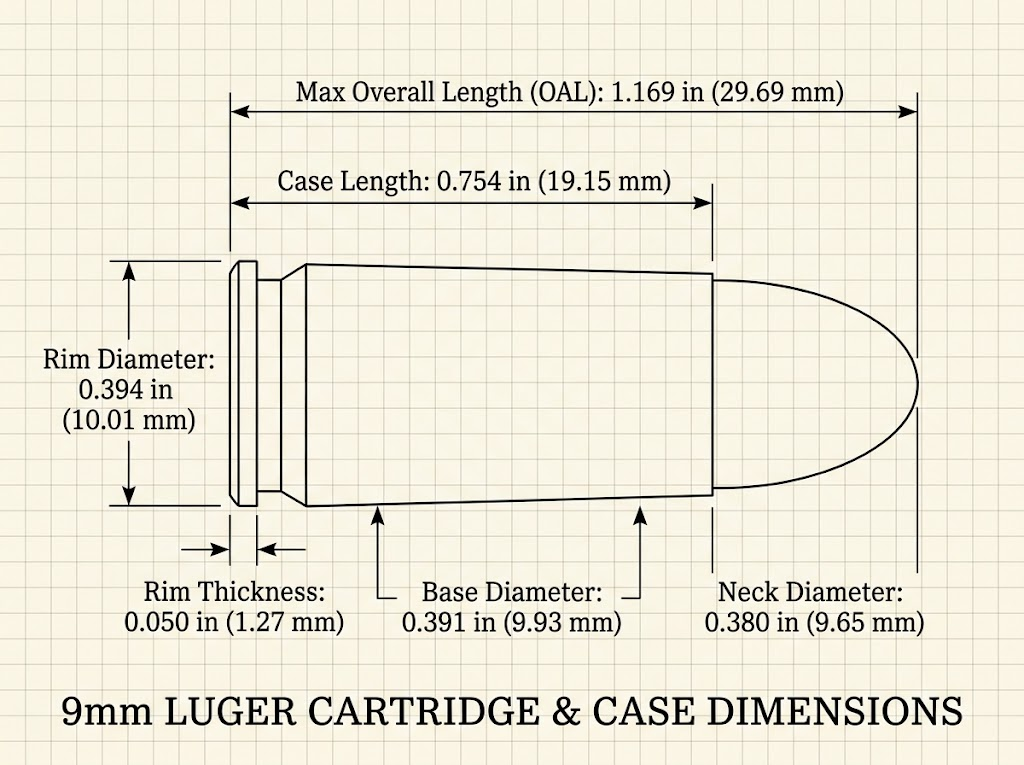
Understanding The 9mm Luger Case Dimensions
To understand how the 9mm Luger interacts with a pistol chamber, barrel, and magazine, you must analyze its discrete geometric components. Because it is a rimless, tapered pistol cartridge, its geometry serves a different engineering purpose than bottleneck rifle cases.
- Case Length: Measured from the base of the rim to the case mouth. This dimension dictates the space available for powder and determines exactly where the cartridge headspaces inside the pistol chamber.
- Rim Diameter and Thickness: The rim provides the gripping surface for the pistol extractor. The diameter ensures the cartridge centers on the breech face, while the thickness affects how securely the extractor claw engages the brass.
- Base Diameter: This is the width of the main cartridge body just ahead of the extractor groove.
- Shoulder Diameter and Geometry: The 9mm Luger does not have a shoulder. It utilizes a continuous body taper.
- Neck Diameter and Length: Without a shoulder step, the case tapers from the 0.391 inch base directly to the 0.380 inch case mouth. The case relies on bullet tension and a slight taper crimp at the mouth rather than a dedicated neck segment.
- Overall Cartridge Length (OAL): The measurement from the case base to the tip of the seated bullet. It dictates whether the round will fit and feed properly from standard pistol magazines.
- Case Capacity: The internal volume of the case, generally expressed in grains of water (gr H2O). This dictates the maximum powder charge the cartridge can safely hold to generate operating pressures.
9mm Luger Case Dimensions In Inches And Millimeters
Official standardization bodies use different base measurement systems. SAAMI specifications rely heavily on inches, whereas European C.I.P. standards utilize metric parameters.
| Dimension | Measurement (Inches) | Measurement (Millimeters) |
| Maximum Case Length | 0.754 in | 19.15 mm |
| Maximum Rim Diameter | 0.394 in | 10.01 mm |
| Maximum Base Diameter | 0.391 in | 9.93 mm |
| Maximum Neck Diameter | 0.380 in | 9.65 mm |
| Maximum Overall Length | 1.169 in | 29.69 mm |
9mm Luger Case Length
The published maximum case length for the 9mm Luger is 0.754 inches (19.15 mm). Consistent case length is highly critical for rimless pistol cartridges because of how they fit into the barrel.
The 9mm Luger headspaces directly on the case mouth. This means the forward edge of the brass physically impacts a small ledge machined into the pistol chamber to stop the cartridge from sliding too far forward into the barrel. If a case is trimmed too short, the firing pin may push the cartridge forward instead of detonating the primer, resulting in a misfire. Most handloaders trim their 9mm Luger cases uniformly to a nominal 0.744 inches to ensure a safe, uniform headspace on every round.
9mm Luger Base And Rim Dimensions
The 9mm Luger utilizes a standard rimless design optimized for reliable feeding and extraction in semi-automatic firearms. The base diameter measures 0.391 inches, while the rim measures slightly wider at a maximum diameter of 0.394 inches.
The 0.050 inch rim thickness provides a durable surface for the extractor claw. Because the cartridge is designed to stack neatly in double stack magazines, the rimless design prevents the rims from locking together during feeding, a common problem in rimmed revolver cartridges.
9mm Luger Shoulder And Neck Dimensions
Because the 9mm Luger is a tapered cartridge, it possesses absolutely zero shoulder diameter, shoulder angle, or distinct neck length.
The case body starts at a base diameter of 0.391 inches and tapers down continuously over its 0.754 inch length to reach a maximum external mouth diameter of 0.380 inches. This 0.011 inch taper is an intentional engineering design. It allows the brass case to extract easily and rapidly from the chamber during the violent cycling of a semi-automatic pistol. The internal dimension of the case mouth measures slightly under the standard 0.355 inch bullet diameter, providing friction to hold the bullet securely in alignment.
9mm Luger Case Capacity
Case capacity heavily influences internal ballistics and powder selection. The nominal, industry accepted capacity for the 9mm Luger is approximately 13.3 grains of water (H2O), or roughly 0.86 cubic centimeters.
Because the 9mm Luger is a high pressure pistol cartridge with a very small case volume, tiny variations in internal capacity can drastically alter chamber pressures. Heavy duty military brass (often stamped 9mm NATO) or brass with internal steps will reduce internal capacity and increase pressure levels compared to standard commercial brass. Reloaders must carefully adjust powder charges when switching brass brands.
9mm Luger Case Dimensions vs .380 ACP
The 9mm Luger (9x19mm) and the .380 ACP (9x17mm) both fire a 0.355 inch diameter bullet, but their case dimensions are fundamentally different.
| Dimension | 9mm Luger | .380 ACP | Source |
| Case Length | 0.754 in | 0.680 in | SAAMI |
| Rim Diameter | 0.394 in | 0.374 in | SAAMI |
| Base Diameter | 0.391 in | 0.374 in | SAAMI |
| Neck Diameter | 0.380 in | 0.373 in | SAAMI |
| Overall Length | 1.169 in | 0.984 in | SAAMI |
| Case Capacity | ~13.3 gr H2O | ~11.8 gr H2O | Standard Data |
| Max Pressure | 35,000 psi | 21,500 psi | SAAMI |
The .380 ACP is a much smaller, lower pressure cartridge designed for direct blowback pistols. The .380 ACP is a true straight-walled case with a 0.374 inch base and a 0.373 inch neck. The 9mm Luger uses a wider 0.391 inch base and features a distinct taper. The 9mm Luger case is also significantly longer at 0.754 inches compared to the 0.680 inch case of the .380 ACP.
9mm Luger Case Dimensions vs 9x18mm Makarov
The 9x18mm Makarov is a Soviet designed pistol cartridge that sits comfortably between the .380 ACP and the 9mm Luger in terms of power and dimensions.
| Dimension | 9mm Luger | 9x18mm Makarov | Source |
| Case Length | 0.754 in | 0.713 in | SAAMI / C.I.P. |
| Rim Diameter | 0.394 in | 0.390 in | SAAMI / C.I.P. |
| Base Diameter | 0.391 in | 0.390 in | SAAMI / C.I.P. |
| Bullet Diameter | 0.355 in | 0.365 in | SAAMI / C.I.P. |
| Overall Length | 1.169 in | 0.984 in | SAAMI / C.I.P. |
The 9x18mm Makarov utilizes a slightly shorter 0.713 inch case length. More importantly, it fires a noticeably wider 0.365 inch bullet compared to the 0.355 inch bullet of the 9mm Luger. The cases are not interchangeable, and firing a 9mm Luger in a Makarov pistol is physically impossible due to the differences in length and base width.
9mm Luger Chamber And Case Dimensions
A pistol chamber must be fractionally larger than the cartridge it accepts. The relationship between 9mm Luger case dimensions and chamber dimensions centers entirely on the case mouth and the body taper.
Because there is no shoulder, headspace for the 9mm Luger is measured from the breech face to the internal ledge of the chamber throat. The brass mouth physically impacts this ledge to stop the cartridge from sliding forward. Due to this headspacing method, the 9mm Luger must use a taper crimp. A traditional roll crimp would fold the brass inward, destroying the square edge needed to headspace on the chamber lip and causing dangerous misfires or excessive headspace conditions.
9mm Luger Case Forming And Resizing
Because the 9mm Luger is slightly tapered rather than perfectly straight, handloaders resizing fired brass will notice more resistance when using standard tungsten carbide sizing dies compared to resizing truly straight-walled cartridges like the .45 ACP or .38 Special.
While carbide dies do not strictly require case lubrication, a light spray of case lube makes resizing the tapered 9mm Luger case much smoother. The 9mm Luger cannot be safely formed from other common pistol cartridges due to its unique base diameter and body taper, making proprietary 9mm Luger brass a necessity for reloaders.
9mm Luger Manufacturer Specifications vs Actual Measurements
There is a documented difference between absolute standards and the dimensions of a physical cartridge sitting on a reloading bench.
SAAMI lists maximum material conditions. Ammunition manufacturers intentionally produce brass slightly smaller than these maximums to guarantee their cartridges will extract cleanly from dirty or tightly machined chambers. A fired 9mm Luger case expands to the exact dimensions of the specific pistol chamber it was fired in. When a handloader runs this fired brass through a carbide sizing die, the machine compresses the base and body back down to factory nominal tolerances.
Common Questions
What are the 9mm Luger case dimensions?
The key maximum case dimensions for the 9mm Luger include a 0.754 inch case length, a 0.394 inch rim diameter, a 0.391 inch base diameter, and a 0.380 inch neck diameter at the case mouth.
What is the 9mm Luger case length?
The maximum SAAMI and C.I.P. case length for the 9mm Luger is 0.754 inches (19.15 mm). The standard trim to length for reloading is typically 0.744 inches.
What is the 9mm Luger rim diameter?
The 9mm Luger rim diameter is 0.394 inches (10.01 mm max).
What is the 9mm Luger base diameter?
The base diameter of the 9mm Luger, measured just above the extractor groove, is 0.391 inches (9.93 mm max).
What is the 9mm Luger shoulder diameter?
The 9mm Luger does not possess a shoulder. It is a tapered case that gradually narrows from the base directly to the mouth.
What is the 9mm Luger neck diameter?
The maximum outside diameter at the case mouth for the 9mm Luger is 0.380 inches (9.65 mm).
What is the 9mm Luger case capacity?
The nominal case capacity of the 9mm Luger is approximately 13.3 grains of water (H2O), or 0.86 cubic centimeters.
What is the 9mm Luger overall length?
The maximum overall cartridge length for the 9mm Luger is 1.169 inches (29.69 mm) under SAAMI specifications.
How does 9mm Luger compare with .380 ACP case dimensions?
The .380 ACP is significantly smaller in every dimension. It features a narrower 0.374 inch base and a shorter 0.680 inch case length. The 9mm Luger uses a wider 0.391 inch base and a longer 0.754 inch case length.
Are 9mm Luger and 9mm NATO case dimensions the same?
Yes. Externally, 9mm Luger and 9mm NATO case dimensions are absolutely identical and will chamber in the same firearms. The difference lies internally. 9mm NATO ammunition is loaded to higher pressures and often utilizes thicker brass walls, reducing the internal case capacity.
What is the 9mm Luger maximum pressure?
The SAAMI maximum average pressure for standard 9mm Luger is 35,000 psi (piezo method). The +P (Overpressure) specification is rated at 38,500 psi. C.I.P. specifications rate the standard maximum pressure at 2350 bar (roughly 34,084 psi).