9mm bullets are available in multiple weights, with the popular 9mm Luger commonly utilizing bullet weights such as 115 grain, 124 grain, and 147 grain. Variations in bullet weight directly influence muzzle velocity, muzzle energy, trajectory, and perceived recoil. Furthermore, the designation 9mm can refer to several different cartridges rather than a single uniform load. Understanding these differences ensures safe and effective ammunition selection.
Table of Contents [Click to minimize]
9mm Bullet Weight
| 9mm Cartridge | Common Bullet Weight | Weight in Grains | Weight in Grams | Typical Use | Notes |
| 9mm Luger / 9x19mm | Standard Target | 115 grain | 7.45 g | Range practice, target shooting | High velocity, lower recoil |
| 9mm Luger / 9x19mm | Standard Service | 124 grain | 8.03 g | Duty, self defense, target | Balanced velocity and energy |
| 9mm Luger / 9x19mm | Heavy Subsonic | 147 grain | 9.53 g | Duty, suppressed shooting | Lower velocity, high momentum |
| 9mm Browning Short / .380 ACP | Standard | 90 grain | 5.83 g | Compact concealed carry | Lower energy, designed for pocket pistols |
| 9mm Makarov / 9x18mm | Standard | 95 grain | 6.16 g | Military surplus, self defense | Specific to Makarov chambered firearms |
| 9mm NATO | Military Standard | 124 grain | 8.03 g | Military service weapons | Slightly higher pressure than standard commercial loads |
| 9mm Largo / 9x23mm | Historical | 125 grain | 8.10 g | Historical firearms | High pressure historical cartridge |
| 9x21mm | European Commercial | 124 grain | 8.03 g | Competition, restricted jurisdictions | Dimensionally longer case than 9mm Luger |
| 9x23mm Winchester | High Velocity | 125 grain | 8.10 g | Competition, heavy duty | Very high pressure and velocity |
Most Common 9mm Bullet Weight: 124 grain. 115 grain and 124 grain are both extremely common 9mm Luger bullet weights, with 147 grain also widely available. Published manufacturer data indicates that 115 grain and 124 grain loadings dominate commercial sales for range training and law enforcement duty use.
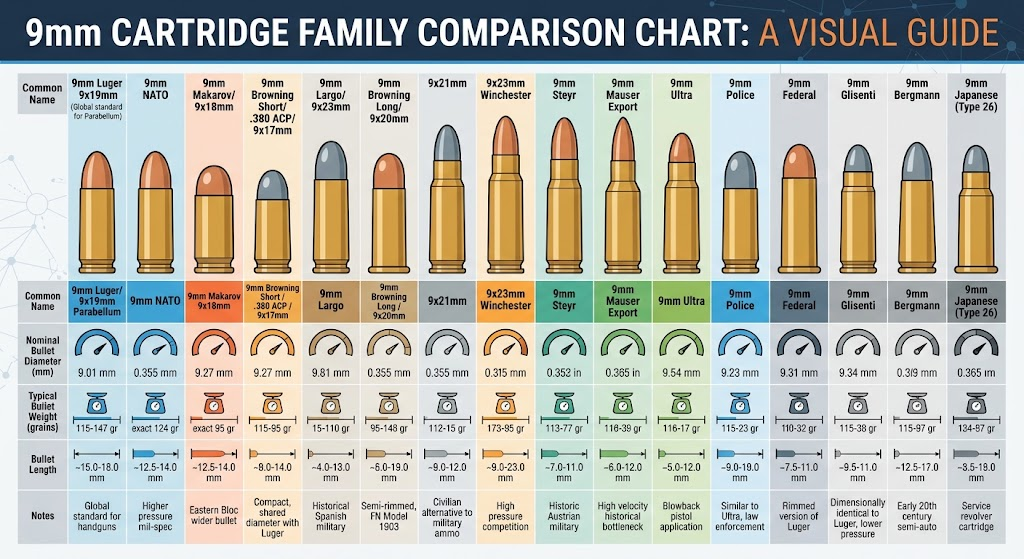
What Is the Standard 9mm Bullet Weight?
There is no single standard bullet weight for all 9mm ammunition because different cartridges and applications require varying performance profiles. Within the dominant 9mm Luger chambering, 115 grain and 124 grain loads serve as the commercial benchmarks. Manufacturers offer different options to accommodate distinct user requirements. For instance, 115 grain projectiles are favored for economical target practice due to their flat trajectory and mild recoil, while 124 grain and 147 grain options are frequently chosen for personal defense and duty applications because of their balanced terminal performance and barrier penetration characteristics.
9mm Bullet Weight in Grams
Bullet weight is traditionally measured in grains, but international standards often require metric mass values. One grain equals approximately 0.0648 grams. The following conversion table outlines common bullet weights from grains to grams across various categories:
| Bullet Weight Category | Grains | Grams |
| Light | 90 grain | 5.83 g |
| Light | 100 grain | 6.48 g |
| Common | 115 grain | 7.45 g |
| Common | 124 grain | 8.03 g |
| Common | 125 grain | 8.10 g |
| Common | 135 grain | 8.75 g |
| Heavy | 147 grain | 9.53 g |
| Heavy | 150 grain | 9.72 g |
| Heavy | 158 grain | 10.24 g |
115 Grain vs 124 Grain vs 147 Grain 9mm
Comparing the three most popular 9mm Luger weights reveals distinct performance traits based on published manufacturer specifications.
| Bullet Weight | Approx. Weight in Grams | Typical Velocity Characteristics | Muzzle Energy Characteristics | Typical Applications | General Characteristics |
| 115 grain | 7.45 g | High (~1,150 to 1,200 fps) | Moderate (~330 to 360 ft-lbs) | Target practice, training | Fast, flat trajectory, mild recoil |
| 124 grain | 8.03 g | Moderate to High (~1,100 to 1,180 fps) | Moderate to High (~350 to 400 ft-lbs) | Law enforcement duty, self defense | Balanced performance, proven track record |
| 147 grain | 9.53 g | Lower / Subsonic (~950 to 1,000 fps) | Moderate to High (~320 to 370 ft-lbs) | Suppressed shooting, duty use | Deep penetration, low noise with suppressors |
Bullet weight directly affects velocity because heavier projectiles require more energy to accelerate within the same barrel length given standard powder charges. Lighter bullets exit the muzzle at higher speeds, whereas heavier bullets rely on mass and momentum.
9mm Bullet Weight and Velocity
The relationship between bullet weight and muzzle velocity is inversely proportional under equivalent powder charges and chamber pressures. Lighter bullets, such as 115 grain loads, accelerate faster down the barrel, resulting in higher muzzle velocities often exceeding 1,150 feet per second. Conversely, heavier bullets, such as 147 grain loads, experience slower acceleration, typically resulting in muzzle velocities between 950 and 1,000 feet per second. A heavier bullet does not automatically produce more or less muzzle energy, as kinetic energy depends on both mass and the square of velocity.
9mm Bullet Weight and Muzzle Energy
Muzzle energy is a measure of kinetic energy imparted by a projectile upon exiting the barrel. It is calculated using the standard kinetic energy formula where energy equals one half of the mass multiplied by velocity squared. Published manufacturer data demonstrates that a 115 grain bullet traveling at 1,180 feet per second can produce roughly 355 foot-pounds of energy, while a 147 grain bullet traveling at 990 feet per second produces approximately 320 foot-pounds of energy. Although energy figures vary by specific ammunition load and barrel length, projectile weight and velocity interact to determine total kinetic performance.
9mm Bullet Weight and Recoil
Perceived recoil is influenced by a combination of bullet weight, muzzle velocity, firearm weight, and powder charge characteristics. While shooting a heavier bullet often generates increased momentum and felt recoil, velocity and total propellant mass play significant roles. A lightweight bullet driven to extreme velocities can produce sharp, snappy recoil, whereas a heavier subsonic bullet may produce a smoother, push-like impulse. Evaluating recoil requires considering the entire ammunition specification rather than relying solely on bullet weight.
9mm Bullet Weight by Cartridge Type
Different cartridges utilizing 9mm dimensions feature distinct case capacities and pressure limits, meaning bullet weight ranges vary significantly.
| Cartridge | Common Bullet Weights | Lightest Common Weight | Heaviest Common Weight | Notes |
| 9mm Luger / 9x19mm | 115, 124, 147 grain | 90 grain | 160 grain | Most widespread pistol cartridge globally |
| 9mm NATO | 124 grain | 115 grain | 124 grain | Military specification with higher pressure tolerances |
| 9mm Makarov / 9x18mm | 95 grain | 90 grain | 95 grain | Slightly larger bullet diameter (.365 inches) |
| 9mm Browning Short / .380 ACP | 95 grain | 85 grain | 100 grain | Compact blowback cartridge |
| 9mm Largo / 9x23mm | 125 grain | 124 grain | 130 grain | Historical Spanish military cartridge |
| 9mm Steyr | 115 grain | 115 grain | 115 grain | Obsolete Austrian military cartridge |
Lightest 9mm Bullets
Lightweight 9mm bullets typically range from 90 grains to 115 grains. Manufacturers produce these lighter projectiles to achieve higher muzzle velocities, flatten trajectories at standard engagement distances, and reduce felt recoil for novice shooters or fast shooting disciplines. Frangible training ammunition and specialized monolithic solid copper projectiles often utilize lighter weights to ensure reliable feeding and specific terminal performance characteristics.
Heaviest 9mm Bullets
Heaviest 9mm bullets commonly include 147 grain, 150 grain, and 158 grain options. Heavy bullets are frequently chosen for duty and self defense because their increased mass provides deep penetration through intermediate barriers. Furthermore, 147 grain 9mm ammunition is naturally subsonic, making it ideal for use with firearm suppressors since it avoids the loud sonic crack produced when bullets break the sound barrier.
9mm Bullet Weight vs Other Common Calibers
To understand 9mm ammunition weight in context, it helps to review typical bullet weight ranges across other popular handgun calibers based on current published manufacturer data.
| Caliber / Cartridge | Typical Bullet Weight Range (Grains) |
| 9mm Luger | 115 to 147 grain |
| .380 ACP | 85 to 100 grain |
| .38 Special | 110 to 158 grain |
| .357 Magnum | 125 to 158 grain |
| .40 S&W | 135 to 180 grain |
| .45 ACP | 185 to 230 grain |
| 10mm Auto | 135 to 200 grain |
Bullet weight alone does not determine cartridge power or effectiveness, as internal pressures, case volumes, and velocity play equally crucial roles.
How to Choose 9mm Bullet Weight
Selecting the appropriate bullet weight requires evaluating multiple technical parameters to ensure safe and optimal firearm operation. Key factors include:
- Firearm compatibility: Ensuring the pistol functions reliably with the chosen projectile profile and length.
- Ammunition specifications: Reviewing manufacturer data sheets for pressure ratings and intended use.
- Bullet design: Evaluating whether the projectile is full metal jacket, hollow point, or frangible.
- Velocity: Determining the speed required for target engagement or expansion thresholds.
- Muzzle energy: Assessing kinetic energy outputs for specific defensive or sporting needs.
- Barrel length: Accounting for how barrel dimensions affect powder burn and projectile acceleration.
- Intended application: Matching the load to target shooting, competition, or personal protection.
- Manufacturer recommendations: Following guidelines provided by firearm and ammunition makers.
9mm Bullet Weight FAQs
What is the most common 9mm bullet weight?
The most common 9mm bullet weight is 124 grain, closely followed by 115 grain for target shooting and 147 grain for duty applications.
What is the standard weight of a 9mm bullet?
There is no single official standard, but 115 grain and 124 grain serve as the commercial benchmarks for 9mm Luger ammunition.
How much does a 9mm bullet weigh?
A 9mm bullet typically weighs between 115 grains and 147 grains for standard 9mm Luger loads, though weights range from 90 grains to over 150 grains across different cartridges.
How many grams is a 115 grain 9mm bullet?
A 115 grain 9mm bullet weighs approximately 7.45 grams.
How many grams is a 124 grain 9mm bullet?
A 124 grain 9mm bullet weighs approximately 8.03 grams.
How many grams is a 147 grain 9mm bullet?
A 147 grain 9mm bullet weighs approximately 9.53 grams.
Is 115 grain or 124 grain 9mm better?
Neither is universally better; 115 grain offers higher velocity and milder recoil for practice, while 124 grain offers balanced performance favored in duty and defense roles.
Is 147 grain 9mm heavier than 124 grain?
Yes, a 147 grain bullet is heavier and possesses more mass than a 124 grain bullet.
What is the heaviest 9mm bullet?
Standard commercial 9mm Luger loads reach up to 147 grains to 150 grains, with specialized heavy loads reaching 158 grains.
What is the lightest 9mm bullet?
Lightweight options for 9mm Luger start around 90 grains, while related cartridges like .380 ACP feature bullets as light as 85 grains.
Does 9mm bullet weight affect velocity?
Yes, lighter bullets generally achieve higher muzzle velocities, while heavier bullets travel at lower velocities under standard powder charges.
Does 9mm bullet weight affect muzzle energy?
Yes, bullet weight combines with velocity to determine muzzle energy, though heavier bullets do not automatically produce higher energy figures.
Does 9mm bullet weight affect recoil?
Yes, bullet weight influences momentum and felt recoil, though velocity, firearm weight, and powder charge also contribute significantly to perceived recoil.