An 8.6 Blackout Ballistics Chart is an incredibly detailed and comprehensive reference table that tracks the velocity, kinetic energy, and trajectory curve of the revolutionary 8.6 Blackout cartridge over various distances. By carefully reviewing this specific chart, you can visualize exactly how your heavy bullet will behave from the precise moment it leaves your barrel until it strikes a target hundreds of yards downrange. This critical data allows you to accurately predict bullet drop, compensate for wind drift, and verify that your massive projectile retains enough energy for an ethical kill on game animals in dense brush or across open fields.
Shooters, hunters, reloaders, and tactical enthusiasts use an 8.6 Blackout Ballistics Chart to unlock the absolute true potential of this modern short action powerhouse. Developed by Kevin Brittingham and his team at Q LLC, this cartridge completely revolutionized the firearms industry by taking a shortened 6.5 Creedmoor brass case and necking it up to accept a massive 338 caliber bullet. It was specifically engineered to maximize terminal performance from extremely short barrels while operating silently with a sound suppressor. By studying the numbers today, a dedicated tactical hunter can confidently take a challenging shot on a feral hog at night knowing their heavy subsonic bullet will perform flawlessly. A recreational marksman uses the trajectory data to understand exactly how much to adjust their rifle scope turrets for hitting steel targets. In this comprehensive guide, you will learn how to analyze ballistics data, choose the absolute best bullet weight for your specific needs, determine the ideal zero distance, and see exactly how this modern cartridge continues to absolutely dominate the hunting and tactical shooting communities.
8.6 Blackout Ballistics Chart
Below is a detailed ballistics table featuring ten of the most popular and proven factory ammunition loads available today. The data represents a standard twelve inch to sixteen inch test barrel and assumes a one hundred yard zero for supersonic loads and a fifty yard zero for subsonic loads, though the chart lists trajectory relative to a one hundred yard baseline for direct comparison. Atmospheric conditions are based on standard sea level metrics. Because this cartridge features a massive divide between high velocity supersonic loads and heavy subsonic loads, the performance metrics vary wildly depending on your ammunition selection.
| Bullet Weight | Bullet Type | Manufacturer | Muzzle Velocity | Velocity At 100 Yards | Velocity At 200 Yards | Velocity At 300 Yards | Velocity At 400 Yards | Velocity At 500 Yards | Muzzle Energy | Energy At 100 Yards | Energy At 200 Yards | Energy At 300 Yards | Energy At 400 Yards | Energy At 500 Yards | Trajectory At 100 Yards | Trajectory At 200 Yards | Trajectory At 300 Yards | Trajectory At 400 Yards | Trajectory At 500 Yards | Ballistic Coefficient | Sectional Density |
| 160 Grain | TAC TX | Gorilla Ammunition | 2400 fps | 2200 fps | 2010 fps | 1830 fps | 1660 fps | 1510 fps | 2046 ft lbs | 1720 ft lbs | 1435 ft lbs | 1190 ft lbs | 979 ft lbs | 810 ft lbs | 0 inches | 5.5 inches drop | 18.5 inches drop | 40.5 inches drop | 74.0 inches drop | 0.395 | 0.200 |
| 210 Grain | TSX | Gorilla Ammunition | 1970 fps | 1788 fps | 1619 fps | 1460 fps | 1320 fps | 1200 fps | 1810 ft lbs | 1491 ft lbs | 1222 ft lbs | 994 ft lbs | 812 ft lbs | 671 ft lbs | 0 inches | 9.4 inches drop | 28.5 inches drop | 60.5 inches drop | 108.5 inches drop | 0.386 | 0.263 |
| 225 Grain | ELD Match | Hornady | 1900 fps | 1750 fps | 1610 fps | 1480 fps | 1360 fps | 1250 fps | 1803 ft lbs | 1530 ft lbs | 1295 ft lbs | 1094 ft lbs | 924 ft lbs | 781 ft lbs | 0 inches | 10.2 inches drop | 30.5 inches drop | 62.5 inches drop | 110.0 inches drop | 0.528 | 0.281 |
| 285 Grain | TUI | Fort Scott Munitions | 1050 fps | 1018 fps | 990 fps | 965 fps | 945 fps | 925 fps | 698 ft lbs | 656 ft lbs | 620 ft lbs | 589 ft lbs | 565 ft lbs | 542 ft lbs | 0 inches | 32.0 inches drop | 102.5 inches drop | 215.0 inches drop | 375.0 inches drop | 0.450 | 0.356 |
| 285 Grain | Fracturing | Gorilla Ammunition | 1050 fps | 1016 fps | 986 fps | 960 fps | 938 fps | 918 fps | 698 ft lbs | 653 ft lbs | 616 ft lbs | 583 ft lbs | 557 ft lbs | 534 ft lbs | 0 inches | 32.1 inches drop | 103.0 inches drop | 216.5 inches drop | 377.0 inches drop | 0.440 | 0.356 |
| 288 Grain | Fracturing | Gorilla Ammunition | 1000 fps | 970 fps | 945 fps | 925 fps | 905 fps | 885 fps | 639 ft lbs | 602 ft lbs | 571 ft lbs | 547 ft lbs | 524 ft lbs | 501 ft lbs | 0 inches | 35.5 inches drop | 112.0 inches drop | 230.5 inches drop | 395.0 inches drop | 0.445 | 0.360 |
| 300 Grain | Sierra MatchKing | Gorilla Ammunition | 1050 fps | 1018 fps | 990 fps | 968 fps | 948 fps | 930 fps | 734 ft lbs | 690 ft lbs | 653 ft lbs | 624 ft lbs | 599 ft lbs | 576 ft lbs | 0 inches | 32.0 inches drop | 102.0 inches drop | 214.5 inches drop | 374.0 inches drop | 0.760 | 0.375 |
| 342 Grain | Pork Shredder | Gorilla Ammunition | 1000 fps | 975 fps | 953 fps | 933 fps | 915 fps | 898 fps | 759 ft lbs | 722 ft lbs | 690 ft lbs | 661 ft lbs | 636 ft lbs | 613 ft lbs | 0 inches | 35.0 inches drop | 110.5 inches drop | 228.0 inches drop | 390.0 inches drop | 0.445 | 0.428 |
| 342 Grain | Punisher Expanding | Gorilla Ammunition | 1025 fps | 998 fps | 975 fps | 955 fps | 935 fps | 918 fps | 798 ft lbs | 756 ft lbs | 722 ft lbs | 693 ft lbs | 664 ft lbs | 640 ft lbs | 0 inches | 33.5 inches drop | 106.0 inches drop | 220.0 inches drop | 380.0 inches drop | 0.445 | 0.428 |
| 350 Grain | Solid Copper HP | Steinel Ammunition | 1050 fps | 1020 fps | 995 fps | 975 fps | 955 fps | 938 fps | 857 ft lbs | 809 ft lbs | 770 ft lbs | 739 ft lbs | 709 ft lbs | 684 ft lbs | 0 inches | 31.8 inches drop | 101.5 inches drop | 213.0 inches drop | 372.0 inches drop | 0.500 | 0.438 |
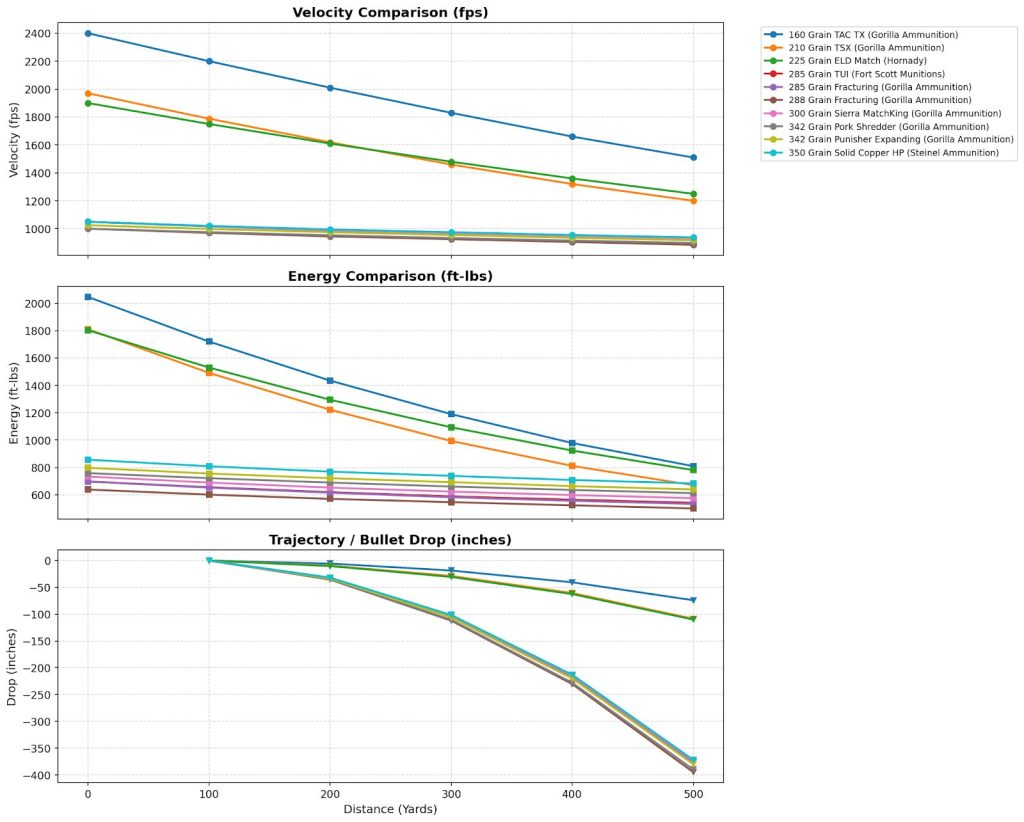
Understanding The Chart
A ballistics chart can look overwhelming at first glance due to the sheer amount of data presented in each row. However, once you break down each individual column, the numbers paint a brilliantly clear picture of how a specific load will perform in the field. Understanding these distinct metrics is absolutely crucial for maximizing your success when utilizing this unique big bore cartridge.
Muzzle Velocity
Muzzle velocity is the exact speed at which the bullet exits the barrel of the firearm. It is measured in feet per second. In this specialized caliber, you will notice a massive divide between supersonic ammunition and subsonic ammunition. Supersonic loads travel much faster than the speed of sound, providing a flatter trajectory and explosive energy. Subsonic loads intentionally leave the barrel below the speed of sound to completely eliminate the loud sonic crack that occurs during flight. When paired with a quality suppressor, the heavy subsonic rounds are remarkably quiet.
Retained Velocity
Retained velocity refers to the speed of the bullet at specific distances downrange, such as one hundred or five hundred yards. Air resistance constantly slows the bullet down as it travels through the atmosphere. Retained velocity is incredibly important for hunters because expanding hunting bullets require a specific minimum velocity to open up properly upon impact. Interestingly, because the subsonic bullets are incredibly heavy and aerodynamic, they actually retain their velocity remarkably well at extended ranges despite their slow initial launch speed.
Kinetic Energy
Kinetic energy is the amount of destructive physical force the bullet carries, measured in foot pounds. It is calculated by utilizing the weight of the bullet and its velocity at any given distance. Hunters must pay close attention to this specific metric on an 8.6 Blackout Energy Chart to ensure they have enough power to ethically harvest game animals. While the subsonic loads generate relatively low kinetic energy on paper, their massive mass and huge diameter create devastating wound channels that perform vastly better than standard mathematical energy formulas would suggest.
Trajectory
Trajectory indicates the actual physical path the bullet takes as it flies through the air, factoring in the constant downward pull of gravity. The 8.6 Blackout Trajectory Chart displays the bullet drop in inches at various yardages relative to your line of sight through the optic. By knowing the exact trajectory curve, shooters can adjust their aim to hit targets precisely without guessing. The heavy subsonic bullets experience a massive rainbow trajectory, dropping several feet by the time they reach three hundred yards, making precise distance estimation an absolute requirement.
Ballistic Coefficient
The Ballistic Coefficient is a numerical value that represents how efficiently a bullet cuts through the air. A higher number means the bullet is much more aerodynamic and will retain its velocity and energy far better over long distances. High Ballistic Coefficient bullets also resist wind drift significantly better than bullets with a lower rating. Because this cartridge fires massive 338 caliber match bullets and heavy hunting projectiles, the aerodynamic ratings are exceptionally high, allowing the heavy bullets to slice through heavy crosswinds effortlessly.
Sectional Density
Sectional density is the ratio of a bullet weight compared directly to its diameter. This metric is a fantastic indicator of how deeply a bullet will penetrate into a target. A higher sectional density generally results in much deeper penetration. Because this cartridge fires incredibly heavy bullets for its caliber, the sectional density numbers are fantastic. These heavy bullets are designed to penetrate deeply through thick muscle and heavy bone on large game animals, guaranteeing excellent terminal performance.
Common 8.6 Blackout Bullet Weights
The cartridge is incredibly versatile, largely due to the wide variety of premium bullet weights it can fire accurately. From lightweight supersonic copper bullets to massive subsonic monolithic projectiles, selecting the proper bullet weight is the single most important decision a shooter can make for a specific field application.
160 Grain
The 160 grain bullet is among the absolute lightest options practically available for this cartridge. It operates exclusively as a supersonic load, offering fast muzzle velocities and an exceptionally flat trajectory. This weight is primarily used for medium game hunting where flat trajectories are highly preferred over silent operation. Premium solid copper choices provide devastating terminal performance and highly reliable expansion on whitetail deer and feral hogs at medium ranges.
210 Grain
Moving up in weight, the 210 grain bullet provides a great balance of high velocity and incredibly deep penetration. Gorilla Ammunition utilizes the famous Barnes TSX solid copper bullet in this weight class to deliver massive kinetic energy transfer. It is an excellent choice for hunting tough wild hogs and large deer species. While it shoots relatively flat at short distances, it packs the heavy punch required to break through thick shoulder bones reliably.
225 Grain
The 225 grain category is heavily dominated by polymer tipped target loads and advanced hunting bullets. This is generally the heaviest weight utilized for supersonic applications before the cartridge transitions into subsonic territory. It strikes the perfect balance between velocity and heavy aerodynamic efficiency, offering excellent performance for shooters who want to ring steel targets at extended distances out to five hundred yards using supersonic ammunition.
285 Grain
The 285 grain weight marks the beginning of the heavy subsonic category. Projectiles in this class are specifically engineered to remain below the speed of sound. Fort Scott Munitions and Gorilla Ammunition both offer fantastic 285 grain options designed for tactical training and hunting. These bullets offer a highly predictable subsonic trajectory while maintaining enough velocity to initiate specialized fracturing or tumbling upon impact with soft tissue.
300 Grain
The 300 grain bullet is an absolute staple for subsonic precision shooting. Factory ammunition commonly utilizes the legendary Sierra MatchKing projectile to provide the ultimate in aerodynamic efficiency and consistent accuracy. While hollow point match bullets are not explicitly designed for hunting, they serve perfectly for training drills, tactical applications, and ringing steel plates silently at two hundred yards with a suppressed rifle.
342 Grain
The 342 grain bullet is arguably the most famous and highly specialized option for this incredible caliber. Gorilla Ammunition specifically designed the Pork Shredder and the Punisher series around this massive solid copper expanding projectile. It is precisely manufactured on a computerized lathe to ensure flawless expansion at very low subsonic speeds. This is the premier choice for hunters who want to remain perfectly silent while ethically harvesting tough game with a massive wound channel.
350 Grain
The 350 grain bullet represents the absolute heaviest practical option commonly used in factory ammunition for this cartridge. These massive projectiles feature the highest sectional density available and require a very fast barrel twist rate to stabilize properly. They hit with the authority of a sledgehammer, transferring all their heavy momentum directly into the target. They are favored by specialized hunters who demand maximum penetration on tough animals at close quarters.
Effective Hunting Range
The 8.6 Blackout Effective Range depends heavily on whether you are using high velocity supersonic ammunition or silent subsonic ammunition. A responsible hunter must understand their own limitations as well as the unique ballistic capabilities of their rifle setup.
Whitetail Deer
For whitetail deer, supersonic loads in the 160 grain to 210 grain range are highly effective out to three hundred yards. The bullets carry plenty of velocity to expand properly and deliver a quick ethical kill. If utilizing specialized expanding subsonic ammunition like the massive 342 grain copper bullets, hunters should strictly limit their shots to one hundred and fifty yards due to the rapid bullet drop and the necessity for precise shot placement in the vital zone.
Elk
Hunting elk with this cartridge is a highly specialized application that requires extreme caution. Elk are massive heavy boned animals that require incredibly deep penetration. While a perfectly placed supersonic solid copper bullet can theoretically harvest an elk at close range, the cartridge is generally considered a short range tool for such massive animals. Hunters utilizing heavy subsonic ammunition must restrict their shots to under one hundred yards and guarantee a perfectly broadside presentation to ensure adequate penetration into the vitals.
Black Bear
Black bears share similar anatomy to large feral hogs and robust deer. A quality supersonic bullet will deliver devastating results on a black bear out to two hundred yards. The cartridge provides plenty of bone crushing power at close ranges. When hunting bears over bait in dense timber, heavy expanding subsonic loads perform exceptionally well, providing immense shock and a massive blood trail without deafening the shooter in a confined hunting blind.
Wild Hogs
Feral hogs are perhaps the absolute perfect target for this cartridge. Tactical hog hunters who operate at night heavily favor heavy subsonic ammunition paired with thermal optics and sound suppressors. Because shots are typically taken within one hundred yards, the massive subsonic round provides absolutely devastating knockdown power while keeping the rifle completely silent. This unique capability often allows the hunter to harvest multiple hogs sequentially before the sounder realizes they are under attack.
Coyotes
When hunting coyotes and other predators, a flat trajectory is far more important than heavy retained energy. Using lightweight supersonic bullets, you can accurately harvest coyotes out to three hundred yards. However, the cartridge cannot match the laser flat trajectory of a dedicated predator round like the 223 Remington or 22 250 Remington. If utilizing subsonic ammunition, distance estimation becomes absolutely critical to avoid shooting under the target.
Target Shooting
For general steel target shooting and range practice, the cartridge is incredibly fun and highly addictive. The extremely mild recoil makes it an absolute joy to shoot during long training sessions. Transitioning between fast supersonic loads and quiet subsonic loads provides excellent training for tactical applications. Ringing steel plates with heavy subsonic bullets provides a highly satisfying delayed impact sound that shooters absolutely love.
Long Range Shooting
This cartridge was absolutely not designed for extreme long range precision. Supersonic loads drop severely past four hundred yards, and subsonic loads drop over ten feet at just three hundred yards. While lobbing heavy match bullets at distant steel targets can be a highly entertaining mathematical challenge for experienced shooters utilizing extreme elevation adjustments, the cartridge is entirely unsuited for competitive long range precision rifle matches.
Factors That Affect 8.6 Blackout Ballistics
Ballistics numbers are never completely static. The exact data provided in an 8.6 Blackout Velocity Chart will change constantly based on environmental conditions and the physical characteristics of your specific rifle setup. Understanding these distinct variables is the key to achieving true precision.
Barrel Length
Barrel length has a major direct impact on your final muzzle velocity. This cartridge was meticulously engineered to achieve a complete powder burn in incredibly short barrels ranging from eight to twelve inches. Using a short barreled rifle provides fantastic maneuverability in close quarters without sacrificing much performance. Upgrading to a sixteen inch barrel will yield a moderate velocity increase for supersonic loads, but offers almost zero ballistic benefit for heavy subsonic loads.
Bullet Weight
The weight of the projectile dictates its speed and trajectory curve. Lighter bullets launch faster and shoot flatter at close range, while massive heavy bullets travel below the speed of sound and drop rapidly due to gravity. You must choose your 8.6 Blackout Bullet Weight based entirely on whether you want a flat trajectory across open agricultural fields or silent suppressed performance in heavy woodland cover.
Bullet Design
The physical shape of your bullet matters just as much as its weight. Solid copper monolithic bullets manufactured on precision lathes provide flawless expansion and incredible weight retention. For subsonic hunting, bullet design is the absolute most critical factor, as standard traditional cup and core bullets will completely fail to expand at such low speeds. You must use specialized subsonic expanding bullets to ensure ethical harvests when shooting suppressed.
Altitude
The elevation at which you are shooting directly changes the density of the air. At higher altitudes, the air is much thinner, which creates less drag on the heavy bullet. As a result, your bullet will shoot noticeably flatter and retain slightly more energy in the high mountains compared to shooting near sea level. Shooters must always verify their specific zero data when traveling to drastically different elevations.
Temperature
Temperature shifts dramatically impact both the air density and the internal pressure of your cartridge chamber. Cold air is dense and creates more drag on the bullet. Furthermore, freezing temperatures can lower the burn rate of your gunpowder, slightly reducing your muzzle velocity and shifting your point of impact downward. This is especially critical for subsonic ammunition, as velocity variations directly affect the heavy trajectory arc.
Humidity
While often completely misunderstood by novice shooters, humidity actually makes the air less dense. Water vapor is lighter than dry atmospheric air molecules. Therefore, high humidity environments provide slightly less resistance to the bullet in flight, resulting in a marginally flatter trajectory. However, for the short practical distances associated with this cartridge, humidity plays almost zero role in actual field performance.
Wind
Wind deflection is a massive challenge when shooting subsonic ammunition. Because heavy subsonic bullets travel so slowly, they spend a tremendous amount of time in the air before reaching the distant target. This extended flight time gives a crosswind much more opportunity to push the bullet laterally off its intended path compared to a fast moving supersonic projectile. Shooters must learn to read the wind carefully when shooting past two hundred yards.
Twist Rate
The twist rate of a rifle barrel determines how fast the bullet spins in flight. To perfectly stabilize massive subsonic bullets, the 8.6 Blackout utilizes a revolutionary one in three barrel twist rate. This unbelievably fast twist spins the bullet at hundreds of thousands of revolutions per minute. When this rapidly spinning bullet enters soft tissue, the extreme rotational energy acts like a high speed blender, violently disrupting tissue and transferring massive energy even at very low forward velocities. This rotational energy is the absolute secret to the terminal success of the cartridge.
Zero Distance
Your selected zero distance establishes the mathematical foundation for your entire trajectory data table. If you zero your rifle at one hundred yards with fast supersonic ammunition, switching to a heavy subsonic load will cause your bullet to impact several inches lower at the exact same distance. Shooters must thoroughly understand their specific zero data and optics adjustments intimately when swapping between different ammunition types in the field.
Best Zero Distance
Selecting the optimal zero distance depends entirely on whether you plan to use supersonic or subsonic ammunition. Different applications require different zero strategies to maximize your success and minimize complicated mental math during stressful hunting scenarios.
25 Yard Zero
A twenty five yard zero is commonly used by tactical shooters running subsonic ammunition in a very short barreled rifle. Because the line of sight through the scope is mounted above the bore on an AR 10 platform, the bullet crosses the visual plane very early. This provides an excellent point blank range for close quarters scenarios where engagements happen inside of a single structure or very dense brush.
50 Yard Zero
The fifty yard zero is widely considered the absolute best choice for heavy subsonic hunting. It keeps the heavy arcing rainbow trajectory perfectly aligned with your line of sight at very close ranges, allowing you to aim dead on from twenty to seventy five yards with complete confidence. This is the optimal setup for hunting feral hogs at night with thermal optics.
100 Yard Zero
A one hundred yard zero is the absolute gold standard for supersonic hunting with this cartridge. It provides a clean and perfect mathematical baseline where all adjustments for longer distances will be dialed upward on the scope turrets. It removes any need to hold under the target, greatly simplifying the math for intermediate range engagements across agricultural fields.
200 Yard Zero
For hunters wanting maximum point blank range with supersonic ammunition, the two hundred yard zero is highly viable. With this zero, a light supersonic bullet will impact roughly three to four inches high at one hundred yards and drop dead center at two hundred yards. This allows the hunter to hold center mass on a medium game animal without calculating complicated holdovers in the heat of the moment.
300 Yard Zero
A three hundred yard zero is absolutely impractical and entirely useless for this specific caliber. It would require the bullet to travel in a massive upward arc, causing it to strike dangerously high at intermediate ranges. This trajectory curve would easily lead to shooting completely over the back of a game animal.
For dedicated subsonic shooters, the fifty yard zero offers the most predictable field performance. For hunters utilizing the speed of supersonic rounds, the one hundred yard zero is completely undisputed for overall practical utility.
8.6 Blackout Ballistics Compared To Other Cartridges
This cartridge was explicitly engineered to fill a very specific tactical niche in the AR 10 and short action bolt rifle platforms. To understand its true value, we must compare it directly against other common tactical and hunting cartridges.
| Cartridge | Muzzle Velocity | Muzzle Energy | Trajectory At 300 Yards | Recoil | Effective Range | Long Range Performance | Hunting Performance |
| 8.6 Blackout Supersonic | 2400 fps | 2046 ft lbs | 18.5 inches drop | Moderate | 300 Yards | Fair | Exceptional |
| 8.6 Blackout Subsonic | 1050 fps | 734 ft lbs | 102.0 inches drop | Very Light | 150 Yards | Poor | Very Good |
| 300 Blackout Supersonic | 2250 fps | 1350 ft lbs | 22.0 inches drop | Light | 250 Yards | Poor | Good |
| 308 Winchester | 2820 fps | 2648 ft lbs | 12.0 inches drop | Moderate | 800 Yards | Excellent | Exceptional |
| 6.5 Creedmoor | 2700 fps | 2280 ft lbs | 11.5 inches drop | Light | 1000 Yards | Exceptional | Very Good |
When comparing the 8.6 Blackout directly to its little brother, the 300 Blackout, the differences are absolutely striking. The 300 Blackout is legendary for suppressed AR 15 performance, but it fires a much smaller thirty caliber bullet. The 8.6 Blackout offers a vastly larger diameter projectile and delivers significantly more kinetic energy, hitting much harder than the 300 Blackout when using heavy subsonic loads. This makes it a far superior choice for hunting tough hogs and deer.
Against the legendary 308 Winchester, the new thirty three caliber cartridge offers completely different advantages. The 308 Winchester is a full power rifle cartridge that vastly outpaces the newer cartridge in raw velocity, kinetic energy, and extreme long range performance. However, the 308 Winchester requires a longer barrel to operate efficiently and is notoriously difficult to suppress down to truly quiet levels due to its massive powder charge. The 8.6 Blackout provides vastly superior subsonic capabilities in a much shorter package.
The 6.5 Creedmoor is actually the parent case of this modern wildcat cartridge. The engineers simply cut the 6.5 Creedmoor case down and widened the neck. The 6.5 Creedmoor shoots highly aerodynamic bullets exceptionally flat, making it a master of one thousand yard precision. The new cartridge trades all of that long range precision for massive short range smashing power and incredible sound suppression.
Overall, the 8.6 Blackout offers a highly specialized and brilliant tool for shooters who explicitly prioritize compact platform size, heavy bullet mass, and ultimate sound suppression over maximum effective range.
Frequently Asked Questions
What is an 8.6 Blackout Ballistics Chart?
It is a highly detailed reference table that precisely tracks the speed, energy, and trajectory curve of the cartridge over various distances. Shooters rely on this specific data to accurately adjust their rifle optics, understand wind deflection, and guarantee their heavy bullet retains enough power for ethical hunting at specific yardages.
How far is an 8.6 Blackout effective?
For hunting medium game with high velocity supersonic ammunition, the 8.6 Blackout Effective Range is highly capable out to roughly three hundred yards. When using heavy subsonic ammunition, the effective hunting range drops to about one hundred and fifty yards due to the rapid loss of forward momentum and the severe downward trajectory arc.
How much does an 8.6 Blackout bullet drop at 300 yards?
If zeroed at one hundred yards, a typical 160 grain supersonic bullet will drop roughly eighteen and a half inches at three hundred yards. Conversely, a massive heavy 300 grain subsonic bullet zeroed at one hundred yards will plummet over one hundred inches by the time it reaches three hundred yards.
Is the 8.6 Blackout good for deer hunting?
Yes, it is an absolutely outstanding deer hunting cartridge when paired with the proper expanding ammunition. Loads featuring solid copper monolithic projectiles offer deep penetration and massive energy transfer, easily taking down large bucks at close to medium ranges.
Is the 8.6 Blackout suitable for elk?
Hunting elk with this cartridge is highly specialized. While a perfectly placed supersonic bullet can harvest an elk at very close range, the cartridge is generally considered a short range tool for massive animals. Hunters utilizing heavy subsonic ammunition must restrict their shots to under one hundred yards and guarantee perfect shot placement.
What is the best 8.6 Blackout bullet weight?
The best weight depends entirely on your specific tactical or hunting goal. For the flattest shooting trajectory and best medium game hunting performance across open fields, the 160 grain to 210 grain supersonic bullets are ideal. For silent suppressed hog hunting, the massive 285 grain to 342 grain expanding subsonic bullets are the undisputed best choice.
What is the best zero distance for an 8.6 Blackout?
For tactical shooters running suppressed subsonic ammunition in heavy timber, a fifty yard zero provides the most forgiving point blank range. For hunters utilizing the speed of supersonic rounds across wide agricultural fields, the one hundred yard zero provides the absolute best baseline for accurate shot placement.
Can an 8.6 Blackout reach 1000 yards?
While a highly skilled shooter can physically lob heavy supersonic match bullets to one thousand yards on a steel target range, the cartridge is absolutely not designed for this purpose. The bullet will experience massive drop and severe wind drift, making it a poor choice for competitive extreme long range precision shooting.
Does barrel length affect 8.6 Blackout velocity?
Yes, shorter barrels will reduce the muzzle velocity of the supersonic loads. However, the cartridge is heavily optimized to burn its powder efficiently in incredibly short barrels ranging from eight to twelve inches. Even an exceptionally short eight inch barrel will still produce devastating terminal performance at close hunting ranges.
What is the fastest factory loaded 8.6 Blackout ammunition?
The fastest factory options are the lightweight 160 grain supersonic loads, which easily leave a sixteen inch barrel at roughly two thousand four hundred feet per second. These specific loads provide the flattest possible trajectory and the absolute longest effective hunting range for this specific caliber.
Conclusion
Understanding an 8.6 Blackout Ballistics Chart is absolutely essential for any shooter looking to harness the full maximum potential of this heavy hitting tactical cartridge. Whether you are consulting an 8.6 Blackout Velocity Chart to verify expansion thresholds for copper bullets or analyzing an 8.6 Blackout Trajectory Chart to perfectly dial your scope for a difficult suppressed shot, the data is the ultimate key to your field success. This modern cartridge represents a massive leap forward in firearm capabilities, offering unprecedented rotational tissue damage and stopping power in a very compact package.
By carefully studying your 8.6 Blackout Hunting Ballistics, understanding the massive performance shift between supersonic and heavy subsonic bullet weights, and picking the right zero distance, you can turn a standard modern sporting rifle into a brilliant dual purpose powerhouse. The 8.6 Blackout Effective Range provides plenty of reach for supersonic hunting while delivering the quiet, sledgehammer blows that tactical and subsonic hog hunters absolutely demand. It truly earns its reputation as one of the most versatile and devastating heavy cartridges ever designed for short barreled rifles.