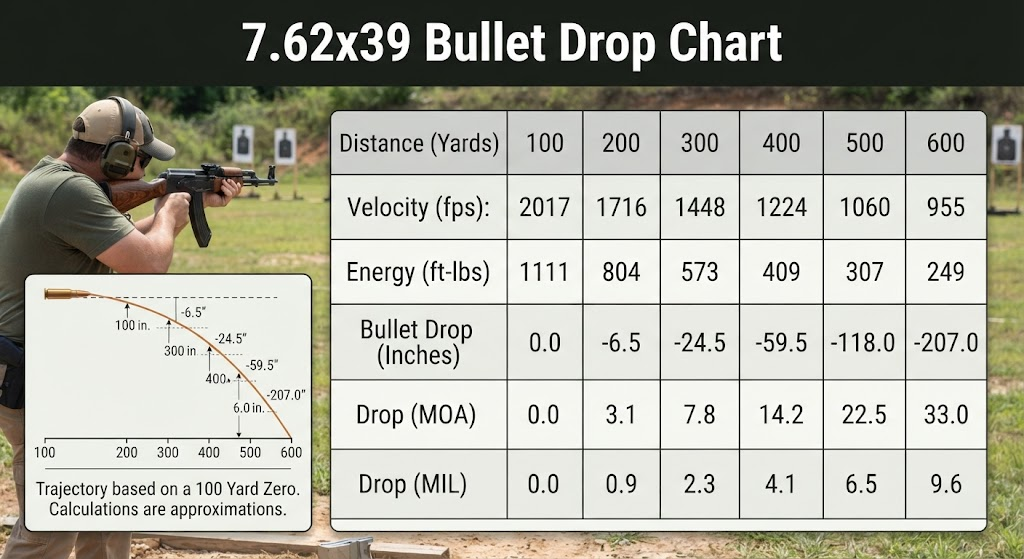
A 7.62×39 bullet drop chart provides the essential trajectory data needed to maximize the accuracy of this legendary intermediate cartridge. Your actual bullet drop will vary depending on your specific ammunition load, bullet weight, muzzle velocity, ballistic coefficient, chosen zero distance, and environmental conditions. By reviewing a reliable ballistic chart, shooters can understand exactly how much their projectile arcs and make necessary optic adjustments. The chart below details the critical flight metrics needed to effectively engage targets and hunt with the 7.62×39.
7.62×39 Bullet Drop Chart
| Distance (Yards) | Velocity (fps) | Energy (ft-lbs) | Bullet Drop (Inches) | Drop (MOA) | Drop (MIL) |
| 100 | 2017 | 1111 | 0.0 | 0.0 | 0.0 |
| 200 | 1716 | 804 | -6.5 | 3.1 | 0.9 |
| 300 | 1448 | 573 | -24.5 | 7.8 | 2.3 |
| 400 | 1224 | 409 | -59.5 | 14.2 | 4.1 |
| 500 | 1060 | 307 | -118.0 | 22.5 | 6.5 |
| 600 | 955 | 249 | -207.0 | 33.0 | 9.6 |
The parameters for the table above are based on standard ballistic data for the highly popular Hornady Black 123-grain SST load. This provides an excellent and widely applicable baseline for standard 7.62×39 hunting and defensive ammunition.
Ballistic Parameters:
- Ammunition Load: Hornady Black 7.62×39
- Bullet Weight & Type: 123-grain Super Shock Tip (Polymer Tip)
- Muzzle Velocity:2350 feet per second (fps)
- Ballistic Coefficient (G1): 0.295
- Zero Distance: 100 Yards
- Sight Height: 1.5 inches above bore
- Test Barrel Length:16.3 inches (Standard AK-47 length)
- Environmental Assumptions: Sea level altitude, 59 degrees Fahrenheit
Note: Velocity and energy figures are sourced from standard manufacturer ballistic calculations for this specific load. Drop figures and extended data out to 600 yards are calculated using a 0.295 ballistic coefficient under standard atmospheric conditions.
Understanding The 7.62×39 Bullet Drop Chart
7.62×39 Bullet Drop At 100 Yards
At 100 yards, the 123-grain projectile reaches its zero distance, meaning it perfectly intersects your line of sight with zero bullet drop. The bullet travels at 2017 fps and retains 1111 foot-pounds of energy. A 100-yard zero provides a clean mathematical baseline for modern optics and red dot sights, making it the most common zeroing distance for the 7.62×39 cartridge.
7.62×39 Bullet Drop At 200 Yards
When the bullet reaches 200 yards, the trajectory limitations of the 7.62×39 begin to show. The projectile drops 6.5 inches below the center line. Shooters need to dial 3.1 MOA or hold 0.9 MIL on their reticle. Retaining roughly 800 foot-pounds of energy, the bullet still delivers plenty of kinetic shock to cleanly harvest deer or hogs at this distance.
7.62×39 Bullet Drop At 300 Yards
At 300 yards, the trajectory steepens significantly with a drop of 24.5 inches. You will need to make an elevation correction of 7.8 MOA or 2.3 MIL. Velocity slows to 1448 fps, and kinetic energy sits at 573 foot-pounds. For most hunters, this represents the absolute maximum ethical range for medium game, as the cartridge sheds energy rapidly beyond this point.
7.62×39 Bullet Drop At 400 Yards
Crossing into 400 yards, the 123-grain bullet falls 59.5 inches below the line of sight. A shooter must compensate by dialing 14.2 MOA or 4.1 MIL. The energy drops to around 400 foot-pounds, which is well below the minimum threshold recommended for ethical hunting. Hitting steel targets at this range requires careful wind reading, as the bullet loses aerodynamic stability.
7.62×39 Bullet Drop At 500 Yards
At 500 yards, the bullet drop plunges to 118.0 inches. You will need a precise elevation adjustment of 22.5 MOA or 6.5 MIL. The velocity drops to 1060 fps, transitioning into the subsonic flight envelope. Engaging targets at 500 yards with a 7.62×39 rifle pushes the cartridge to its extreme limits and requires significant holdovers or major optic adjustments.
Frequently Asked Questions
What factors change my 7.62×39 bullet drop chart?
Your personal trajectory will vary depending on your specific ammunition and rifle configuration. A shorter 10.5-inch barrel will produce a much lower muzzle velocity than a standard 16.3-inch barrel, which directly increases bullet drop at every distance. Environmental factors like high altitude, warm temperatures, and low barometric pressure reduce air density, allowing the bullet to fly flatter than it would at sea level.
How does 7.62×39 bullet drop compare to 5.56 NATO or 300 Blackout?
The 5.56 NATO fires a much lighter bullet at a significantly higher velocity, resulting in a substantially flatter trajectory.At 300 yards, a 5.56 NATO drops roughly half as much as a 7.62×39. When comparing the 7.62×39 to the 300 Blackout, the trajectories are remarkably similar when firing supersonic ammunition, as both utilize similar bullet weights and muzzle velocities.
What is the best zero distance for a 7.62×39 rifle?
A 100-yard zero is the standard recommendation because it simplifies optic adjustments and keeps math straightforward. However, because the 7.62×39 is a relatively heavy and slow cartridge, many tactical shooters prefer a 50-yard zero. With a 50-yard zero, the bullet crosses the line of sight again near 200 yards, allowing a shooter to hit targets from zero to roughly 225 yards without holding over the target.
What is the maximum effective hunting range for the 7.62×39?
The effective hunting range of the 7.62×39 is generally limited to 150 to 200 yards for medium game like deer or hogs. Experts recommend a minimum of 1000 foot-pounds of energy upon impact to ensure a quick and ethical harvest. Looking at standard ballistic data, a 123-grain 7.62×39 bullet falls below this critical threshold just past the 125-yard mark, though the 150-yard distance remains highly effective with quality expanding ammunition.