The 6.5 Weatherby RPM (Rebated Precision Magnum) Ballistics Chart is a comprehensive reference guide that details the velocity, kinetic energy, trajectory curve, and wind drift of this modern high-efficiency cartridge over various distances. By studying this chart, you can visualize exactly how your high-ballistic-coefficient 6.5mm bullet will behave from the moment it leaves your barrel until it strikes a target hundreds of yards downrange. This critical data allows you to accurately predict bullet drop, compensate for wind deflection, and verify that your projectile retains enough energy for an ethical harvest on big game animals across open terrain.
Shooters, hunters, reloaders, and backcountry enthusiasts use a 6.5 Weatherby RPM Ballistics Chart to unlock the full potential of what many consider to be the ultimate lightweight mountain rifle cartridge. Introduced in 2019, the 6.5 RPM represents a massive departure from traditional Weatherby designs. It completely abandons the classic belted magnum case and double-radius shoulder, opting instead for a lengthened, non-belted case with a rebated rim. This brilliant engineering allows the cartridge to deliver magnum-level performance while fitting perfectly onto a standard .30-06 bolt face (.473-inch), making it the ultimate powerhouse for ultra-lightweight standard-action rifles. In this comprehensive guide, you will learn how to interpret ballistics data, choose the absolute best bullet weight for your specific needs, determine the ideal zero distance, and see exactly how this highly efficient cartridge performs compared to other popular 6.5mm calibers.
6.5 Weatherby RPM Ballistics Chart
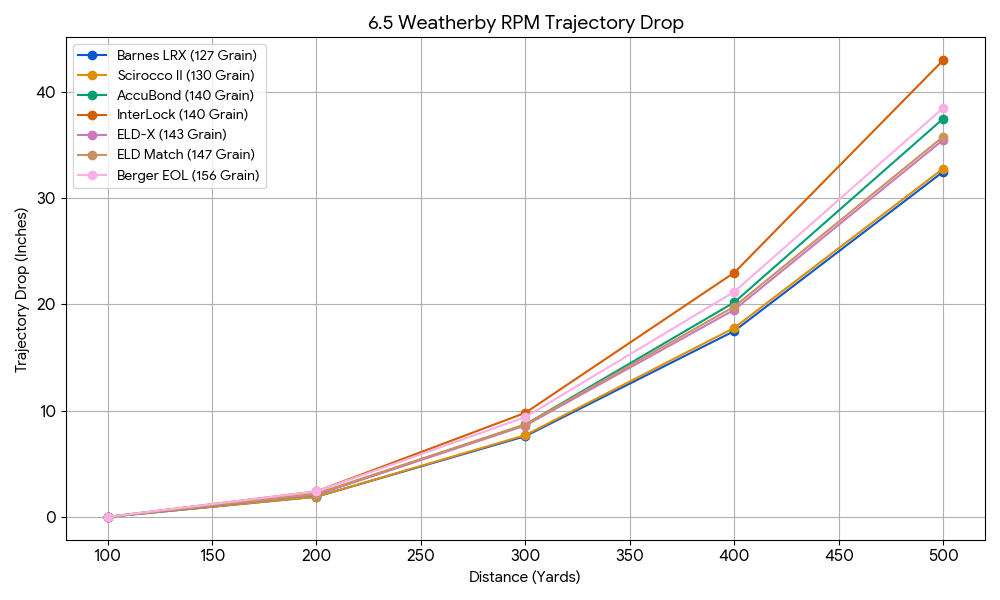
Below is a detailed ballistics table featuring Weatherby’s official factory-loaded ammunition alongside premium custom loads available for the 6.5 Weatherby RPM today. The data represents a standard 24-inch test barrel and assumes a 100-yard zero under standard sea-level atmospheric conditions.
| Bullet Weight | Bullet Type | Manufacturer | Muzzle Velocity | Velocity At 100 Yards | Velocity At 200 Yards | Velocity At 300 Yards | Velocity At 400 Yards | Velocity At 500 Yards | Muzzle Energy | Energy At 100 Yards | Energy At 200 Yards | Energy At 300 Yards | Energy At 400 Yards | Energy At 500 Yards | Trajectory At 100 Yards | Trajectory At 200 Yards | Trajectory At 300 Yards | Trajectory At 400 Yards | Trajectory At 500 Yards | Ballistic Coefficient | Sectional Density |
| 127 Grain | Barnes LRX | Weatherby | 3225 fps | 3011 fps | 2809 fps | 2615 fps | 2429 fps | 2251 fps | 2933 ft lbs | 2557 ft lbs | 2224 ft lbs | 1928 ft lbs | 1664 ft lbs | 1428 ft lbs | 0 inches | 1.9 inches drop | 7.6 inches drop | 17.5 inches drop | 32.5 inches drop | 0.468 | 0.260 |
| 130 Grain | Scirocco II | Custom Load | 3200 fps | 3015 fps | 2835 fps | 2665 fps | 2500 fps | 2340 fps | 2955 ft lbs | 2623 ft lbs | 2320 ft lbs | 2050 ft lbs | 1804 ft lbs | 1580 ft lbs | 0 inches | 1.9 inches drop | 7.7 inches drop | 17.8 inches drop | 32.8 inches drop | 0.571 | 0.266 |
| 140 Grain | AccuBond | Weatherby | 3075 fps | 2885 fps | 2703 fps | 2529 fps | 2361 fps | 2199 fps | 2939 ft lbs | 2587 ft lbs | 2272 ft lbs | 1988 ft lbs | 1733 ft lbs | 1504 ft lbs | 0 inches | 2.1 inches drop | 8.7 inches drop | 20.2 inches drop | 37.5 inches drop | 0.509 | 0.287 |
| 140 Grain | InterLock | Weatherby | 2975 fps | 2772 fps | 2579 fps | 2393 fps | 2215 fps | 2045 fps | 2751 ft lbs | 2389 ft lbs | 2067 ft lbs | 1780 ft lbs | 1525 ft lbs | 1300 ft lbs | 0 inches | 2.4 inches drop | 9.8 inches drop | 23.0 inches drop | 43.0 inches drop | 0.465 | 0.287 |
| 143 Grain | ELD-X | Custom Load | 3050 fps | 2895 fps | 2745 fps | 2600 fps | 2460 fps | 2325 fps | 2954 ft lbs | 2661 ft lbs | 2392 ft lbs | 2146 ft lbs | 1921 ft lbs | 1716 ft lbs | 0 inches | 2.1 inches drop | 8.6 inches drop | 19.5 inches drop | 35.5 inches drop | 0.625 | 0.293 |
| 147 Grain | ELD Match | Custom Load | 3000 fps | 2860 fps | 2725 fps | 2595 fps | 2465 fps | 2340 fps | 2937 ft lbs | 2669 ft lbs | 2423 ft lbs | 2197 ft lbs | 1983 ft lbs | 1787 ft lbs | 0 inches | 2.2 inches drop | 8.7 inches drop | 19.8 inches drop | 35.8 inches drop | 0.697 | 0.301 |
| 156 Grain | Berger EOL | Custom Load | 2925 fps | 2785 fps | 2650 fps | 2520 fps | 2390 fps | 2265 fps | 2963 ft lbs | 2686 ft lbs | 2432 ft lbs | 2198 ft lbs | 1978 ft lbs | 1777 ft lbs | 0 inches | 2.4 inches drop | 9.4 inches drop | 21.2 inches drop | 38.5 inches drop | 0.679 | 0.320 |
Understanding The Chart
A ballistics chart can look overwhelming at first glance due to the sheer volume of data presented. Breaking down each individual column reveals key information about how a specific load performs in the field.
Muzzle Velocity
Muzzle velocity is the speed at which the bullet exits the barrel of the firearm, measured in feet per second (fps). The 6.5 Weatherby RPM achieves exceptionally high muzzle velocities by utilizing a lengthened case with minimal body taper and a sharp 35-degree shoulder. This efficiently maximizes powder capacity, allowing it to launch 140-grain bullets well past 3,000 fps without requiring a magnum-sized receiver.
Retained Velocity
Retained velocity refers to the speed of the bullet at specific distances downrange, such as 100 or 500 yards. Air resistance constantly slows the bullet down as it travels through the atmosphere. Retained velocity is critical for hunters because most expanding hunting bullets require a minimum velocity threshold (typically 1,800 to 2,000 fps) to expand reliably upon impact. Thanks to the incredibly high aerodynamic ratings of modern 6.5mm bullets, the RPM retains lethal velocity far past extended hunting distances.
Kinetic Energy
Kinetic energy is the amount of destructive physical force the bullet carries, measured in foot-pounds (ft-lbs). It is calculated using the weight of the bullet and its velocity at any given distance. Hunters analyze this metric on any 6.5 RPM Energy Chart to verify that the load delivers sufficient power for an ethical harvest on big game. The cartridge generates over 2,900 ft-lbs of energy at the muzzle and comfortably retains over 1,500 ft-lbs at 500 yards, guaranteeing deep penetration.
Trajectory
Trajectory indicates the physical path the bullet takes as it flies through the air, factoring in the constant downward pull of gravity. The trajectory chart displays bullet drop in inches at various yardages relative to a 100-yard zero line of sight. By knowing the exact trajectory curve, shooters can accurately adjust their aim or dial their scope turrets. The blistering velocity of this cartridge provides a remarkably flat trajectory, acting much like a laser beam across deep mountain canyons.
Ballistic Coefficient
The Ballistic Coefficient (BC) is a numerical value that represents how efficiently a bullet cuts through the air. A higher number indicates a more aerodynamic bullet that retains velocity and energy better over long distances. High BC bullets also resist lateral displacement from crosswinds much better than lower-rated projectiles. The 6.5mm (.264-inch) bore diameter is legendary for offering some of the highest BC projectiles relative to bullet weight on the market today.
Sectional Density
Sectional density (SD) is the ratio of a bullet weight compared directly to its diameter. This metric indicates potential penetration depth into a target. Higher sectional density values generally correlate with deeper penetration. Heavy 6.5mm bullets weighing 140 to 156 grains offer incredibly high sectional density values, allowing these relatively slender bullets to punch completely through thick hide and heavy bone on tough game animals.
Common 6.5 Weatherby RPM Bullet Weights
The performance characteristics of the 6.5 RPM shift noticeably based on bullet weight selection, making it a highly versatile mountain hunting cartridge.
127 Grain
The 127-grain Barnes LRX (Long Range X) is the absolute flagship lightweight offering for this cartridge. As a solid copper monolithic bullet, it retains nearly 100% of its weight upon impact. Pushed at over 3,200 fps, this weight delivers a devastating combination of hyper-velocity hydrostatic shock and laser-flat trajectories, making it the perfect choice for sheep, antelope, and mule deer.
140 Grain
The 140-grain category represents the true sweet spot and traditional standard for 6.5mm cartridges. Premium bonded bullets like the Nosler AccuBond strike a perfect balance between high muzzle velocity (over 3,070 fps) and structural integrity. This weight is widely considered the ultimate “do-it-all” option for taking everything from whitetails to bull elk at extended distances.
143 to 147 Grain
The 143 to 147-grain range includes highly advanced, high-BC designs like the Hornady ELD-X and ELD Match. These specialized bullets are explicitly engineered to combat wind drift and retain massive amounts of momentum far downrange. They are ideal for open-country hunters and target shooters who regularly engage targets past 600 yards.
156 Grain
The 156-grain bullet represents the absolute heaviest practical option commonly loaded for this cartridge today. Massive projectiles like the Berger EOL (Extreme Outer Limits) Elite Hunter require a fast-twist barrel but reward the shooter with extreme aerodynamic efficiency. While they launch at a slightly slower muzzle velocity, they penetrate incredibly deep, making them optimal for moose or heavy-bodied bull elk.
Effective Hunting Range
The 6.5 Weatherby RPM’s effective range is among the most impressive of any standard-action hunting cartridge.
Whitetail Deer and Antelope
For deer, sheep, and antelope, the 6.5 RPM is incredibly effective out to 800 yards in the hands of a highly skilled marksman. With proper expanding ammunition, it maintains a completely flat flight path, massive kinetic energy, and velocity levels that guarantee rapid ethical expansion across open plains.
Elk and Moose
Elk and moose require heavy energy delivery and deep penetration. The 6.5 RPM retains over 1,500 ft-lbs of kinetic energy past 500 yards with heavy 140-grain to 156-grain projectiles. This makes it a premier lightweight mountain rifle cartridge for massive game, provided the hunter ensures proper shot placement behind the heavy shoulder bones.
Black Bear
Black bears feature dense muscle tissue and thick fat layers that require reliable projectile expansion and structural integrity. Heavy bonded or solid copper 127 to 140-grain bullets fired from the RPM easily penetrate to vital organs across deep canyons or heavy timber clearings.
Factors That Affect 6.5 Weatherby RPM Ballistics
Ballistics figures are heavily influenced by physical, mechanical, and environmental variables.
Barrel Length
Barrel length directly influences final velocity. Factory data is generated using a 24-inch barrel. Because this cartridge is primarily chambered in ultra-lightweight backcountry rifles, many hunters opt for 20-inch or 22-inch carbon fiber barrels to save weight. Shortening the barrel will cause a noticeable drop in velocity (roughly 25 to 35 fps per inch removed), slightly increasing your overall bullet drop at distance.
Altitude and Air Density
Higher elevations feature thinner, less dense air, reducing atmospheric drag on the bullet. Shooting the 6.5 RPM at 9,000 feet of elevation during a backcountry alpine hunt results in a significantly flatter trajectory, less wind drift, and higher retained energy downrange compared to the sea-level data presented in standard charts.
Twist Rate
To stabilize long, highly aerodynamic 143-grain to 156-grain projectiles, rifles chambered in 6.5 Weatherby RPM require fast barrel twist rates, typically 1-in-8 inches. Weatherby standardizes this twist rate across their Mark V lineup to ensure impeccable stability with the heaviest bullets available.
Best Zero Distance
Selecting the optimal zero distance depends on your scope setup and field application.
100 Yard Zero
A 100-yard zero is the preferred baseline for precision marksmen and long-range hunters who utilize dialable optic turrets or modern ballistic reticles. It establishes a clean mathematical baseline where all turret adjustments for extended distances are dialed upward without any confusing under-holds.
200 Yard Zero
A 200-yard zero is highly recommended for big-game hunters using a Maximum Point-Blank Range (MPBR) strategy. With a fast-moving 127-grain load zeroed at 200 yards, the bullet impacts roughly 1.5 inches high at 100 yards and drops only a few inches at 250 yards. This enables a hunter to hold dead-center on a deer or elk’s vital zone out past 300 yards without ever needing to touch the scope turrets.
6.5 Weatherby RPM Compared To Other Cartridges
Below is a comparison showcasing how the 6.5 RPM evaluates against established 6.5mm hunting cartridges at 500 yards under standard conditions.
| Cartridge | Muzzle Velocity | Muzzle Energy | Trajectory At 500 Yards | Recoil | Action Size | Bolt Face |
| 6.5 Weatherby RPM (140gr) | 3075 fps | 2939 ft lbs | 37.5 inches drop | Moderate | Standard Long | Standard (.473″) |
| 6.5 Creedmoor (140gr) | 2700 fps | 2266 ft lbs | 54.0 inches drop | Light | Short Action | Standard (.473″) |
| 6.5 PRC (143gr) | 2960 fps | 2782 ft lbs | 41.5 inches drop | Moderate | Short/Medium | Magnum (.532″) |
| 6.5-300 Weatherby (140gr) | 3384 fps | 3393 ft lbs | 29.5 inches drop | Heavy | Magnum Long | Magnum (.532″) |
| 270 Winchester (140gr) | 2950 fps | 2705 ft lbs | 44.0 inches drop | Moderate | Standard Long | Standard (.473″) |
The true genius of the 6.5 Weatherby RPM becomes apparent when compared to the 6.5 PRC and 6.5-300 Weatherby. The RPM outperforms the highly popular 6.5 PRC in raw velocity, but achieves this without requiring a magnum bolt face. When compared to the massive 6.5-300 Weatherby, the RPM shoots slightly slower but burns significantly less powder, generating less recoil and extending barrel life, all while fitting perfectly into Weatherby’s slender, ultra-light 6-lug titanium actions.
Frequently Asked Questions
What is a 6.5 Weatherby RPM Ballistics Chart?
It is a data reference table outlining velocity, kinetic energy, trajectory drop, and wind drift metrics for the cartridge across various distances. It helps shooters calculate precise elevation drops and energy retention thresholds for ethical hunting and extreme long-range target shooting.
What does “RPM” stand for?
RPM stands for Rebated Precision Magnum. It refers to the case design which utilizes a rebated rim (the rim is smaller than the body of the case). This allows the cartridge to hold magnum-level powder capacities while remaining compatible with a standard .30-06 size (.473-inch) bolt face.
How far is the 6.5 Weatherby RPM effective on elk?
Loaded with premium 140-grain to 156-grain expanding hunting bullets, it carries over 1,500 foot-pounds of kinetic energy past 500 yards. In the hands of a highly experienced shooter, it is a highly capable and ethical elk cartridge at those extended distances across open terrain.
Is the 6.5 RPM better than the 6.5 Creedmoor?
For hunting large game at extended distances, yes. The 6.5 RPM holds significantly more powder and launches identical bullets nearly 400 feet per second faster than the 6.5 Creedmoor. This translates to vastly more kinetic energy, a much flatter trajectory, and less wind drift, though it does generate noticeably more recoil.
Does the 6.5 RPM require a magnum action?
No. The greatest advantage of the 6.5 Weatherby RPM is that it was explicitly designed to fit in a standard long-action receiver with a standard bolt face. This allows rifle manufacturers to build incredibly slender, ultra-lightweight mountain rifles that still deliver magnum ballistic performance.
Conclusion
Understanding a 6.5 Weatherby RPM Ballistics Chart reveals exactly why this cartridge is rapidly becoming a favorite among hardcore backcountry hunters. By abandoning the traditional belted magnum design in favor of a highly efficient, rebated-rim case, Weatherby created a cartridge that delivers blistering velocities and heavy kinetic energy without the traditional weight and recoil penalties of massive magnums. Understanding its trajectory curvature, retained velocity, and energy transfer characteristics enables hunters to extract maximum accuracy and devastating terminal performance across deep canyons and open mountain terrain.