The main difference between the cartridges is that the 6.5 Precision Rifle Cartridge utilizes exceptionally aerodynamic projectiles in a short-action receiver to deliver incredibly flat trajectories with mild recoil, whereas the .300 Winchester Magnum relies on a massive long-action belted case to drive significantly heavier projectiles at high velocities for unparalleled kinetic energy and deep penetration on the largest game animals in the world.
The 6.5 PRC was officially released by Hornady in 2018 to serve as the big brother to the wildly popular 6.5 Creedmoor, offering precision rifle competitors and modern hunters a highly efficient cartridge that maximizes downrange performance while extending barrel life and reducing shooter fatigue.
The .300 Winchester Magnum was introduced in 1963 by the Winchester Repeating Arms Company and has spent over half a century proving itself as the ultimate global benchmark for versatile big game hunting and military sniper applications. While the 6.5 PRC represents the cutting edge of modern cartridge geometry and aerodynamic efficiency, the .300 Winchester Magnum relies on sheer powder capacity and brute force to accomplish its mission. Choosing between these two legendary calibers requires a deep understanding of external ballistics, recoil management, and the specific size of the game you intend to pursue.
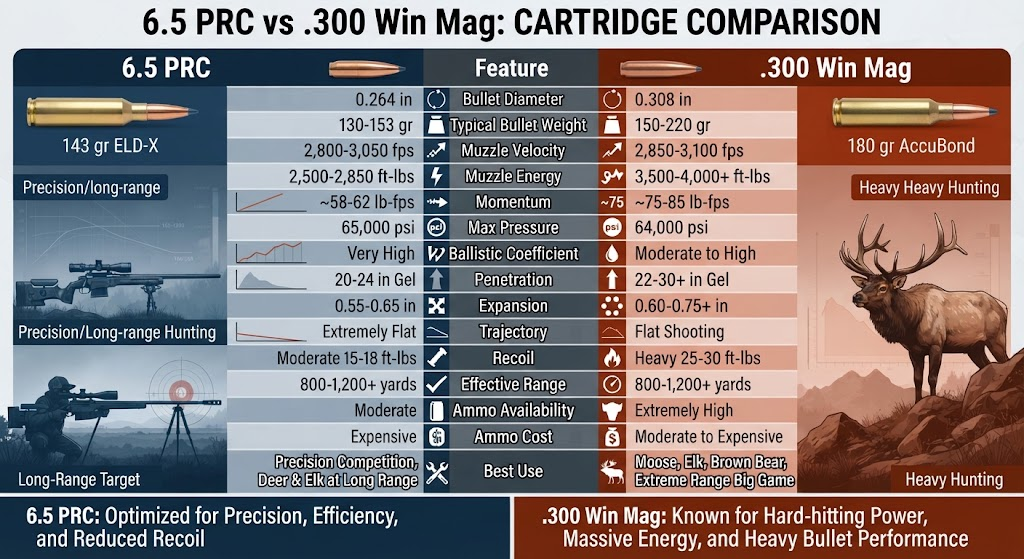
6.5 PRC vs 300 Win Mag Comparison
| Feature | 6.5 PRC | .300 Win Mag |
| Bullet Diameter | 0.264 inches (6.7 mm) | 0.308 inches (7.82 mm) |
| Typical Bullet Weight | 130 gr to 153 gr (typically 143 gr or 147 gr) | 150 gr to 220 gr (typically 180 gr or 200 gr) |
| Muzzle Velocity | 2,800 to 3,050 fps (24-inch barrel) | 2,850 to 3,100 fps (24-inch barrel) |
| Muzzle Energy | 2,500 to 2,850 ft-lbs | 3,500 to 4,000+ ft-lbs |
| Momentum | ~58 to ~62 lb-fps | ~75 to ~85 lb-fps |
| Maximum Pressure | 65,000 psi (SAAMI) | 64,000 psi (SAAMI) |
| Ballistic Coefficient | Very High (0.500 to 0.690) | Moderate to High (0.450 to 0.626) |
| Penetration | 20 to 24 inches (Gelatin) | 22 to 30+ inches (Gelatin) |
| Expansion | 0.55 to 0.65 inches | 0.60 to 0.75+ inches |
| Trajectory | Extremely flat, resists wind drift exceptionally well | Flat shooting, requires slightly more wind hold |
| Recoil | Moderate (15 to 18 ft-lbs) | Heavy (25 to 30 ft-lbs) |
| Effective Range | 800 to 1,200+ yards | 800 to 1,200+ yards |
| Ammo Availability | Moderate (Premium hunting and match) | Extremely High (Global standard) |
| Ammo Cost | Expensive ($2.00 to $3.50 per round) | Moderate to Expensive ($1.50 to $3.50 per round) |
| Best Use | Precision rifle competition, deer and elk at long range | Moose, elk, brown bear, extreme range big game |
The table above outlines the foundational differences between a twenty-first-century precision cartridge and a mid-twentieth-century magnum powerhouse. To truly understand how they perform in the field, we must examine their physical case dimensions and the firearms required to shoot them.
The 6.5 PRC is classified as a short-magnum cartridge. It features a non-belted case with a sharp thirty-degree shoulder angle that headspaces off the shoulder. This modern geometry promotes highly efficient powder burns and exceptional inherent accuracy. Because the overall cartridge length is restricted to 2.955 inches, it fits perfectly into short-action rifle receivers. This allows hunters to build lighter, more compact rifles that are easier to carry through steep mountain terrain.
The .300 Winchester Magnum (.300 Win Mag) is a classic long-action cartridge derived from the .375 H&H Magnum case. It features a distinct brass belt just above the extractor groove, which was originally designed to control headspace. With an overall cartridge length measuring 3.340 inches, it requires a full-size long-action receiver. This receiver adds physical weight to the rifle and requires a longer bolt throw from the shooter. The massive brass case holds a tremendous volume of slow-burning powder, which is necessary to accelerate heavy .30 caliber bullets to magnum velocities.
6.5 PRC vs 300 Win Mag Ballistics
To objectively evaluate the ballistic capabilities of the 6.5 PRC against the .300 Win Mag, we must examine real-world factory ammunition across their most common applications in hunting and target shooting. Ammunition selection dictates performance, and comparing high-quality modern loads from a standardized 24-inch test barrel is the only way to ensure a fair representation.
The .300 Win Mag has benefited greatly from the modern trend of loading long, heavy, high ballistic coefficient bullets, but it still relies heavily on traditional hunting weights like 180 grains. The 6.5 PRC was designed from its inception to fire long, heavy-for-caliber 143-grain and 147-grain projectiles.
- Load A (6.5 PRC Hunting): Hornady 143-grain ELD-X Precision Hunter. Tested from a 24-inch barrel. Muzzle velocity is 2,960 feet per second. Muzzle energy is 2,782 foot-pounds. Ballistic Coefficient is 0.625.
- Load B (6.5 PRC Target): Hornady 147-grain ELD Match. Tested from a 24-inch barrel. Muzzle velocity is 2,910 feet per second. Muzzle energy is 2,764 foot-pounds. Ballistic Coefficient is 0.697.
- Load C (.300 Win Mag Hunting): Federal Premium 180-grain Nosler Partition. Tested from a 24-inch barrel. Muzzle velocity is 2,960 feet per second. Muzzle energy is 3,501 foot-pounds. Ballistic Coefficient is 0.474.
- Load D (.300 Win Mag Long Range Hunting): Hornady 200-grain ELD-X Precision Hunter. Tested from a 24-inch barrel. Muzzle velocity is 2,850 feet per second. Muzzle energy is 3,607 foot-pounds. Ballistic Coefficient is 0.626.
Manufacturer-rated data is generally captured under controlled atmospheric conditions using standardized universal receiver barrels. Real-world velocities measured over a personal chronograph will vary slightly depending on your specific firearm chamber tolerances, altitude, and barrel temperature.
6.5 PRC vs 300 Win Mag Velocity
Velocity dictates how flat a projectile shoots across long distances and influences how quickly expanding bullets open upon impacting soft tissue. High velocity also dictates the amount of wind deflection a bullet will suffer over a long distance, especially when combined with a highly aerodynamic projectile.
When evaluating velocity, both cartridges operate in the high-speed magnum tier, but they arrive there through different methods. The 6.5 PRC utilizes an incredibly efficient powder column to push a relatively lightweight 143-grain bullet at nearly 3,000 feet per second. This initial speed is excellent, but the true velocity advantage of the 6.5 PRC is found downrange. Because 6.5 millimeter bullets are exceptionally long and sleek, they slice through the atmosphere with minimal drag. A 143-grain 6.5 PRC bullet retains its velocity much more efficiently than a standard traditional hunting bullet.
The .300 Win Mag relies on massive powder charges to achieve its speed. A standard 150-grain bullet fired from a .300 Win Mag can exceed 3,200 feet per second, but most hunters prefer heavier bullets for large game. When loaded with a classic 180-grain hunting bullet, the .300 Win Mag achieves roughly 2,960 feet per second. When loaded with a heavy 200-grain modern polymer-tipped bullet, the velocity drops to around 2,850 feet per second. While the .300 Win Mag starts incredibly fast, older bullet designs with blunt noses (like soft points and partitions) shed velocity much faster than the needle-like profile of the 6.5 PRC projectiles. However, when the .300 Win Mag is loaded with modern high-BC bullets like the 200-grain ELD-X, it matches the aerodynamic efficiency of the 6.5 PRC while carrying significantly more mass.
6.5 PRC vs 300 Win Mag Muzzle Energy
Muzzle energy represents the kinetic work capacity of a projectile. Because velocity plays a disproportionately large role in generating kinetic energy, both cartridges produce impressive numbers. However, the sheer mass of the .30 caliber projectiles gives the .300 Win Mag a massive mathematical advantage.
A standard 143-grain 6.5 PRC hunting load produces roughly 2,780 foot-pounds of energy at the muzzle. This is an exceptional amount of energy that easily exceeds standard cartridges like the 6.5 Creedmoor and the .308 Winchester. It is fully capable of humanely harvesting mule deer, pronghorn antelope, and elk at extended distances.
The .300 Win Mag is an absolute powerhouse. A standard 180-grain or 200-grain hunting load produces between 3,500 and 3,600 foot-pounds of energy at the muzzle. Some heavy custom handloads can even push past 4,000 foot-pounds of energy. The .300 Win Mag generates roughly 800 to 1,000 more foot-pounds of kinetic energy than the 6.5 PRC at the muzzle. This massive disparity in raw power is the primary reason professional guides in bear country and hunters pursuing gigantic Alaskan moose heavily favor the .300 Win Mag. When you need to deliver devastating blunt force trauma to a massive animal, there is no substitute for heavy bullet weight.
6.5 PRC vs 300 Win Mag Momentum
Momentum is a linear measurement calculating mass in motion. In terminal ballistics, high momentum correlates closely with the ability of a bullet to crush through dense bone, heavy winter hides, and thick shoulder muscles without being deflected or stopping prematurely inside the target.
Because momentum relies equally on bullet weight and velocity, the heavier .300 Win Mag completely outclasses the lighter 6.5 PRC in this category.
A 143-grain 6.5 PRC bullet traveling at 2,960 feet per second yields approximately 60 pound-feet per second of linear momentum.
A heavy 200-grain .300 Win Mag bullet traveling at 2,850 feet per second yields approximately 81 pound-feet per second of linear momentum.
This dramatic difference in momentum translates directly to terminal performance in the field. If a hunter takes a quartering-away shot on a large bull elk, the bullet must travel through several feet of dense stomach content and muscle before reaching the vital cardiovascular organs. The massive 200-grain .300 Win Mag bullet possesses the driving force necessary to reliably track straight through that resistance. The lighter 143-grain 6.5 PRC bullet, while highly lethal on broadside shots, runs a higher risk of failing to reach the far-side vitals on poor shot angles due to its lower momentum profile.
6.5 PRC vs 300 Win Mag Trajectory
Understanding external ballistics and bullet drop is critical for any shooter attempting to hit targets beyond 300 yards. The trajectory of a bullet is dictated by its initial velocity, gravity, and the aerodynamic efficiency of the projectile as it cuts through the atmosphere. Aerodynamic efficiency is measured as a Ballistic Coefficient.
The calculations below assume a standard high-profile optic height of 1.5 inches above the bore and a clearly stated zero distance of 200 yards, which is the standard zero for modern centerfire hunting rifles. We will compare the Hornady 143-grain ELD-X in 6.5 PRC against the Hornady 200-grain ELD-X in .300 Win Mag to demonstrate their flight paths.
| Distance | 6.5 PRC (143 gr ELD-X at 2,960 fps) Drop | .300 Win Mag (200 gr ELD-X at 2,850 fps) Drop |
| Muzzle | -1.5 inches | -1.5 inches |
| 100 Yards | +1.5 inches | +1.7 inches |
| 200 Yards | 0.0 inches (Zero) | 0.0 inches (Zero) |
| 300 Yards | -6.3 inches | -7.0 inches |
| 400 Yards | -17.8 inches | -19.6 inches |
| 500 Yards | -35.2 inches | -38.6 inches |
The data confirms that both cartridges are spectacular long-range tools. The 6.5 PRC shoots slightly flatter out to 500 yards because it begins its flight at a higher initial velocity. The difference in drop at 500 yards is a mere 3.4 inches, which is virtually indistinguishable on the vital zone of an elk.
However, gravity is only half the equation in long-range shooting. Wind deflection is the primary cause of missed targets at extreme distances. Assuming a direct 10 mile per hour crosswind, the 143-grain 6.5 PRC bullet will drift approximately 14.5 inches at 500 yards. The heavy 200-grain .300 Win Mag bullet, boasting an identical ballistic coefficient but traveling slightly slower, will drift approximately 15.5 inches at the exact same distance. Both cartridges provide phenomenal resistance to atmospheric interference, making them top-tier choices for precision riflemen.
6.5 PRC vs 300 Win Mag Recoil
Recoil management is a major factor in rapid and accurate shooting. The physical recoil generated by a firearm is heavily influenced by the weight of the rifle, the mass of the powder charge, and the weight of the bullet. A shooter who flinches in anticipation of heavy recoil will never achieve their maximum accuracy potential.
The 6.5 PRC was intentionally engineered to provide magnum performance without magnum punishment. Fired from a standard 8-pound short-action hunting rifle, a typical 143-grain hunting load generates roughly 16 to 18 foot-pounds of free recoil energy. This is a very comfortable level of recoil that most adult shooters can tolerate for long range sessions. It is slightly heavier than a 6.5 Creedmoor, but it remains mild enough that the shooter can easily spot their own bullet impacts through a magnified riflescope.
The .300 Win Mag is globally recognized as a heavy recoiling cartridge. Fired from a standard 8.5-pound long-action hunting rifle, a full-power 180-grain or 200-grain load generates approximately 26 to 30 foot-pounds of free recoil energy. This represents nearly double the recoil energy of the 6.5 PRC. Without a highly efficient muzzle brake or a heavy rifle suppressor, the .300 Win Mag delivers a violent, sharp shove to the shoulder that will quickly induce shooter fatigue during an extended practice session. Many hunters find the recoil of the .300 Win Mag to be their absolute upper limit of tolerance.
6.5 PRC vs 300 Win Mag Penetration
Terminal penetration is rigorously evaluated to ensure the ethical harvesting of game animals. A bullet must penetrate deep enough into soft tissue to reach critical cardiovascular structures regardless of the physical angle the target presents.
The 6.5 PRC utilizes long, slender bullets with excellent sectional density. Sectional density is the ratio of a bullet mass to its diameter. High sectional density allows a lightweight bullet to penetrate much deeper than expected. When utilizing premium bonded hunting bullets or solid copper monolithic projectiles, the 6.5 PRC will reliably penetrate 20 to 24 inches in ballistic gelatin. This is perfect for broadside shots on elk and quartering shots on large mule deer.
The .300 Win Mag is a penetration monster. Because it utilizes massive 180-grain to 220-grain bullets, it retains its forward momentum through the toughest barriers nature can provide. A premium 200-grain bullet fired from a .300 Win Mag will easily shatter the heavy shoulder bones of a moose or a grizzly bear and continue pushing deep into the vital cavity. Penetration depths of 24 to 30 inches or more are common with heavy hunting loads, guaranteeing an exit wound on almost any North American game animal.
6.5 PRC vs 300 Win Mag Expansion
Bullet expansion dictates the diameter of the permanent wound channel inside the target. Wide expansion increases the likelihood of severing major arteries and causing rapid incapacitation through catastrophic blood loss.
Striking a target at over 2,800 feet per second generates immense hydraulic pressure on the nose of a hollow point or polymer-tipped bullet. This intense pressure forces the lead and copper jacket to peel back violently into a classic mushroom shape.
A standard 143-grain expanding bullet fired from a 6.5 PRC will typically open to roughly 0.55 to 0.65 inches in diameter, which is more than double the original caliber size.
A massive 200-grain bullet fired from a .300 Win Mag starts at a wider 0.308-inch diameter and contains far more lead and copper to peel back. Upon impact at high velocities, these heavy bullets frequently expand to 0.65 to 0.75 inches in diameter or larger. The combination of a wider expanded diameter and higher kinetic energy means the .300 Win Mag creates a significantly larger permanent crush cavity inside the animal, leading to faster ethical kills on heavy game.
6.5 PRC vs 300 Win Mag Effective Range
The effective range of a cartridge is determined by the intersection of velocity retention, bullet drop predictability, and the mechanical accuracy of the rifle platform. Both cartridges are highly accurate long-range tools capable of ringing steel targets well beyond 1,000 yards.
For ethical hunting applications, the effective range is limited by the minimum velocity required for bullet expansion (typically 1,800 feet per second) and the minimum kinetic energy required to humanely kill the animal (typically 1,000 foot-pounds for deer and 1,500 foot-pounds for elk).
The 6.5 PRC maintains at least 1,000 foot-pounds of energy and stays above 1,800 feet per second out to approximately 800 yards under standard atmospheric conditions. This makes it an incredibly effective long-range deer cartridge. However, it drops below the recommended 1,500 foot-pound threshold for elk around 600 yards.
The .300 Win Mag maintains staggering energy levels at extreme distances. A 200-grain .300 Win Mag bullet retains over 1,500 foot-pounds of energy all the way out to 800 yards, and maintains over 1,000 foot-pounds of energy well past 1,000 yards. For a hunter possessing the elite marksmanship skills required to shoot big game at a half mile, the .300 Win Mag delivers the necessary payload.
6.5 PRC vs 300 Win Mag Self Defense
When discussing self defense with high-powered centerfire rifle cartridges, the conversation revolves around tactical applications and the inherent risks of severe over-penetration in residential environments.
Neither the 6.5 PRC nor the .300 Win Mag is suitable for urban home defense. Firing a magnum rifle inside a residential hallway without hearing protection will cause immediate and permanent hearing damage due to the concussive muzzle blast. Furthermore, both cartridges will effortlessly pass through an intruder, multiple interior drywall partitions, exterior brick walls, and continue flying into neighboring properties. The danger posed to innocent bystanders is extreme and unacceptable.
If utilized for rural property defense or military sniper applications, both cartridges are highly lethal. The .300 Win Mag has a long history of service with military sniper teams across the globe, prized for its ability to defeat light barriers and disable enemy combatants at extreme ranges. The 6.5 PRC is gaining traction in tactical precision rifle competitions due to its flat trajectory, but it lacks the heavy armor-defeating mass of the .300 Win Mag.
6.5 PRC vs 300 Win Mag Concealed Carry
Concealed carry with either the 6.5 PRC or the .300 Win Mag is impossible and entirely impractical. Both of these cartridges are massive centerfire rifle cartridges. The 6.5 PRC measures 2.955 inches in overall length, and the .300 Win Mag measures 3.340 inches in overall length. They require large rifle actions and substantial barrel lengths to safely contain their operating pressures. There are no practical handguns manufactured that can chamber these rounds for concealed carry. Their appropriate transport method involves a dedicated rifle hard case, a vehicle rack, or a sturdy tactical sling worn over the shoulder in the backcountry.
Which Has More Stopping Power: 6.5 PRC or 300 Win Mag?
Stopping power is a non-scientific term generally used to describe the ability of a cartridge to quickly incapacitate a biological target without requiring long tracking jobs into the brush.
The .300 Win Mag possesses significantly more stopping power on large game animals. While the 6.5 PRC is a highly efficient killer through precise shot placement, it cannot match the sheer blunt force trauma delivered by a .30 caliber magnum. Striking an animal with nearly 4,000 foot-pounds of kinetic energy and a heavy 200-grain bullet creates a massive wound channel that induces rapid hydrostatic shock and central nervous system failure. For animals larger than mule deer, the .300 Win Mag anchors targets with unparalleled authority.
Which Is More Powerful: 6.5 PRC or 300 Win Mag?
Power is defined quantitatively by kinetic energy and linear momentum. Based on the laws of physics and the raw data, the .300 Win Mag is vastly more powerful than the 6.5 PRC.
The .300 Win Mag generates between 3,500 and 4,000 foot-pounds of muzzle energy depending on the specific load. The 6.5 PRC generates roughly 2,500 to 2,800 foot-pounds of muzzle energy. The .300 Win Mag delivers nearly 1,000 more foot-pounds of kinetic energy to the target and boasts a massive advantage in linear momentum. The sheer volume of powder housed inside the belted magnum case guarantees a higher power output in every measurable category.
6.5 PRC Pros and Cons
Pros
- Exceptionally efficient short-action magnum cartridge allows for lighter, more maneuverable mountain rifles
- Extremely aerodynamic 6.5 millimeter bullets provide incredibly flat trajectories and resist wind drift beautifully
- Moderate recoil profile allows shooters to practice extensively without developing flinches or suffering fatigue
- Superb inherent accuracy makes it a top-tier choice for competitive precision rifle shooting
Cons
- Lacks the heavy bullet mass (180+ grains) preferred by many hunters for taking moose and large bears
- Ammunition is expensive and generally restricted to premium match or hunting loads
- Availability of ammunition in small, rural hardware stores is limited compared to traditional legacy calibers
- Barrel life is shorter than standard cartridges due to high velocities burning the throat of the chamber
300 Win Mag Pros and Cons
Pros
- Unbelievable kinetic energy and momentum generation for taking the absolute largest big game in the world
- Global ubiquitous availability ensures hunters can find ammunition in almost any gun shop on the planet
- Vast selection of bullet weights ranging from 150 grains for deer to 220 grains for dangerous game
- Proven century-long track record of reliability in the harshest hunting and military environments
Cons
- Generates severe, punishing recoil that requires a heavy rifle or an aggressive muzzle brake to manage comfortably
- Requires a long-action receiver, making rifles physically heavier and requiring a longer bolt throw to cycle
- Ammunition can be very expensive when purchasing premium hunting loads
- Muzzle blast and concussive shockwave can be highly disruptive to the shooter and nearby bystanders
Final Comparison
| Category | Winner | Reason |
| Velocity | Tie | Both achieve 2,850 to 3,000+ fps depending on specific bullet weight |
| Muzzle Energy | .300 Win Mag | Generates roughly 1,000 more ft-lbs of kinetic energy than the 6.5 PRC |
| Momentum | .300 Win Mag | Massive .30 caliber bullets carry immense linear driving mass |
| Penetration | .300 Win Mag | Heavy 200-grain bullets effortlessly shatter heavy bone structures |
| Expansion | .300 Win Mag | Starts wider and contains more mass to peel back into a larger mushroom |
| Trajectory | 6.5 PRC | Lighter aerodynamic bullets shoot marginally flatter out to 500 yards |
| Recoil Control | 6.5 PRC | Produces nearly half the free recoil energy of the .300 Win Mag |
| Effective Range | .300 Win Mag | Retains ethical hunting kinetic energy thresholds at much greater distances |
| Self Defense | Neither | Both present extreme over-penetration hazards in any residential setting |
| Concealed Carry | Neither | Both are massive long-range rifle cartridges entirely unsuitable for concealment |
| Ammo Cost | .300 Win Mag | Massive global production offers cheaper bulk practice options |
| Ammo Availability | .300 Win Mag | Found in immense quantities in every sporting goods store worldwide |
| Overall Performance | Depends on Target | 6.5 PRC for precision targets and deer; .300 Win Mag for elk and heavy game |
6.5 PRC vs 300 Win Mag: Which Should You Choose?
Selecting between the 6.5 PRC and the .300 Win Mag requires a practical assessment of your physical recoil tolerance, the type of rifle you wish to carry, and the specific size of the animals you intend to hunt.
Choose the 6.5 PRC if you are building a lightweight short-action mountain rifle primarily dedicated to hunting mule deer, antelope, and sheep at long distances. It provides a mathematically superior aerodynamic flight path with minimal wind deflection, allowing you to execute precision shots without enduring the punishing recoil of a true heavy magnum. It is also the vastly superior choice if you intend to shoot long-range steel targets competitively, as the low recoil allows you to spot your own trace and impacts through your optic.
Choose the .300 Win Mag if you want the ultimate, do-everything North American big game rifle and you are not sensitive to heavy recoil. Whether you are hunting whitetail deer across a bean field or pursuing gigantic bull elk and moose in dark timber, the .300 Win Mag provides the raw kinetic energy and bone-crushing momentum required to anchor the largest animals instantly. The peace of mind that comes with knowing you can find .300 Win Mag ammunition in almost any hardware store in the world makes it the premier choice for traveling hunters.
FAQs
Is 6.5 PRC more powerful than 300 Win Mag?
No, the .300 Win Mag is vastly more powerful. It generates approximately 1,000 more foot-pounds of muzzle energy and significantly higher linear momentum than the 6.5 PRC.
Which has more muzzle energy?
The .300 Win Mag easily generates between 3,500 and 4,000 foot-pounds of muzzle energy. The 6.5 PRC generates roughly 2,500 to 2,850 foot-pounds of muzzle energy.
Which has more stopping power?
The .300 Win Mag provides superior stopping power on large game animals like elk, moose, and bear due to its heavy bullet weight and massive kinetic energy transfer. The 6.5 PRC is highly lethal but relies on precise shot placement rather than brute force.
Which has more recoil?
The .300 Win Mag produces significantly more recoil. Fired from a standard hunting rifle, the .300 Win Mag generates nearly double the free recoil energy of the 6.5 PRC, making it much harder for novice shooters to master.
Which has better penetration?
The .300 Win Mag penetrates deeper on heavy game. Its extreme bullet mass allows the projectiles to punch through dense muscle and thick shoulder bones without deflecting or losing critical momentum.
Which expands more?
Because it starts at a wider 0.308-inch diameter and contains more lead and copper mass, a premium .300 Win Mag expanding bullet will generally create a wider final expanded profile than a 6.5 millimeter bullet.
Which has a flatter trajectory?
The 6.5 PRC shoots marginally flatter out to 500 yards when firing standard hunting ammunition due to its exceptionally aerodynamic bullet designs, but the difference is minimal in practical hunting scenarios.
Which is better for self defense?
Neither cartridge is suitable for civilian self defense due to the extreme danger of over-penetration through residential walls and the blinding, deafening muzzle blast indoors.
Which is better for concealed carry?
Neither. Both are large centerfire rifle cartridges fired from long, heavy rifles that cannot be concealed on the human body.
Is 6.5 PRC faster than 300 Win Mag?
Their muzzle velocities are very similar. Both cartridges launch their respective projectiles at roughly 2,850 to 3,000 feet per second depending on the specific load and bullet weight chosen.
Is 300 Win Mag stronger than 6.5 PRC?
Yes, in terms of sheer kinetic energy, bullet mass, and momentum, the .300 Win Mag is drastically stronger than the 6.5 PRC.
Which is cheaper to shoot?
The .300 Win Mag is generally cheaper to shoot. Because it has been a global standard for decades, ammunition manufacturers produce lower-cost practice ammunition. The 6.5 PRC is mostly relegated to expensive premium hunting and match ammunition.
Can a 300 Win Mag shoot 6.5 PRC?
No. They are completely different calibers with vastly different case geometries. The .300 Win Mag is a long-action belted cartridge, and the 6.5 PRC is a short-action beltless cartridge.
Which is easier to shoot?
The 6.5 PRC is drastically easier to shoot due to its mild recoil impulse, making it highly preferred for high-volume precision rifle competitions and training new shooters.
Which should you choose?
Choose the 6.5 PRC for a lightweight short-action rifle, low recoil, and precision long-range target shooting. Choose the .300 Win Mag for maximum kinetic energy, heavy bullet weights, and hunting the absolute largest big game in the world.