A 50 Caliber Muzzleloader Ballistics Chart is a specialized numerical data table that meticulously tracks the velocity energy and bullet drop of half inch black powder projectiles across various hunting distances. This comprehensive visual reference helps traditional hunters and primitive weapons enthusiasts understand exactly how different bullets and powder charges perform under realistic field conditions. By studying these specific flight metrics marksmen can calculate precise optical holdovers while ensuring massive terminal knockdown power on large game animals. Utilizing this extensive ballistic data guarantees supreme accuracy and absolute ethical harvesting when participating in restricted primitive hunting seasons.
50 Caliber Muzzleloader Ballistics Chart
| Manufacturer | Bullet Weight | Bullet Type | Ballistic Coefficient | Sectional Density | Muzzle Velocity | Velocity At 100 Yards | Velocity At 200 Yards | Velocity At 300 Yards | Velocity At 400 Yards | Velocity At 500 Yards | Muzzle Energy | Energy At 100 Yards | Energy At 200 Yards | Energy At 300 Yards | Energy At 400 Yards | Energy At 500 Yards | Trajectory At 100 Yards | Trajectory At 200 Yards | Trajectory At 300 Yards | Trajectory At 400 Yards | Trajectory At 500 Yards |
| Hornady | 250 gr | SST ML | 0.210 | 0.175 | 2250 fps | 1852 fps | 1529 fps | Not Available | Not Available | Not Available | 2735 ft lbs | 1904 ft lbs | 1297 ft lbs | Not Available | Not Available | Not Available | 3.0 in High | 2.7 in Low | Not Available | Not Available | Not Available |
| Hornady | 300 gr | SST ML | 0.250 | 0.210 | 2130 fps | 1826 fps | 1554 fps | Not Available | Not Available | Not Available | 3022 ft lbs | 2221 ft lbs | 1609 ft lbs | Not Available | Not Available | Not Available | 3.0 in High | 2.9 in Low | Not Available | Not Available | Not Available |
| Traditions | 170 gr | Bleed | 0.200 | 0.120 | 2150 fps | 1773 fps | 1449 fps | Not Available | Not Available | Not Available | 1745 ft lbs | 1187 ft lbs | 792 ft lbs | Not Available | Not Available | Not Available | 0.0 in | 9.7 in Low | Not Available | Not Available | Not Available |
| Traditions | 170 gr | Bleed | 0.200 | 0.120 | 1665 fps | 1358 fps | 1131 fps | Not Available | Not Available | Not Available | 1046 ft lbs | 696 ft lbs | 483 ft lbs | Not Available | Not Available | Not Available | 0.0 in | 24.5 in Low | Not Available | Not Available | Not Available |
| Traditions | 200 gr | XR Polymer | 0.196 | 0.140 | 2256 fps | 1860 fps | 1515 fps | Not Available | Not Available | Not Available | 2260 ft lbs | 1536 ft lbs | 1020 ft lbs | Not Available | Not Available | Not Available | 0.0 in | 8.7 in Low | Not Available | Not Available | Not Available |
| Traditions | 200 gr | XR Polymer | 0.196 | 0.140 | 2356 fps | 1949 fps | 1592 fps | Not Available | Not Available | Not Available | 2465 ft lbs | 1687 ft lbs | 1125 ft lbs | Not Available | Not Available | Not Available | 0.0 in | 7.8 in Low | Not Available | Not Available | Not Available |
| Traditions | 230 gr | XR Polymer | 0.227 | 0.161 | 2199 fps | 1860 fps | 1559 fps | Not Available | Not Available | Not Available | 2469 ft lbs | 1767 ft lbs | 1241 ft lbs | Not Available | Not Available | Not Available | 0.0 in | 8.0 in Low | Not Available | Not Available | Not Available |
| Traditions | 250 gr | XR Polymer | 0.262 | 0.175 | 2120 fps | 1831 fps | 1571 fps | Not Available | Not Available | Not Available | 2495 ft lbs | 1860 ft lbs | 1370 ft lbs | Not Available | Not Available | Not Available | 0.0 in | 9.0 in Low | Not Available | Not Available | Not Available |
| Traditions | 250 gr | Carnivore | 0.262 | 0.175 | 2120 fps | 1831 fps | 1571 fps | Not Available | Not Available | Not Available | 2495 ft lbs | 1860 ft lbs | 1370 ft lbs | Not Available | Not Available | Not Available | 0.0 in | 9.0 in Low | Not Available | Not Available | Not Available |
| Traditions | 250 gr | Carnivore | 0.262 | 0.175 | 1550 fps | 1329 fps | 1146 fps | Not Available | Not Available | Not Available | 1334 ft lbs | 980 ft lbs | 729 ft lbs | Not Available | Not Available | Not Available | 0.0 in | 23.5 in Low | Not Available | Not Available | Not Available |
Reviewing this comprehensive table illustrates exactly how different powder charges and bullet designs manage atmospheric drag across extended hunting distances.
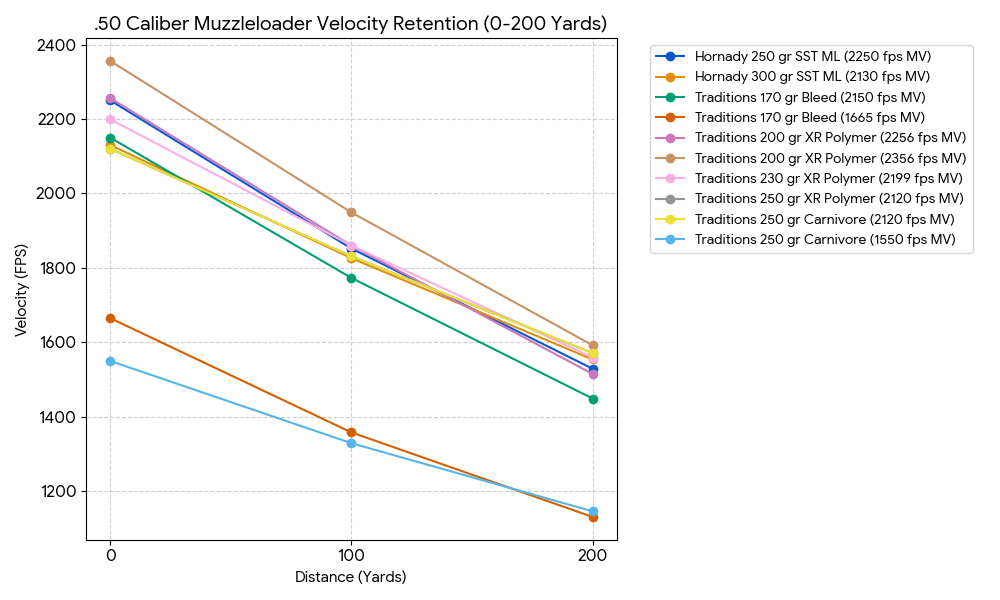
Understanding The 50 Caliber Muzzleloader Ballistics Chart
Analyzing the provided data reveals that pushing an enormous projectile from a primitive weapon creates absolutely devastating impacts inside two hundred yards.
Every specific observation perfectly demonstrates why this massive platform remains the absolute global standard for crushing heavy barriers and dropping thick skinned hogs instantly.
Velocity Analysis
Evaluating the velocity metrics within the table shows that modern magnum loads heavily outpace traditional loose powder combinations.
The Hornady two hundred and fifty grain bullet is the undisputed speed leader with an incredible muzzle velocity of 2250 feet per second.
This exceptional starting speed gives the lightweight monolithic projectile a massive advantage across the first one hundred yards of flight.
However examining the heavier bullets reveals that pure mass plays a crucial role in velocity retention over extended brush hunting distances.
The Hornady three hundred grain bullet starts at a much slower 2130 feet per second but remarkably retains 1554 feet per second at the two hundred yard mark.
In contrast the lightweight Traditions Bleed one hundred and seventy grain bullet sheds its initial velocity very rapidly arriving at two hundred yards with only 1449 feet per second remaining.
This specific velocity data proves that for extended heavy brush hunting heavy cast bullets preserve their forward momentum far better than ultra light expanding options.
Energy Analysis
Muzzle energy dictates the sheer physical shock delivered to a heavy target upon initial bullet impact in the field.
The table data highlights that the Hornady three hundred grain load produces the absolute highest initial strike force with 3022 foot pounds of muzzle energy.
Modern lightweight options like the Hornady two hundred and fifty grain load also start incredibly strong generating 2735 foot pounds of energy at the barrel exit.
Downrange energy retention is where massive ultra heavy cast bullets truly separate themselves from standard expanding ammunition across thick timber.
By the time the projectiles reach the two hundred yard line the Hornady three hundred grain load retains a massive 1609 foot pounds of lethal kinetic force.
Meanwhile the Traditions Bleed one hundred and seventy grain load bleeds off power incredibly fast arriving at two hundred yards with only 792 foot pounds of energy remaining.
High retained energy values guarantee that the massive bullet maintains enough pure momentum to crush heavy shoulder bones and penetrate thick hog shields at extended distances.
Trajectory Analysis
Reviewing the trajectory profile demonstrates the massive gravitational rainbow curve this huge platform experiences at extended ranges.
The flattest shooting combination in the chart is the Hornady two hundred and fifty grain bullet which exhibits a bullet drop of only 2.7 inches at two hundred yards.
The Traditions two hundred grain Polymer load also provides a relatively stellar trajectory dropping just 7.8 inches at the same distance.
As distance increases beyond the one hundred and fifty yard line older blunt projectile designs begin to fall rapidly due to massive atmospheric drag.
The Traditions Carnivore two hundred and fifty grain bullet pushed by standard powder plunges drastically dropping a massive 23.5 inches by the time it reaches the two hundred yard target.
Practical holdover estimates using these chart values indicate that shooters require significantly more optical dialing when pushing this platform past one hundred yards.
Ballistic Coefficient Analysis
The ballistic coefficient values listed in the table reveal the inherent aerodynamic limitations of firing giant half inch projectiles.
The Traditions Carnivore two hundred and fifty grain bullet dominates this vital category with a rating of 0.262.
Traditional lightweight configurations like the Traditions XR Polymer two hundred grain bullet feature a much lower aerodynamic rating of just 0.196.
These incredibly low numbers explain exactly why the massive projectiles lose velocity and energy so rapidly when flying through open air.
The blunt nose profiles simply cannot slice through atmospheric resistance causing them to shed their speed aggressively during flight.
Sectional Density Analysis
Sectional density directly influences how stable a heavy bullet remains during flight and how deeply it penetrates thick targets upon physical arrival.
The chart confirms that the Hornady three hundred grain projectile possesses the absolute highest sectional density rating of 0.210.
The lighter one hundred and seventy grain hunting options exhibit a noticeably lower sectional density value of just 0.120.
A higher sectional density means the bullet concentrates its massive physical weight over a relatively small cross sectional area forcing it incredibly deep into vital targets.
This specific data confirms that marksmen pursuing deep straight line penetration should completely rely on the massive three hundred grain projectiles to maximize their kinetic impact.
Best Factory Loads Based On The Chart
For Extreme Flat Trajectory inside one hundred yards the Hornady two hundred and fifty grain option is the absolute best choice due to its massive initial velocity.
For Precision Brush Hunting the Traditions Carnivore two hundred and fifty grain bullet provides a perfectly balanced trajectory with excellent momentum retention.
If Maximum Initial Velocity is your primary goal the Traditions XR Polymer two hundred grain bullet takes the absolute top spot by reaching 2356 feet per second.
When seeking Maximum Retained Energy at extended distances the Hornady three hundred grain bullet wins easily by preserving 1609 foot pounds of strike force at two hundred yards.
For General Purpose Target Shooting the Traditions Bleed one hundred and seventy grain bullet offers incredibly reliable feeding accuracy and moderate recoil that prevents shooter fatigue.
Key Takeaways From The Chart
The fastest combination in the entire chart at the muzzle is the Traditions XR Polymer two hundred grain bullet at 2356 feet per second.
The highest initial muzzle energy is produced by the Hornady three hundred grain bullet at 3022 foot pounds.
The highest retained kinetic energy at two hundred yards belongs to the Hornady three hundred grain bullet at 1609 foot pounds.
The flattest trajectory at two hundred yards is achieved by the Hornady two hundred and fifty grain bullet with just 2.7 inches of total bullet drop.
The highest overall ballistic coefficient listed is the Traditions Carnivore two hundred and fifty grain bullet at 0.262.
The best overall extreme penetration performer based on combined mass and energy retention metrics is the Hornady three hundred grain bullet.
Common 50 Caliber Muzzleloader Bullet Weights
The incredibly versatile powder capacity of this massive straight wall platform allows it to utilize a wide spectrum of projectile weights optimized for distinct tactical roles.
170 Grain
The one hundred and seventy grain projectile weight is a highly specialized lightweight offering designed specifically for maximum muzzle velocity and extreme terminal expansion.
Typical muzzle velocity for this specific weight easily breaks the 2100 feet per second barrier creating a laser flat flight path inside one hundred yards.
The primary advantage of this weight is the incredibly low bullet drop making it exceptionally easy to use on fast moving feral hogs in the brush.
The main disadvantage is that the extremely light mass limits deep penetration making it totally unsuitable for shooting through heavy shoulder bones.
This specific weight is best applied in general target practice and open country predator control where massive over penetration is not required.
200 Grain
The two hundred grain projectile represents a perfectly balanced lightweight ground for shooters wanting both high velocity and superior accuracy.
Typical muzzle velocity sits comfortably around 2250 feet per second generating an immense hydrostatic shock upon initial target impact.
The primary advantages of two hundred grain options are brilliant velocity retention manageable recoil and incredibly reliable loading procedures.
The primary disadvantage is that these specific bullets lack the extreme mass required for reliable pass through shots on the largest bears.
This weight is the absolute ideal choice for defensive applications and general purpose hunting where a balance of speed and weight is highly desired.
250 Grain
The two hundred and fifty grain projectile weight represents the absolute gold standard and the most popular factory loaded weight for this specific large bore platform.
Typical muzzle velocity is roughly 2120 feet per second which translates into incredibly consistent accuracy and heavy terminal bone crushing force.
The single biggest advantage of this weight is its traditional massive design which holds together beautifully when encountering heavy shoulder muscles.
The primary disadvantage is that standard ammunition utilizing this specific weight suffers from poor aerodynamics limiting its ethical range to roughly two hundred yards.
This weight is the ultimate choice for marksmen carrying a modern inline rifle in the deep woods for versatile wildlife harvesting.
270 Grain
The two hundred and seventy grain bullet is an incredibly well rounded monolithic option designed exclusively for extreme dangerous game defense and ultra deep linear penetration.
Typical muzzle velocity reaches 2118 feet per second maintaining immense structural momentum without fragmenting into small pieces upon impact.
The massive advantage is unmatched deep tissue penetration capabilities allowing it to completely pass through massive bears from end to end.
The main disadvantage is the incredibly punishing recoil which requires extreme physical strength and flawless shooting fundamentals to control effectively.
This extreme weight is strictly reserved for carrying in the most dangerous timber environments on earth where absolute maximum stopping power is entirely mandatory.
300 Grain
The three hundred grain bullet represents a massive heavy hitting option for traditional shooters wanting complete pass through performance.
Typical muzzle velocity sits right around 2130 feet per second yielding incredible momentum and massive penetration on large animals.
The major benefit is that it provides excellent sectional density guaranteeing the bullet will smash through heavy shoulders without deflecting entirely off course.
The disadvantage is the massive recoil generated making rapid follow up shots incredibly difficult for smaller framed shooters.
This heavyweight class is universally recommended for dedicated traditional hunters pursuing thick skinned animals in dense brush environments.
350 Grain
The three hundred and fifty grain bullet represents the absolute maximum heavy hitting limit for commercial factory ammunition in this caliber.
Typical muzzle velocity drops down to around 1850 feet per second though it maintains immense structural momentum and heavy bone crushing power.
The advantage of this massive bullet is its unmatched deep tissue penetration capabilities making it devastating on heavy timber hogs.
The main disadvantage is a noticeably steeper initial trajectory arc when compared to the hyper fast lightweight hollow point options.
This extreme weight is universally recommended for pursuing large game animals and carrying in heavy bear country for highly reliable penetration.
Effective Range
Understanding the realistic physical limits of this massive platform helps shooters select the correct equipment and optical setups for their specific goals.
Target Shooting
For standard paper and steel targets the effective range easily spans from fifty yards all the way out to two hundred yards using quality saboted ammunition.
At these moderate distances the massive heavy projectile remains comfortably stable keeping its flight path highly predictable through varying atmospheric conditions.
Extreme Long Range Shooting
When participating in extreme long range activities expert marksmen absolutely must realize that this platform was never designed for extreme distances.
Shooting past three hundred yards is highly discouraged because the bullet drops incredibly fast and loses almost all of its ethical terminal hunting energy.
Military Applications
This specific primitive platform concept was originally utilized by military professionals looking for a massive thumper round for historical combat situations.
The goal was to deliver a heavy large diameter projectile that could instantly neutralize targets with a single shot at close distances.
Today its military connection remains purely historical serving primarily as an incredibly popular civilian big game hunting tool.
Competition Shooting
Within local sporting rifle matches the platform performs admirably at all standard distances out to roughly two hundred meters.
At extreme distances the massive bullet drop requires veteran shooters to utilize specialized optical scopes with custom bullet drop compensating reticles.
Factors That Affect 50 Caliber Muzzleloader Ballistics
External environmental atmospheric variables and physical firearm attributes combine to completely alter how a heavy bullet behaves once it leaves the muzzle.
Barrel Length
Barrel length plays a critical role in determining exactly how much velocity the charge can generate before the massive bullet exits into the open atmosphere.
A standard twenty eight inch barrel allows the fast burning powder inside the bore to completely ignite maximizing the initial velocity push.
Shorter twenty inch tactical barrels can cause a massive loss of velocity which noticeably diminishes hollow point expansion downrange.
Powder Charge Volume
The total volumetric measurement of the powder charge absolutely dictates the exact starting speed of the heavy projectile.
Hunters utilizing one hundred and fifty grains by volume will experience significantly flatter trajectories than those utilizing a standard one hundred grain load.
Powder Type
Modern synthetic powder substitutes produce drastically higher velocities and much cleaner burns than traditional black powder options.
Utilizing loose powder allows for precise granular tuning while utilizing preformed pellets provides incredible convenience in the field.
Bullet Weight
Bullet weight dictates the core fundamental relationship between quick initial exit speed and late flight momentum conservation over open hunting ground.
Lighter bullets leave the barrel much faster but lose speed quickly due to drag whereas heavier bullets start slower but penetrate deeper.
Bullet Construction
The physical exterior design of the projectile whether it is an exposed lead core a hollow point or a polymer tipped variant heavily affects flight efficiency.
Polymer tipped bullets track significantly better because they absolutely minimize flight imbalances and slice through the air slightly cleaner than hollow points.
Sabot Thickness
The precise thickness of the plastic sabot sleeve ensures that the undersized bullet engages the barrel rifling perfectly without slipping.
A loose sabot will cause massive accuracy issues while a perfectly fitted sabot guarantees high velocity retention and spectacular precision.
Primer Type
The strength of the ignition primer determines how quickly and efficiently the main powder charge completely detonates inside the breech.
Modern two hundred and nine shotgun primers provide a massive blast of heat that ensures totally uniform combustion even in freezing rain.
Altitude
High altitude mountain environments feature incredibly thin air which drastically reduces the aerodynamic drag forces acting against a flying bullet in motion.
Shooters operating in elevated mountain ranges will notice slightly flatter overall pathways and much higher retained velocities than those shooting near sea level.
Temperature
Air temperature heavily impacts atmospheric density with freezing cold temperatures creating denser air that slows down flying projectiles much faster over distance.
Additionally extreme temperature fluctuations can completely alter powder burn rates inside the barrel causing unexpected changes in initial muzzle velocity.
Wind
Due to the incredibly poor aerodynamic profile of straight wall big bore bullets crosswinds have a profound and massive effect on the downrange trajectory.
A strong continuous crosswind will push the bullet sideways over long distances requiring precise windage alignment based on detailed ballistic chart evaluations.
Zero Distance
The specific distance at which a hunting rifle is physically zeroed determines the entire mathematical arc of the flight trajectory relative to the optic.
An inappropriate zero distance can cause the heavy bullet to impact several inches high at close range leading to frustrating misses on deer.
Best Zero Distance
Choosing the absolute correct zero distance establishes an incredibly efficient baseline for maintaining accuracy at various hunting distances.
50 Yard Zero
A fifty yard zero is highly popular and considered the absolute gold standard among civilian hunters operating in incredibly dense timber environments.
The primary advantage is that it aligns the sights perfectly for close quarters engagements where the vast majority of deep woods harvests occur.
The main disadvantage is that the heavy bullet will drop noticeably when taking unexpected shots at game standing near the one hundred and fifty yard line.
This zero is best for general target practice baseline rifle testing and ensuring total mathematical simplicity when hunting in thick brush.
100 Yard Zero
A one hundred yard zero serves as an exceptional general purpose baseline for hunters anticipating shots across small open fields or clear cuts.
Utilizing a one hundred yard zero keeps the bullet path relatively flat through the first one hundred and twenty five yards of travel.
The disadvantage is a significant mid range rise near fifty yards which requires the hunter to aim slightly low to hit the exact center of the vital zone.
This zero is highly recommended for field marksmen who require instant readiness out to one hundred and fifty yards without adjusting their optical turrets.
150 Yard Zero
A one hundred and fifty yard zero is an incredibly specialized configuration utilized only by hunters operating in open woods with modern inline scoped rifles.
The massive advantage is that it completely eliminates the need to hold high when engaging distant animals right at the extreme edge of the effective hunting range.
The severe disadvantage is that the bullet flies significantly higher than the line of sight at close distances which guarantees high misses on small targets.
This approach is best reserved for dedicated medium range field shooting where target distances are consistently uniform and always relatively far away.
200 Yard Zero
A two hundred yard zero is entirely impractical for this specific primitive platform due to the massive rainbow trajectory arc it creates.
The major detriment of attempting this zero is that the bullet trajectory would fly extremely high at mid range making practical hits mathematically impossible.
The heavy blunt projectile simply lacks the velocity and aerodynamic efficiency to ever maintain a flat path across this extreme distance.
This zero is strictly an academic absurdity and should never be applied to practical tactical shooting scenarios or standard hunting operations.
50 Caliber Muzzleloader Compared To Similar Cartridges
| Cartridge | Velocity | Energy | Trajectory At 200 Yards | Ballistic Coefficient | Effective Range | Recoil | Overall Performance |
| 50 Caliber Muzzleloader | 2250 fps | 2735 ft lbs | 2.7 in Low | 0.210 | 250 yd | Heavy | Excellent Primitive Season Power |
| 450 Bushmaster | 2200 fps | 2686 ft lbs | 10.5 in Low | 0.210 | 250 yd | Heavy | Modern Straight Wall Standard |
| 45 70 Government | 2050 fps | 2800 ft lbs | 14.0 in Low | 0.230 | 250 yd | Heavy | Historic Big Bore Powerhouse |
| 12 Gauge Sabot Slug | 1900 fps | 3000 ft lbs | 6.0 in Low | 0.150 | 175 yd | Severe | Massive Close Range Impact |
| 350 Legend | 2250 fps | 1800 ft lbs | 8.5 in Low | 0.220 | 200 yd | Low | Soft Shooting Deer Option |
The major difference shown above is that the modern primitive rifle absolutely dominates the smaller straight wall options in raw kinetic energy. It delivers incredible large diameter mass making it the premier choice when massive tissue damage is prioritized over soft shooting recoil. When compared to historical big bore centerfire cartridges the modern inline platform delivers slightly flatter trajectories while providing nearly identical terminal performance on large game animals.
Frequently Asked Questions
What is the typical muzzle velocity of a modern fifty caliber inline muzzleloader?
Typical factory loaded configurations will exit the barrel between fifteen hundred and twenty two hundred feet per second depending on the specific powder charge volume.
How much bullet drop does a two hundred and fifty grain sabot bullet have at two hundred yards?
With a standard one hundred yard zero a typical primitive hunting bullet experiences exactly between seven and eleven inches of total gravitational drop at two hundred yards.
Which powder charge retains velocity best at extended hunting ranges?
Maximum loads containing one hundred and fifty grains of modern synthetic powder retain velocity incredibly well due to their massive initial starting speeds.
Is the platform truly effective for hunting thick skinned feral hogs?
Yes this specific platform was purposefully popularized precisely because the massive lead projectiles crush heavy bone and penetrate thick hog shields instantly.
What is the average muzzle energy of a standard inline hunting setup?
Average muzzle energy spans from one thousand to over two thousand five hundred foot pounds making it a highly capable and devastatingly consistent big game hunting tool.
Why do massive solid bullets penetrate so much deeper than jacketed hollow points?
Solid hard cast bullets penetrate incredibly deep because they absolutely refuse to deform or expand when encountering heavy shoulder bone or thick muscle tissue.
What makes this specific platform ideal for modern primitive hunting seasons?
It utilizes modern inline ignition technology allowing it to function perfectly in terrible weather conditions while still meeting the strict legal definitions of a primitive weapon.
Does barrel length significantly change the extreme stopping power in the field?
Yes extremely short carbine barrels bleed off massive amounts of pressure reducing velocity drastically whereas a twenty eight inch barrel allows full powder burn for maximum kinetic energy.
What is the best zero distance for a dedicated heavy timber hunting rifle?
A one hundred yard zero provides the absolute best general purpose baseline keeping all math calculations simple and ensuring dead on accuracy for sudden close quarters engagements.
How does recoil affect the shooter compared to standard centerfire hunting calibers?
Due to its massive heavy physical profile and extreme powder capacity it generates significantly more felt recoil than standard intermediate rifle cartridges requiring excellent shooter technique to master.