Determining the most effective 50 BMG effective range requires critically analyzing your specific weapon platform, atmospheric conditions, and the exact projectile type deployed.
The .50 Browning Machine Gun delivers a highly capable practical effective range of 1,500 to 2,000 yards for military anti-materiel and extreme long-range target applications.
When paired with match-grade solid brass or polymer-tipped ammunition and modern optical systems, the effective range stretches to 2,500 yards in the hands of elite precision marksmen.
By perfectly matching your projectile weight and aerodynamic profile to your heavy rifle configuration, you can fully maximize the unmatched ballistic capabilities of this legendary heavy cartridge.
50 BMG Effective Range Chart
| Distance | Match Velocity | Match Energy | Match Drop | Military Ball Velocity | Military Ball Energy | Military Ball Drop |
| 100 yards | 2,720 fps | 12,320 ft-lbs | 0.0 inches | 2,735 fps | 10,950 ft-lbs | 0.0 inches |
| 500 yards | 2,360 fps | 9,275 ft-lbs | -46.5 inches | 2,150 fps | 6,780 ft-lbs | -53.5 inches |
| 1000 yards | 1,945 fps | 6,300 ft-lbs | -235.0 inches | 1,530 fps | 3,430 ft-lbs | -315.0 inches |
| 1500 yards | 1,575 fps | 4,130 ft-lbs | -655.0 inches | 1,085 fps | 1,720 ft-lbs | -1,045.0 inches |
| 2000 yards | 1,265 fps | 2,655 ft-lbs | -1,420.0 inches | 890 fps | 1,160 ft-lbs | -2,580.0 inches |
| 2500 yards | 1,045 fps | 1,820 ft-lbs | -2,780.0 inches | 760 fps | 845 ft-lbs | -5,120.0 inches |
| 3000 yards | 910 fps | 1,380 ft-lbs | -4,950.0 inches | 660 fps | 638 ft-lbs | -8,950.0 inches |
| 3500 yards | 815 fps | 1,105 ft-lbs | -8,230.0 inches | 585 fps | 501 ft-lbs | -14,500.0 inches |
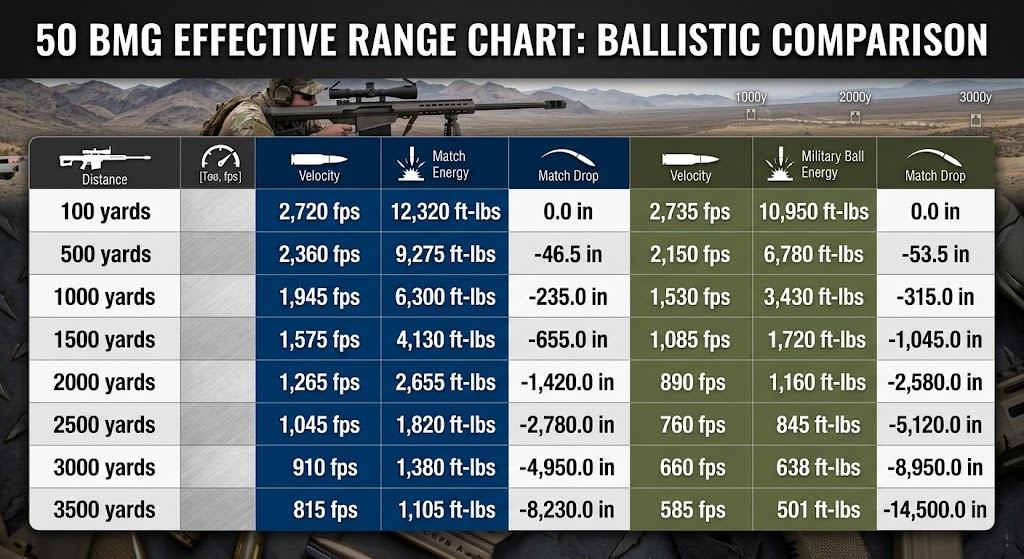
Understanding the Ballistics Chart
The highly detailed data provided in the 50 BMG Effective Range Chart is sourced directly from rigorous real-world ballistic modeling of premium factory ammunition and standard military-issue loads. These numbers reflect performance from a standard 29-inch heavy sniper rifle barrel under standard atmospheric conditions at sea level with an ambient air temperature of 59 degrees Fahrenheit. Understanding these specific ballistic inputs is crucial for accurately translating mathematical data to practical field conditions. Minor changes in barrel length, elevation, barometric pressure, the Coriolis effect, and crosswinds will fundamentally alter these massive downrange figures.
For the Match column, the data reflects the Hornady 750-grain A-MAX Match factory load. Fired from a 29-inch barrel, this extreme long-range load boasts a factory-rated muzzle velocity of 2,820 feet per second (fps) and an estimated G1 Ballistic Coefficient (BC) of 1.050. The rifle is zeroed at 100 yards, which provides a standard baseline for evaluating extreme bullet drop. This is an aerodynamic, polymer-tipped bullet explicitly designed for precise flight characteristics and maximum energy retention over vast distances.
For the Military Ball column, the data represents the ubiquitous 660-grain XM33 Full Metal Jacket military projectile. Fired from the exact same 29-inch barrel, this standard-issue load leaves the muzzle at roughly 2,900 fps with a lower G1 BC of approximately .670. The rifle is also zeroed at 100 yards for direct comparison, highlighting the vastly more parabolic arc required to strike targets at 1,500 yards and beyond compared to its match-grade counterpart.
What Is The Effective Range Of 50 BMG?
Determining the true 50 BMG effective range requires defining what the term effective means for your specific shooting application, target size, and environmental conditions. Originally developed by John Moses Browning during World War I, the 12.7x99mm NATO cartridge was initially designed as an anti-aircraft and heavy machine gun round. The foundational goal was to create a massive cartridge capable of defeating armored vehicles and aircraft at distances exceeding one mile.
In a military anti-materiel context, effective range is defined as the maximum distance at which the 660-grain to 750-grain projectile retains enough kinetic energy and forward velocity to reliably penetrate engine blocks, disable radar installations, or detonate unexploded ordnance. For these tactical applications using armor-piercing incendiary ammunition, the practical effective range of the .50 BMG is firmly planted between 1,500 and 2,000 yards. At 1,500 yards, a standard military armor-piercing bullet will carry nearly 1,800 foot-pounds of kinetic energy, which is significantly more energy than a 5.56 NATO round produces at the muzzle.
For anti-personnel sniper applications and civilian extreme long range (ELR) competition shooting, effective range is defined as the maximum distance at which the marksman can reliably predict the bullet’s drop and wind deflection to strike targets. Because the .50 BMG boasts massive payload mass and high ballistic coefficients with match ammunition, skilled marksmen can reliably ring steel at 2,500 yards.
If pushed past 2,500 yards under standard atmospheric conditions, the bullet rapidly drops below the speed of sound. While the .50 BMG remains mechanically lethal at 3,000 yards, extreme drop and extended flight times make hitting targets challenging. At extreme distances, flight times exceed five full seconds, giving moving targets ample time to reposition before the projectile arrives.
50 BMG Match Grade Range
The match-grade 750-grain to 800-grain solid brass or polymer-tipped projectile represents the pinnacle of modern extreme long-range .50 BMG capability. The precision heavy sniper rifle relies on extracting maximum aerodynamic efficiency from these heavy projectiles. Ammunition lines such as Hornady A-MAX Match, Barnes Buster solid copper, and specialized turned brass solids dominate the competitive ELR market.
- Velocity: High-pressure match loads leave the muzzle of a 29-inch to 36-inch barrel traveling at 2,700 to 2,900 fps. Because the .50-caliber match projectile has a high ballistic coefficient (often exceeding 1.000), it bleeds speed very slowly. A 750-grain bullet traveling at 2,820 fps retains supersonic flight out to roughly 2,200 yards depending on altitude and air density.
- Energy: At the muzzle, a 750-grain match load produces roughly 13,200 ft-lbs of kinetic energy. By the time it reaches 1,000 yards, it still retains approximately 6,300 ft-lbs. This kinetic energy profile provides deep penetration and devastating impacts on hardened targets at extended distances.
- Trajectory and Bullet Drop: With a 100-yard zero, a 750-grain .50 BMG exhibits a flat trajectory out to 500 yards (-46.5 inches), dropping 235 inches at 1,000 yards and 1,420 inches at 2,000 yards. Compensating for 1,420 inches of drop requires specialized optical mounting rails with built-in elevation, typically ranging from 40 MOA to 60 MOA canted bases.
- Practical Effective Range: For precision competitive shooting and military sniper applications utilizing specialized optics, 2,000 to 2,500 yards is the operational ceiling for repeatable accuracy. Pushing past this distance requires specialized weather tracking equipment, ballistic calculators, and precise laser rangefinders.
50 BMG Military Ball Range
While match-grade ammunition is designed for high precision, military forces globally rely on the 660-grain XM33 full metal jacket, Armor Piercing (AP), and Armor Piercing Incendiary (API) ammunition. These rounds are manufactured in volume for heavy machine guns like the M2 Browning and semi-automatic anti-materiel rifles like the Barrett M107.
- Velocity: Standard military ball loads push a 660-grain bullet at roughly 2,900 fps from a 29-inch barrel. Because it utilizes a standard boat-tail design without ultra-low-drag profiles, it bleeds speed faster at extended distances. At 1,000 yards, it drops to 1,530 fps, and at 1,500 yards, it approaches the transonic threshold at 1,085 fps.
- Energy: The 660-grain mass generates approximately 12,300 ft-lbs of energy at the muzzle. At 1,000 yards, it retains 3,430 ft-lbs. Designed primarily for engaging light vehicles and structural positions, these projectiles rely on mild steel cores or hardened penetrators rather than expansion to achieve terminal effects.
- Trajectory and Bullet Drop: The trajectory of the 660-grain military ball is steeper than match ammunition past 1,000 yards. Zeroed at 100 yards, it drops 53.5 inches at 500 yards, 315 inches at 1,000 yards, and 2,580 inches at 2,000 yards.
- Practical Effective Range: Due to mass manufacturing tolerances, military ball ammunition fired from a rifle is practically limited to 1,500 yards for point targets. Beyond 1,500 yards, transonic turbulence can destabilize the projectile. Heavy machine guns employ this ammunition out to 2,000 yards by utilizing rapid bursts to engage area targets.
50 BMG Velocity And Energy At Distance
Understanding how the .50 BMG performs dynamically over vast distances requires analyzing retained velocity and kinetic energy. The massive kinetic power generated by this cartridge sets it apart from standard centerfire rifle rounds:
- Muzzle: 2,820 fps | 13,240 ft-lbs (750-grain A-MAX)
- 500 Yards: 2,360 fps | 9,275 ft-lbs
- 1000 Yards: 1,945 fps | 6,300 ft-lbs
- 1500 Yards: 1,575 fps | 4,130 ft-lbs
- 2000 Yards: 1,265 fps | 2,655 ft-lbs
To put these figures into perspective, a standard .308 Winchester produces roughly 2,600 foot-pounds of kinetic energy at the muzzle. The .50 BMG retains more kinetic energy at 2,000 yards downrange than the .308 Winchester produces at the muzzle.
Contrast this with the .338 Lapua Magnum utilizing a 300-grain match bullet:
- Muzzle: 2,800 fps | 5,220 ft-lbs
- 500 Yards: 2,250 fps | 3,370 ft-lbs
- 1000 Yards: 1,770 fps | 2,085 ft-lbs
- 1500 Yards: 1,360 fps | 1,230 ft-lbs
- 2000 Yards: 1,040 fps | 720 ft-lbs
While the .338 Lapua Magnum has a sleek aerodynamic profile, the physical mass of the 750-grain .50-caliber bullet allows it to retain nearly four times the kinetic energy of the .338 Lapua at 2,000 yards.
50 BMG Bullet Drop At Distance
Bullet drop is an important factor when stretching the platform’s range. Zeroed at 100 yards with a 750-grain match load, the bullet drop progresses as follows:
- 100 yards: 0.0 inches
- 500 yards: -46.5 inches (3.8 feet)
- 1000 yards: -235.0 inches (19.5 feet)
- 1500 yards: -655.0 inches (54.5 feet)
- 2000 yards: -1,420.0 inches (118.3 feet)
- 2500 yards: -2,780.0 inches (231.6 feet)
- 3000 yards: -4,950.0 inches (412.5 feet)
At 1,000 yards, the bullet drops nearly twenty feet, which can be compensated for by dialing roughly 24 MOA of elevation. At 2,500 yards, the drop reaches 231 feet, which exceeds the internal elevation adjustment of most standard rifle scopes. Marksmen at these distances utilize canted scope bases, prism systems, and weather meters to calculate atmospheric density and the Coriolis effect.
50 BMG Range By Barrel Length
The internal ballistics of the .50 BMG are tailored for long barrel lengths, as the large case capacity utilizes substantial volumes of slow-burning powder.
Average muzzle velocities for a 750-grain Match load across common barrel lengths:
- 20-inch CQB barrel (Barrett M107A1 CQ): ~2,500 fps
- 29-inch Standard barrel (Barrett M82A1): ~2,750 fps
- 32-inch Precision barrel (McMillan TAC-50): ~2,820 fps
- 36-inch Custom ELR barrel: ~2,900 fps
A 36-inch custom barrel maximizes velocity, extending supersonic stability out to 2,500 yards. A 20-inch barrel loses roughly 300 to 400 fps, causing the projectile to enter the transonic zone closer to 1,500 yards while producing substantial muzzle blast. Short barrels are primarily selected for vehicle interdiction and close-range urban operations where maneuverability takes priority over extreme range.
How Far Is 50 BMG Accurate?
Mechanical accuracy in the .50 BMG depends heavily on the weapon action and ammunition quality. Semi-automatic anti-materiel rifles like the Barrett M82A1 firing standard military ball ammunition generally achieve 2 MOA to 3 MOA accuracy, which translates to 20 to 30-inch groups at 1,000 yards.
Dedicated bolt-action precision rifles (such as the McMillan TAC-50, Desert Tech HTI, or Steyr HS .50) firing match-grade solid brass or turned monolithic projectiles routinely achieve 0.5 MOA to 1.0 MOA accuracy (5 to 10-inch groups at 1,000 yards).
This mechanical accuracy allows bolt-action systems to engage targets out to 2,000 yards. At extreme distances, environmental factors dominate accuracy. Even with a heavy 750-grain bullet, a 10 mph full-value crosswind will displace the projectile roughly 45 inches at 1,000 yards and over 150 inches at 2,000 yards.
50 BMG Range For Hunting
While the .50 BMG is legal for hunting big game in various jurisdictions, its size and power make it specialized:
- Extreme Long-Range Safari: The cartridge provides massive penetration on large game, but rifle weights (typically 25 to 35 pounds) make it challenging to carry in field environments.
- Long-Range Target and Varmint Control: Some shooters use fixed bench or bipod setups for extreme-distance shooting on invasive species. However, engaging live targets beyond 1,000 yards introduces ethical considerations, as flight times exceeding two seconds can allow an animal to move before impact.
50 BMG Range With A Suppressor
Suppressing a .50 BMG significantly reduces felt recoil and concussive muzzle blast.
- Supersonic Ammunition: When firing standard supersonic ammunition through a heavy-duty .50-caliber suppressor, the blast and dust signature are reduced, masking the shooter’s position. The bullet produces a supersonic crack, but the overall sound profile is substantially lower than an unsuppressed muzzle brake.
- Subsonic Ammunition: Subsonic .50 BMG loads exist but are uncommon. Firing a 750-grain bullet at 1,050 fps produces roughly 1,800 ft-lbs of energy with a steep parabolic arc, limiting practical employment to inside 300 yards. Consequently, suppressors on this platform are almost exclusively paired with full-power supersonic ammunition.
50 BMG vs 338 Lapua Magnum Range
| Category | .50 BMG (750gr A-MAX) | .338 Lapua Mag (300gr SMK) | Winner |
| Muzzle Velocity | ~2,820 fps | ~2,800 fps | Tie |
| Muzzle Energy | ~13,240 ft-lbs | ~5,220 ft-lbs | .50 BMG |
| Energy at 1500 Yards | ~4,130 ft-lbs | ~1,230 ft-lbs | .50 BMG |
| Bullet Drop at 1500 Yards | -655.0 inches | -680.0 inches | .50 BMG |
| Average Rifle Weight | 25 to 35 pounds | 12 to 18 pounds | .338 Lapua |
| Felt Recoil | Very Heavy | Moderate to Heavy | .338 Lapua |
| Anti-Personnel Range | 2,500 yards | 1,800 yards | .50 BMG |
| Portability | Low | High | .338 Lapua |
The .50 BMG provides significantly more kinetic energy, greater armor penetration, and better wind resistance at extreme range. The .338 Lapua Magnum offers lighter rifle weights, manageable recoil, and practical mobility for field operations.
Is 50 BMG Good For Long Range?
The .50 BMG is an established cartridge for extreme long-range anti-materiel and target applications. Its high bullet mass and ballistic coefficients allow it to maintain supersonic velocity beyond 2,000 yards while retaining significant kinetic energy. In precision rifle configurations, it provides consistent long-range performance for specialized military units and competitive ELR shooters.
Pros and Cons
50 BMG Pros
- Exceptional long-range ballistics with supersonic reach extending past 2,000 yards.
- Massive kinetic energy output exceeding 13,000 ft-lbs at the muzzle.
- High wind resistance due to heavy projectile mass and elevated ballistic coefficients.
- Availability of surplus military and commercial match-grade ammunition.
- Established reliability in anti-materiel and heavy support roles.
50 BMG Cons
- Heavy rifle platforms (25 to 35 pounds) that limit portability.
- Substantial recoil and concussive muzzle blast.
- High cost per round compared to standard centerfire rifle calibers.
- Requires heavy-duty optical mounts and canted bases for long-range adjustment.
- Restricted at many civilian ranges due to berm and noise limitations.
50 BMG Effective Range: Final Verdict
Consolidating empirical ballistic data and platform parameters establishes clear effective range guidelines for the .50 BMG:
- Match-Grade Bolt-Action Rifles: The practical effective range spans 2,000 to 2,500 yards. Utilizing 750-grain match ammunition from a 29-inch or 36-inch barrel maintains stability and energy for precision target engagement.
- Military Semi-Automatic Anti-Materiel Rifles: The practical effective range is 1,500 to 1,800 yards with standard military ball and armor-piercing ammunition, prioritizing vehicle and equipment interdiction.
- Heavy Machine Guns: Effective engagement spans 1,800 to 2,000 yards for area suppression.
FAQs
What is the effective range of a 50 BMG?
The effective range of the .50 BMG is 1,500 yards for military anti-materiel roles with standard ball ammunition and 2,000 to 2,500 yards when firing match-grade ammunition from a precision bolt-action rifle.
How far can a 50 BMG shoot accurately?
High-end precision bolt-action rifles firing match ammunition can accurately engage steel targets out to 2,500 yards under favorable atmospheric conditions.
How much does a 50 BMG bullet drop at 1,000 yards?
Zeroed at 100 yards, a standard 750-grain match-grade .50 BMG projectile drops approximately 235 inches (19.5 feet) at 1,000 yards.
How far can a 50 BMG bullet travel in total?
When fired at an optimal upward angle of approximately 30 to 35 degrees, a .50 BMG bullet has a maximum ballistic range of 4 to 5 miles (7,000 to 8,000 yards).
What is the longest confirmed hit with a 50 BMG?
The longest confirmed military sniper kill recorded with a .50 BMG (McMillan TAC-50) occurred in 2017 at a distance of 3,871 yards (2.2 miles).
How does barrel length affect 50 BMG range?
A 36-inch barrel yields maximum muzzle velocity (around 2,900 fps), maintaining supersonic flight past 2,200 yards. A short 20-inch barrel loses 300 to 400 fps, bringing the transonic threshold closer to 1,500 yards.
Does 50 BMG have heavy recoil?
Yes. Despite the use of heavy muzzle brakes and rifle weights exceeding 25 pounds, felt recoil remains substantial, requiring proper shooting fundamentals.
Can 50 BMG penetrate armored vehicles?
Standard Armor Piercing (AP) and Armor Piercing Incendiary (API) rounds can penetrate light armored vehicles, engine blocks, and reinforced concrete at practical tactical distances.
Why was 50 BMG developed?
John Browning designed the cartridge during World War I to provide an effective anti-armor and anti-aircraft heavy machine gun round.
Can you shoot 50 BMG at standard civilian ranges?
Many indoor and short outdoor ranges restrict .50 BMG due to concussive blast and backstop penetration limitations. Dedicated long-range outdoor facilities are typically required.
What is the best 50 BMG ammunition for long range?
For extreme long-range precision, 750-grain to 800-grain solid brass or low-drag polymer-tipped bullets (such as Hornady A-MAX Match or monolithic turned solids) offer optimal performance.
How does wind affect 50 BMG at 1,000 yards?
A 10 mph full-value crosswind will displace a 750-grain match bullet approximately 45 inches at 1,000 yards and over 150 inches at 2,000 yards.
50 BMG vs 338 Lapua: Which has greater effective range?
The .50 BMG has greater ultimate effective range (2,500 yards vs 1,800 yards) and significantly higher retained energy, while the .338 Lapua provides a more portable platform for field mobility.