The .22 Hornet is a highly efficient, low-recoil varmint cartridge that relies on light projectiles and hyper-velocity for explosive terminal performance.
When firing a standard 35-grain polymer-tipped load, muzzle velocities average approximately 2,910 fps from a 16-inch barrel and 2,975 fps from an 18-inch barrel.
As barrel length increases, this velocity scales to roughly 3,025 fps from a 20-inch barrel, 3,065 fps from a 22-inch barrel, and hits a factory-advertised 3,100 fps from a 24-inch test barrel.
Heavier 45-grain soft point loads travel slower, averaging about 2,690 fps from a 24-inch barrel to provide deeper penetration on tough predators.
It is critical to note that exact velocity varies by ammunition brand, bullet weight, chamber tolerances, and environmental test conditions.
Analyzing these chronograph statistics allows shooters to choose the ideal barrel length for maximum flat trajectory or lightweight maneuverability in the field.
22 Hornet Velocity Chart
| Barrel Length | Load | Bullet Weight | Muzzle Velocity | Velocity Difference |
| 16 inches | Hornady V-MAX | 35 grain | 2,910 fps | – |
| 18 inches | Hornady V-MAX | 35 grain | 2,975 fps | +65 fps |
| 20 inches | Hornady V-MAX | 35 grain | 3,025 fps | +50 fps |
| 22 inches | Hornady V-MAX | 35 grain | 3,065 fps | +40 fps |
| 24 inches | Hornady V-MAX | 35 grain | 3,100 fps | +35 fps |
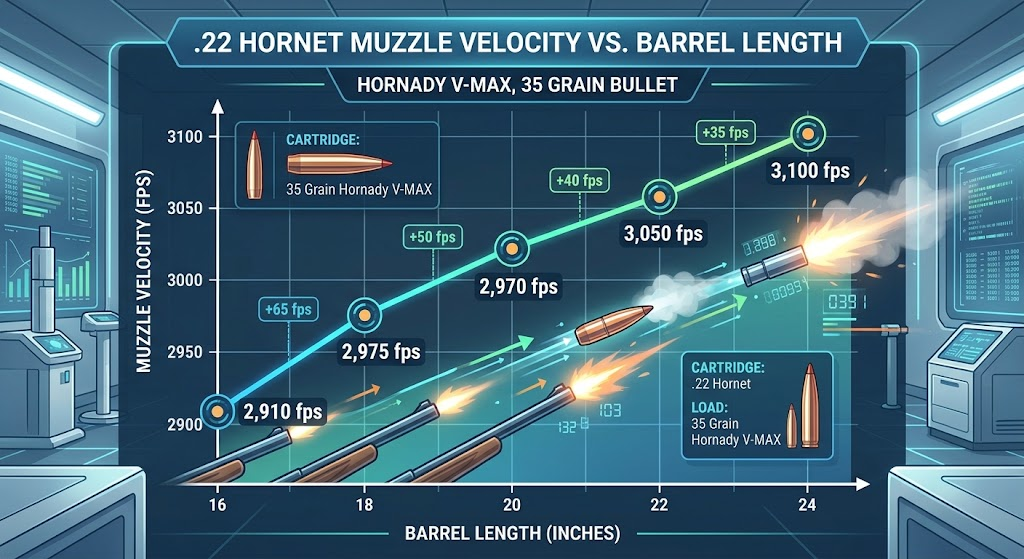
How Much Velocity Does 22 Hornet Gain From Barrel Length?
Chronograph data shows that the .22 Hornet gains speed predictably, but the rate of gain diminishes as the barrel gets longer. Because the cartridge utilizes a very small powder capacity (typically 10 to 13 grains of fast-burning propellant like Lil’Gun or H110), the powder column reaches complete combustion relatively early in the bore.
Between 16 and 20 inches, the .22 Hornet gains an average of 25 to 30 fps per inch of barrel added. However, as the expanding gases begin to lose pressure in longer barrels, the gains flatten out. Moving from a 22-inch barrel to a 24-inch barrel only yields an average increase of 15 to 20 fps per inch.
Does Barrel Length Affect 22 Hornet Velocity?
Yes, barrel length directly affects .22 Hornet velocity, but the cartridge is less heavily penalized by short barrels compared to modern, overbore centerfires like the .22-250 Remington.
Dropping from a standard 24-inch barrel down to a 16-inch carbine barrel results in a total loss of roughly 190 fps for a 35-grain bullet. While this drops the muzzle energy slightly, 2,910 fps is still devastatingly fast and well above the fragmentation threshold for polymer-tipped varmint bullets. If two 20-inch barrels yield different speeds, the variance is almost always caused by chamber tightness, throat wear, or lot-to-lot inconsistencies in factory rimmed ammunition.
22 Hornet Supersonic Velocity By Barrel Length
The .22 Hornet is engineered exclusively as a high-velocity, supersonic varmint cartridge.
- 35 Grain: The lightest standard factory option, popularized by the Hornady V-MAX. It maximizes the cartridge’s flat trajectory, launching at roughly 2,910 fps from a 16-inch barrel and peaking at 3,100 fps from a 24-inch barrel.
- 40 Grain: A highly popular mid-weight option. Bullets like the Nosler Ballistic Tip average 2,850 fps from a 24-inch barrel, retaining slightly better wind-bucking characteristics at 150 yards.
- 45 Grain: Traditional soft point loads prioritize penetration over explosive fragmentation. They typically leave a 24-inch barrel at approximately 2,690 fps, dropping to roughly 2,520 fps when fired from a 16-inch carbine.
22 Hornet Subsonic Velocity By Barrel Length
While the .22 Hornet is a fantastic candidate for suppression, there is no commercially available subsonic .22 Hornet ammunition.
The reason is basic ballistics: downloading a 40-grain or 45-grain .224-caliber bullet to travel below the speed of sound (1,125 fps) perfectly replicates the ballistics of a standard .22 Long Rifle. Attempting to achieve subsonic velocities inside the high-volume .22 Hornet case would require dangerously small powder charges, leading to inconsistent ignition and a high risk of squib loads. If a shooter requires subsonic performance, a standard .22 LR or heavy subsonic .300 Blackout is the appropriate choice.
22 Hornet 16 Inch Barrel Velocity
A 16-inch barrel turns the .22 Hornet into an incredibly agile brush gun or truck rifle.
- 35-Grain Load: Averages roughly 2,910 fps.
- Considerations: While you sacrifice nearly 200 fps compared to a 24-inch test barrel, the lightweight rifle becomes perfectly balanced for carrying on long walks, especially if attaching a rimfire-rated suppressor.
22 Hornet 20 Inch Barrel Velocity
The 20-inch barrel is widely considered the sweet spot for modern bolt-action walking varmint rifles.
- 35-Grain Load: Yields approximately 3,025 fps.
- Considerations: This length achieves complete powder burn, significantly dampening the muzzle report while retaining over 700 ft-lbs of kinetic energy for coyotes and foxes.
22 Hornet 24 Inch Barrel Velocity
A 24-inch barrel is the classic factory test length, found on many traditional or vintage single-shot rifles.
- 35-Grain Load: Reaches the advertised 3,100 fps maximum.
- Considerations: Extracts the absolute highest flat-shooting trajectory possible from the tiny case, though the extra 4 inches of steel provide heavily diminishing returns in speed while making the rifle unwieldy in dense woods.
22 Hornet Velocity And Energy By Barrel Length
The following table calculates muzzle energy based on tested velocity averages for a standard 35-grain Hornady V-MAX load.
| Barrel Length | Bullet Weight | Velocity | Muzzle Energy |
| 16 inches | 35 grain | 2,910 fps | 658 ft-lbs |
| 18 inches | 35 grain | 2,975 fps | 688 ft-lbs |
| 20 inches | 35 grain | 3,025 fps | 711 ft-lbs |
| 22 inches | 35 grain | 3,065 fps | 730 ft-lbs |
| 24 inches | 35 grain | 3,100 fps | 747 ft-lbs |
Practical Applications
Muzzle velocity dictates the effective hunting range for the .22 Hornet:
- Pest & Varmint Control: For prairie dogs, groundhogs, and squirrels, the 3,000+ fps velocity from an 18 to 22-inch barrel ensures explosive expansion and prevents ricochets, as the fragile bullets disintegrate upon impact.
- Predator Hunting: When hunting foxes or coyotes at 150 yards, hunters often opt for heavier 45-grain soft points from a 20 to 24-inch barrel. The retained 2,690 fps velocity guarantees adequate penetration without destroying valuable pelts.
- Suppressed Use: Because the cartridge uses such a small powder charge, it suppresses exceptionally well. A 16-inch or 18-inch barrel paired with a lightweight suppressor creates a nearly recoil-free, hearing-safe platform for small game.
What Is The Best Barrel Length For 22 Hornet?
The data strongly suggests that the 20-inch to 22-inch range is the best overall barrel length for the .22 Hornet.
Because the cartridge was designed to be housed in lightweight, quick-pointing rifles, saddling it with a 24-inch or 26-inch barrel defeats its purpose while offering only a marginal 35 to 75 fps gain. The 20-inch barrel perfectly optimizes the fast-burning powder column. It drives 35-grain bullets effortlessly past the 3,000 fps mark, wringing out the flat trajectory the cartridge is famous for, while keeping the rifle’s center of gravity perfectly balanced between the shooter’s hands.
Pros and Cons
Short Barrel Pros (16-18 Inches)
- Superb agility in thick brush and vehicles.
- Ideal overall length when hosting a suppressor.
- Excellent balance for lightweight, single-shot carbines.
Short Barrel Cons (16-18 Inches)
- Drops muzzle velocity below 3,000 fps.
- Slightly louder muzzle report due to higher exit pressures.
- Increased bullet drop beyond 150 yards.
Long Barrel Pros (20-24 Inches)
- Achieves factory-advertised maximum velocities (3,100 fps).
- Flattest possible trajectory for small targets at 200 yards.
- Complete powder burn reduces muzzle flash and blast.
- Longer sight radius if utilizing iron sights.
Long Barrel Cons (20-24 Inches)
- Heavily diminishing velocity returns beyond 20 inches.
- Unnecessary length and weight for a low-recoil, short-range cartridge.
22 Hornet Velocity: What The Data Shows
Chronograph testing proves that the .22 Hornet is a highly efficient cartridge that does not require massive barrel lengths to perform. While a 24-inch barrel produces the absolute highest velocity—launching a 35-grain bullet at 3,100 fps—the speed gained over a 20-inch barrel (3,025 fps) is a mere 75 fps.
By analyzing the data curve, shooters can see that cutting the barrel down to 16 inches only penalizes the cartridge by roughly 190 fps. This means that even in a compact carbine, the .22 Hornet generates over 650 ft-lbs of energy and shoots drastically flatter than any magnum rimfire. Ultimately, for shooters wanting the absolute flattest trajectory, a 22-inch or 24-inch barrel delivers. But for the vast majority of practical field applications, a 20-inch barrel remains the optimal balance of ballistics and handling.
FAQs
How fast is 22 Hornet from a 16-inch barrel?
From a 16-inch barrel, a 35-grain polymer-tipped load averages approximately 2,910 fps. A heavier 45-grain soft point load will average roughly 2,520 fps.
How fast is 22 Hornet from a 20-inch barrel?
A 20-inch barrel pushes a 35-grain bullet to roughly 3,025 fps, generating over 710 ft-lbs of muzzle energy.
How fast is 22 Hornet from a 24-inch barrel?
A 24-inch barrel extracts maximum speed, pushing 35-grain loads to their factory-advertised 3,100 fps and 45-grain loads to approximately 2,690 fps.
Does barrel length affect 22 Hornet velocity?
Yes, but because it utilizes a very small charge of fast-burning powder, it reaches its optimal velocity curve much faster than larger centerfire cartridges.
How much velocity does 22 Hornet lose per inch?
Between 16 and 20 inches, the cartridge loses roughly 25 to 30 fps per inch. Between 20 and 24 inches, the loss tapers off to about 15 to 20 fps per inch.
What is the fastest 22 Hornet barrel length?
A 24-inch barrel generally produces the fastest velocities commercially available for the .22 Hornet, allowing maximum time for gas expansion.
What is the best barrel length for 22 Hornet?
The 20-inch barrel is widely regarded as optimal. It pushes light bullets past 3,000 fps, offers a complete powder burn, and keeps the rifle perfectly balanced for field carry.
Does 22 Hornet gain velocity from a longer barrel?
Yes. It continues to gain velocity up to 24 inches, though the returns diminish significantly after the 20-inch mark.
How fast is subsonic 22 Hornet?
There is no commercially available subsonic .22 Hornet ammunition. Attempting to download it below 1,125 fps would replicate a .22 LR and cause dangerous pressure inconsistencies.
How fast is supersonic 22 Hornet?
Standard supersonic .22 Hornet ammunition travels anywhere from 2,520 fps up to 3,100 fps, depending on bullet weight and barrel length.
What is the velocity difference between a 16 and 24 inch 22 Hornet barrel?
For a 35-grain load, the velocity difference is roughly 190 fps (2,910 fps vs. 3,100 fps), representing a difference of about 90 ft-lbs of kinetic energy.