The 50 BMG (Browning Machine Gun) is a massive centerfire rifle and heavy machine gun cartridge featuring a maximum case length of 3.910 inches (99.31 mm) and a maximum overall cartridge length of 5.450 inches (138.43 mm). Based on official SAAMI and military specifications, the rimless bottleneck case features a 0.804 inch rim diameter, a 0.804 inch base diameter, a 0.735 inch shoulder diameter, and a maximum neck diameter of 0.560 inches. A fully formed neck provides immense tension to securely hold 0.510 caliber projectiles weighing upwards of 750 grains. Published specifications can vary slightly depending on whether they represent maximum material conditions, military technical parameters, or specific commercial brass tolerances.
50 BMG Case Dimensions
| Case Dimension | Inches | Millimeters | Specification Type | Source | Notes |
| Case Length | 3.910 | 99.31 | Maximum | SAAMI / NATO | Standard trim to length is 3.900 in. |
| Rim Diameter | 0.804 | 20.42 | Maximum | SAAMI / NATO | Standard 50 caliber bolt face. |
| Rim Thickness | 0.083 | 2.11 | Maximum | SAAMI | Controls heavy extractor engagement. |
| Base Diameter | 0.804 | 20.42 | Maximum | SAAMI / NATO | Measured just above the extractor groove. |
| Shoulder Diameter | 0.735 | 18.67 | Maximum | SAAMI / NATO | Body to shoulder intersection. |
| Neck Diameter | 0.560 | 14.22 | Maximum | SAAMI / NATO | Outside case neck diameter. |
| Neck Length | 0.650 | 16.51 | Nominal | Derived | Ensures adequate grip on massive bullets. |
| Shoulder Angle | 15° | N/A | Half Angle | SAAMI / NATO | Shallow angle feeds reliably in machine guns. |
| Overall Length | 5.450 | 138.43 | Maximum | SAAMI | Fits standard heavy machine gun links and magazines. |
| Case Capacity | ~292.0 | 18.95 cm³ | Nominal (H2O) | Industry Std. | Varies by commercial or military brass manufacturer. |
| Maximum Pressure | 54,000 | 372.32 MPa | Max Average | SAAMI (Piezo) | Military spec is commonly cited around 55,000 psi. |
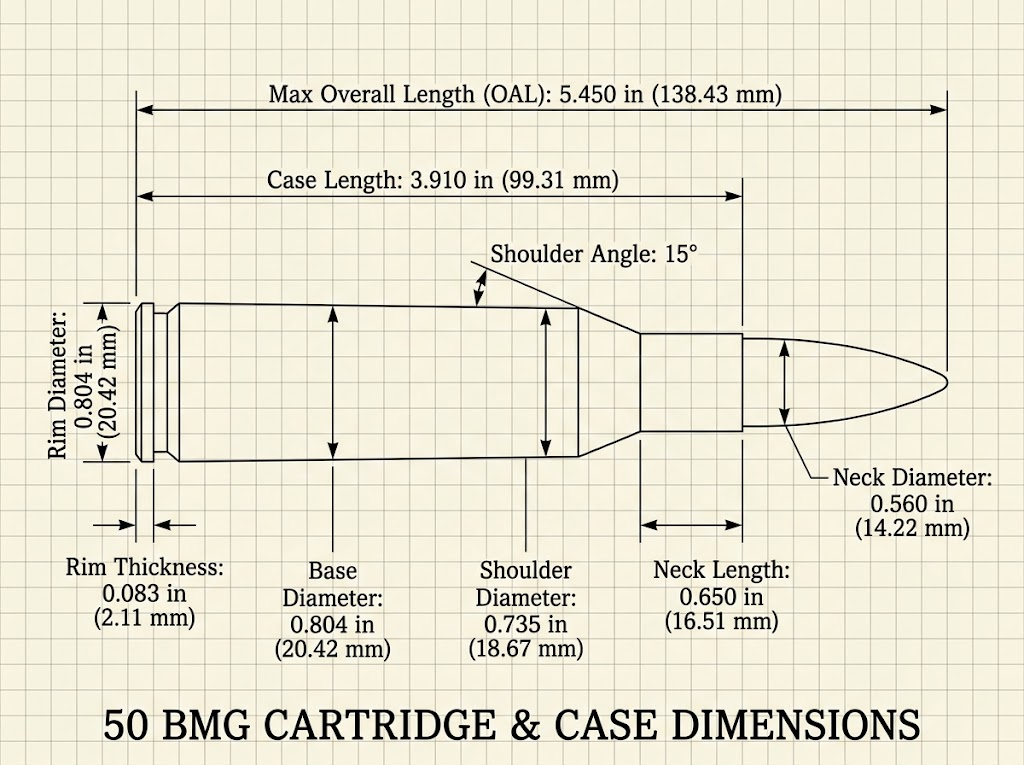
Understanding The 50 BMG Case Dimensions
To understand how the 50 BMG interacts with a rifle chamber, heavy bolt, and feeding mechanism, you must analyze its discrete geometric components. Every dimension is scaled up significantly compared to standard small arms cartridges to withstand extreme mechanical forces.
- Case Length: Measured from the base of the rim to the case mouth, case length determines how far the thick brass extends into the chamber before contacting the end of the neck clearance.
- Rim Diameter and Thickness: The thick 0.083 inch rim provides an extremely durable gripping surface for the massive rifle extractor. The diameter ensures the cartridge centers on the oversized bolt face.
- Base Diameter: This is the widest part of the main cartridge body, situated just ahead of the extractor groove. The 0.804 inch base diameter provides the immense internal volume required to house nearly 300 grains of slow burning powder.
- Shoulder Diameter and Geometry: The shoulder acts as the physical stop that prevents the cartridge from pushing too far into the barrel. Its diameter and shallow 15 degree angle dictate chamber fit, headspacing, and reliable feeding during fully automatic fire.
- Neck Diameter: The neck holds the bullet. The outside diameter must clear the chamber walls to allow the thick brass to expand and release the projectile safely upon firing.
- Overall Cartridge Length (OAL): The measurement from the case base to the tip of the seated bullet. It dictates magazine fit, belt link alignment, and whether the bullet will prematurely engage the rifling lands.
- Case Capacity: The internal volume of the case, generally expressed in grains of water (gr H2O). This dictates the maximum powder charge the cartridge can safely hold.
50 BMG Case Dimensions In Inches And Millimeters
Global standardization bodies use different base measurement systems. SAAMI specifications rely on inches, whereas military NATO and European C.I.P. standards utilize metric parameters (designating it the 12.7x99mm NATO).
| Dimension | Measurement (Inches) | Measurement (Millimeters) |
| Maximum Case Length | 3.910 in | 99.31 mm |
| Maximum Rim Diameter | 0.804 in | 20.42 mm |
| Maximum Base Diameter | 0.804 in | 20.42 mm |
| Maximum Shoulder Diameter | 0.735 in | 18.67 mm |
| Maximum Neck Diameter | 0.560 in | 14.22 mm |
| Maximum Overall Length | 5.450 in | 138.43 mm |
50 BMG Case Length
The published maximum case length for the 50 BMG is 3.910 inches (99.31 mm). Due to the massive volume of powder combusting and the extreme pressures pushing against heavy projectiles, 50 BMG brass flows forward and stretches significantly during firing and resizing.
Operating precisely at this maximum can cause safety issues if the case mouth pinches inside the chamber throat. Handloaders universally utilize a trim length of 3.900 inches. Trimming a case of this magnitude requires specialized, heavy duty case trimmers. This nominal case length provides a 0.010 inch buffer, ensuring consistent chamber fit, uniform neck tension, and safe bullet release.
50 BMG Base And Rim Dimensions
The 50 BMG features a massive rimless, bottleneck design. Its base diameter measures 0.804 inches, and the rim diameter is identical at 0.804 inches.
This 0.804 inch base is essentially the largest standard caliber permitted before crossing into destructive device classifications in many jurisdictions. The massive solid brass web located just above the extractor groove is engineered to withstand extreme bolt thrust forces. The thick 0.083 inch rim ensures the extractor claw will not rip through the brass during the violent extraction cycle of an M2 Browning machine gun.
50 BMG Shoulder And Neck Dimensions
Above the straight taper of the body, the case steps down to grip a 0.510 caliber bullet. The shoulder diameter at the intersection of the case body is 0.735 inches. From there, the brass angles inward at a shallow 15 degree half angle to meet the neck.
This 15 degree shoulder is relatively shallow compared to modern precision rifle cartridges that often use 30 degree shoulders. The shallow angle was specifically designed by John Moses Browning in the 1910s to facilitate smooth, reliable feeding from ammunition belts into the chamber of automatic weapons. The neck diameter reaches a maximum allowable specification of 0.560 inches, with a thick wall designed to tightly grip bullets weighing over an ounce and a half.
50 BMG Case Capacity
Case capacity heavily influences internal ballistics and pressure generation. The nominal, industry accepted capacity for the 50 BMG is approximately 292.0 grains of water (H2O), or roughly 18.95 cubic centimeters.
This is an astronomical powder capacity. It requires incredibly slow burning powders like H50BMG to prevent the pressure from peaking too rapidly before the heavy bullet can move down the barrel. Case capacity is not a static specification. It fluctuates wildly between brass manufacturers. Military surplus brass (such as Lake City) features incredibly thick internal walls for machine gun durability, drastically reducing case capacity compared to commercial match brass from Hornady or Lapua. Load data must always be adjusted when switching between military and commercial brass.
50 BMG Case Dimensions vs 12.7x108mm
The 12.7x108mm is the Soviet and Russian equivalent to the American 50 BMG. While both fire half inch projectiles, their case geometries are completely different and they are not interchangeable.
| Dimension | 50 BMG (12.7x99mm) | 12.7x108mm Russian | Source |
| Case Length | 3.910 in (99.31 mm) | 4.252 in (108.00 mm) | SAAMI / C.I.P. |
| Rim Diameter | 0.804 in (20.42 mm) | 0.854 in (21.70 mm) | SAAMI / C.I.P. |
| Base Diameter | 0.804 in (20.42 mm) | 0.862 in (21.90 mm) | SAAMI / C.I.P. |
| Bullet Diameter | 0.510 in | 0.511 in | SAAMI / C.I.P. |
| Overall Length | 5.450 in (138.43 mm) | 5.787 in (147.00 mm) | SAAMI / C.I.P. |
The 12.7x108mm utilizes a significantly longer 108mm case length compared to the 99mm case length of the 50 BMG. The Russian cartridge also features a wider 0.862 inch base. Due to the larger physical dimensions, the 12.7x108mm holds more powder and typically generates slightly higher muzzle velocities than the 50 BMG when firing similar bullet weights.
50 BMG vs 416 Barrett Case Dimensions
The 416 Barrett was designed by Chris Barrett as an ultra long range precision alternative to the 50 BMG, specifically engineered to bypass caliber restrictions in certain states.
The 416 Barrett is derived directly from the 50 BMG parent case. They share the exact same 0.804 inch base diameter and rim diameter, allowing them to use the same bolt face. However, Barrett shortened the case length from 3.910 inches down to 3.270 inches and necked it down to accept a highly aerodynamic 0.416 caliber bullet. This shortened, necked down design creates a lighter, faster projectile that stays supersonic at much further distances than the heavy 50 BMG.
50 BMG vs 338 Lapua Magnum Case Dimensions
While the 338 Lapua Magnum is considered a massive cartridge for anti-personnel sniper rifles, it is dwarfed by the anti-materiel 50 BMG.
The 338 Lapua Magnum features a 0.588 inch base diameter and a 2.724 inch case length. The 50 BMG utilizes a massive 0.804 inch base diameter and a 3.910 inch case length. The 50 BMG holds more than double the powder capacity of the 338 Lapua Magnum and fires a bullet that is two to three times heavier.
50 BMG Chamber And Case Dimensions
A rifle chamber must be fractionally larger than the cartridge it accepts. The relationship between 50 BMG case dimensions and chamber dimensions centers heavily on headspacing.
Headspace for the 50 BMG is measured from the bolt face to a specific datum line on the 15 degree case shoulder. When the firing pin strikes, the massive case expands to seal the chamber. Because military surplus ammunition is designed with loose tolerances to feed reliably in dirty machine guns, firing surplus ammunition in a tightly cut match grade chamber can cause extraction issues. Proper cartridge dimensions ensure safe alignment, efficient extraction, and reliable bullet entry into the rifling.
50 BMG Case Forming And Resizing
Reloading the 50 BMG requires completely different equipment than standard rifle cartridges. Because the 0.804 inch base diameter is so massive, it will not fit into standard 7/8-14 threaded reloading presses.
Handloaders must use specialized oversized presses with 1-1/2 inch threads to accommodate the giant steel dies. The physical force required to push a fired 50 BMG case into a full length sizing die is immense. Heavy duty case lubrication is absolutely mandatory to prevent the brass from becoming permanently stuck inside the die, which can destroy the reloading equipment.
50 BMG Manufacturer Specifications vs Actual Measurements
There is a documented difference between absolute standards and the dimensions of a physical cartridge sitting on a reloading bench.
SAAMI lists maximum material conditions. Military ammunition manufacturers intentionally produce brass slightly smaller than these maximums to guarantee their cartridges will chamber in hot, fouled machine guns. A fired 50 BMG case expands to the exact dimensions of the specific rifle chamber it was fired in. When a handloader runs this fired brass through a full length sizing die, the machine compresses the base, shoulder, and neck back down to factory nominal tolerances.
Common Questions
What are the 50 BMG case dimensions?
The key maximum case dimensions for the 50 BMG include a 3.910 inch case length, a 0.804 inch rim diameter, a 0.804 inch base diameter, a 0.735 inch shoulder diameter, and a 0.560 inch neck diameter.
What is the 50 BMG case length?
The maximum SAAMI and NATO case length for the 50 BMG is 3.910 inches (99.31 mm). The standard trim to length for reloading is 3.900 inches.
What is the 50 BMG rim diameter?
The 50 BMG rim diameter is 0.804 inches (20.42 mm max), which matches the base diameter.
What is the 50 BMG base diameter?
The base diameter of the 50 BMG, measured just above the extractor groove, is 0.804 inches (20.42 mm max).
What is the 50 BMG shoulder diameter?
The maximum shoulder diameter of the 50 BMG is 0.735 inches (18.67 mm).
What is the 50 BMG neck diameter?
The maximum outside neck diameter of the 50 BMG is 0.560 inches (14.22 mm).
What is the 50 BMG case capacity?
The nominal case capacity of the 50 BMG is approximately 292.0 grains of water (H2O), or 18.95 cubic centimeters. Actual capacity varies greatly depending on whether the brass is commercial or military surplus.
What is the 50 BMG overall length?
The maximum overall cartridge length for the 50 BMG is 5.450 inches (138.43 mm) under SAAMI specifications.
How does 50 BMG compare with 12.7x108mm case dimensions?
The Russian 12.7x108mm is larger than the 50 BMG. It features a wider 0.862 inch base and a longer 4.252 inch (108mm) case length compared to the 0.804 inch base and 3.910 inch (99mm) case length of the 50 BMG.
How does 50 BMG compare with 416 Barrett case dimensions?
The 416 Barrett utilizes the exact same 0.804 inch base and rim diameter as the 50 BMG parent case. However, the 416 Barrett is shortened to a 3.270 inch case length and necked down to accept a 0.416 caliber bullet.
What is the 50 BMG maximum pressure?
The SAAMI maximum average pressure for the 50 BMG is 54,000 psi (piezo method). Military specifications and European C.I.P. standards frequently allow for slightly higher maximum operating pressures near 60,000 psi.