The typical .50 Beowulf muzzle energy ranges from 2,100 to over 2,800 foot-pounds for standard factory loads. For example, standard Alexander Arms 300-grain FTX ammunition produces 2,141 ft-lbs, while their heavy 400-grain Hawk Flat Point load generates a massive 2,877 ft-lbs of energy.This .50 Beowulf muzzle energy variance depends entirely on the bullet weight, the powder charge of the ammunition, the barrel length of the rifle, and the resulting muzzle velocity.A standard 16-inch barrel will safely maximize the kinetic energy output, while a shorter 12-inch tactical barrel will bleed off some velocity.Engineered for the AR-15 platform, the .50 Beowulf relies on massive bullet weights and moderate speeds to deliver absolutely devastating kinetic payloads at close ranges.
.50 Beowulf Muzzle Energy
| Ammunition / Load | Bullet Weight | Muzzle Velocity | Muzzle Energy |
| Alexander Arms FTX | 300 grain | 1,793 fps | 2,141 ft-lbs |
| Alexander Arms Speer Gold Dot JHP | 300 grain | 1,870 fps | 2,330 ft-lbs |
| Alexander Arms Rainier Plated FP | 335 grain | 1,771 fps | 2,333 ft-lbs |
| Alexander Arms Speer JHP | 325 grain | 1,800 fps | 2,338 ft-lbs |
| Underwood Ammo XTP JHP | 350 grain | 1,775 fps | 2,449 ft-lbs |
| Underwood Ammo Lehigh Xtreme Penetrator | 420 grain | 1,650 fps | 2,539 ft-lbs |
| Alexander Arms Rainier Plated HP | 335 grain | 1,900 fps | 2,684 ft-lbs |
| Alexander Arms Hawk Flat Point | 400 grain | 1,800 fps | 2,877 ft-lbs |
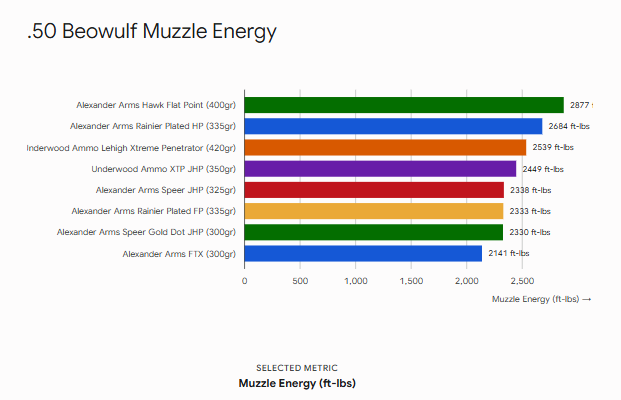
Explaining The 50 Beowulf Muzzle Energy Chart
Based on the real world chronograph and factory test data above, we can identify several key performance baselines:
- Lowest Tested Muzzle Energy:The Alexander Arms 300-grain FTX yields 2,141 ft-lbs. This load is designed for rapid expansion on thin-skinned game like whitetail deer, trading maximum raw kinetic power for a flatter trajectory.
- Highest Tested Muzzle Energy: The Alexander Arms 400-grain Hawk Flat Point generates a highly impressive 2,877 ft-lbs. By utilizing a heavy monolithic bullet pushed by a maximum powder charge, it achieves an incredible 1,800 fps out of a rifle barrel.
- Typical Range: The standard .50 Beowulf energy baseline falls exactly between 2,300 and 2,600 ft-lbs. This is where most traditional 300-grain to 350-grain hunting and defensive ammunition operates.
- How Bullet Weight Affects Energy:The .50 Beowulf utilizes massive bullet weights to generate its power. Pushing a heavy 400-grain bullet creates a tremendous amount of kinetic energy simply because there is so much physical mass traveling downrange.
- How Velocity Affects Energy: Velocity has an exponential physical effect on kinetic energy. Because the 335-grain Rainier Plated HP is pushed to a very fast 1,900 fps, it generates 2,684 ft-lbs. This is significantly more energy than the heavier 350-grain Underwood load traveling at 1,775 fps.
Importantly, muzzle energy is strictly a physics measurement of a bullet’s mass and speed as it leaves the barrel. It is not a direct measurement of terminal performance, tissue damage, or absolute stopping power.
What Is The Muzzle Energy Of .50 Beowulf?
The muzzle energy of .50 Beowulf ammunition generally sits around 2,300 to 2,600 foot-pounds for standard pressure loads fired from a standard 16-inch rifle barrel. However, depending on the specific application, ranging from lighter 300-grain rounds up to massive 420-grain specialty cartridges, the .50 Beowulf energy spectrum spans from roughly 2,100 ft-lbs up to nearly 2,900 ft-lbs.
.50 Beowulf Muzzle Energy By Bullet Weight
Because manufacturers load this cartridge across wildly different projectile types to achieve massive penetration or rapid expansion, muzzle energy shifts dramatically depending on the weight selected.The .50 Beowulf muzzle energy by bullet weight table below uses specific factory load examples to illustrate how energy scales with physical mass and velocity.
| Bullet Weight | Example Velocity | Muzzle Energy |
| 300 grain (Alexander Arms FTX) | 1,793 fps | 2,141 ft-lbs |
| 335 grain (Alexander Arms FP) | 1,771 fps | 2,333 ft-lbs |
| 350 grain (Underwood XTP) | 1,775 fps | 2,449 ft-lbs |
| 400 grain (Alexander Arms Hawk) | 1,800 fps | 2,877 ft-lbs |
| 420 grain (Underwood Penetrator) | 1,650 fps | 2,539 ft-lbs |
Note: These figures represent specific factory test loads. Not every .50 Beowulf load of the same bullet weight produces the exact same energy.
.50 Beowulf 300 Grain Muzzle Energy
The 300-grain bullet is the undisputed flagship option for the .50 Beowulf.Because a 300-grain projectile offers a perfect balance of massive diameter and achievable speed, it is highly favored by hunters and tactical shooters. Standard .50 Beowulf 300 grain muzzle energy typically produces between 2,100 and 2,350 ft-lbs out of a 16-inch barrel. This delivers an incredibly hard hitting payload at close to medium ranges, expanding violently on medium game.
.50 Beowulf 350 Grain Muzzle Energy
The 350-grain bullet is a highly popular heavy option for the .50 Beowulf. Standard 350-grain loads typically produce around 2,450 ft-lbs of energy. Moving at a moderate 1,775 fps, these loads provide excellent barrier penetration and deep tissue damage while still offering a reasonable trajectory inside of 150 yards.
.50 Beowulf 400 Grain Muzzle Energy
The massive 400-grain bullet is engineered for maximum straight line penetration on heavy game. To cycle properly, manufacturers must ensure it leaves the barrel with enough gas pressure. As a result, standard 400-grain muzzle energy often measures an immense 2,877 ft-lbs when pushed to 1,800 fps. The immense bullet weight ensures crushing momentum and excellent barrier penetration.
.50 Beowulf Muzzle Energy By Barrel Length
A cartridge’s advertised muzzle energy is usually derived from a standard 16-inch test barrel. However, the .50 Beowulf is highly effective in short barreled rifles and AR-pattern pistols for close quarters use.
Because the cartridge utilizes fast burning powders, it reaches peak pressure quickly. While a 16-inch barrel is required to extract the absolute maximum velocity, shorter barrels are still highly effective.
Using published factory data for 300-grain and 400-grain ammunition, here is how .50 Beowulf muzzle energy generally performs by barrel length:
- 12 inches (300-grain FTX): ~1,695 fps | 1,913 ft-lbs
- 16 inches (300-grain FTX): 1,793 fps | 2,141 ft-lbs
- 12 inches (400-grain Hawk): ~1,517 fps | 2,044 ft-lbs
- 16 inches (400-grain Hawk): 1,800 fps | 2,877 ft-lbs
Dropping down to a 12-inch barrel will cost the shooter roughly 100 to 280 fps in velocity, which mathematically results in a loss of several hundred foot-pounds of potential kinetic energy. However, even out of a short 12-inch barrel, the .50 Beowulf still delivers nearly 2,000 foot-pounds of energy.
.50 Beowulf Velocity And Muzzle Energy
To understand how .50 Beowulf muzzle velocity and energy are related, it is critical to look at the physics calculation. Kinetic energy relies heavily on speed. In physics, velocity plays an exponential mathematical role in generating high foot-pounds of energy compared to bullet weight alone.
To calculate the muzzle energy of a bullet without using mathematical formulas, you simply multiply the bullet’s physical weight by its flight velocity, multiply it by the velocity a second time, and then divide that massive number by the standard constant of 450436.
For example, pushing a 335-grain bullet to 1,900 fps creates 2,684 ft-lbs of energy. If you take a much heavier 420-grain bullet but only push it to 1,650 fps, it generates less energy at 2,539 ft-lbs. Any intentional loss of speed will drastically reduce the total foot-pounds produced at the muzzle, regardless of how heavy the bullet is.
.50 Beowulf Muzzle Energy vs .450 Bushmaster and .458 SOCOM
The .50 Beowulf is frequently compared against the .450 Bushmaster and the .458 SOCOM, making up the most popular big bore AR-15 cartridges. The table below compares standard factory hunting loads across all three cartridges.
| Cartridge | Bullet Weight | Muzzle Velocity | Muzzle Energy |
| .458 SOCOM | 300 grain | 1,900 fps | 2,405 ft-lbs |
| .50 Beowulf | 300 grain | 1,870 fps | 2,330 ft-lbs |
| .450 Bushmaster | 250 grain | 2,200 fps | 2,686 ft-lbs |
The .50 Beowulf sits directly beside the .458 SOCOM in terms of raw kinetic energy. Both cartridges produce incredibly similar kinetic energy numbers when firing identical 300-grain bullet weights. However, the .450 Bushmaster utilizes a lighter bullet driven at much higher velocities, resulting in the highest overall muzzle energy of the big bore AR-15 group.
What Muzzle Energy Actually Tells You
Muzzle energy is a useful comparative metric, but it has severe limitations when analyzing a cartridge’s effectiveness in real world shooting scenarios.
- Muzzle Energy vs. Downrange Energy:Muzzle energy is measured inches from the muzzle.Because .50 Beowulf bullets are extremely heavy and incredibly blunt, they shed velocity and energy very rapidly past 150 yards.It is strictly a close to medium range cartridge.
- Energy vs. Penetration: High muzzle energy does not guarantee deep penetration. A lightweight 300-grain hollow point with high energy might expand explosively and stop shallow, whereas a heavy 400-grain solid will penetrate much deeper.
- Stopping Power:The .50 Beowulf derives its effectiveness from crushing a wide permanent wound channel using half-inch diameter projectiles.It does not rely on transferring extreme kinetic shock like a high velocity 5.56 NATO rifle round.
.50 Beowulf Muzzle Energy Pros
- Supersonic loads deliver potent kinetic energy levels exceeding 2,300 ft-lbs from standard AR-15 magazine dimensions.
- The massive half-inch caliber diameter ensures incredible energy transfer and wide permanent wound cavities upon impact.
- Easily generates more kinetic energy than standard .308 Winchester loads at close ranges.
.50 Beowulf Muzzle Energy Limitations
- Poor ballistic coefficients across all bullet weights mean the energy drops off rapidly at distance.
- The cartridge generates heavy recoil compared to standard AR-15 rifles.
- Falls slightly short of the raw kinetic foot-pounds generated by the competing .450 Bushmaster at the muzzle.
.50 Beowulf Muzzle Energy: How Much Energy Does It Produce?
The .50 Beowulf produces a typical muzzle-energy range of 2,100 to 2,800 foot-pounds for standard pressure factory ammunition.
Common 300-grain loads reliably produce around 2,100 to 2,350 ft-lbs. The highly popular 350-grain loads predictably push past 2,400 ft-lbs. The heavy 400-grain loads often exceed 2,800 ft-lbs to ensure they deliver massive penetration on heavy game. The highest verified energy in our research is the Alexander Arms 400-grain Hawk Flat Point, which generates an impressive 2,877 ft-lbs out of a standard 16-inch AR-15 barrel.
Ultimately, there is no single universal .50 Beowulf energy number. The final output depends entirely on the bullet weight selected by the manufacturer and the exact length of the barrel firing the cartridge.
FAQs
How much muzzle energy does a .50 Beowulf have?
Standard .50 Beowulf loads typically generate between 2,100 and 2,800 foot-pounds of muzzle energy, depending heavily on the bullet weight and powder charge.
What is the muzzle energy of a 300 grain .50 Beowulf?
The flagship 300-grain load traveling at roughly 1,793 to 1,870 fps produces approximately 2,100 to 2,350 foot-pounds of muzzle energy when fired from a standard 16-inch barrel.
How much energy does a 400 grain .50 Beowulf have?
Heavy 400-grain factory loads produce roughly 2,877 ft-lbs of energy. They operate by trading a slight amount of velocity for extreme physical mass, relying on momentum for deep penetration.
What is the muzzle energy of a 350 grain .50 Beowulf?
Most 350-grain factory defensive and hunting loads produce around 2,400 to 2,450 ft-lbs of energy, offering a balance of moderate velocity and heavy barrier penetration capabilities.
Does barrel length affect .50 Beowulf muzzle energy?
Yes. Firing a .50 Beowulf from a short 12-inch barrel will result in less velocity and lower muzzle energy compared to a 16-inch barrel. The muzzle energy of a 300-grain bullet drops from 2,141 ft-lbs in a 16-inch barrel down to roughly 1,913 ft-lbs in a 12-inch barrel.
What is the highest energy .50 Beowulf load?
Heavy hunting loads produce the highest kinetic energy numbers. Ammunition like the Alexander Arms 400-grain Hawk Flat Point can generate nearly 2,880 ft-lbs of muzzle energy.
How does .50 Beowulf muzzle energy compare with .450 Bushmaster?
The .450 Bushmaster generally produces slightly more kinetic energy than the .50 Beowulf. By utilizing lighter 250-grain bullets driven at faster speeds, the .450 Bushmaster often exceeds 2,600 foot-pounds of energy.
How does .50 Beowulf muzzle energy compare with .458 SOCOM?
The .50 Beowulf produces nearly identical muzzle energy to the .458 SOCOM when using identical 300-grain bullet weights. Both cartridges hover right around 2,350 to 2,400 foot-pounds of energy.
Is .50 Beowulf powerful enough for hunting?
Yes, it is highly capable of hunting large game including deer, elk, and bear. However, because of its poor ballistic coefficient, it is strictly a short to moderate range hunting cartridge and loses energy rapidly past 150 yards.
Does higher muzzle energy mean more stopping power for self defense?
No. Muzzle energy is just a kinetic measurement of speed and mass. Stopping power in a defensive scenario relies heavily on using proper expanding ammunition, achieving adequate penetration depths, and ensuring accurate shot placement.
How is .50 Beowulf muzzle energy calculated?
It is calculated by multiplying the physical weight of the bullet by its flight velocity, multiplying it by the velocity a second time, and then dividing the total by a specific physics constant. Because velocity is multiplied twice in this calculation, speed plays a major role in generating high foot-pounds of energy.