The typical .458 SOCOM muzzle energy ranges from 2,200 to 2,600 foot-pounds for standard supersonic loads, while heavy subsonic ammunition sits around 950 to 1,250 foot-pounds. For example, standard Underwood 300-grain JHP ammunition produces 2,405 ft-lbs, and the massive SBR Ammunition 500-grain subsonic load generates 1,224 ft-lbs. This 458 SOCOM muzzle energy variance is entirely dependent on whether the ammunition is supersonic or subsonic, the bullet weight, the powder charge, and the barrel length. A standard 16-inch rifle barrel will safely maximize the supersonic energy output, while a shorter 10.5-inch barrel will bleed off velocity and kinetic energy. Engineered for military special operations, the .458 SOCOM relies on massive bullet weights and moderate speeds to deliver absolutely devastating kinetic payloads from a standard AR-15 platform.
Table of Contents [Click to minimize]
.458 SOCOM Muzzle Energy
| Ammunition / Load | Bullet Weight | Muzzle Velocity | Muzzle Energy |
| Black Butterfly Maker Subsonic | 400 grain | 1,050 fps | 979 ft-lbs |
| SBR Ammunition Subsonic FMJ | 500 grain | 1,050 fps | 1,224 ft-lbs |
| Buffalo Bore JFN | 405 grain | 1,575 fps | 2,231 ft-lbs |
| Underwood Ammo FMJ Flat Nose | 350 grain | 1,700 fps | 2,246 ft-lbs |
| Black Butterfly Barnes TTSX | 300 grain | 1,850 fps | 2,280 ft-lbs |
| CorBon JHP | 300 grain | 1,900 fps | 2,405 ft-lbs |
| Underwood Ammo JHP | 300 grain | 1,900 fps | 2,405 ft-lbs |
| Underwood Ammo Xtreme Penetrator | 250 grain | 2,150 fps | 2,566 ft-lbs |
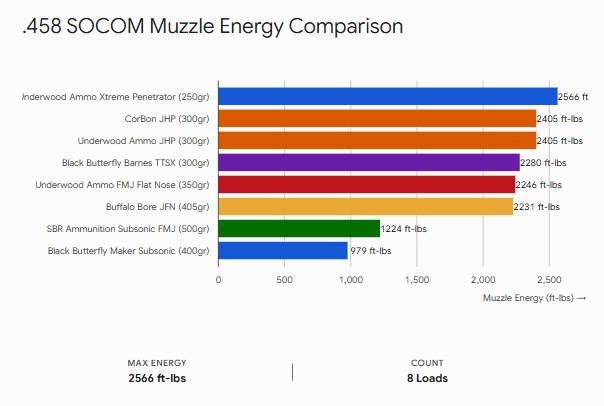
Explaining The 458 SOCOM Muzzle Energy Chart
Based on the real world chronograph and factory test data above, we can identify several key performance baselines:
- Lowest Tested Muzzle Energy: The Black Butterfly 400-grain subsonic load yields 979 ft-lbs. This load is intentionally kept under the speed of sound to eliminate the supersonic crack, making it incredibly quiet when suppressed but drastically lowering its kinetic output.
- Highest Tested Muzzle Energy: The Underwood Ammo 250-grain Xtreme Penetrator generates a highly impressive 2,566 ft-lbs. By utilizing a lightweight monolithic bullet pushed by a maximum powder charge, it achieves an incredible 2,150 fps out of a rifle barrel.
- Typical Range: The standard .458 SOCOM energy baseline falls between 2,200 and 2,500 ft-lbs for supersonic ammunition.
- How Bullet Weight Affects Energy: The .458 SOCOM utilizes heavy bullets to forcefully keep the velocity below the speed of sound, resulting in lower total energy for suppressed shooting. Lighter bullets are driven at high speeds, which creates significantly more kinetic energy.
- How Velocity Affects Energy: Velocity has an exponential physical effect on kinetic energy. Because supersonic .458 SOCOM rounds travel nearly twice as fast as the heavy subsonic rounds, they produce more than double the foot-pounds of energy at the muzzle despite using much lighter bullets.
Importantly, muzzle energy is strictly a physics measurement of a bullet’s mass and speed as it leaves the barrel. It is not a direct measurement of terminal performance, tissue damage, or absolute stopping power.
What Is The Muzzle Energy Of .458 SOCOM?
The muzzle energy of .458 SOCOM ammunition is effectively two completely different numbers depending on the type of ammunition loaded. Subsonic 458 SOCOM energy generally sits around 1,000 to 1,200 foot-pounds, which is incredibly powerful for a subsonic round. Conversely, supersonic .458 SOCOM energy generally sits around 2,200 to 2,500 foot-pounds, mirroring the kinetic energy output of traditional big bore hunting cartridges.
.458 SOCOM Muzzle Energy By Bullet Weight
Because manufacturers load this cartridge across wildly different projectile types to achieve either maximum stealth or supersonic power, muzzle energy shifts dramatically depending on the weight selected. The .458 SOCOM muzzle energy by bullet weight table below uses specific factory load examples to illustrate how energy scales with physical mass and velocity.
| Bullet Weight | Example Velocity | Muzzle Energy |
| 250 grain (Underwood XP) | 2,150 fps | 2,566 ft-lbs |
| 300 grain (CorBon JHP) | 1,900 fps | 2,405 ft-lbs |
| 350 grain (Underwood FMJ) | 1,700 fps | 2,246 ft-lbs |
| 405 grain (Buffalo Bore JFN) | 1,575 fps | 2,231 ft-lbs |
| 500 grain (SBR Subsonic) | 1,050 fps | 1,224 ft-lbs |
Note: These figures represent specific factory test loads. Not every .458 SOCOM load of the same bullet weight produces the exact same energy.
.458 SOCOM 300 Grain Muzzle Energy
The 300-grain bullet is the undisputed flagship supersonic option for the .458 SOCOM. Because a 300-grain projectile offers a perfect balance of massive diameter and achievable speed, it is highly favored by hunters and tactical shooters. Standard .458 SOCOM 300 grain muzzle energy typically produces between 2,250 and 2,450 ft-lbs out of a 16-inch barrel. This delivers an incredibly hard hitting payload at close to medium ranges, expanding violently on medium to large game.
.458 SOCOM 500 Grain Muzzle Energy
The massive 500-grain bullet is specifically engineered for suppressed subsonic shooting. To keep the round silent, manufacturers must ensure it leaves the barrel slower than the speed of sound. As a result, standard 500-grain muzzle energy measures roughly 1,224 ft-lbs. While the kinetic energy is restricted by the low velocity, the immense bullet weight ensures crushing momentum, excellent barrier penetration, and reliable cycling.
.458 SOCOM Muzzle Energy By Barrel Length
A cartridge’s advertised muzzle energy is usually derived from a standard 16-inch test barrel. However, the .458 SOCOM was engineered specifically to be highly efficient in short barreled rifles and AR-pattern pistols for close quarters combat.
Because the cartridge utilizes very fast burning pistol powders, it reaches peak pressure quickly. While a 16-inch barrel is required to extract the absolute maximum velocity, shorter barrels are still highly effective.
Using standard 300-grain supersonic ammunition, here is how .458 SOCOM muzzle energy by barrel length generally performs:
- 10.5 inches (e.g., Tactical AR Pistols): ~1,720 fps | 1,970 ft-lbs
- 16 inches (e.g., Standard Carbines): 1,900 fps | 2,405 ft-lbs
Dropping down to a 10.5-inch barrel will cost the shooter roughly 150 to 200 fps in velocity, which mathematically results in a loss of about 400 foot-pounds of potential kinetic energy. However, subsonic loads use even faster burning powders and will retain almost all of their muzzle energy even in incredibly short configurations.
.458 SOCOM Muzzle Velocity And Energy
To understand how .458 SOCOM muzzle velocity and energy are related, it is critical to look at the differences between its subsonic and supersonic capabilities. Kinetic energy relies heavily on speed. In physics, velocity plays an exponential role in generating high foot-pounds of energy compared to bullet weight alone.
To calculate the muzzle energy of a bullet without using mathematical formulas, you simply multiply the bullet’s physical weight by its flight velocity, multiply it by the velocity a second time, and then divide that massive number by the standard constant of 450436.
For example, a subsonic 500-grain bullet is significantly heavier than a supersonic 250-grain bullet. However, because the lighter 250-grain bullet is traveling more than twice as fast, it produces more than double the total kinetic energy. Any intentional loss of speed required to keep a bullet subsonic will drastically reduce the total foot-pounds produced at the muzzle.
.458 SOCOM Muzzle Energy vs .450 Bushmaster and .50 Beowulf
The .458 SOCOM is frequently compared against the .450 Bushmaster and the .50 Beowulf, making up the most popular big bore AR-15 cartridges. The table below compares the standard supersonic loads of all three cartridges.
| Cartridge | Bullet Weight | Muzzle Velocity | Muzzle Energy |
| .50 Beowulf | 300 grain | 1,870 fps | 2,330 ft-lbs |
| .458 SOCOM | 300 grain | 1,900 fps | 2,405 ft-lbs |
| .450 Bushmaster | 250 grain | 2,200 fps | 2,686 ft-lbs |
The .458 SOCOM perfectly splits the difference between the two competing calibers. It produces slightly more kinetic energy than the standard .50 Beowulf while firing the exact same bullet weight. However, the .450 Bushmaster utilizes a lighter bullet driven at much higher velocities, resulting in the highest overall muzzle energy of the big bore AR-15 group.
What Muzzle Energy Actually Tells You
Muzzle energy is a useful comparative metric, but it has severe limitations when analyzing a cartridge’s effectiveness in real world shooting scenarios.
- Muzzle Energy vs. Downrange Energy: Muzzle energy is measured inches from the muzzle. Because .458 SOCOM bullets are heavy and incredibly blunt, they shed velocity and energy very rapidly past 150 yards. It is strictly a close to medium range cartridge.
- Subsonic Limitations: Subsonic loads inherently have low muzzle energy numbers. They rely entirely on massive physical weight and specialized expanding bullet designs to cause tissue damage, not raw kinetic shock.
- Energy vs. Penetration: High muzzle energy does not guarantee deep penetration. A lightweight supersonic bullet with high energy might expand explosively and stop shallow, whereas a heavy 500-grain subsonic solid will penetrate much deeper despite having half the kinetic energy.
.458 SOCOM Muzzle Energy Pros
- Supersonic loads deliver potent kinetic energy levels exceeding 2,400 ft-lbs from standard AR-15 magazine dimensions.
- Subsonic loads deliver significantly more kinetic energy than standard .300 Blackout subsonic loads due to their massive weight.
- The large caliber diameter ensures massive energy transfer and wide permanent wound cavities upon impact.
.458 SOCOM Muzzle Energy Limitations
- Poor ballistic coefficients across all bullet weights mean the energy drops off rapidly at distance.
- The cartridge generates heavy recoil compared to standard 5.56 NATO AR-15 rifles.
- Supersonic variants fall slightly short of the raw kinetic foot-pounds generated by the competing .450 Bushmaster.
.458 SOCOM Muzzle Energy: How Much Energy Does It Produce?
The .458 SOCOM produces a typical muzzle-energy range of 2,200 to 2,600 foot-pounds for standard supersonic ammunition and 950 to 1,250 foot-pounds for heavy subsonic ammunition.
Common 250-grain supersonic loads reliably produce around 2,500 to 2,600 ft-lbs. The highly popular 300-grain supersonic hunting loads predictably push past 2,300 to 2,450 ft-lbs. The heavy 400-grain and 500-grain subsonic loads strictly produce 950 to 1,250 ft-lbs to ensure they stay safely under the speed of sound. The highest verified energy in our research is the Underwood Ammo 250-grain Xtreme Penetrator, which generates an impressive 2,566 ft-lbs out of a standard AR-15 length barrel.
Ultimately, there is no single universal .458 SOCOM energy number. The final output depends entirely on whether you prioritize heavy silent subsonic performance or the high velocity impact of supersonic ammunition.
FAQs
How much muzzle energy does a .458 SOCOM have?
Supersonic .458 SOCOM loads typically generate between 2,200 and 2,600 foot-pounds of muzzle energy, while heavy subsonic ammunition produces between 950 and 1,250 foot-pounds.
What is the muzzle energy of a 300 grain .458 SOCOM?
The flagship 300-grain supersonic load traveling at roughly 1,900 fps produces approximately 2,405 foot-pounds of muzzle energy when fired from a standard 16-inch barrel.
How much energy does a 500 grain subsonic .458 SOCOM have?
Standard 500-grain subsonic loads produce roughly 1,224 ft-lbs of energy. They operate by trading velocity for extreme physical mass, relying on momentum rather than speed.
Does barrel length affect .458 SOCOM muzzle energy?
Yes, but primarily for supersonic loads. Firing a supersonic .458 SOCOM from a short 10.5-inch barrel will result in less velocity and lower muzzle energy compared to a 16-inch barrel. However, subsonic loads burn powder extremely fast and will retain almost all of their muzzle energy even in short barreled configurations.
What is the highest energy .458 SOCOM load?
Lightweight supersonic loads produce the highest kinetic energy numbers. Ammunition like the Underwood 250-grain Xtreme Penetrator can generate nearly 2,600 ft-lbs of muzzle energy.
How does .458 SOCOM muzzle energy compare with .450 Bushmaster?
The .450 Bushmaster generally produces slightly more kinetic energy than the .458 SOCOM. By utilizing lighter 250-grain bullets driven at faster speeds, the .450 Bushmaster often exceeds 2,600 foot-pounds of energy.
How does .458 SOCOM muzzle energy compare with .50 Beowulf?
The .458 SOCOM produces slightly more muzzle energy than the .50 Beowulf when using identical 300-grain bullet weights, primarily because the .458 SOCOM pushes the bullet just a bit faster out of the barrel.
Is subsonic .458 SOCOM powerful enough for hunting?
Yes, but within strict distance limits. Subsonic .458 SOCOM produces roughly 1,200 ft-lbs of energy. While it is fully capable of taking medium game and feral hogs, it lacks the kinetic speed required for ethical shots at distances beyond 100 yards.
Does higher muzzle energy mean more stopping power for self defense?
No. Muzzle energy is just a kinetic measurement of speed and mass. Stopping power in a defensive scenario relies heavily on using proper expanding ammunition, achieving adequate penetration depths, and ensuring accurate shot placement.
How is .458 SOCOM muzzle energy calculated?
It is calculated by multiplying the physical weight of the bullet by its flight velocity, multiplying it by the velocity a second time, and then dividing the total by a specific physics constant. Because velocity is multiplied twice in this calculation, the much faster supersonic loads generate more than double the total energy of the slower subsonic loads.