The .38 Special ballistics chart provides critical data on the performance of a bullet after leaving the barrel. Shooters utilize these charts to understand a cartridge’s velocity, energy retention, and bullet drop over various distances, which is essential for accurate shot placement and understanding practical range, particularly in self-defense and recreational scenarios. In this article, we present a comprehensive trajectory table for a common factory defensive load: the Hornady Critical Defense 110 gr FTX. It’s important to understand that actual ballistic performance will vary based on multiple factors, including the revolver’s barrel length (whether it’s a snub-nose, 4-inch, or 6-inch model), the specific ammunition type (+P vs standard pressure), and environmental conditions.
38 Special Ballistics Chart
Load: Hornady Critical Defense Bullet Weight: 110 gr Bullet Type: Flex Tip eXpanding (FTX) Muzzle Velocity: 1010 fps Muzzle Energy: 249 ft-lbs Ballistic Coefficient (G1): 0.131 Barrel Length: 4-inch (vented)
| Range (yards) | Velocity (fps) | Energy (ft-lbs) | Bullet Drop (inches) | Bullet Drop (MOA) | Bullet Drop (MIL) | Wind Drift (10 mph) | Time of Flight (seconds) | Remaining Energy (%) |
| 0 | 1010 | 249 | 0 | 0.0 | 0.0 | 0.00 | 0.000 | 100% |
| 25 | 981 | 234 | 1.1 | 4.2 | 1.2 | 0.29 | 0.075 | 94% |
| 50 | 953 | 221 | 4.6 | 8.8 | 2.6 | 1.18 | 0.152 | 89% |
| 75 | 928 | 209 | 10.7 | 13.6 | 3.9 | 2.69 | 0.231 | 84% |
| 100 | 904 | 199 | 19.5 | 18.6 | 5.4 | 4.86 | 0.313 | 80% |
| 125 | 881 | 189 | 31.2 | 23.8 | 6.9 | 7.71 | 0.397 | 76% |
| 150 | 859 | 180 | 46.0 | 29.3 | 8.5 | 11.27 | 0.483 | 72% |
| 175 | 838 | 171 | 64.0 | 34.9 | 10.1 | 15.56 | 0.571 | 69% |
| 200 | 818 | 163 | 85.3 | 40.7 | 11.9 | 20.61 | 0.661 | 65% |
NOTE: The values in this table are based on manufacturers’ published data and standard ballistics calculations for the specific Hornady 110 gr FTX load from a 4-inch barrel. Actual performance will differ depending on your specific firearm’s barrel length, ammunition, and environmental factors.
38 Special Ballistics Chart Image
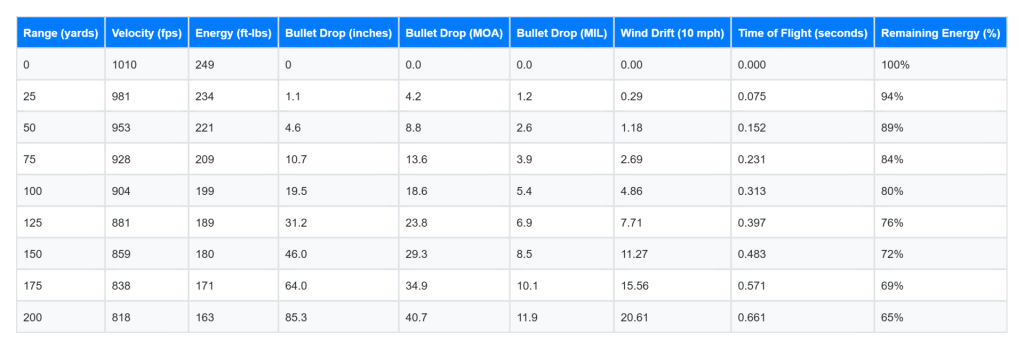
How to Read the 38 Special Ballistics Chart
- Range (yards): Distance from the muzzle to the target.
- Velocity (fps): Speed of the bullet in feet per second at that range.
- Energy (ft-lbs): Kinetic energy of the bullet in foot-pounds at that range. Higher energy typically equates to greater potential damage.
- Bullet Drop (inches): Vertical distance the bullet has fallen from the point of aim (assuming a zero range, which is often 25 yards for handguns). A zero range is not explicitly defined for this table, with the drop value showing absolute fall from muzzle height. Self-correction: The chart shows absolute drop from the muzzle height, not from a zeroed point of aim. The column should be defined clearly as drop from muzzle height, and the example load and general principles should explain this.
Velocity Performance
Discuss:
- Muzzle velocity. Retained velocity.
- Barrel length significantly impacts muzzle velocity. Shorter barrels (e.g., snub-nose revolvers) have less time to burn powder and accelerate the bullet, resulting in lower muzzle velocities and potentially less predictable performance. Full-size revolvers (e.g., 4-inch, 6-inch) achieve higher velocities.
- +P ammunition is loaded to higher pressures and produces higher velocities than standard pressure rounds for the same bullet weight. The difference is measurable, but the actual effective range increase may be limited in practical defensive distances.
Bullet points/short paragraphs:
- Muzzle velocity is the initial speed, with retention affected by drag. Slower handgun bullets lose velocity relatively quickly compared to many rifle cartridges.
- Retained velocity at different distances is shown.
- Typical .38 Special standard pressure loads have muzzle velocities between 750-850 fps from a 4″ barrel for 158 gr bullets, and higher for lighter bullets like the 110 gr (approx. 1010 fps). +P versions increase this.
Energy Performance
Explain retained energy and practical terminal performance. Discuss suitability for:
- Self-defense: The .38 Special, particularly +P and modern defensive loads, offers sufficient energy and terminal performance for typical self-defense scenarios, especially when well-placed. Bullet expansion and penetration are key considerations.
- Target shooting: Adequate for precise target practice and competition at appropriate ranges. Consistent performance across distances.
- Recreational shooting: Fun and manageable to shoot for practice and enjoyment.
Bullet points/short paragraphs:
- Kinetic energy is crucial for stopping power in defensive use. Energy values in standard pressure .38 Special loads often range from 185 to 333 ft-lbs from 4″ barrels, with lighter bullets like the 110 gr starting around 249 ft-lbs. +P increases this significantly (e.g., ~290 ft-lbs for 110 gr +P).
- Understanding retained energy helps evaluate a load’s effectiveness at longer distances. Modern hollow point designs aim to expand even at reduced velocities found downrange in shorter barrel weapons.
Bullet Drop
Explain:
- Trajectory. MOA corrections. MIL corrections. Why drop increases rapidly beyond 75-100 yards.
Bullet points/short paragraphs:
- The path of a bullet is curved due to gravity and air resistance. The ballistics table provides the number of inches the bullet falls over each distance from the muzzle height. For longer distances, shooters must compensate by aiming higher (holds) or adjusting their sights using MOA or MIL values found in the chart.
- MOA and MIL are angular measurements used for precision adjustments. Note that MOA corrections are approximately 1 inch per hundred yards (so a 1 MOA adjustment at 100 yards is ~1 inch, and at 200 yards is ~2 inches). Refer to the specific chart values for exact corrections.
- Drop increases more dramatically at longer ranges as velocity decreases and the bullet’s flight time increases. Slower .38 Special bullets exhibit significant drop beyond typical defensive ranges, with substantial differences clearly shown in the chart between 100 and 200 yards.
Wind Drift
Explain how a 10 mph crosswind affects the .38 Special due to its relatively low velocity. A crosswind will blow a bullet off its intended path. Slower, less aerodynamic bullets like the .38 Special are more susceptible to wind drift, especially as range increases. The table shows substantial wind drift for a 10 mph crosswind starting from as little as 25 yards, with significant movement by 200 yards. Correcting for wind requires accurate estimation of wind speed and direction and appropriate holds, which are challenging with handguns at longer ranges. The drift is often larger than typical targets at longer ranges.
Time of Flight
Explain why slower handgun bullets remain in flight longer than many rifle cartridges. The time it takes for a bullet to reach a given distance is its time of flight. This value is determined by velocity and drag. Slower bullets, like the typical .38 Special, take significantly longer to travel a certain distance compared to faster bullets found in high-powered rifles. This extended flight time contributes to more significant bullet drop and wind drift. Time of flight is listed in seconds in the detailed table for the reference load to 200 yards.
Effective Range
Discuss practical effective ranges for different use cases and include a comparison table.
- Self-defense: Most self-defense shootings occur within very close ranges (often under 7-10 yards). The .38 Special, particularly with modern defensive loads and good shot placement, is considered effective at these practical distances. For longer ranges (e.g., 25-50 yards), accuracy and sufficient energy for effective terminal performance are more challenging, though achievable. Add text clarifying the difference between accuracy and practical effectiveness.
- Home defense: Similar principles apply, with engagement ranges typically being very short. Considerations include over-penetration (less likely with lighter, expanding bullets). Modern hollow points are often the preferred choice to minimize risk to other residents while still ensuring potential to stop a threat.
- Recreational target shooting: For enjoyable practice, engaging targets up to 50-75 yards can be realistic and accurate with appropriate revolvers and practice, though the increasing bullet drop becomes significant past 50 yards and very substantial beyond 100 yards. Long-range competition is not typical for standard .38 Special configurations.
- Small pest control: Within very short ranges (up to 25-50 yards with light loads/bullets), the .38 Special can be effective for small animal control where legally appropriate. Practice for shot placement and understanding trajectory are vital.
Effective Range Comparison Table
| Use Case | Recommended Practice Distances (yards) |
| Self-Defense (Realistic) | 0 – 25 |
| Home Defense (Realistic) | 0 – 15 |
| Recreational Target Shooting | 10 – 75 (up to 100+ with significant trajectory knowledge) |
| Small Pest Control | 5 – 35 |
Standard Pressure vs +P Loads
Create a comparison table.
Standard Pressure vs +P .38 Special Loads Comparison
| Load Type | Typical Velocity (fps – 4″ Barrel) | Typical Energy (ft-lbs) | Recoil | Best Use | Advantages | Disadvantages |
| Standard Pressure | 750 – 850 (158gr), ~1010 (110gr) | 185 – 333, ~249 (110gr) | Moderate, manageable | General practice, recreational shooting, older/lighter firearms (with caution), some self-defense | Less wear on older firearms, easier for new shooters, typically less expensive for training | Lower performance (velocity, energy), less reliable expansion for some hollow points in very short barrels |
| +P Ammunition | ~1090 (110gr), ~1000 (125gr, non-HB), ~975 (158gr, Buffalo Bore) | ~290 (110gr), 248+ (125gr+), ~333 (158gr Buffalo Bore), ~434 (Underwood 125gr) | Increased, snappy (especially in small revolvers) | Modern self-defense, home defense | Improved terminal performance (better velocity, energy, expansion), flatter trajectory within realistic distances | Greater recoil, increased wear on firearms, must be used only in firearms rated for +P |
Best Factory Loads for 38 Special
Create another comparison table.
Best Factory .38 Special Loads Comparison
| Manufacturer | Bullet | Weight (gr) | Bullet Type | Velocity (fps) | Energy (ft-lbs) | Primary Use |
| Hornady | Critical Defense | 110 | FTX | 1010 (Standard) / 1090 (+P) | 249 (Standard) / 290 (+P) | Self-Defense (especially short barrel) |
| Speer | Gold Dot Short Barrel | 135 | GDHP Short Barrel (+P) | 860 | 222 | Self-Defense (optimised for short barrel) |
| Federal Premium | Hydra-Shok | 110 / 129 | Hydra-Shok JHP / Hydra-Shok JHP (+P) | 1000 / 950 | 245 / 258 | Self-Defense |
| Federal American Eagle | Target | 130 | FMJ | 890 | 189 | Training / Target Practice |
| Winchester | Super-X | 158 | LRN | 755 | 200 | Recreational / Practice (traditional) |
| Remington | HTP | 110 / 125 | JHP (+P) / SJHP (+P) | 995 / 945 | 242 / 248 | Self-Defense |
| Buffalo Bore | Heavy +P | 158 | LSWCHP-GC / HC Keith | 1162 / 1167 | 474 / 476 | Heavy-Duty Defense, Outdoor, Pest |
| Underwood Ammunition | XTP / Gold Dot | 125 / 125 | JHP +P (XTP) / JHP +P (Gold Dot) | 1250 / 1200 | 434 / 400 | Powerful Self-Defense |
| PMC Ammunition | Bronze | 132 | FMJ | 917 | 235 | Target Practice / Training |
Factors That Affect 38 Special Ballistics
- Barrel length: Shorter barrels generally reduce velocity. This has the most significant impact among firearm variables.
- Bullet weight: Lighter bullets often have higher muzzle velocity but lose energy and velocity faster and are more affected by wind and gravity over distance. Heavier bullets, like the traditional 158 gr, start slower, retain energy better, and fly flatter at longer ranges, but may have more significant drop initially.
- Bullet construction: Modern hollow points (like FTX, Gold Dot) are designed to expand even at lower velocities, crucial for terminal performance. FMJ (Full Metal Jacket) rounds typically over-penetrate and don’t expand. Lead bullets, traditional in .38 Special, vary in performance and potential for leading. Add text about wadcutters.
- +P vs standard pressure: +P ammunition is loaded to higher pressures, generating more velocity and energy. Clarify again that this must be used only in rated guns.
- Temperature: Higher air temperature slightly reduces air density, resulting in less drag and slightly less bullet drop at very long ranges, and also increases muzzle velocity. This effect is minimal at typical distances and is rarely compensated for in practical revolver shooting. Correct: Higher ammo temperature increases velocity, while lower air temperature increases air density and drag, slightly increasing drop.
- Altitude: Higher altitude has lower air pressure and density, resulting in less drag and slightly less bullet drop. The effect, while measurable, is not typically practical for compensation in short-range shooting.
- Wind: Crosswinds cause bullet drift (sideways movement). While negligible at very short ranges, wind drift becomes significant for the slower .38 Special past typical self-defense distances. Slower handgun bullets are particularly susceptible to wind deflection over extended distances due to longer flight time. Add illustrative text.
Frequently Asked Questions
- How far is a .38 Special accurate? Practical accuracy varies greatly. For well-trained shooters with quality revolvers, engaging targets up to 25-50 yards is realistic, with potential for reasonable accuracy beyond that distance for experienced individuals on larger targets, especially with longer-barreled weapons and heavier bullets. However, effective performance (terminal and consistent) and manageable trajectory diminish rapidly past 50-75 yards for typical defensive loads. Long-range competition is not common for standard configurations.
- Is .38 Special good for self-defense? Yes, especially with modern +P and dedicated defensive ammunition (like Hornady FTX or Speer Gold Dot) and good shot placement, the .38 Special is considered a capable self-defense round. Its power is suitable for typical, close-range engagement distances. Revolvers are generally reliable and easy to handle for some users, but typically have lower capacity than modern semi-automatics and can be harder to reload quickly. Shot placement and using quality ammunition are critical factors in its effectiveness.
- What is the effective range of a .38 Special? The realistic effective range for self-defense is generally within close, practical distances of up to 25 yards. While accurate target engagement may extend to 50 yards or slightly beyond with practice, consistency and terminal performance become less reliable for standard loads.
- How much does a .38 Special drop at 100 yards? Bullet drop is significant. According to the example chart for the Hornady 110 gr FTX, a round fired from a 4-inch barrel exhibits a substantial absolute drop of approximately 19.5 inches at 100 yards from the muzzle height. Refer to a full ballistics table, like the one included, for exact values across various loads.
- Does +P ammunition shoot flatter? Self-correction: Based on search and standard knowledge, +P loads are faster and generally have a flatter trajectory than standard pressure loads of the same weight and bullet design within realistic distances. Faster bullets experience less time of flight for the same distance, resulting in slightly less drop and wind drift. So, yes, +P ammunition will have a slightly flatter trajectory compared to equivalent standard pressure loads over practical distances. The actual practical difference within 25 yards might be minimal, but becomes more apparent at slightly longer ranges as shown in comparative trajectory charts.
- What barrel length gives the best velocity? Generally, longer barrels provide higher velocities for a given cartridge, as they allow the expanding gases to act on the bullet for a longer duration before it exits the muzzle. A 6-inch revolver will typically produce higher velocities than a 4-inch model, which in turn will generate higher velocities than a snub-nose (e.g., 2-inch). For the .38 Special, 4-inch barrels are often considered a good balance, but 6-inch models will maximize velocity. Some +P loads are specifically optimized for shorter barrels using faster-burning powders to achieve effective expansion even at reduced velocities, reducing the relative advantage of a very long barrel.
Is the 38 Special Still a Good Defensive Cartridge?
Provide a balanced conclusion discussing:
- Reliability, Recoil, Accuracy, Concealed carry, Revolver use, Ammunition availability, Practical defensive performance.
Bullet points/short paragraphs:
- The .38 Special remains a viable defensive option for many, particularly in the form of +P loads and advanced bullet designs. Revolvers, while lacking capacity and rapid reloading compared to semi-automatics, are legendary for their inherent reliability and simplicity, and can be easier to master for some shooters. This reliability, combined with sufficient power and manageable recoil (especially with non-+P loads and slightly larger firearms) makes them suitable for many.
- Accuracy is generally excellent for practical ranges, and many models are well-suited for concealed carry, especially snub-nose versions and some compact frame models, which can be made very concealable. Standard pressure loads offer lower recoil for those sensitive to it, while still being potentially effective for defense.
- Modern bullet technology has significantly improved the terminal performance of the .38 Special. Hollow points like the Hornady Critical Defense, Speer Gold Dot, and Federal Hydra-Shok are designed to expand reliably and penetrate sufficiently even at the velocities achieved in short revolver barrels. This makes the cartridge significantly more effective today than it was with older, less efficient designs.
- Availability of both ammunition and quality revolvers chambered for .38 Special is widespread, ensuring a variety of options for training, practice, and personal defense. The manageable recoil with standard loads allows for extensive practice, improving overall skill and confidence.
- While not the most powerful handgun cartridge, the .38 Special offers a practical balance of power, recoil control, and size that is difficult to match in extremely concealable handguns, especially revolvers. When combined with the inherent reliability of the revolver, modern advanced ammunition, and, most importantly, diligent training for good shot placement, the .38 Special continues to be a respectable and effective choice for personal protection.