The comparison of 454 Casull vs 460 S&W pits two of the world’s most powerful production handgun cartridges against each other in a battle of big-bore supremacy. The main difference is that the .460 S&W Magnum utilizes a significantly longer case to hold more powder, allowing it to achieve much higher velocities and flatter trajectories than the .454 Casull. Understanding where each cartridge performs better will help you decide which caliber suits your extreme hunting or wilderness defense requirements.
Table of Contents [Click to minimize]
.454 Casull vs .460 S&W: Main Difference
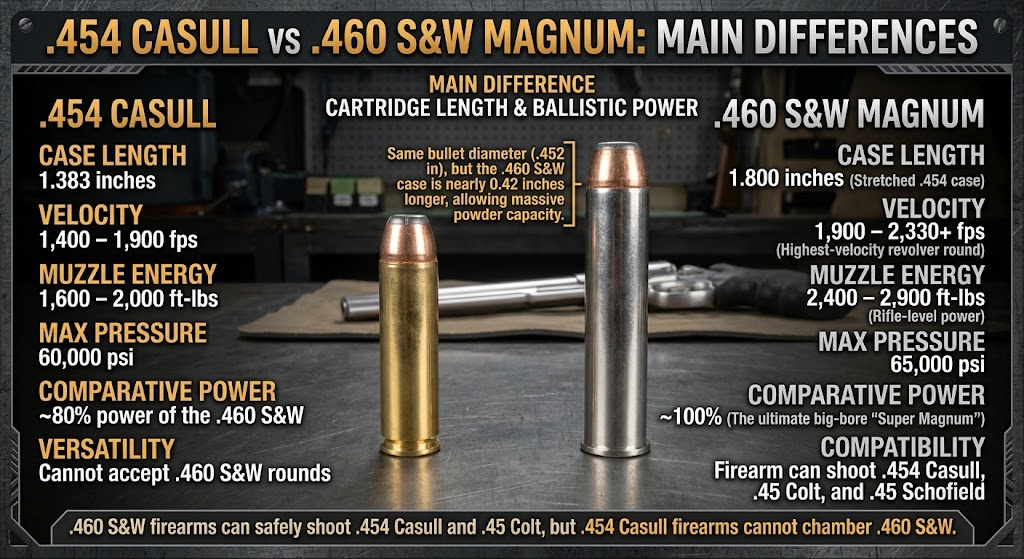
The .460 S&W was explicitly designed to outpace the velocity of the already monstrous .454 Casull. While both cartridges fire the exact same .452-inch diameter bullets and operate at the same maximum pressure (65,000 psi), the main difference lies in case capacity. The lengthened case of the .460 S&W generates massive increases in muzzle velocity and energy.
Below is a comparison table outlining the core specifications of both cartridges. Note: Actual velocity, energy, and recoil can vary significantly depending on bullet weight, ammunition, barrel length, firearm, and specific load.
| Specification | .454 Casull | .460 S&W Magnum |
| Bullet Diameter | .452 inches | .452 inches |
| Typical Bullet Weights | 240, 260, 300, 360, 400 grains | 200, 260, 300, 360, 395 grains |
| Muzzle Velocity | 1,400 – 1,900 fps | 1,900 – 2,300+ fps |
| Muzzle Energy | 1,600 – 2,000 ft-lbs | 2,100 – 2,800 ft-lbs |
| Effective Range | 100 – 150 yards (Handgun) | 200 – 250 yards (Handgun) |
| Recoil | Severe | Extreme (often mitigated by heavy firearms/compensators) |
| Typical Firearm Types | Heavy-frame revolvers, lever-action rifles | X-Frame revolvers, specialty single-shot or lever rifles |
| Common Uses | Dangerous game defense, large game hunting | Long-range handgun hunting, dangerous game defense |
| Hunting Suitability | Elk, Moose, Grizzly Bear, African Game | Elk, Moose, Grizzly Bear, African Game at longer distances |
.454 Casull Overview
Developed in 1957 by Dick Casull and Jack Fulmer, the .454 Casull was created by lengthening and reinforcing the traditional .45 Colt case. It operates at an incredibly high maximum pressure of 65,000 psi (Pounds per Square Inch). For decades, it held the title of the most powerful production handgun cartridge in the world, renowned for its ability to drive heavy bullets deep into thick-skinned, heavy-boned animals.
.460 S&W Overview
Introduced in 2005 by Smith & Wesson and Hornady, the .460 S&W Magnum was built to be the highest-velocity production revolver cartridge in the world. Engineers achieved this by taking the .454 Casull case and lengthening it. Designed alongside the massive S&W X-Frame revolver, it was built specifically to extend the ethical range of handgun hunting past 200 yards.
.454 Casull vs .460 S&W Ballistics
When looking at 454 Casull vs 460 S&W ballistics, the shared bullet diameter makes for a direct comparison of powder capacity and speed. Both are devastatingly powerful, but the .460 S&W represents the absolute upper limit of commercial handgun ballistics.
Velocity Comparison
The .460 S&W achieves dramatically higher velocities. A standard 200-grain bullet fired from a .460 S&W revolver can easily exceed 2,300 fps (feet per second) at the muzzle. By comparison, lighter bullets in the .454 Casull peak around 1,900 fps. Even with heavy 300-grain bullets, the .460 S&W routinely travels 300 to 400 fps faster than the .454 Casull.
Energy Comparison
Because velocity plays such a critical role in kinetic energy calculations, the .460 S&W dominates this category. A typical .454 Casull load generates a massive 1,600 to 2,000 ft-lbs of muzzle energy. However, the .460 S&W pushes well past this, consistently generating between 2,100 and 2,800 ft-lbs of energy.
Recoil Comparison
Both cartridges produce recoil that is punishing to the average shooter, but the raw free recoil of the .460 S&W is noticeably higher. However, felt recoil is subjective and heavily influenced by the firearm. Most .460 S&W revolvers are extremely heavy and come factory-equipped with muzzle compensators, which helps tame the sharp, violent snap. Firing a .454 Casull from a slightly lighter, uncompensated revolver can actually feel more painful to the shooter than the heavier .460 S&W.
Range Comparison
This is where the .460 S&W may be the better choice for dedicated handgun hunters. The immense velocity of the .460 S&W results in a remarkably flat trajectory for a pistol cartridge, allowing for ethical shots on medium to large game out to 200 or even 250 yards with proper optics. The .454 Casull has an arcing trajectory that generally limits its practical hunting range to 100–150 yards.
Bullet and Cartridge Dimensions
Both cartridges fire the same .452-inch diameter bullets, but the cases are vastly different in length.
- .454 Casull: Case length of 1.383 inches, overall length of 1.765 inches.
- .460 S&W: Case length of 1.800 inches, overall length of 2.300 inches.
Due to these dimensions, a revolver chambered in .460 S&W can safely chamber and fire .460 S&W, .454 Casull, and .45 Colt ammunition. A .454 Casull firearm cannot chamber the longer .460 S&W case.
Handgun Use
Where each cartridge is commonly used in handguns dictates the platform. The .454 Casull is chambered in large-frame revolvers like the Ruger Super Redhawk or Freedom Arms Model 83. While heavy, they can be carried in a sturdy chest rig for bear defense. The .460 S&W requires massively oversized frames (like the S&W X-Frame) to accommodate the 2.3-inch cartridge. These revolvers are exceptionally heavy and bulky, making them better suited for dedicated hunting with a rest rather than daily wilderness carry.
Lever-Action Rifle Use
The .454 Casull is a popular chambering for lever-action rifles. In a rifle barrel, the .454 Casull gains significant velocity, making it an incredible brush gun for large game. The .460 S&W is much harder to adapt to standard lever-action platforms due to its extreme overall length. While specialty manufacturers (like Big Horn Armory) make .460 S&W lever-action rifles, they are rare, custom-tier firearms.
Hunting Applications
Both cartridges are capable of taking any game animal on Earth. Where the .454 Casull is commonly used is in dense timber or brush hunting for moose, bear, or feral hogs at distances under 100 yards. The .460 S&W is favored for open-country hunting, where a hunter may need to take a 200-yard shot across a canyon or field at an elk or large deer, relying on the cartridge’s flat trajectory and massive energy retention.
Advantages and Disadvantages of Each Cartridge
.454 Casull Advantages:
- Lighter, more compact firearms compared to the .460 S&W.
- Exceptional penetration for close-quarters dangerous game defense.
- Wider availability of lever-action rifles.
- Can safely fire .45 Colt for practice.
.454 Casull Disadvantages:
- Steeper trajectory limits long-range hunting capabilities.
- In lighter revolvers, the felt recoil can be incredibly sharp and painful.
.460 S&W Advantages:
- Unmatched velocity and flat trajectory for a straight-walled pistol cartridge.
- Incredible versatility: can fire .460 S&W, .454 Casull, and .45 Colt.
- Ample power for 200+ yard handgun hunting.
.460 S&W Disadvantages:
- Firearms are exceedingly heavy, bulky, and difficult to carry casually.
- Extreme muzzle blast and concussion.
- Very limited availability in repeating rifles.
Where .454 Casull is the Better Option
The .454 Casull is the better option for wilderness guides, hikers, or anglers in grizzly country who need a powerful defense revolver that is reasonably portable. It is also where the .454 Casull has an advantage for hunters who specifically want a heavy-hitting lever-action rifle without paying for a custom-built firearm.
Where .460 S&W is the Better Option
The .460 S&W is the better option for the dedicated handgun hunter who hunts from a blind or uses shooting sticks in open environments. Where the .460 S&W may be the better choice is for the shooter who demands absolute maximum ballistic performance, flat trajectories, and the unmatched versatility of firing three different calibers from a single revolver cylinder.
FAQ
What is the main difference between .454 Casull and .460 S&W?
The main difference is case length; the .460 S&W uses a significantly longer case to hold more gunpowder, which generates much higher velocities, flatter trajectories, and more kinetic energy than the .454 Casull.
Is .460 S&W more powerful than .454 Casull?
Yes. The .460 S&W easily produces 2,100 to 2,800 foot-pounds of muzzle energy, making it substantially more powerful than the .454 Casull, which typically tops out around 2,000 foot-pounds.
Which has more recoil, .454 Casull or .460 S&W?
In terms of raw energy, the .460 S&W produces more recoil. However, because .460 S&W revolvers are typically heavier and feature aggressive muzzle brakes, the felt recoil can sometimes feel less punishing than a .454 Casull fired from a lighter, uncompensated revolver.
Which has a longer effective range?
The .460 S&W has a much longer effective range. Its extreme velocity allows it to shoot flat and retain lethal energy out to 200-250 yards, whereas the .454 Casull is generally limited to 100-150 yards.
Which is better for hunting?
Both are phenomenal for hunting large game. The .454 Casull is better for short-range brush hunting and defensive carry, while the .460 S&W is better for long-range handgun hunting in open terrain.
Where is .454 Casull preferable to .460 S&W?
The .454 Casull is preferable where shooters need a slightly more compact, lighter revolver for chest-carry in bear country, or where a shooter wants a readily available lever-action brush rifle.
Where does .460 S&W have the biggest advantage?
The .460 S&W has the biggest advantage where hunters need to take long-range shots with a handgun, and in its extreme versatility, as it can fire .460 S&W, .454 Casull, and .45 Colt ammunition from the same firearm.