The main difference between the 10mm Auto and the .357 Magnum is that the 10mm is designed for high capacity semi-automatic pistols offering a rapid rate of fire, while the .357 Magnum is a rimmed cartridge built primarily for highly reliable revolvers and lever-action rifles. Both cartridges deliver devastating kinetic energy, making them legendary choices for handgun hunting and backcountry defense against large predators. The .357 Magnum utilizes a slightly lighter, narrower bullet with excellent sectional density to achieve incredible penetration through thick bone and hide. Conversely, the 10mm fires a wider, heavier projectile that creates massive wound channels while allowing you to carry up to fifteen rounds in a standard magazine. Choosing between these two powerhouse calibers comes down to whether you prefer the classic reliability of a heavy steel revolver or the modern firepower of a semi-automatic handgun.
10mm vs 357 Ballistics Chart
| Specification / Metric | 10mm Auto (180 gr JHP) | .357 Magnum (158 gr JHP) |
| Cartridge | 10mm Automatic | .357 S&W Magnum |
| Parent Case | Original Design | .38 Special |
| Bullet Diameter | .400 inches | .357 inches |
| Typical Bullet Weight | 155 to 220 grains | 125 to 180 grains |
| Muzzle Velocity | 1,250 fps | 1,240 fps |
| Velocity at 50 Yards | 1,110 fps | 1,090 fps |
| Velocity at 100 Yards | 1,015 fps | 990 fps |
| Muzzle Energy | 624 ft-lbs | 539 ft-lbs |
| Energy at 50 Yards | 492 ft-lbs | 417 ft-lbs |
| Energy at 100 Yards | 412 ft-lbs | 344 ft-lbs |
| Bullet Drop (100 Yds, 50 Yd Zero) | -3.5 inches | -4.0 inches |
| Sectional Density | 0.161 | 0.177 |
| Effective Hunting Range | 75 to 100 yards | 75 to 100 yards |
| Maximum Effective Range | 100+ yards | 100+ yards |
| Recoil (Free Recoil Energy) | ~11.0 ft-lbs | ~10.0 ft-lbs |
| Trajectory | Flat for a handgun | Flat for a handgun |
| Hunting Performance | Deer, hogs, black bear | Deer, hogs, black bear |
| Defensive Performance | Exceptional stopping power | Exceptional stopping power |
| Ammunition Availability | High | Very High |
| Ammunition Cost | High | Moderate to High |
| Handgun Availability | Common in full size frames | Universal in revolvers |
| Magazine Capacity | 15 rounds (full size) | 6 to 8 rounds (cylinder) |
| Best Use Cases | Bear defense, handgun hunting | Handgun hunting, backcountry carry |
| Main Advantages | High capacity, fast reloads | Extreme reliability, deep penetration |
| Main Disadvantages | Large grip size, snappy recoil | Limited capacity, slow reloads |
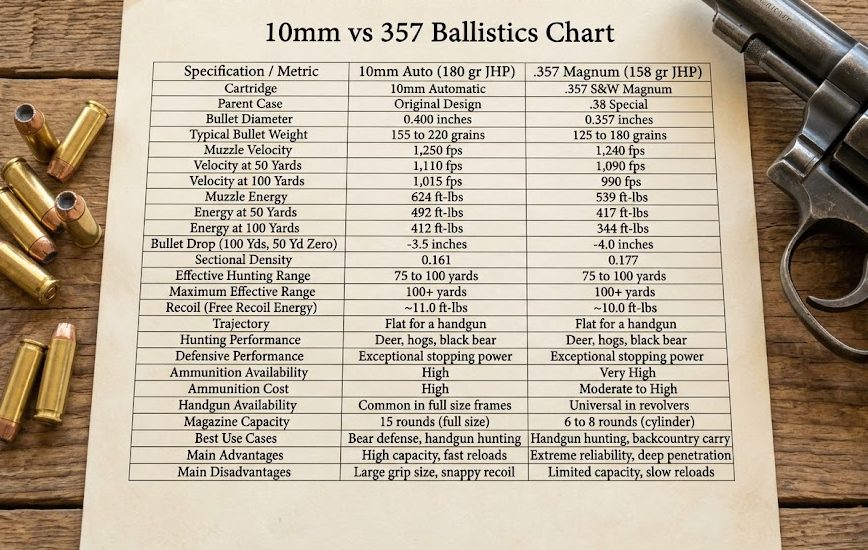
The comparison table above shows two different calibers arriving at almost the exact same ballistic destination. When comparing standard full power hunting loads, both cartridges leave the muzzle at roughly 1,250 feet per second. Because the 10mm pushes a slightly heavier 180 grain bullet compared to the 158 grain bullet of the .357 Magnum, it generates a bit more raw kinetic energy.
However, the .357 Magnum compensates for its lighter weight with superior sectional density. The narrower .357 caliber bullet concentrates its energy over a smaller surface area, allowing it to penetrate just as deeply as the heavier 10mm bullet. Downrange, both cartridges retain their speed and energy remarkably well for handguns, delivering almost identical bullet drop and striking power at 100 yards.
For the shooter, the ballistic similarities mean the real difference lies in the firearm. The 10mm offers modern semi-automatic advantages like 15 round magazines and quick reloads. The .357 Magnum offers the mechanical simplicity and bullet weight versatility of a revolver. Both provide more than enough power to stop human threats and medium to large game animals effectively.
Detailed Comparison Sections
Understanding the Comparison Chart
To truly understand how these cartridges match up, you must look at how they are measured. Semi-automatic 10mm pistols typically feature 4.5 to 5 inch barrels, which optimize powder burn. Revolvers chambered in .357 Magnum are often measured using 4 inch or 6 inch barrels. A longer barrel on a .357 Magnum will dramatically increase its velocity and energy, often allowing it to surpass the 10mm in raw performance.
How to Read the Ballistics Chart
When analyzing handgun ballistics for hunting and backcountry defense, kinetic energy and sectional density are the most important numbers. Kinetic energy provides the crushing force required to stop a threat, while sectional density predicts how reliably the bullet will penetrate through thick muscle and bone to reach vital organs.
Velocity Comparison
Both of these cartridges are incredibly fast for handguns. The 10mm easily pushes a 180 grain bullet to 1,250 feet per second. A 4 inch .357 Magnum revolver will push a 158 grain bullet to 1,240 feet per second. If you step down to lighter bullets, both cartridges can easily exceed 1,400 feet per second. This blistering speed ensures rapid, reliable bullet expansion upon impact.
Energy Comparison
At the muzzle, a full power 10mm load generates roughly 624 foot pounds of energy. A standard .357 Magnum produces around 539 foot pounds. While the 10mm has a slight edge on paper due to its heavier bullet mass, no animal or human threat will notice the difference of 80 foot pounds. Both cartridges deliver devastating terminal performance and hit with enough force to drop large predators.
Trajectory Comparison
Trajectory is highly relevant for handgun hunters who may need to take shots out to 75 or 100 yards. Both of these cartridges excel in this category.
Bullet Drop Comparison
If you zero both handguns at 50 yards, they will shoot incredibly flat out to 100 yards. The 10mm will drop roughly 3.5 inches at 100 yards. The .357 Magnum will drop about 4.0 inches. This flat flight path allows hunters to hold their sights directly on the vitals of a deer without calculating complex drop holds.
Sectional Density Comparison
Sectional density measures a bullet’s weight relative to its diameter. A higher number indicates better penetrating capability. The .357 Magnum has a very high sectional density of 0.177 for a 158 grain bullet. The 10mm has a sectional density of 0.161 for a 180 grain bullet. This is why the .357 Magnum is legendary for punching through car doors and heavy bear skulls despite firing a lighter projectile.
Accuracy Potential
Both cartridges are mechanically capable of extreme accuracy. The .357 Magnum has a long history in precision target shooting, largely because fixed barrel revolvers offer incredible inherent accuracy. The 10mm is also highly accurate, but achieving precision with a semi-automatic handgun requires mastering a more complex trigger system and managing the violent slide cycling under heavy recoil.
Effective Range Comparison
For personal defense against human threats, both cartridges are devastating inside 25 yards. For handgun hunting, both the 10mm and the .357 Magnum are highly effective out to 75 or 100 yards in the hands of a practiced marksman.
Hunting Performance Comparison
If you are hunting whitetail deer or feral hogs with a handgun, both calibers are phenomenal choices. They create large wound channels and usually provide complete pass through penetration. The .357 Magnum is often favored for hunting simply because it can be chambered in lever-action rifles, allowing hunters to use the exact same ammunition in their rifle and sidearm.
Defensive Target Performance
For concealed carry and urban defense, both calibers are extremely powerful and carry a significant risk of over penetration. A hollow point bullet from either cartridge can easily pass entirely through a human target and strike whatever is behind them. They are generally considered too powerful for everyday concealed carry unless loaded with specialized lightweight defensive ammunition.
Recoil Comparison
Both cartridges produce heavy, snappy recoil. A 10mm generates roughly 11.0 foot pounds of free recoil energy. A .357 Magnum generates roughly 10.0 foot pounds. The perceived recoil feels very different, however. A polymer 10mm absorbs some energy as the slide cycles backward, creating a sharp snap. A heavy steel .357 Magnum revolver transfers all the energy directly into the shooter’s palm, resulting in a heavy roll.
Ammunition Cost Comparison
Neither cartridge is cheap to shoot. Because they are high pressure magnum rounds, they require thick brass and heavy powder charges. Practice ammunition for the .357 Magnum is generally a bit more affordable than the 10mm, but you will pay premium prices for high quality hunting loads in either caliber.
Ammunition Availability
The .357 Magnum has been in continuous production since 1935. You can find it at literally every sporting goods store in America. The 10mm has experienced a massive resurgence in recent years, making it widely available, but it is still slightly harder to find in rural hardware stores than the classic revolver cartridge.
Handgun Compatibility
This is the ultimate deciding factor. The 10mm requires a large frame semi-automatic pistol. The grip is wide to accommodate the long cartridges, which can be difficult for shooters with small hands. The .357 Magnum is a revolver cartridge. Revolvers can be fitted with custom grips of any size to perfectly match the shooter’s hand, offering a more tailored ergonomic experience.
Pros and Cons of 10mm
Pros:
- High capacity magazines hold 15 rounds.
- Very fast reloads under stress.
- Massive kinetic energy and stopping power.
- Flat trajectory for long range handgun hunting.
Cons:
- Large, bulky grip size.
- Snappy recoil can be difficult to control.
- Magazines can fail in dirty backcountry environments.
Pros and Cons of .357 Magnum
Pros:
- Unmatched mechanical reliability of revolvers.
- Exceptional sectional density for deep penetration.
- Can safely fire cheaper .38 Special ammunition for practice.
- Compatible with classic lever-action rifles.
Cons:
- Limited to 6 or 8 rounds.
- Very slow to reload under stress.
- Heavy double action triggers require practice.
Which Cartridge Is Better for Beginners?
Neither cartridge is suitable for a beginner. The concussive blast and heavy recoil of both calibers will almost certainly cause a new shooter to flinch. However, the .357 Magnum offers a unique advantage. You can load a .357 Magnum revolver with incredibly mild .38 Special ammunition, allowing a beginner to learn the fundamentals with zero recoil before stepping up to full power loads.
Which Cartridge Is Better for Hunting?
Both are excellent, but the .357 Magnum has a slight historical edge for hunting. The ability to use heavy 180 grain hard cast bullets in a revolver guarantees deep, straight line penetration. Furthermore, pairing a .357 Magnum revolver with a .357 Magnum lever-action rifle creates the perfect brush hunting combination.
Which Cartridge Is Better for Backcountry Carry?
This is an ongoing debate among outdoorsmen. The 10mm gives you 15 rounds of magnum power, which is highly comforting when facing a charging bear or a pack of wild hogs. However, semi-automatic handguns can jam if pressed against an animal or dropped in the mud. The .357 Magnum revolver only holds 6 rounds, but it will fire reliably even if pressed directly into the side of an attacking predator.
Which Cartridge Should You Choose?
Choose the 10mm if you want maximum firepower, high capacity magazines, and modern semi-automatic ergonomics for your backcountry defense sidearm. Choose the .357 Magnum if you prefer the absolute mechanical reliability of a revolver, plan to hunt with a lever-action rifle, and want the versatility to practice with cheap .38 Special ammunition.
Verdict
The 10mm Auto and the .357 Magnum offer the exact same solution using completely different machinery. Ballistically, they are practically identical in the field. They both hit like a sledgehammer, penetrate deeply, and have successfully stopped the largest predators on the North American continent. The 10mm brings that massive power into the 21st century, giving shooters the distinct advantage of high capacity magazines and rapid reloads. The .357 Magnum remains a timeless classic that prioritizes absolute mechanical reliability and versatile ammunition capability over volume of fire. If you are comfortable carrying a large semi-automatic pistol, the 10mm provides unmatched firepower. If you trust your life to the simplicity of a heavy steel cylinder, the .357 Magnum will never let you down.
FAQs
Is a 10mm more powerful than a .357 Magnum?
On paper, a standard 10mm produces slightly more muzzle energy than a standard .357 Magnum fired from a 4 inch barrel. However, if you fire a .357 Magnum from a longer 6 inch barrel or use heavy specialty hunting loads, the .357 Magnum can easily equal or exceed the energy of a 10mm.
Can you use a .357 Magnum for bear defense?
Yes, the .357 Magnum is a highly respected choice for bear defense. When loaded with 180 grain hard cast lead bullets, it will easily crush through the thick skull and heavy muscle of a charging bear to reach the central nervous system.
Does a 10mm kick harder than a .357 Magnum?
Both cartridges produce very similar amounts of recoil energy. The perceived kick depends entirely on the firearm. A heavy steel revolver will roll in the hand, while a lighter polymer 10mm pistol will snap violently backward. Most shooters find heavy steel revolvers slightly more comfortable to shoot with full power loads.
Can I shoot .38 Special in a .357 Magnum?
Yes. A .357 Magnum revolver can safely chamber and fire .38 Special ammunition. The .38 Special casing is slightly shorter and produces significantly less pressure and recoil, making it perfect for cheap target practice and training.
Can I shoot .40 S&W in a 10mm?
While .40 S&W shares the same bullet diameter as the 10mm and will physically fit into the chamber, it is generally not recommended by manufacturers. The shorter .40 S&W case relies on the pistol’s extractor to hold it in place, which can cause excessive wear, reliable feeding issues, and potential extractor breakage over time.