The main .45 ACP bullet types include Full Metal Jacket (FMJ), Jacketed Hollow Point (JHP), Lead Semi-Wadcutter (LSWC), Total Metal Jacket (TMJ), and Extreme Penetrator or Solid Copper monolithic rounds. FMJ and TMJ loads are the standard choices for affordable range training, target shooting, and historical pistol operation. JHP ammunition is specifically engineered for civilian concealed carry and law enforcement home defense to maximize stopping power while preventing over-penetration. Because the .45 ACP is a foundational defensive and military cartridge, all of these bullet variants are widely available to everyday shooters without restriction.
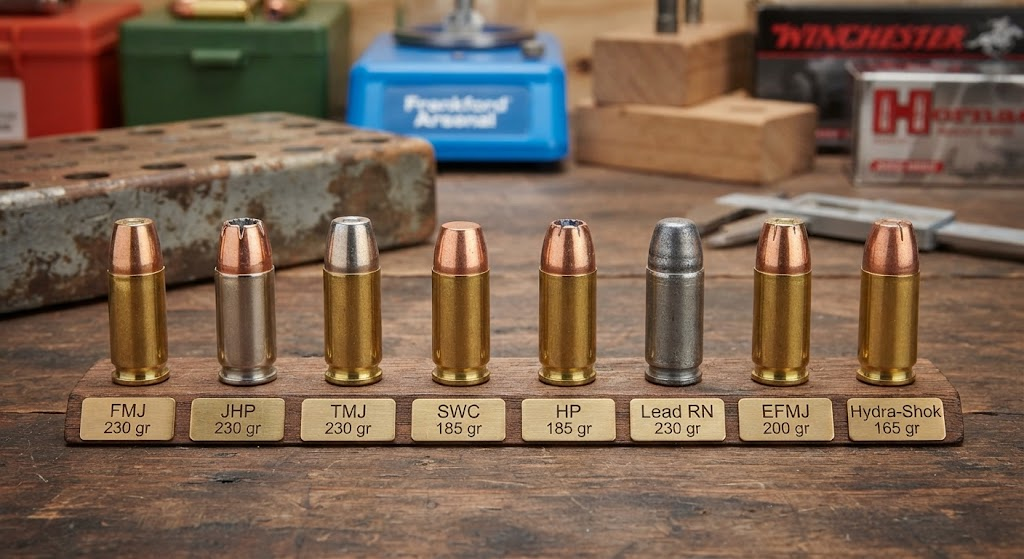
45 ACP Bullet Types
The .45 Automatic Colt Pistol (11.43×23mm) cartridge is inherently subsonic, designed from its inception to push a heavy, slow-moving projectile with high momentum and reliable terminal effect. For target shooters, the priority is feeding reliability and clean paper targets. For personal defense, the focus shifts to controlled hydraulic expansion at moderate velocities, ensuring that the heavy bullet expands without sacrificing necessary penetration depth.
Below is a comprehensive comparison of the core .45 ACP bullet types based on published manufacturer data:
| Bullet Type | Typical Projectile Design | Main Purpose | Typical Weight | Typical Velocity | Key Characteristic |
| FMJ | Full Metal Jacket (Ball) | Range training / military surplus | 230 gr | 830 to 850 fps | Lead core completely covered by copper jacket |
| JHP | Jacketed Hollow Point | Self-defense / home defense | 230 gr | 850 to 900 fps | Hollow cavity expands rapidly upon soft-tissue impact |
| LSWC | Lead Semi-Wadcutter | Target competition / plinking | 185 to 200 gr | 770 to 850 fps | Flat nose with a sharp shoulder that cuts clean holes |
| TMJ | Total Metal Jacket | Indoor range training | 230 gr | 830 fps | Encapsulated base prevents airborne lead vapors |
| Solid Copper | Monolithic Fluted Solid | Barrier penetration / defense | 118 to 185 gr | 1,000 to 1,150 fps | Non-expanding fluted design creates hydraulic wound channels |
45 ACP FMJ Ammo
.45 ACP FMJ (Full Metal Jacket) ammo, often referred to as “hardball,” is the original military specification round introduced alongside the M1911 pistol in 1911. The standard load features a 230-grain full metal jacket bullet traveling at roughly 830 to 850 feet per second (fps). Because the heavy 230-grain bullet travels at subsonic speeds, it naturally mimics the exact point of impact and recoil impulse of premium defensive loads. FMJ ammunition feeds flawlessly in almost every 1911, Glock, or modern semi-automatic pistol, making it the undisputed standard for high-volume range practice.
45 ACP JHP Ammo
.45 ACP JHP (Jacketed Hollow Point) ammo is engineered for civilian concealed carry and law enforcement protection. Because the .45 ACP operates at relatively low velocities compared to cartridges like the 9mm, expanding bullets must be meticulously designed to open reliably at sub-900 fps speeds. Premium defensive loads, such as the Federal HST 230-grain JHP or Speer Gold Dot 230-grain JHP, utilize large cavity mouths and skived jacket walls to peel outward into a wide mushroom shape upon impact. This transfers maximum kinetic energy to the target while reducing the risk of over-penetration in urban environments.
45 ACP LSWC Ammo
.45 ACP LSWC (Lead Semi-Wadcutter) ammo is a specialized target projectile featuring an unjacketed lead body with a flat-faced nose and a sharp shoulder. Commonly loaded in 185-grain or 200-grain weights traveling around 800 fps, LSWC bullets are heavily favored by competitive target shooters. The sharp shoulder of the semi-wadcutter cleanly cuts paper targets, allowing range officers and shooters to easily read scoring rings. Furthermore, LSWC bullets have a long history of success in tuned match-grade pistols when loaded to optimal target velocities.
45 ACP TMJ Ammo
.45 ACP TMJ (Total Metal Jacket) ammo is an evolution of the standard FMJ bullet designed specifically for indoor shooting ranges. In a traditional FMJ bullet, the base of the lead core is exposed at the bottom of the projectile. When superheated by expanding propellant gases, that exposed lead vaporizes and contributes significantly to airborne lead pollution in poorly ventilated indoor ranges. TMJ ammunition completely encapsulates the lead core in copper, including the base, ensuring clean indoor training environments without sacrificing feeding reliability.
45 ACP Solid Copper Monolithic Ammo
.45 ACP solid copper monolithic ammo (such as the Lehigh Defense Extreme Defender or Barnes solid lines) represents modern barrier-penetrating technology. Instead of using a traditional hollow point that can plug with heavy winter clothing or auto glass, these lightweight (118 to 185 grain), CNC-machined solid copper bullets feature fluted transfer noses. As the bullet enters fluid or tissue, the flutes redirect hydraulic energy outward to create massive permanent wound channels while punching straight through intermediate barriers like car doors and heavy bone.
45 ACP Ammo Types Compared
Different .45 ACP bullet types explained by their optimal application:
- Concealed Carry & Home Defense: 230-grain Jacketed Hollow Points (JHP) provide the proven balance of massive mass, controlled expansion, and low over-penetration risk.
- High-Volume Range Training: 230-grain Full Metal Jacket (FMJ) ammunition offers the exact weight and recoil profile of defensive rounds at a fraction of the cost.
- Indoor Range Practice: Total Metal Jacket (TMJ) loads prevent lead vaporization, making them the safest choice for enclosed indoor shooting facilities.
- Target Competition: Lead Semi-Wadcutter (LSWC) bullets cut clean holes in paper and offer soft-recoiling target accuracy.
- Barrier Penetration & Tactical Use: Solid copper monolithic fluted bullets defeat heavy barriers without relying on traditional hollow-point expansion.
How To Choose 45 ACP Ammo
Choosing the right .45 ACP bullet type depends on your firearm’s feed ramp geometry and your primary intended application. If you carry a classic 1911 with a traditional, unpolished mil-spec throat, you should select standard 230-grain FMJ or traditional rounded JHP ammunition (such as Hornady Critical Duty or Federal Hydra-Shok), as aggressive or overly wide hollow-point cavities can occasionally snag on the feed ramp and cause malfunctions. For modern polymer striker-fired pistols like a Glock 21, almost any modern JHP will feed reliably. Always run at least one full magazine of your chosen defensive ammunition through your carry pistol to verify 100 percent reliability before trusting it for personal protection.
Pros And Cons Of Different 45 ACP Bullet Types
Full Metal Jacket (FMJ)
- Pros: Inexpensive, feeds flawlessly in every handgun, mimics the exact recoil of standard defensive loads.
- Cons: Over-penetrates in soft targets; zero expansion makes it a poor choice for home defense.
Jacketed Hollow Point (JHP)
- Pros: Outstanding energy transfer, rapid expansion, engineered to prevent over-penetration in populated areas.
- Cons: Significantly more expensive per round; hollow cavities can occasionally clog with thick fabric.
Total Metal Jacket (TMJ)
- Pros: Eliminates airborne lead exposure at indoor ranges; protects the barrel from lead fouling.
- Cons: Slightly more expensive than traditional exposed-base FMJ ammunition.
Solid Copper Monolithic
- Pros: Unmatched barrier penetration; unaffected by heavy clothing or glass clogging.
- Cons: Extremely expensive per round; lighter weights can alter point-of-impact at distance.
FAQs
What are the different types of 45 ACP bullets?
The main types include Full Metal Jacket (FMJ), Jacketed Hollow Point (JHP), Lead Semi-Wadcutter (LSWC), Total Metal Jacket (TMJ), and solid copper monolithic bullets.
What is .45 ACP FMJ ammo?
FMJ (Full Metal Jacket), also called ball ammo, features a lead core wrapped in a copper shell. It does not expand and is used for military deployment and affordable target practice.
What is .45 ACP JHP ammo?
JHP (Jacketed Hollow Point) ammo has a hollow cavity in the nose that forces the bullet to peel open and expand upon impact, making it the standard choice for self-defense.
What is the best weight for .45 ACP ammo?
The 230-grain weight class is universally considered the gold standard for .45 ACP, matching the original military design parameters and offering optimal momentum and terminal energy.
Is .45 ACP naturally subsonic?
Yes. Standard .45 ACP loads typically travel between 800 and 900 fps, which is comfortably below the speed of sound (roughly 1,125 fps), making it inherently quiet when paired with a firearm suppressor.
What is the difference between FMJ and TMJ in .45 ACP?
FMJ bullets leave the lead base exposed at the bottom of the projectile, whereas TMJ bullets completely enclose the lead core in copper, reducing lead vapor exposure at indoor ranges.
Can a 1911 feed hollow point ammo reliably?
Modern 1911 pistols with polished feed ramps handle hollow points well, but some vintage or mil-spec 1911s are designed strictly for round-nose FMJ ammunition and may experience jams with wide hollow cavities.
What is .45 ACP +P ammo?
+P ammunition is loaded to a higher internal pressure specification, generating slightly higher velocities (around 950 to 1,050 fps) to ensure reliable hollow-point expansion from compact handguns.
What is the effective range of .45 ACP?
The effective practical range for accurate self-defense or target engagement with a .45 ACP handgun is generally within 50 yards, though the bullet retains lethal ballistic energy much further out.
Why is .45 ACP so popular?
It has a legendary historical track record in the military, offers massive frontal diameter and heavy mass, and delivers exceptional stopping power while operating at comfortable subsonic pressures.
Are solid copper bullets good for .45 ACP?
Yes, solid copper fluted bullets (like Lehigh Defense) provide deep, barrier-defeating penetration without relying on traditional expansion, making them popular for specialized defense.
45 ACP Bullet Types: Final Answer
When evaluating .45 ACP bullet types, selection is divided between high-volume training and high-stakes defense. Traditional 230-grain Full Metal Jacket (FMJ) ammunition serves as the reliable, affordable baseline for range practice and matches the exact ballistic profile of standard service loads. For civilian concealed carry and home defense, premium Jacketed Hollow Point (JHP) rounds—such as Federal HST or Speer Gold Dot—provide the necessary hydraulic expansion to stop threats effectively. Meanwhile, Total Metal Jacket (TMJ) and solid copper monolithic rounds offer specialized solutions for clean indoor training and uncompromised barrier penetration, ensuring that the venerable .45 ACP remains a peak performer.