Understanding 45-70 ballistics requires examining how different bullet weights and powder charges perform across various distances. The following tables and analysis provide comprehensive data on velocity, energy, and trajectory for modern .45-70 Government factory ammunition.
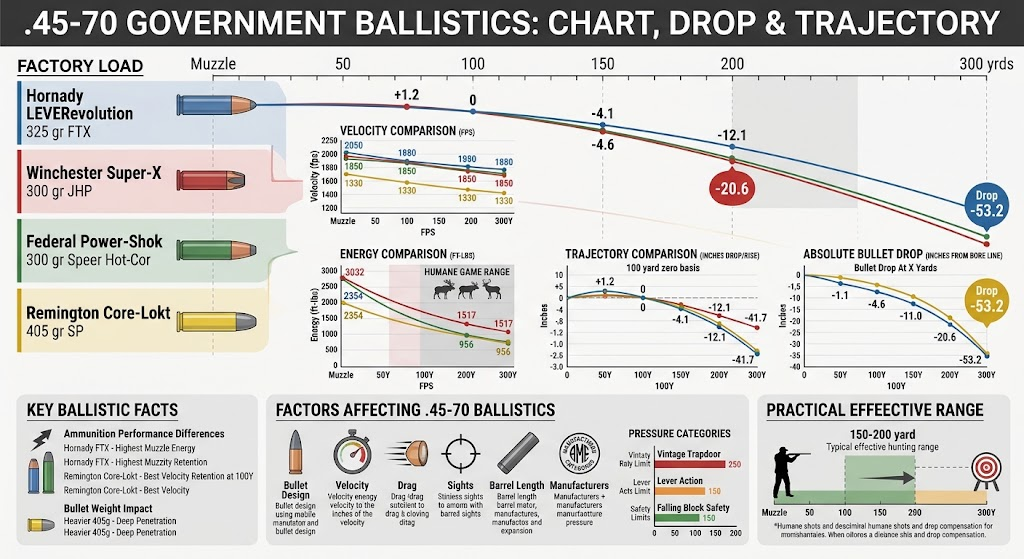
Table of Contents [Click to minimize]
45-70 Ballistics Chart
| Bullet Weight | Bullet Type | Manufacturer and Load | Muzzle Velocity | Velocity At 50 Yards | Velocity At 100 Yards | Velocity At 150 Yards | Velocity At 200 Yards | Velocity At 300 Yards | Muzzle Energy | Energy At 50 Yards | Energy At 100 Yards | Energy At 150 Yards | Energy At 200 Yards | Energy At 300 Yards | Bullet Drop At 50 Yards | Bullet Drop At 100 Yards | Bullet Drop At 150 Yards | Bullet Drop At 200 Yards | Bullet Drop At 300 Yards | Trajectory At 50 Yards | Trajectory At 100 Yards | Trajectory At 150 Yards | Trajectory At 200 Yards | Trajectory At 300 Yards | Ballistic Coefficient |
| 325 gr | FTX | Hornady LEVERevolution | 2050 fps | 1887 fps | 1731 fps | 1586 fps | 1450 fps | 1225 fps | 3032 ft-lbs | 2570 ft-lbs | 2163 ft-lbs | 1815 ft-lbs | 1517 ft-lbs | 1083 ft-lbs | -1.1 in | -4.6 in | -11.0 in | -20.6 in | -53.2 in | 1.2 in | 0.0 in | -4.1 in | -12.1 in | -41.7 in | 0.230 |
| 300 gr | JHP | Winchester Super-X | 1880 fps | 1681 fps | 1498 fps | 1335 fps | 1198 fps | 1021 fps | 2354 ft-lbs | 1882 ft-lbs | 1494 ft-lbs | 1187 ft-lbs | 956 ft-lbs | 694 ft-lbs | -1.4 in | -6.1 in | -14.6 in | -27.8 in | -74.3 in | 1.6 in | 0.0 in | -5.5 in | -15.7 in | -56.3 in | 0.197 |
| 300 gr | Speer Hot-Cor | Federal Power-Shok | 1850 fps | 1665 fps | 1495 fps | 1342 fps | 1209 fps | 1025 fps | 2280 ft-lbs | 1846 ft-lbs | 1489 ft-lbs | 1199 ft-lbs | 974 ft-lbs | 700 ft-lbs | -1.5 in | -6.3 in | -15.1 in | -28.7 in | -75.8 in | 1.6 in | 0.0 in | -5.7 in | -16.3 in | -57.4 in | 0.199 |
| 405 gr | SP | Remington Core-Lokt | 1330 fps | 1245 fps | 1172 fps | 1110 fps | 1056 fps | Not verified | 1590 ft-lbs | 1393 ft-lbs | 1235 ft-lbs | 1108 ft-lbs | 1003 ft-lbs | Not verified | -3.1 in | -13.0 in | -30.9 in | -57.7 in | Not verified | 3.4 in | 0.0 in | -11.4 in | -31.7 in | Not verified | 0.281 |
The 45-70 ballistics chart assumes a 100 yard sight in distance with a 1.5 inch sight height over the bore. Bullet drop represents absolute gravitational fall from the muzzle, while trajectory represents the path relative to the shooter’s line of sight.
45-70 Bullet Drop Chart
| Manufacturer and Load | Bullet Weight | Sight-In Distance | Bullet Drop At 50 Yards | Bullet Drop At 100 Yards | Bullet Drop At 150 Yards | Bullet Drop At 200 Yards | Bullet Drop At 300 Yards |
| Hornady LEVERevolution | 325 gr | 100 Yards | -1.1 in | -4.6 in | -11.0 in | -20.6 in | -53.2 in |
| Winchester Super-X | 300 gr | 100 Yards | -1.4 in | -6.1 in | -14.6 in | -27.8 in | -74.3 in |
| Federal Power-Shok | 300 gr | 100 Yards | -1.5 in | -6.3 in | -15.1 in | -28.7 in | -75.8 in |
| Remington Core-Lokt | 405 gr | 100 Yards | -3.1 in | -13.0 in | -30.9 in | -57.7 in | Not verified |
Bullet Drop Analysis
- The 325 grain Hornady load drops 20.6 inches at 200 yards, making it the flattest shooting option listed.
- The 405 grain Remington load drops 57.7 inches at 200 yards due to its lower initial velocity.
- By 300 yards, standard 300 grain hollow point loads drop over 70 inches from the bore line.
- Heavier bullets with lower velocities experience exponentially greater drop past 100 yards.
45-70 Trajectory Chart
| Manufacturer and Load | Bullet Weight | Sight-In Distance | Trajectory At 50 Yards | Trajectory At 100 Yards | Trajectory At 150 Yards | Trajectory At 200 Yards | Trajectory At 300 Yards |
| Hornady LEVERevolution | 325 gr | 100 Yards | +1.2 in | 0.0 in | -4.1 in | -12.1 in | -41.7 in |
| Winchester Super-X | 300 gr | 100 Yards | +1.6 in | 0.0 in | -5.5 in | -15.7 in | -56.3 in |
| Federal Power-Shok | 300 gr | 100 Yards | +1.6 in | 0.0 in | -5.7 in | -16.3 in | -57.4 in |
| Remington Core-Lokt | 405 gr | 100 Yards | +3.4 in | 0.0 in | -11.4 in | -31.7 in | Not verified |
Positive trajectory numbers mean the bullet is traveling above the line of sight, while negative numbers mean it has fallen below.
45-70 Ammo Ballistics
| Manufacturer and Load | Bullet Weight | Muzzle Velocity | Velocity at 100 Yards | Muzzle Energy | Energy at 100 Yards |
| Hornady LEVERevolution | 325 gr | 2050 fps | 1731 fps | 3032 ft-lbs | 2163 ft-lbs |
| Winchester Super-X | 300 gr | 1880 fps | 1498 fps | 2354 ft-lbs | 1494 ft-lbs |
| Remington Core-Lokt | 405 gr | 1330 fps | 1172 fps | 1590 ft-lbs | 1235 ft-lbs |
Ammunition Performance Differences
- The 325 grain Hornady FTX load generates 3032 foot pounds of muzzle energy, outperforming standard 300 grain loads by nearly 700 foot pounds.
- The 405 grain Remington load retains 74 percent of its initial velocity at 100 yards.
- Polymer tipped bullets, like the Hornady FTX, maintain velocity better than traditional flat nose or hollow point designs.
- Always match the ammunition pressure category to your specific firearm, as vintage trapdoor rifles cannot safely fire modern high pressure hunting loads.
45-70 Government Ballistics by Bullet Weight
| Manufacturer and Load | Bullet Weight | Muzzle Velocity | Velocity at 200 Yards | Muzzle Energy | Energy at 200 Yards |
| Winchester Super-X | 300 gr | 1880 fps | 1198 fps | 2354 ft-lbs | 956 ft-lbs |
| Hornady LEVERevolution | 325 gr | 2050 fps | 1450 fps | 3032 ft-lbs | 1517 ft-lbs |
| Remington Core-Lokt | 405 gr | 1330 fps | 1056 fps | 1590 ft-lbs | 1003 ft-lbs |
Bullet Weight Impact
- Lighter 300 grain bullets achieve higher muzzle velocities but lose speed rapidly due to lower ballistic coefficients.
- The mid weight 325 grain bullet offers the highest 200 yard energy at 1517 foot pounds.
- Heavy 405 grain bullets start slow but provide deep penetration characteristics preferred for large game.
45-70 Velocity and Energy Chart
| Distance | Hornady 325 gr Velocity | Hornady 325 gr Energy | Winchester 300 gr Velocity | Winchester 300 gr Energy |
| Muzzle | 2050 fps | 3032 ft-lbs | 1880 fps | 2354 ft-lbs |
| 50 Yards | 1887 fps | 2570 ft-lbs | 1681 fps | 1882 ft-lbs |
| 100 Yards | 1731 fps | 2163 ft-lbs | 1498 fps | 1494 ft-lbs |
| 150 Yards | 1586 fps | 1815 ft-lbs | 1335 fps | 1187 ft-lbs |
| 200 Yards | 1450 fps | 1517 ft-lbs | 1198 fps | 956 ft-lbs |
Velocity and Energy Retention
- The 325 grain load loses 30 percent of its velocity by 200 yards.
- The 300 grain load falls below 1000 foot pounds of energy shortly after 150 yards.
- At 100 yards, modern .45-70 Government ballistics still deliver well over 1400 foot pounds of energy, sufficient for North American big game.
Factors That Affect 45-70 Ballistics
Bullet Weight and Bullet Design
Bullet weight directly impacts muzzle velocity and downrange momentum. Traditional flat nose bullets are required for tubular magazines but suffer from poor aerodynamics. Modern polymer tipped options improve aerodynamics while remaining safe in lever action rifles.
Muzzle Velocity
Higher muzzle velocities flatten the trajectory and increase initial kinetic energy. Velocity is dictated by powder charge, bullet weight, and the pressure limits of the intended firearm.
Ballistic Coefficient and Aerodynamic Drag
The .45-70 fires heavy, wide projectiles with inherently low ballistic coefficients (typically between 0.150 and 0.290). This high aerodynamic drag causes rapid velocity loss and pronounced bullet drop at extended ranges.
Sight-In Distance and Sight Height
Zeroing at 100 yards keeps the mid range trajectory manageable for hunting. Taller sights or magnified optics alter the line of sight relative to the bore, slightly shifting the trajectory curve.
Rifle Barrel Length
Most factory data is generated using 24 inch test barrels. Shorter 18.5 inch guide guns will produce muzzle velocities roughly 100 to 150 feet per second slower than published data.
Differences Between Ammunition Manufacturers
Manufacturers load .45-70 ammunition to different pressure specifications. Brands like Buffalo Bore produce maximum pressure loads for modern firearms, while Remington traditional loads are kept to lower pressures safe for vintage rifles.
Ammunition Pressure Category and Firearm Compatibility
Ammunition is strictly categorized by pressure. “Trapdoor” loads are low pressure (under 28,000 CUP) for vintage guns. Lever action loads run at medium pressures (up to 40,000 CUP). High pressure loads are reserved exclusively for strong modern falling block single shots like the Ruger No. 1.
How Far Can a 45-70 Bullet Travel?
While a .45-70 bullet can physically travel over a mile if fired at an optimal upward angle, its practical hunting range is much shorter. Due to the severe 45-70 bullet drop chart figures, most hunters limit shots to 150 or 200 yards to ensure humane terminal performance and accurate shot placement. The heavy projectile retains dangerous lethal energy long after its trajectory makes hitting a specific target impractical.
Frequently Asked Questions
1. What is .45-70 ballistics?
It refers to the flight path, velocity, energy, and physical performance of the .45-70 Government cartridge from the moment it leaves the barrel until it impacts the target.
2. Where can I find a 45-70 ballistics chart?
A comprehensive 45-70 ballistics chart is located at the top of this article, detailing factory load data from major manufacturers.
3. What is the effective range of a .45-70 Government rifle?
The effective range is typically 150 to 200 yards for hunting big game, depending on the load and the shooter’s ability to compensate for trajectory.
4. How much does a .45-70 bullet drop at 100 yards?
When zeroed at 100 yards, the bullet drop from the bore line is roughly 4.5 to 6.5 inches depending on the specific load.
5. How much does a .45-70 bullet drop at 200 yards?
A standard 300 grain bullet zeroed at 100 yards will drop approximately 15 to 16 inches below the line of sight at 200 yards.
6. What is the trajectory of a .45-70 bullet at 300 yards?
At 300 yards, most 300 grain to 325 grain factory loads drop between 40 and 60 inches below the line of sight.
7. How fast does a .45-70 bullet travel?
Muzzle velocities range from 1300 feet per second for heavy traditional loads to over 2000 feet per second for modern, lighter hunting loads.
8. How much energy does a .45-70 bullet produce?
Depending on the load, muzzle energy ranges from 1500 foot pounds to over 3000 foot pounds.
9. Does bullet weight affect .45-70 ballistics?
Yes, lighter bullets fly faster and flatter at short ranges, while heavier bullets retain momentum better but exhibit more dramatic drop.
10. Are all .45-70 Government ammunition loads suitable for every rifle?
No, modern high pressure ammunition can destroy vintage trapdoor rifles. Always check manufacturer guidelines for your specific firearm.