The main difference between .380 ACP and .38 Special stopping power is that the .38 Special typically drives a significantly heavier bullet, granting it superior momentum and deeper penetration, whereas the .380 ACP relies on lighter, faster bullets optimized for ultra-compact semi-automatic pistols.
When discussing firearms for self-defense, “stopping power” is a broad and often subjective term that lacks a single scientifically established measurement. No pistol cartridge can guarantee an immediate physical stop, as terminal performance depends heavily on ammunition design, shot placement, the physical constitution of the threat, and specific environmental circumstances.
To determine which of these popular concealed carry calibers is truly more effective, we cannot rely on muzzle energy alone. Instead, this article evaluates the measurable factors that influence terminal performance: actual muzzle velocity, muzzle energy, bullet weight, momentum, bullet diameter, sectional density, penetration depth, expanded bullet diameter, recoil, and ammunition design based on independent testing and manufacturer specifications.
By looking objectively at 380 vs 38 Special stopping power through the lens of modern ballistic science, you will have the data necessary to make an informed choice for your personal protection.
Table of Contents [Click to open]
380 ACP vs 38 Special Comparison Table
To establish a baseline, the following table compares the typical specifications and performance metrics of both cartridges using standard defensive loads fired from their most common concealed carry platforms (a 2.75-inch micro-compact pistol for the .380 ACP, and a 2-inch snub-nose revolver for the .38 Special).
| Specification | .380 ACP | .38 Special (Standard & +P) |
| Bullet Diameter | 0.355 inches (9mm) | 0.357 inches |
| Typical Bullet Weight | 85 gr, 90 gr, 95 gr, 99 gr | 110 gr, 125 gr, 130 gr, 135 gr, 158 gr |
| Common Bullet Types | FMJ, JHP, Solid Copper | LRN, LSWCHP, FMJ, JHP |
| Typical Muzzle Velocity | 850 – 1,000 fps (2.75″ barrel) | 750 – 950 fps (2″ barrel) |
| Muzzle Energy | 150 – 200 ft-lbs | 200 – 250 ft-lbs (up to 300 ft-lbs +P) |
| Momentum | ~12.8 lbs-ft/sec (90gr load) | ~16.5 lbs-ft/sec (135gr load) |
| Maximum Pressure (SAAMI) | 21,500 psi | 17,000 psi (Standard) / 20,000 psi (+P) |
| Typical Penetration | 9 – 14 inches (10% ordnance gel) | 11 – 16 inches (10% ordnance gel) |
| Typical Expansion | 0.40 – 0.55 inches | 0.45 – 0.60 inches |
| Recoil | Low to Moderate (snappy in micro pistols) | Moderate to High (in lightweight snubbies) |
| Effective Range | 10 – 15 yards | 15 – 25 yards |
| Common Barrel Length | 2.5 to 3.8 inches | 1.875 to 4 inches |
| Ammunition Availability | Very High | Very High |
| Ammunition Cost | Moderate | Moderate to slightly higher |
| Concealed Carry Suitability | Excellent (Pocket/IWB) | Excellent (IWB/Pocket) |
| Best Use | Deep concealment, backup gun | Primary concealed carry, backup gun, home defense |
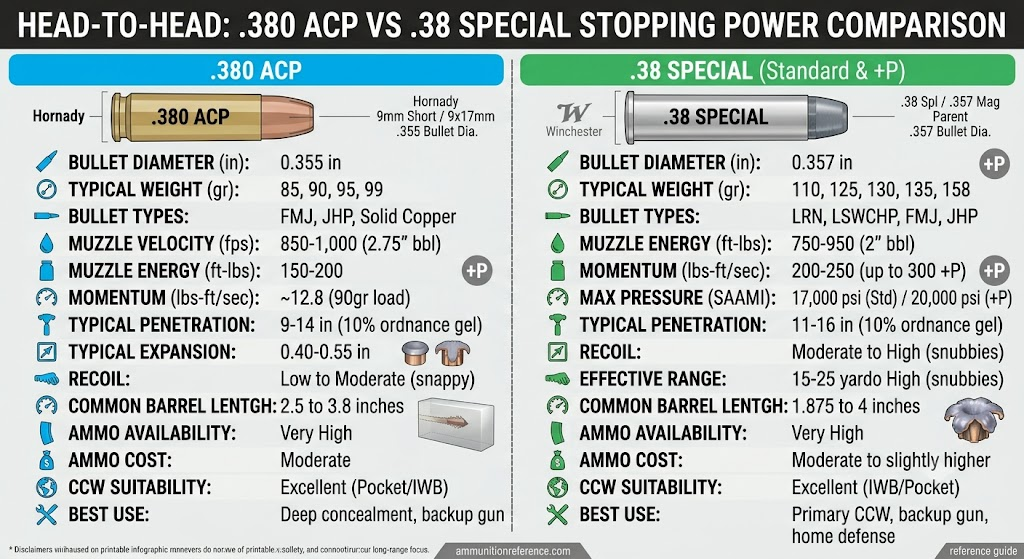
Looking at the raw specifications, it becomes immediately apparent that while bullet diameters are practically identical (0.355″ vs. 0.357″), the .38 Special achieves its ballistic footprint through bullet mass. A typical .38 Special self-defense bullet weighs between 35% and 60% more than a standard .380 ACP bullet. Furthermore, the .38 Special operates at a lower chamber pressure but still yields higher overall muzzle energy and momentum due to a larger case capacity.
Which Has More Stopping Power: .380 ACP or .38 Special?
When analyzing measurable ballistic characteristics, the .38 Special possesses greater overall stopping power than the .380 ACP, particularly when utilizing modern +P (overpressure) ammunition.
This advantage does not come from bullet diameter—as both are essentially 9mm projectiles—but rather from the significantly heavier bullet weights the .38 Special is capable of firing. Heavier bullets provide greater momentum and a higher sectional density, which translates to deeper and more consistent penetration, especially when encountering heavy clothing, bone, or intermediate barriers.
However, it is vital to acknowledge the limitations of using raw muzzle energy as the sole predictor of terminal performance. Energy alone does not wound; rather, energy is the fuel that allows a bullet to penetrate tissue and expand. If a lighter bullet (.380 ACP) exhausts its energy too rapidly due to rapid expansion, it will under-penetrate, failing to reach vital organs. Conversely, if it fails to expand, it acts like a needle, over-penetrating and leaving a minimal permanent wound cavity. The .38 Special’s mass acts as an insurance policy, ensuring adequate penetration even when expansion occurs, leading to more reliable terminal performance.
.380 ACP vs .38 Special Velocity
Velocity is a critical component of handgun ballistics, primarily because modern hollow-point bullets require a minimum velocity threshold to open and expand properly.
In a vacuum, comparing velocity between these two cartridges is difficult because the .380 ACP is primarily fired from short 2.5- to 3-inch barrels, whereas the .38 Special is widely carried in 1.875-inch to 2-inch “snub-nose” revolvers, but tested by manufacturers in 4-inch vented test barrels. The table below compares the actual chronographed velocities from typical concealed carry barrel lengths, rather than manufacturer box numbers.
| Ammunition Manufacturer & Load | Cartridge | Bullet Weight | Barrel Length | Measured Velocity |
| Hornady Critical Defense FTX | .380 ACP | 90 gr | 2.75″ | ~910 fps |
| Speer Gold Dot JHP | .380 ACP | 90 gr | 2.75″ | ~960 fps |
| Federal Premium Micro HST | .380 ACP | 99 gr | 2.75″ | ~930 fps |
| Hornady Critical Defense FTX | .38 Special (Std) | 90 gr | 2.0″ | ~950 fps |
| Speer Gold Dot Short Barrel +P | .38 Special +P | 135 gr | 2.0″ | ~860 fps |
| Federal Punch +P | .38 Special +P | 120 gr | 2.0″ | ~900 fps |
As the data shows, the .380 ACP and the .38 Special generate relatively similar velocities (ranging from 850 fps to 960 fps) when fired from their respective concealed carry platforms. Because the velocities are so similar, the differentiating factor in their terminal ballistics comes down entirely to bullet weight and construction. The .38 Special and .380 ACP can produce different velocity results depending on barrel length, but load-for-load in pocket guns, they run neck-and-neck on speed.
.380 ACP vs .38 Special Muzzle Energy
Muzzle energy is measured in foot-pounds (ft-lbs) and represents the kinetic energy of the bullet as it exits the muzzle. It is calculated using the formula: Energy = (Bullet Weight in grains × Velocity in fps²) / 450,240.
Here is how representative defensive loads compare when fired from common concealed carry firearms:
| Load | Bullet Weight | Velocity | Calculated Muzzle Energy |
| Speer Gold Dot .380 ACP | 90 gr | 960 fps | 184 ft-lbs |
| Federal Premium Micro HST .380 ACP | 99 gr | 930 fps | 190 ft-lbs |
| Hornady Critical Defense .38 Special | 90 gr | 950 fps | 180 ft-lbs |
| Federal Punch .38 Special +P | 120 gr | 900 fps | 216 ft-lbs |
| Speer Gold Dot Short Barrel .38 Special +P | 135 gr | 860 fps | 222 ft-lbs |
Clearly, standard pressure .380 ACP and standard pressure .38 Special (especially with ultra-light 90gr bullets) produce very similar muzzle energy, hovering just below 200 ft-lbs. However, when you step up to .38 Special +P defensive ammunition driving heavier 120gr to 135gr bullets, the .38 Special pulls ahead, generating 10% to 20% more muzzle energy.
Readers must remember not to imply that higher muzzle energy automatically means greater stopping power. A 222 ft-lb impact from a .38 Special is functionally similar to a 190 ft-lb impact from a .380 ACP in terms of immediate tissue displacement; the true advantage of the .38 Special’s energy lies in its ability to push a heavier bullet deeper into the target.
Bullet Size and Weight Comparison
To understand why the .38 Special generally performs better, we must evaluate the projectiles themselves.
Bullet Diameter:
Both cartridges utilize bullets that are nearly identical in width. The .380 ACP utilizes a 0.355-inch diameter bullet (the exact same diameter as the 9x19mm Luger). The .38 Special uses a 0.357-inch diameter bullet (the exact same diameter as the .357 Magnum). This 0.002-inch difference is visually imperceptible and functionally irrelevant to wound channel size prior to expansion.
Bullet Weight and Sectional Density:
The standard bullet weight for .380 ACP is 90 grains, with defensive loads ranging from 85 grains up to 99 grains. Because the cartridge case is extremely short (17mm), longer, heavier bullets cannot be seated without dangerously compressing the powder charge.
The .38 Special case is much longer (29mm), allowing it to comfortably seat much heavier bullets. Typical weights range from 110 grains to 158 grains.
This difference dramatically affects sectional density—the ratio of a bullet’s mass to its cross-sectional area. A 158-grain .38 Special bullet has a much higher sectional density than a 90-grain .380 ACP bullet. In ballistic terms, a projectile with higher sectional density will encounter less proportional resistance as it travels through tissue, resulting in deeper, more reliable penetration.
Momentum Comparison
While kinetic energy favors velocity (since velocity is squared in the energy equation), momentum favors mass. Momentum is a crucial metric for evaluating a bullet’s ability to crush through heavy clothing, bone, and dense muscle without being deflected or halted prematurely.
We can calculate momentum in pound-feet per second (lbs-ft/sec) using the formula: (Bullet Weight in grains / 7,000) × Velocity in fps.
- .380 ACP (Speer Gold Dot 90 gr @ 960 fps):(90 / 7,000) × 960 = 12.34 lbs-ft/sec
- .38 Special +P (Speer Gold Dot 135 gr @ 860 fps):(135 / 7,000) × 860 = 16.58 lbs-ft/sec
The .38 Special +P load demonstrates over 34% more momentum than the .380 ACP load. This is a massive physical advantage. Momentum and energy measure different aspects of projectile performance; while energy dictates the dynamic stretch of the temporary wound cavity, momentum dictates the unrelenting forward crush of the bullet. This explains why a heavy .38 Special bullet traveling at a modest 860 fps can often penetrate just as deep, or deeper, than a lighter bullet traveling much faster.
Penetration Comparison
Penetration depth is arguably the single most critical factor in handgun terminal ballistics. The FBI established a widely recognized standard dictating that a self-defense bullet must penetrate a minimum of 12 inches, and a maximum of 18 inches, in 10% properly calibrated ordnance gelatin, often after passing through four layers of heavy denim.
Independent ballistic testing, such as the comprehensive data published by Lucky Gunner Labs, reveals clear differences in how these two cartridges behave.
.380 ACP Penetration:
The .380 ACP frequently struggles to meet the FBI standard. Because the bullet is light and the powder capacity is low, ammunition designers must make a difficult choice. If they design a hollow point that expands aggressively (like the Federal Micro HST 99gr), it often acts like a parachute, slowing the light bullet down too rapidly and resulting in under-penetration (e.g., 9 to 10 inches). If they design a bullet that penetrates deeply (like various 90-grain Hornady XTP loads), it often achieves that depth by failing to expand, passing through the block like a full metal jacket (FMJ).
.38 Special Penetration:
The .38 Special, owing to its superior mass and momentum, penetrates much more reliably. Modern +P loads like the Remington Golden Saber 125gr +P and Speer Gold Dot 135gr +P routinely penetrate between 12 and 14 inches through heavy clothing while maintaining expansion. Furthermore, older designs like the venerable 158-grain Lead Semi-Wadcutter Hollow Point (LSWCHP)—often called the “FBI Load”—have an established track record of penetrating deeply (14 to 16 inches) even when fired from short 2-inch barrels.
It is important not to use a single ammunition test to claim that every .380 ACP or .38 Special load behaves identically. A solid copper monolithic bullet in .380 ACP will penetrate deeper than a lightweight frangible .38 Special load. However, on average, the .38 Special satisfies the FBI penetration protocol with a much wider variety of ammunition.
Expansion Comparison
Expansion occurs when fluid pressure forces the hollow-point cavity to peel back, increasing the bullet’s frontal surface area. This serves two purposes: it creates a larger permanent wound channel, and it acts as a braking mechanism to prevent over-penetration.
When reliable test data is evaluated (such as bare gelatin and heavy clothing tests), both cartridges face challenges due to the low velocities generated by short barrels.
- .380 ACP (Hornady Critical Defense 90 gr):Expands from 0.355 inches to approximately 0.40 inches (a 12% increase in diameter).
- .380 ACP (Federal HST 99 gr):Expands aggressively to approximately 0.58 inches (a 63% increase), but at the cost of penetration depth.
- .38 Special (Speer Gold Dot 135 gr +P):Expands from 0.357 inches to approximately 0.53 inches (a 48% increase) while maintaining ideal penetration.
- .38 Special (Winchester Defender 130 gr +P):Expands to approximately 0.55 inches (a 54% increase).
Expansion varies significantly by bullet design, velocity, and test medium. Heavy clothing (denim) often plugs the cavity of older hollow-point designs, turning them into solid projectiles. Modern designs utilizing polymer tips (like Hornady FTX) or specialized skiving (like Federal HST and Speer Gold Dot) circumvent this.
Overall, the .38 Special is more capable of balancing the delicate act of expanding substantially (over 0.50 inches) while retaining enough mass and momentum to still reach the 12-inch penetration minimum. The .380 ACP almost always forces the shooter to sacrifice either expansion or penetration; it rarely achieves both optimally.
Terminal Performance Comparison
Bringing together velocity, energy, momentum, penetration, expansion, and bullet construction, the .38 Special holds the definitive edge in overall terminal performance.
While neither cartridge is a “magnum” capable of generating rifle-like hydrostatic shock, the .38 Special’s ability to drive a 125-grain to 158-grain bullet deep into soft tissue while expanding reliably provides a mathematically larger and deeper permanent wound channel.
The .380 ACP is highly capable and certainly lethal, but its light 90-grain bullets operate on the extreme margins of acceptable terminal ballistics. If a .380 ACP hollow point encounters a heavy winter coat followed by a sternum, its low momentum gives it a higher likelihood of deflection or inadequate penetration compared to a heavier .38 Special projectile.
We must avoid unsupported statements about either cartridge being “devastating.” They are sub-caliber to service rounds like the 9x19mm Luger and .45 ACP. However, within their size constraints, the ballistic evidence clearly favors the .38 Special for consistent incapacitation potential.
.380 ACP vs .38 Special Recoil
Stopping power is completely irrelevant if a shooter cannot hit their target. This brings us to recoil, a crucial factor in practical accuracy, flinch mitigation, and the speed of follow-up shots.
Comparing recoil requires looking at the firearms housing the cartridges.
A typical .380 ACP pocket pistol (like the Ruger LCP) weighs approximately 10.6 ounces.
A typical .38 Special lightweight revolver (like the Smith & Wesson 642 J-frame) weighs approximately 14.4 ounces.
Despite the .380 pistol being lighter, the .38 Special generates significantly more free recoil energy.
- Firing a 90-grain .380 ACP from a 10.6 oz pistol yields roughly 4.5 to 5.5 ft-lbs of free recoil energy.
- Firing a 135-grain .38 Special +P from a 14.4 oz revolver yields roughly 8.0 to 10.0 ft-lbs of free recoil energy.
Furthermore, felt recoil is exacerbated by firearm design. The .380 ACP is a semi-automatic; some of the recoil energy is absorbed by the reciprocating slide and recoil spring. The .38 Special is a revolver with a fixed breech; 100% of the rearward force goes directly into the shooter’s hand.
Consequently, a lightweight .38 Special snub-nose revolver has a sharp, often painful recoil impulse that can be exceedingly difficult for novice shooters to manage. The .380 ACP is certainly “snappy” in tiny guns, but it produces mathematically less recoil, making it easier to keep on target for rapid follow-up shots.
How Barrel Length Changes .380 ACP and .38 Special Performance
A cartridge’s performance cannot be judged outside the context of barrel length.
The .380 ACP is explicitly designed for short barrels.
Because it relies on fast-burning powders and light bullets, the .380 ACP reaches its peak ballistic efficiency very quickly. Moving from a 2.75-inch pocket pistol barrel to a 4-inch barrel will increase velocity, but only marginally (perhaps 50 to 80 fps). Thus, the .380 ACP does not “lose” much performance when fired from a micro-pistol.
The .38 Special was originally designed for 4-inch to 6-inch duty revolvers.
The cartridge relies on a relatively large volume of powder pushing a heavy bullet. When you chop a .38 Special barrel down to 1.875 inches, you severely handicap the cartridge. A standard pressure 158-grain .38 Special might leave a 4-inch barrel at 850 fps, but from a 2-inch barrel, that velocity can plummet to 700 fps.
This velocity loss is why specialized “Short Barrel” ammunition (like the Speer Gold Dot Short Barrel line) was invented. These loads use modified powders designed to burn faster and bullets designed to expand at lower velocity thresholds. If you use standard .38 Special ammunition designed for a full-size gun in a snub-nose, you risk severe energy loss and expansion failure.
Which Is Better for Concealed Carry?
Determining which is better for concealed carry requires balancing ballistic performance against shootability, capacity, and concealability.
Firearm Size and Weight: Micro .380 ACP pistols are generally thinner, flatter, and lighter than .38 Special revolvers. A semi-auto slide is much easier to hide inside a waistband or pocket than a rounded revolver cylinder.
Ammunition Capacity: A typical .380 ACP pocket gun holds 6+1 or 7+1 rounds. Some modern variants hold 10+1. A .38 Special snub-nose revolver holds exactly 5 rounds.
Shootability and Recoil: The .380 ACP is softer shooting and easier to reload rapidly (via magazines versus speed loaders).
While the .38 Special possesses superior ballistics, the .380 ACP is generally considered better for deep concealed carry. A micro .380 ACP can be carried in gym shorts or a suit pocket effortlessly, carries more ammunition, and is easier to shoot quickly. However, for those who value terminal ballistics above all else, or who prioritize the mechanical reliability of a revolver (which cannot suffer a limp-wristing malfunction or out-of-battery failure), the .38 Special remains an elite choice.
Does Ammunition Make a Difference?
Comparing cartridges without specifying ammunition can produce highly misleading conclusions. The gap between premium defensive ammunition and cheap target ammunition is staggering.
Full Metal Jacket (FMJ) vs Jacketed Hollow Point (JHP):
In .38 Special, using a round-nose FMJ or Lead Round Nose (LRN) for self-defense is highly discouraged. These bullets will over-penetrate massively (often passing straight through a threat) and leave a very narrow wound channel. You must use a modern JHP or LSWCHP to maximize the .38 Special’s stopping power.
In .380 ACP, ammunition selection is heavily debated. Because .380 ACP hollow points often fail to reach the FBI 12-inch minimum penetration depth, some ballistic experts recommend using FMJ ammo for the .380 ACP to absolutely guarantee penetration to vital organs, accepting the fact that the wound channel will be narrow. Others prefer modern high-tech JHPs (like Hornady Critical Defense) that balance moderate penetration with slight expansion.
Ultimately, ammunition matters immensely. A premium .380 ACP defensive load will drastically outperform a cheap, generic .38 Special lead round nose load. Cartridge performance is only as good as the bullet leaving the muzzle.
Pros and Cons
.380 ACP
Pros:
- Fits into ultra-compact, thin, and lightweight pocket pistols.
- Generates lower recoil than .38 Special, enabling faster follow-up shots.
- Higher ammunition capacity in comparable firearm sizes (often 6+1 or 10+1).
- Extremely easy to carry in almost any attire without printing.
Cons:
- Frequently struggles to meet the FBI 12-inch penetration standard with expanding ammunition.
- Lower bullet weight results in poor momentum for defeating heavy clothing or bone.
- Can be prone to limp-wristing malfunctions in micro semi-autos.
.38 Special
Pros:
- Heavier bullets provide superior momentum and highly reliable penetration.
- +P variants offer significant upgrades in velocity and kinetic energy.
- Proven track record in self-defense, particularly with 135gr and 158gr loads.
- Immune to limp-wristing and slide-interruption malfunctions (when fired from a revolver).
Cons:
- Snub-nose revolvers have low capacity (5 rounds).
- High free recoil energy in lightweight aluminum/scandium frames makes it difficult to shoot accurately.
- Cylinders make the firearm thicker and bulkier to conceal compared to micro semi-autos.
- Suffers massive velocity loss when fired from 2-inch barrels.
Decision Table
| Category | Better Choice | Why |
| Stopping Power | Advantage .38 Special | Heavier bullets yield superior momentum and crush factor. |
| Muzzle Energy | Advantage .38 Special | Especially when utilizing +P overpressure ammunition. |
| Penetration | Advantage .38 Special | Reliably reaches 12-16 inches through heavy clothing. |
| Expansion | Advantage .38 Special | Superior expansion characteristics without sacrificing depth. |
| Recoil | Advantage .380 ACP | Generates significantly less free recoil energy. |
| Concealed Carry | Advantage .380 ACP | Flatter, thinner firearms with higher capacities. |
| Shootability | Advantage .380 ACP | Lighter recoil allows for faster, more accurate follow-up shots. |
| Ammunition Availability | Tie | Both are among the most commonly produced calibers globally. |
| Cost | Tie | Practice ammunition is similarly priced. |
| Compact Firearms | Advantage .380 ACP | Semi-auto platforms allow for incredibly small footprints. |
| Overall Ballistic Performance | Advantage .38 Special | More mass, more energy, better barrier blindness. |
380 vs 38 Special Stopping Power: Final Verdict
When addressing the core question of 380 vs 38 Special stopping power, the .38 Special possesses a definitive ballistic advantage.
Because it fires a substantially heavier projectile (up to 60% heavier than the .380 ACP), the .38 Special generates the necessary momentum to reliably crush through heavy clothing, bone, and dense tissue to reach vital organs. While both cartridges struggle with velocity loss in short barrels, a heavy bullet that fails to expand will still penetrate deeply, whereas a light .380 ACP bullet that fails to expand is more easily deflected. Furthermore, when loaded with modern +P hollow points, the .38 Special yields a measurable advantage in both kinetic energy and expanded diameter.
However, the most powerful cartridge is not automatically the best practical choice for every shooter. The .380 ACP’s slight disadvantage in terminal ballistics buys the user a firearm that is significantly easier to conceal, holds more ammunition, and is mathematically much softer to shoot. Shot placement and proficiency matter far more than raw ballistic numbers; a fast, accurate string of fire from a controllable .380 ACP is vastly superior to a missed shot from a high-recoil .38 Special snub-nose.
Ultimately, if you prioritize raw terminal ballistics and absolute reliability, choose the .38 Special. If you prioritize deep concealment, higher capacity, and recoil management, choose the .380 ACP.
FAQ
Does .38 Special have more stopping power than .380 ACP?
Yes, generally speaking. The .38 Special fires a much heavier bullet, which provides greater momentum, allowing it to penetrate more reliably and deeply through heavy clothing and tissue compared to the lighter .380 ACP.
Is .380 ACP weaker than .38 Special?
In terms of kinetic energy and momentum, yes. A standard .380 ACP produces between 150 and 200 ft-lbs of energy, while a .38 Special can produce between 200 and 300 ft-lbs of energy, particularly in +P loadings.
Which has more muzzle energy?
The .38 Special produces more muzzle energy. Even from a short 2-inch barrel, modern .38 Special +P defensive ammunition consistently yields higher energy figures than .380 ACP fired from a standard pocket pistol.
Which has more recoil?
The .38 Special has significantly more recoil, especially when fired from lightweight, aluminum-framed snub-nose revolvers. The free recoil energy of a .38 Special can be nearly double that of a micro .380 ACP, resulting in a sharp, snappy felt recoil.
Which penetrates deeper?
The .38 Special penetrates deeper. Independent gel testing consistently shows .38 Special loads reaching the FBI recommended 12-to-18-inch depths, while the .380 ACP frequently under-penetrates (stopping at 9 to 11 inches) if the hollow point expands rapidly.
Which expands better?
Modern .38 Special +P loads tend to expand more reliably while maintaining penetration. Because the .380 ACP is so light, aggressive expansion usually halts the bullet too quickly, forcing ammunition makers to limit the expansion to ensure adequate penetration.
Is .380 ACP good for self-defense?
Yes. While it is considered the minimum acceptable caliber for self-defense by many experts, modern ammunition has vastly improved the .380 ACP’s performance. Its true strength lies in the fact that the small firearms chambered for it are incredibly easy to carry every day.
Is .38 Special good for self-defense?
Yes, it has been a premier self-defense and law enforcement cartridge for over a century. When loaded with modern JHP ammunition and fired accurately, it is highly capable of stopping threats.
Which is easier to shoot?
The .380 ACP is generally easier to shoot. Despite being chambered in very small pistols, the lower chamber pressure and lighter bullet result in less rearward force, making recoil management and rapid follow-up shots much easier than with a .38 Special revolver.
Which is better for concealed carry?
This depends on user preference. The .380 ACP is better for “deep concealment” (pocket carry, athletic wear) because the guns are flatter and hold more rounds. The .38 Special is better for those who want a flawlessly reliable mechanical system (a revolver) and better terminal ballistics.
Does barrel length change .38 Special performance?
Drastically. The .38 Special was designed for longer barrels. When fired from a 2-inch snub-nose revolver, it loses a significant amount of velocity, which is why it is critical to use specialized “short barrel” ammunition optimized to expand at lower speeds.
Does ammunition make a difference?
Ammunition makes all the difference. Comparing a cheap full metal jacket .38 Special load to a premium, high-tech .380 ACP hollow point will skew results. You must evaluate premium defensive hollow points against one another to understand the true capabilities of the cartridges.
Is .38 Special more powerful than .380 ACP?
Yes. Due to heavier bullet weights, a larger powder capacity, and the availability of +P (overpressure) ratings, the .38 Special is definitively the more powerful of the two cartridges.
Which has better ballistics?
The .38 Special has better terminal ballistics due to its superior sectional density and momentum, allowing it to easily pass the FBI heavy clothing and ballistic gelatin testing protocols that the .380 ACP often fails.
What is the difference between .380 ACP and .38 Special?
The .380 ACP is a rimless cartridge designed for compact semi-automatic pistols, firing a light bullet at moderate speeds. The .38 Special is a rimmed cartridge designed for revolvers, firing a much heavier bullet at moderate speeds to achieve deeper penetration.