The main difference between the .380 Auto and the .38 Special is that the .380 Auto is a rimless cartridge engineered specifically for extremely small semi automatic pocket pistols that rely on a lighter bullet traveling at higher velocities, whereas the .38 Special is a rimmed cartridge designed for revolvers that pushes a significantly heavier and wider bullet at lower velocities to achieve deep and reliable penetration. When deciding between these two immensely popular concealed carry calibers, shooters are essentially choosing between the modern capacity and flat profile of a micro semi automatic pistol versus the legendary mechanical reliability and heavy bullet mass of a traditional snub nose revolver. By reading this comprehensive guide, you will learn exactly how these cartridges compare in terms of velocity, muzzle energy, trajectory, bullet drop, wind drift, recoil, stopping power, penetration, expansion, accuracy, effective range, suppressor performance, short barrel capabilities, home defense viability, and ammunition cost, allowing you to confidently choose the perfect cartridge for your personal protection needs.
.380 Auto vs .38 Special Comparison Table
| Specification | .380 Auto (9x17mm) | .38 Special |
| Cartridge Type | Semi Automatic Handgun | Centerfire Revolver |
| Parent Case | None (Original Design by Browning) | .38 Long Colt |
| Bullet Diameter | .355 inches (9.02 mm) | .357 inches (9.07 mm) |
| Case Length | 0.680 inches | 1.155 inches |
| Overall Length | 0.984 inches | 1.550 inches |
| Typical Bullet Weights | 85 grains to 99 grains | 110 grains to 158 grains |
| Muzzle Velocity (Compact bbl) | 1,000 feet per second (90gr JHP) | 850 feet per second (125gr JHP) |
| Muzzle Energy (Compact bbl) | 200 foot pounds | 200 foot pounds |
| Maximum Pressure | 21,500 psi (SAAMI Specification) | 17,000 psi (SAAMI Specification) |
| Effective Range | 15 to 25 yards | 15 to 25 yards |
| Trajectory | Relatively Flat at short distances | Arced |
| Bullet Drop (50 yds) | Approximately 3.0 inches | Approximately 4.5 inches |
| Wind Drift | High (Lightweight bullet) | Moderate (Heavier bullet) |
| Recoil | Snappy in lightweight pocket pistols | Moderate in lightweight revolvers |
| Barrel Length Performance | Excels in 2.5 to 3.5 inch barrels | Excels in 1.8 to 4.0 inch barrels |
| Suppressor Performance | Poor (Action noise is loud) | Poor (Revolver cylinder gap leaks gas) |
| Short Barrel Performance | Good (Fast burning powders) | Poor (Significant velocity loss) |
| Carbine Performance | Minimal velocity gains | Excellent velocity gains in lever actions |
| Accuracy | High (Limited by short sight radius) | High (Limited by heavy trigger pull) |
| Penetration | Shallow to Moderate | Moderate to Deep |
| Expansion | Unreliable in heavy clothing | Unreliable without Plus P ammunition |
| Hunting Performance | Not Recommended | Small game only |
| Home Defense | Good (Easy to suppress recoil in larger guns) | Good (Supreme mechanical reliability) |
| Tactical Use | Police backup ankle weapons | Historical Police primary duty weapon |
| AR 15 Compatibility | Very Rare | No |
| Capacity (Concealed Carry) | 6 to 12 rounds in flush fit magazines | 5 rounds in small frame cylinders |
| Ammunition Cost | Moderate | Moderate to High |
| Ammo Availability | Ubiquitous | Ubiquitous |
| Reloading | Difficult (Tiny brass and small charges) | Extremely Easy (Large straight walled case) |
| Best Uses | Deep concealed carry in pocket holsters | Backup guns and ultra reliable carry |
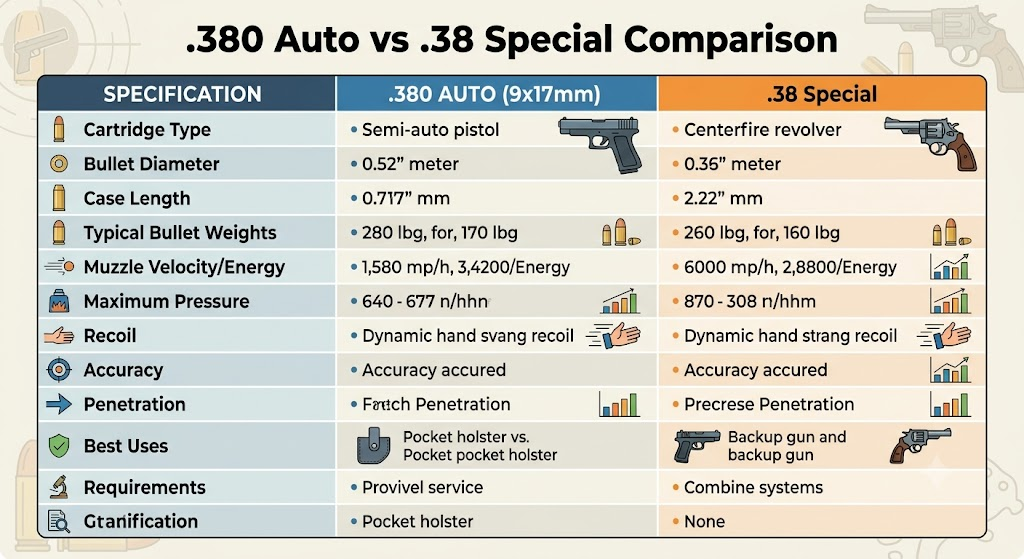
Understanding the Numbers
The technical differences between these cartridges highlight two completely different eras of firearms engineering. Smith and Wesson introduced the .38 Special in 1898 to provide military and police forces with a more powerful cartridge than the anemic .38 Long Colt. Because it was originally designed during the transition from black powder to smokeless powder, the brass case is very long and features a large internal volume. To ensure that modern high pressure ammunition does not blow up antique revolvers manufactured over a century ago, the Sporting Arms and Ammunition Manufacturers Institute strictly limits standard .38 Special ammunition to a very low maximum pressure of 17,000 psi.
Legendary firearms inventor John Moses Browning designed the .380 Auto in 1908 specifically for his Colt Model 1908 pocket hammerless pistol. Browning wanted a cartridge that was small enough to fit into an ultra compact blowback operated semi automatic pistol without requiring a heavy locked breech mechanism. The .380 Auto uses a very short rimless case and operates at a much higher modern pressure limit of 21,500 psi. This higher pressure allows the tiny cartridge to achieve lethal velocities despite its incredibly small powder capacity.
Velocity Comparison
Velocity dictates how reliably a hollow point bullet forces its cavity open upon entering soft fluid tissue.
When examining standard premium factory self defense loads fired from typical concealed carry barrel lengths, the .380 Auto possesses a clear velocity advantage. Federal Premium loads their 90 grain Hydra Shok jacketed hollow point to approximately 1,000 feet per second. Conversely, Federal loads their 125 grain jacketed hollow point for the .38 Special to roughly 850 feet per second when fired from a standard length barrel.
The .380 Auto achieves higher velocity because it pushes a significantly lighter projectile and operates at a higher internal chamber pressure. The 90 grain bullet faces less resistance moving down the barrel, allowing the rapidly expanding gases to accelerate it past the 1,000 feet per second threshold. The .38 Special must overcome the inertia of a massive 125 grain or 158 grain bullet while operating at a lower pressure, which naturally restricts its maximum speed.
Muzzle Energy Comparison
Muzzle energy measures the absolute kinetic force transferred to the target upon impact, providing a mathematical representation of raw power.
Despite the differences in velocity and bullet weight, both cartridges generate remarkably similar kinetic energy at the muzzle. The mathematical formula for kinetic energy factors in both mass and velocity. The 90 grain .380 Auto bullet traveling at 1,000 feet per second generates precisely 200 foot pounds of energy. The 125 grain .38 Special bullet traveling at 850 feet per second generates exactly 200 foot pounds of energy.
Therefore, on paper, neither cartridge holds a distinct power advantage over the other. The difference lies entirely in how they deliver that 200 foot pounds of energy. The .380 Auto delivers it quickly with a lightweight projectile, while the .38 Special delivers it slowly with a heavy, crushing projectile.
Trajectory Comparison
A flat trajectory ensures the bullet point of impact matches the point of aim without requiring the shooter to calculate vertical drop.
Both cartridges are incredibly slow compared to modern rifle calibers, meaning gravity affects their flight paths significantly. However, because the .380 Auto launches its bullet 150 feet per second faster than the .38 Special, it shoots a noticeably flatter trajectory. The bullet reaches the target faster, giving gravity less time to pull the projectile toward the earth.
In practical self defense scenarios, trajectory is completely irrelevant. Defensive handgun engagements overwhelmingly occur inside of seven yards. At seven yards, the trajectory of both cartridges is perfectly straight, and the bullet will strike exactly where the front sight is placed.
Bullet Drop Comparison
Assuming a standard 25 yard zero for both handguns, the mathematical bullet drop at 50 yards illustrates the trajectory difference between the light and heavy projectiles.
The .380 Auto, firing a 90 grain bullet, will drop approximately 3.0 inches at 50 yards. The .38 Special, firing a heavy 125 grain bullet at slower speeds, will drop approximately 4.5 inches at 50 yards. While a 1.5 inch difference might matter to a competitive target shooter, it is negligible for the average concealed carry permit holder. Neither cartridge was designed for precision marksmanship at extended distances.
Wind Drift Comparison
Wind deflection is mitigated by a bullet’s velocity and its aerodynamic efficiency, known as the ballistic coefficient.
Handgun bullets are short and blunt, giving them terrible aerodynamic profiles. The .380 Auto fires a very lightweight 90 grain bullet. In a strong crosswind at 25 yards, the wind can easily push this light projectile off course. The .38 Special fires a much heavier 125 grain or 158 grain bullet. This extra mass acts like an anchor in the air, resisting wind deflection significantly better than the .380 Auto. If you are forced to take a longer shot in poor weather conditions, the heavy mass of the .38 Special provides a slightly more predictable flight path.
Recoil Comparison
Recoil directly dictates a shooter’s ability to fire rapid and accurate follow up shots under the extreme stress of a defensive encounter.
Comparing the recoil of these two cartridges is complicated because recoil is heavily dependent on the mechanical design of the firearm. Most .380 Auto handguns on the market, such as the Ruger LCP or the Walther PPK, utilize a direct blowback operating system. In a blowback pistol, the barrel is fixed directly to the frame, and the sheer mass of the slide and a heavy recoil spring are the only forces keeping the chamber closed during ignition. When the gun fires, all the rearward force transfers violently and directly into the web of the shooter’s hand. Because these pocket pistols often weigh less than 12 ounces, the .380 Auto can feel incredibly snappy and painful to shoot, despite its low kinetic energy.
However, if you fire the .380 Auto from a modern locked breech pistol like the Glock 42 or the Smith and Wesson EZ, the mechanical unlocking of the barrel absorbs a massive amount of the recoil, making it incredibly soft and pleasant to shoot.
The .38 Special operates in a revolver, which means there is no reciprocating slide to absorb any recoil energy. Every ounce of force transfers directly into the grip. When fired from a heavy steel revolver like the Smith and Wesson Model 10, the .38 Special produces a very gentle, rolling push. However, the most popular .38 Special carry guns are ultra lightweight aluminum snub nose revolvers weighing 15 ounces. Firing a .38 Special from an aluminum snub nose generates a very sharp, stinging recoil impulse that many novice shooters find highly uncomfortable.
Stopping Power Comparison
Stopping power against a human threat requires a combination of adequate penetration, rapid energy transfer, and wide bullet expansion to cause rapid blood loss and disrupt the central nervous system.
Historically, the .38 Special has a much stronger reputation for stopping power simply because it served as the primary duty weapon for American law enforcement for nearly seventy years. The heavy 158 grain lead semi wadcutter hollow point, famously known as the FBI Load, developed a legendary reputation for stopping threats reliably because the heavy mass ensured deep penetration through thick winter clothing.
The .380 Auto was traditionally considered underpowered for primary defensive use. Because it relies on a very light bullet, it historically struggled to achieve enough penetration to reach vital organs. However, modern metallurgical advancements have leveled the playing field. Companies like Hornady and Speer have designed highly advanced hollow points for the .380 Auto that maximize energy transfer and expansion, making the modern .380 Auto a highly viable defensive cartridge.
Penetration Comparison
Penetration is the absolute most critical metric for any defensive handgun cartridge. The Federal Bureau of Investigation mandates that a defensive bullet must penetrate a minimum of 12 inches into calibrated ballistic gelatin to ensure it can reach vital organs from any angle.
The .38 Special consistently meets and exceeds this 12 inch FBI penetration standard. The heavy 125 grain and 158 grain bullets carry immense forward momentum. Even if the bullet strikes heavy bone or thick layers of denim, the sheer mass of the .38 Special ensures it plows deeply into the target.
The .380 Auto notoriously struggles in this category. Because the bullet weighs only 90 grains, it lacks the momentum to push deeply. When a .380 Auto hollow point expands perfectly like a parachute, the wide frontal area creates immense drag in the fluid tissue, often causing the bullet to stop at 8 or 9 inches of penetration. This failure to reach the 12 inch minimum is why many professional firearms instructors recommend carrying non expanding Full Metal Jacket ammunition in .380 Auto pocket pistols. A Full Metal Jacket bullet will not expand, but it guarantees deep penetration through bone and muscle.
Expansion Comparison
To accurately test bullet expansion, the ballistics industry relies on calibrated 10 percent ordinance gel covered in heavy clothing protocols.
Both cartridges suffer from expansion issues, but for entirely different reasons. The .380 Auto travels fast enough to force a hollow point to expand, but if the hollow cavity gets plugged with heavy cotton or denim clothing, it acts like a solid ball and fails to open.
The .38 Special rarely suffers from clothing plugs because the cavity is very wide, but it suffers from a lack of velocity. Standard pressure .38 Special hollow points travel so slowly that the fluid pressure inside the gel is often not strong enough to peel the copper jacket back. To guarantee reliable expansion from a .38 Special, shooters must typically purchase specialized Plus P overpressure ammunition or specific short barrel loads designed with massive, deeply scored hollow cavities.
Accuracy Comparison
Both cartridges are capable of elite mechanical accuracy, but practical accuracy in the hands of a human shooter favors the .380 Auto.
Most .380 Auto pistols utilize striker fired mechanisms or single action hammers. These trigger systems provide a short, crisp trigger pull weighing approximately 5 to 6 pounds. This light trigger pull makes it very easy to fire the weapon without disturbing the sight alignment.
The .38 Special is almost exclusively fired from double action revolvers. A double action trigger pull requires the shooter’s finger to physically rotate the heavy steel cylinder and cock the hammer back before the gun fires. This results in a very long, heavy trigger pull weighing between 10 and 14 pounds. Pulling a 12 pound trigger on a firearm that only weighs 15 ounces requires immense grip strength and perfect trigger control to prevent the muzzle from dipping downward before the shot breaks.
Effective Range Comparison
The effective range of a concealed carry handgun is severely limited by its short sight radius, heavy trigger pull, and rapidly decreasing bullet energy.
For the average shooter under extreme physiological stress, the practical effective defensive range of both the .380 Auto and the .38 Special is absolutely limited to 15 yards. While highly trained experts can reliably hit steel plates at 50 yards with these small pocket guns, using them defensively beyond 25 yards is statistically highly improbable and practically very difficult due to the tiny, hard to see sights equipped on most micro compact pistols and snub nose revolvers.
Suppressor Performance Comparison
Suppressing a personal defense weapon helps protect the shooter’s hearing in the confined spaces of a hallway or bedroom, but neither of these cartridges performs well with silencers.
The .38 Special is naturally subsonic, which theoretically makes it perfect for suppression. However, the mechanical design of a revolver ruins its suppressor capabilities. There is a tiny gap between the front of the rotating cylinder and the rear of the barrel. When the cartridge fires, high pressure gases and a deafening acoustic crack escape through this cylinder gap before the sound ever reaches the silencer attached to the muzzle.
The .380 Auto is also naturally subsonic. You can successfully thread a silencer onto a .380 Auto barrel, and it will reduce the muzzle blast significantly. Unfortunately, because most .380 Auto pistols operate on a direct blowback action, the breech opens incredibly fast while chamber pressures are still high. This causes a very loud “port pop” as noise escapes out the ejection port next to the shooter’s ear.
Short Barrel Performance Comparison
Modern concealed carry requires highly concealable firearms, meaning barrels are frequently chopped down to microscopic lengths.
The .38 Special suffers catastrophic performance degradation in short barrels. The cartridge case is very long and contains a large powder charge. When fired from a 1.8 inch snub nose revolver, the bullet exits the muzzle before the powder has time to fully combust. This unburnt powder creates a blinding muzzle flash and a deafening roar, and the bullet loses massive amounts of velocity. A 125 grain .38 Special hollow point often leaves a snub nose barrel traveling well under 800 feet per second, completely ruining its ability to expand reliably.
The .380 Auto was engineered specifically for tiny pocket pistols. It utilizes very small charges of extremely fast burning pistol powder. Because the powder burns entirely within the first inch of barrel travel, the .380 Auto retains a much higher percentage of its velocity when fired from a 2.75 inch micro pistol barrel.
Carbine vs Handgun Performance Comparison
Pistol caliber carbines are incredibly popular for home defense and target shooting, offering better accuracy and higher velocity than handguns.
You will practically never find a carbine chambered in .380 Auto. Because it is a rimless pocket pistol cartridge, there is no market demand for a heavy, bulky rifle chambered in such a weak caliber.
The .38 Special performs absolutely brilliantly in lever action carbines. The classic lever action rifle features a fully sealed breech and a long 16 inch barrel. This allows the slow burning powder of the .38 Special to fully combust. When fired from a 16 inch lever action rifle, a standard 158 grain .38 Special bullet gains hundreds of feet per second in velocity, transforming it from a marginal defensive handgun round into a highly capable small game hunting cartridge.
Home Defense Comparison
Inside the home, a defender must balance stopping power against ammunition capacity, weapon control, and ease of use in the dark.
The .380 Auto is a very capable home defense cartridge when chambered in a slightly larger firearm. Modern micro compact pistols like the SIG Sauer P365 in .380 Auto hold up to 12 rounds in a flush fit magazine, allow for the easy attachment of bright weapon mounted flashlights, and feature incredibly soft recoil. However, semi automatic slides can be difficult to rack for elderly individuals or those with arthritis.
The .38 Special revolver is the ultimate symbol of mechanical simplicity. There are no safety levers to disengage, no slides to rack, and no magazines to seat. If you experience a bad primer and the gun fails to fire, you simply pull the heavy trigger again to rotate to the next fresh cartridge. This supreme reliability makes the .38 Special revolver an excellent choice for absolute beginners. However, the limited 5 round capacity and lack of flashlight mounting options make it less optimal for modern home defense strategies compared to high capacity semi automatics.
Hunting Comparison
Neither of these standard cartridges is highly recommended for hunting medium game like deer or feral hogs. They simply lack the kinetic energy and flat trajectory required for ethical, deep penetrating harvests on large animals.
However, the .38 Special can be highly effective for small game hunting and pest control. When loaded with flat nosed wadcutter bullets, the .38 Special is incredibly accurate and will easily dispatch raccoons, coyotes, or venomous snakes at close ranges without destroying excessive amounts of meat or pelt. The .380 Auto is strictly a personal defense cartridge and serves no viable purpose in the hunting woods.
Tactical and Duty Use Comparison
The .38 Special served as the gold standard for American law enforcement from the 1920s through the late 1980s. Every major police department, including the Federal Bureau of Investigation, issued heavy 4 inch .38 Special revolvers to their patrol officers. It proved its tactical worth in countless gunfights over the decades. Today, it has been entirely replaced by high capacity 9mm semi automatic pistols for primary duty use.
The .380 Auto has never been utilized as a primary duty weapon by modern military or major police forces. It lacks the barrier penetration capability required to punch through auto glass or heavy steel car doors. However, both the .380 Auto and the .38 Special remain incredibly popular among police officers as secondary backup weapons strapped to their ankles in deep concealment holsters.
Capacity and Platform Comparison
The physical dimensions of these cartridges dictate the types of firearms that can chamber them.
Revolver cylinders are limited by the physical diameter of the cartridges they hold. Because the .38 Special is a relatively wide, rimmed cartridge, a standard small frame snub nose revolver can only safely accommodate five rounds of ammunition. Reloading a revolver under extreme panic requires fine motor skills to align speed loaders with the tiny cylinder holes.
The .380 Auto is a much narrower, rimless cartridge designed to stack efficiently inside spring loaded magazines. A modern micro compact pistol of the exact same physical size and weight as a 5 shot revolver can easily hold 10 to 12 rounds of .380 Auto ammunition in the grip. Furthermore, ejecting an empty magazine and slamming a fresh one into the grip is significantly faster and requires less fine motor coordination than reloading a revolver. Gaining double the ammunition capacity in a highly concealable firearm is a massive tactical advantage for the .380 Auto.
Ammo Cost Comparison
To become proficient with a defensive handgun, you must practice frequently and build muscle memory.
Both the .380 Auto and the .38 Special are moderately priced cartridges. Because they require more raw brass and copper material than the immensely popular 9mm cartridge, they typically cost slightly more per box. You can expect to pay practically identical prices for full metal jacket target practice ammunition for both calibers. Premium hollow point defensive ammunition is also priced identically across both platforms.
Ammo Availability Comparison
Availability ensures you can always feed your defensive weapon during times of supply chain disruption.
Walk into any sporting goods store, rural hardware store, or indoor shooting range in the world, and you will find both .380 Auto and .38 Special ammunition sitting on the shelf. They are two of the most universally available pistol cartridges in existence. Ammunition manufacturers dedicate massive production lines to both calibers year round, guaranteeing you will never struggle to find practice or defensive ammunition.
Reloading Comparison
Both cartridges are absolute favorites in the handloading community, but the revolver cartridge is vastly superior for beginners.
The .38 Special is arguably the easiest and most enjoyable cartridge in the world to reload. It is a large, straight walled cartridge that operates at very low pressures. The large case capacity allows for massive variations in powder charges without dangerously spiking the chamber pressure. The rimmed case extracts perfectly every time from sizing dies, and you can cast your own heavy lead bullets to save money.
The .380 Auto is incredibly difficult and tedious to reload. The brass case is microscopic, making it very hard for large fingers to manipulate on a reloading press. Furthermore, because the case capacity is so tiny, the difference between a safe powder charge and a catastrophic overcharge is often less than a single grain of gunpowder. Handloading the .380 Auto requires meticulous attention to detail and extremely precise digital scales.
Pros and Cons
.380 Auto
Pros
- Microscopic firearms fit easily into standard pants pockets.
- High magazine capacity relative to the size of the weapon.
- Extremely fast and easy to reload using spare magazines.
- Fast burning powders retain high velocity in ultra short barrels.
- Modern locked breech pistols offer incredibly soft recoil.
Cons
- Extremely lightweight bullets often fail to achieve deep penetration.
- Direct blowback pocket pistols produce painful, snappy recoil.
- Slide manipulation can be difficult for elderly shooters.
- Microscopic sights make accurate shooting beyond 10 yards difficult.
- Very tedious and unforgiving to reload at home.
.38 Special
Pros
- Supreme mechanical reliability with absolutely zero feeding issues.
- Heavy bullet mass guarantees deep penetration through heavy clothing.
- Simple manual of arms makes it perfect for absolute beginners.
- Incredibly mild recoil when fired from medium or full size steel revolvers.
- One of the easiest and safest cartridges to reload at home.
Cons
- Terrible velocity loss when fired from short snub nose barrels.
- Low velocity frequently causes hollow points to fail to expand.
- Limited to only 5 rounds in standard concealed carry cylinders.
- Long, heavy double action trigger pulls degrade practical accuracy.
- Slow and mechanically complex to reload under extreme stress.
Final Verdict
Choosing between the .380 Auto and the .38 Special comes down to balancing modern semi automatic capacity and concealability against traditional mechanical simplicity and heavy bullet momentum.
- For Deep Concealment in Pocket Holsters: Choose the .380 Auto. Modern micro compact pistols chambered in .380 Auto are thinner, lighter, and hold twice as much ammunition as a comparably sized snub nose revolver, making them the ultimate effortless carry guns.
- For Absolute Beginners: Choose the .38 Special. A medium frame revolver loaded with standard pressure .38 Special offers practically zero recoil and requires absolutely no training on how to clear malfunction jams or rack a heavy slide. You simply point and pull the trigger.
- For Guaranteed Penetration: Choose the .38 Special. If you live in a cold climate where attackers wear heavy winter coats, the massive 158 grain semi wadcutter .38 Special bullet provides the unstoppable momentum required to punch deeply through heavy fabric and reach vital organs.
- For Recoil Sensitive Shooters: Choose the .380 Auto (specifically in a modern locked breech pistol like the Smith and Wesson EZ). The mechanical unlocking of the slide absorbs recoil so efficiently that it feels like shooting a loud rimfire pistol, allowing for rapid, flinch free accuracy.
- For Ankle Carry and Backup Guns: Choose the .38 Special. The enclosed mechanics of a hammerless snub nose revolver guarantee that the gun will fire even if the cylinder is packed with dust, lint, or mud from being carried near the ground on an ankle holster.
FAQ
Is the .380 Auto more powerful than the .38 Special?
No. When comparing standard factory ammunition, the .380 Auto and the .38 Special generate practically identical kinetic energy at the muzzle, hovering around 200 foot pounds. However, the .38 Special fires a heavier and wider bullet, which many ballistics experts argue provides superior practical momentum and deep penetration on human targets.
Can a .38 Special shoot .357 Magnum ammunition?
Absolutely not. The .357 Magnum cartridge case is significantly longer and operates at more than double the internal pressure of the .38 Special. Attempting to fire a .357 Magnum in a firearm rated only for .38 Special will result in a catastrophic explosion. However, every .357 Magnum revolver can safely chamber and fire .38 Special ammunition for cheap, low recoil practice.
Why do people choose .380 Auto over 9mm?
Shooters choose the .380 Auto over the 9mm purely for concealability and reduced recoil. A .380 Auto pistol can be manufactured significantly smaller and lighter than a 9mm pistol because the lower pressure cartridge does not require heavy steel locking lugs. Furthermore, the recoil impulse of a locked breech .380 Auto is much softer than a comparable 9mm pistol.
Does the .38 Special kick hard?
In firearms of medium to large size, the .38 Special produces an incredibly mild, pleasant recoil impulse that feels like a gentle push. However, if you fire the .38 Special from an ultra lightweight 15 ounce aluminum snub nose revolver, the recoil becomes very sharp and snappy, which can be painful for novice shooters.
What does ACP stand for in .380 ACP?
ACP stands for Automatic Colt Pistol. Legendary firearms inventor John Moses Browning designed the .380 Auto cartridge in 1908 for use in his prototype semi automatic pistols, which were subsequently manufactured by the Colt Patent Firearms Manufacturing Company.
Why do hollow points fail in short barrel .38 Special revolvers?
Hollow point bullets require fluid pressure to force the copper jacket open upon impact. This requires velocity. Because short 1.8 inch snub nose barrels do not allow the powder enough time to burn, the .38 Special bullet often exits the muzzle traveling too slowly to generate the necessary fluid pressure to expand the hollow cavity.
Is the .380 Auto adequate for self defense?
Yes, the modern .380 Auto is highly adequate for self defense. While historically considered underpowered, massive advancements in projectile engineering over the last decade have produced highly efficient defensive hollow points that maximize energy transfer. When loaded with premium ammunition, the .380 Auto is a highly lethal and capable defensive tool.