The 38 Special fires a 0.357-inch diameter bullet from a straight-walled 1.155-inch case, generating a maximum overall length of 1.550 inches. Typical bullet weights range from 110-grain lightweight defense loads to traditional 158-grain lead round nose projectiles. Muzzle velocities average between 750 and 1,000 fps, producing roughly 200 to 300 foot-pounds of muzzle energy depending on the barrel length. The standard cartridge operates safely at a SAAMI maximum pressure of 17,000 PSI, with +P variants rated for a slightly higher 20,000 PSI. Primarily utilized in 2-inch to 4-inch revolver barrels with a 1:18.75 twist rate, the vast majority of 38 Special ammunition is naturally subsonic.
Table of Contents [Click to minimize]
38 Special Specs
| Specification | 38 Special |
| Cartridge Name | .38 Smith & Wesson Special |
| Bullet Diameter | 0.357 inches |
| Bullet Weight | 110 grains to 158+ grains |
| Case Length | 1.155 inches |
| Overall Length | 1.550 inches (maximum SAAMI) |
| Base Diameter | 0.379 inches |
| Neck Diameter | 0.379 inches |
| Rim Diameter | 0.440 inches |
| Shoulder Angle | None (Straight Wall) |
| Maximum Pressure | 17,000 PSI (Standard) / 20,000 PSI (+P) |
| Typical Twist Rate | 1:16 or 1:18.75 |
| Typical Barrel Length | 1.875 inches to 6 inches |
| Muzzle Velocity | 700 fps to 1,100 fps |
| Muzzle Energy | 200 to 350 ft-lbs |
| Ballistic Coefficient | ~0.110 to 0.160 (G1) |
| Parent Case | .38 Long Colt |
| Platform | Revolver, Lever Action |
| Supersonic Loads | Light +P loads (110gr) in 4+ inch barrels |
| Subsonic Loads | 130 to 158 grains (Standard and +P) |
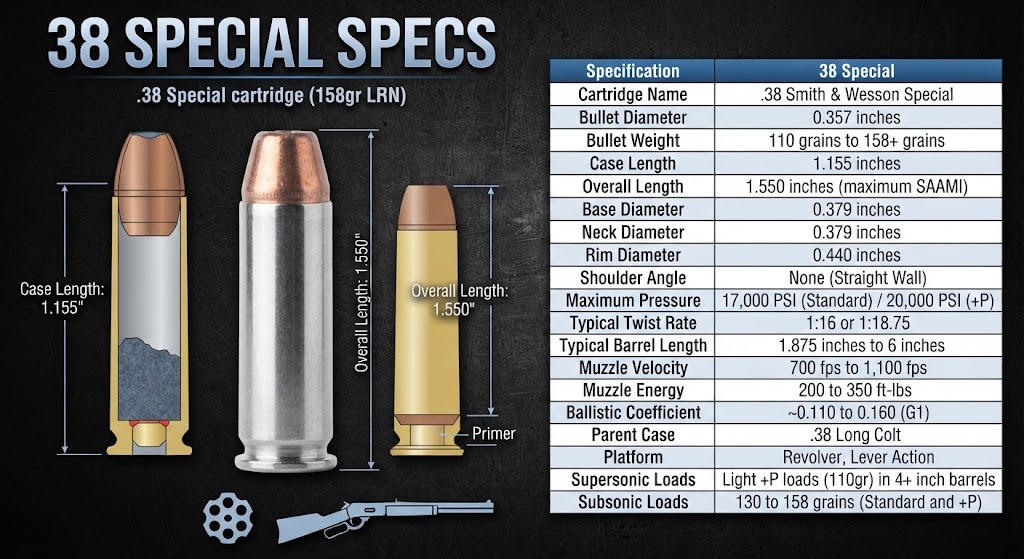
38 Special Bullet Diameter
Despite the “.38” moniker, the 38 Special bullet diameter is exactly 0.357 inches. The name is a historical holdover from its predecessor, the .38 Long Colt, which originally used a “heeled” bullet that matched the outside diameter of the brass case.
38 Special Case Length
The 38 Special case length is 1.155 inches. This straight-walled cylindrical brass case offers ample internal volume, a byproduct of being originally designed to hold 21 grains of black powder in 1898 before transitioning to more energetic smokeless powders.
38 Special Overall Length
SAAMI established the 38 Special overall length at a maximum of 1.550 inches. Maintaining this dimension ensures the cartridge fits perfectly into the cylinder of standard short-frame and medium-frame revolvers without protruding past the cylinder face and causing a cylinder bind.
38 Special Bullet Weights
Typical 38 Special bullet weight varies significantly depending on the application. Target and practice ammunition often utilizes 130-grain full metal jackets or 148-grain wadcutters, while self-defense and traditional service loads rely heavily on 125-grain jacketed hollow points and 158-grain lead semi-wadcutters.
38 Special Muzzle Velocity
The 38 Special muzzle velocity is generally quite moderate. From a standard 4-inch barrel, traditional 158-grain loads travel around 750 to 800 fps. Lighter 110-grain +P (overpressure) defensive loads can break 1,000 to 1,100 fps.
38 Special Muzzle Energy
Due to its moderate velocity, 38 Special muzzle energy generally falls between 200 and 300 foot-pounds. While this is less kinetic energy than modern 9mm Luger cartridges, it is highly effective with well-designed hollow points, particularly in the +P format which can generate up to 350 foot-pounds.
38 Special Maximum Pressure
The standard 38 Special maximum pressure is 17,000 PSI. Because many older revolvers were not built with modern metallurgy, this standard pressure keeps vintage firearms safe. Modern self-defense ammunition is often rated “+P”, which safely increases the SAAMI pressure limit to 20,000 PSI for use in modern, reinforced steel frames.
38 Special Twist Rate
A standard 38 Special twist rate is 1:18.75 or 1:16 inches. These relatively slow twist rates are perfectly suited to stabilize the short, blunt projectiles fired at standard pistol velocities.
38 Special Barrel Length
The 38 Special barrel length drastically dictates its performance. It is most commonly chambered in 1.875-inch “snub-nose” revolvers for concealed carry, standard 4-inch duty revolvers, and occasionally 16-inch to 20-inch lever-action rifles, which can boost velocities by 200 to 300 fps.
38 Special Ballistic Coefficient
Because revolver bullets are flat-nosed or hollow-cavity designs intended for short-range stopping power rather than long-range aerodynamics, the 38 Special ballistic coefficient is very low, typically ranging from 0.110 to 0.160 (G1).
Supersonic vs Subsonic
Because of its heavy bullets and low pressure limits, the 38 Special is an inherently subsonic cartridge.
| Load Type | Typical Bullet Weight | Velocity | Muzzle Energy | Main Characteristic |
| Supersonic | 110 grains (+P only) | ~1,100+ fps | ~300 ft-lbs | Only achievable with light bullets in 4-inch or longer barrels |
| Subsonic | 125 – 158 grains | 750 – 950 fps | 200 – 250 ft-lbs | Standard performance; virtually all standard pressure ammo is subsonic |
The 38 Special subsonic nature makes it extremely pleasant to shoot, offering mild recoil and a reduced concussive blast indoors compared to high-pressure supersonic rounds.
Factory Load Specifications
When reviewing 38 Special cartridge specs, factory ammunition data highlights the difference between target loads and modern +P defensive rounds. (Velocities typically based on 4-inch vented test barrels).
- 110 grain: Hornady Critical Defense standard pressure. Velocity: 1,010 fps. Muzzle Energy: 249 ft-lbs.
- 125 grain: Remington UMC Jacketed Hollow Point +P. Velocity: 945 fps. Muzzle Energy: 248 ft-lbs.
- 130 grain: Federal American Eagle Full Metal Jacket. Velocity: 890 fps. Muzzle Energy: 229 ft-lbs.
- 135 grain: Speer Gold Dot Short Barrel +P. Velocity: 860 fps (from a 2-inch barrel). Muzzle Energy: 222 ft-lbs.
- 158 grain: Winchester Super-X Lead Round Nose. Velocity: 755 fps. Muzzle Energy: 200 ft-lbs.
Cartridge Dimensions
The 38 Special dimensions feature a prominent rim to prevent the cartridge from slipping through the chambers of a revolver cylinder.
| Dimension | Measurement |
| Bullet Diameter | 0.357 inches |
| Case Length | 1.155 inches |
| Overall Length | 1.550 inches |
| Base Diameter | 0.379 inches |
| Neck Diameter | 0.379 inches |
| Rim Diameter | 0.440 inches |
| Rim Thickness | 0.058 inches |
| Shoulder Angle | None (Straight Wall) |
Barrel Length
One of the most critical 38 Special specs to understand is how much velocity is lost when moving from a standard revolver to a short snub-nose for concealed carry.
- 1.875 inches (Snub-Nose): Commonly drops standard 158-grain velocity down to roughly 650–700 fps. Specialized short-barrel ammunition is highly recommended to ensure proper hollow-point expansion at these low speeds.
- 4 inches (Standard): The benchmark for the cartridge, providing full velocity and a sight radius long enough for accurate shooting.
- 16+ inches (Lever Action): Firing a 38 Spl from a lever-action rifle maximizes the powder burn, often adding 200 to 250 fps to standard velocities, drastically increasing muzzle energy.
Ballistics
The 38 Special ballistics profile is strictly intended for short-range personal defense and target shooting. Trajectory data for a standard 130-grain FMJ load with a 25-yard zero:
- Muzzle: 890 fps | 229 ft-lbs | Drop: -0.5 in (bore height)
- 25-yard: 850 fps | 208 ft-lbs | Drop: 0.0 in (Zero)
- 50-yard: 815 fps | 191 ft-lbs | Drop: -2.8 in
- 100-yard: 755 fps | 164 ft-lbs | Drop: -18.5 in
Platform And Compatibility
The 38 Special is arguably the most famous revolver cartridge in history, though it appears in a few other platforms.
- Revolvers: The primary platform. From ultra-light 5-shot aluminum J-frames to full-size 6-shot steel duty revolvers.
- 357 Magnum Backward Compatibility: Any firearm chambered in .357 Magnum can safely fire .38 Special ammunition. The .357 Magnum case is simply a lengthened .38 Special case. However, a .38 Special revolver CANNOT chamber or fire a .357 Magnum.
- Lever Action Rifles: Many modern lever-action rifles chambered in .357 Magnum also feed and cycle .38 Special rounds perfectly, offering a virtually recoilless shooting experience.
38 Special vs 9mm
The debate between these two cartridges generally comes down to the platform (revolver vs. semi-automatic).
| Specification | 38 Special | 9mm Luger |
| Bullet Diameter | 0.357 inches | 0.355 inches |
| Typical Bullet Weight | 110 gr – 158 gr | 115 gr – 147 gr |
| Muzzle Velocity (4″ Bbl) | ~800 fps (158gr) | ~1,150 fps (115gr) |
| Muzzle Energy | ~200 – 300 ft-lbs | ~350 – 400 ft-lbs |
| Maximum Pressure | 17,000 PSI | 35,000 PSI |
| Platform | Revolver | Semi-Auto Pistol |
| Primary Advantage | Reliability, ease of use | High capacity, superior kinetic energy |
The 9mm operates at more than double the internal pressure of the 38 Spl, delivering considerably more speed and kinetic energy. However, the 38 Special remains dominant in small, simple, ultra-reliable pocket revolvers.
Pros And Cons
38 Special Pros
- Exceptional accuracy and very mild recoil, making it ideal for new shooters.
- Completely backward compatible with all .357 Magnum revolvers and rifles.
- Incredibly reliable platform; revolvers do not suffer from limp-wristing or feed-ramp malfunctions.
- Massive variety of ammunition, from ultra-light wadcutters for target practice to bonded +P hollow points for defense.
38 Special Cons
- Low muzzle energy compared to modern semi-automatic pistol cartridges.
- Standard-pressure loads fired from 2-inch barrels often fail to expand modern hollow points due to low velocity.
- Capacity is strictly limited by the revolver cylinder, typically capping at 5 or 6 rounds.
FAQs
What are the specifications of 38 Special?
The 38 Special fires a 0.357-inch bullet from a 1.155-inch case with a maximum overall length of 1.550 inches. It operates at a low SAAMI pressure of 17,000 PSI and is primarily chambered in revolvers.
What is the bullet diameter of 38 Special?
Despite its name, the true 38 Special bullet diameter is 0.357 inches.
What is the case length of 38 Special?
The official SAAMI specification for the 38 Special case length is 1.155 inches.
What is the overall length of 38 Special?
The maximum 38 Special overall length is 1.550 inches, which ensures the bullet will not protrude past the front of a standard revolver cylinder.
What bullet weights are available for 38 Special?
The 38 Special specs usually revolve around 130-grain FMJ for target practice, 125-grain JHP for defense, and the traditional 158-grain lead round nose.
What is the muzzle velocity of 38 Special?
The 38 Special muzzle velocity is generally between 750 fps and 1,000 fps depending on the bullet weight and whether it is a standard or +P load.
What is the muzzle energy of 38 Special?
Standard loads typically produce between 200 and 250 foot-pounds of muzzle energy, while heavy +P loads can reach up to 350 foot-pounds.
What is the maximum pressure of 38 Special?
Standard pressure for the 38 Special is 17,000 PSI. Modern +P (overpressure) ammunition raises that limit safely to 20,000 PSI.
What is the twist rate for 38 Special?
Standard revolvers chambered for 38 Spl generally use a 1:16 or 1:18.75 twist rate.
What is the heaviest 38 Special bullet?
While 158 grains is the traditional heavy standard, some boutique manufacturers produce 180-grain hard cast lead bullets for outdoor defense.
Is 38 Special subsonic?
Yes, the vast majority of 38 Special ammunition is naturally subsonic because of its heavy bullets and low pressure limits.
Is 38 Special supersonic?
Rarely. Only lightweight 110-grain +P loads fired from barrels 4 inches or longer will consistently break the supersonic barrier.
What barrel length is best for 38 Special?
A 4-inch barrel provides the optimal balance of velocity and sight radius for the 38 Special, though 1.875-inch snub-noses remain incredibly popular for concealed carry.
Is 38 Special compatible with a 357 Magnum?
Yes. You can safely fire 38 Special ammunition out of any firearm chambered in .357 Magnum. The reverse, however, is impossible and highly dangerous.
How does 38 Special compare with 9mm?
The 9mm is a high-pressure semi-automatic cartridge that holds more rounds, flies faster, and hits harder. The 38 Special is a low-pressure revolver cartridge favored for its mechanical reliability and ease of use in simple, pocket-sized platforms.