The 22 Advanced Rifle Cartridge (22 ARC) utilizes a standard 0.224-inch bullet seated in a 1.525-inch case, generating an overall length of 2.260 inches to fit AR-15 magazines. Engineered to maximize aerodynamic efficiency, typical factory bullet weights range from 62 grains up to heavy 88-grain match projectiles. Depending on the load, muzzle velocities span from 2,820 fps to 3,300 fps, generating approximately 1,500 foot-pounds of muzzle energy.The cartridge operates at a conservative SAAMI maximum pressure of 52,000 PSI to ensure reliable cycling and extended bolt life in gas-operated platforms. Optimized for 16-inch to 24-inch barrels, the 22 ARC requires a fast 1:7 twist rate to properly stabilize its extremely long, high-BC bullets.
Table of Contents [Click to minimize]
22 ARC SAAMI Specs
| Specification | 22 ARC |
| Cartridge Name | 22 Advanced Rifle Cartridge (22 ARC) |
| Bullet Diameter | 0.224 inches |
| Bullet Weight | 62 grains to 88 grains |
| Case Length | 1.525 inches |
| Overall Length | 2.260 inches (maximum) |
| Base Diameter | 0.441 inches |
| Neck Diameter | ~0.256 inches |
| Shoulder Diameter | 0.428 inches |
| Rim Diameter | 0.441 inches |
| Shoulder Angle | 30 degrees |
| Maximum Pressure | 52,000 PSI (SAAMI) |
| Typical Twist Rate | 1:7 |
| Typical Barrel Length | 16 to 24 inches |
| Muzzle Velocity | 2,820 to 3,300 fps (factory loads) |
| Muzzle Energy | 1,490 to 1,575 ft-lbs |
| Ballistic Coefficient | ~0.395 to 0.545 (G1) |
| Parent Case | 6.5 Grendel / 6mm ARC |
| Platform | AR-15 (Requires 6.5 Grendel Type 2 Bolt) |
| Supersonic Loads | 62 to 88 grains |
| Subsonic Loads | Not applicable |
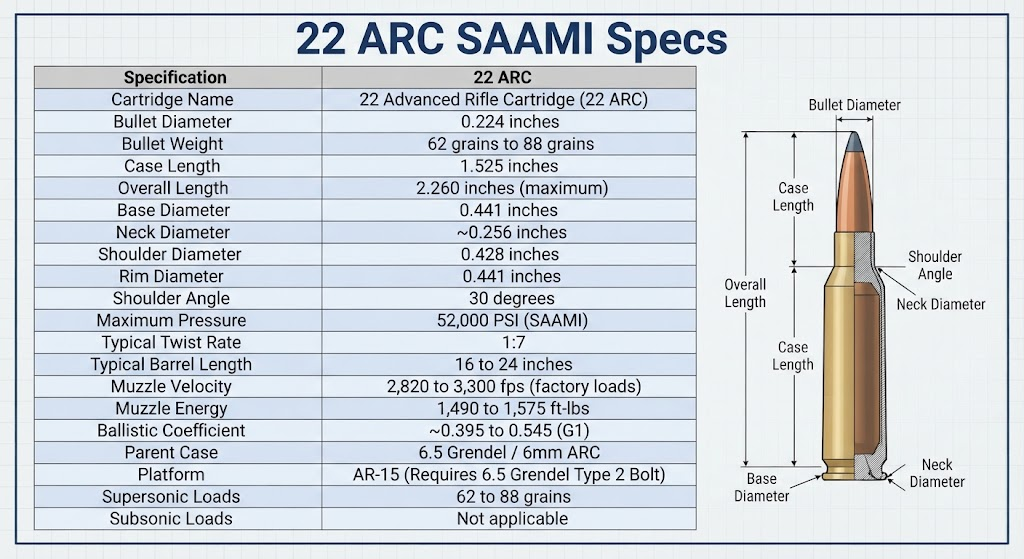
22 ARC Bullet Diameter
The 22 ARC bullet diameter is 0.224 inches. While this is the exact same caliber utilized by the 5.56 NATO and .223 Remington, the 22 ARC chamber is engineered specifically to accommodate modern, heavy-for-caliber match bullets that cannot fit into standard .223 chambers.
22 ARC Case Length
The 22 ARC case length is a short 1.525 inches. By shortening the parent 6.5 Grendel case, engineers created enough room in the AR-15 magazine box to seat exceptionally long bullets entirely outside of the powder column.
22 ARC Overall Length
SAAMI established the 22 ARC overall length at a maximum of 2.260 inches. This is the critical internal dimension of standard AR-15 magazines. Retaining this exact length ensures the cartridge feeds flawlessly in the AR-15 platform.
22 ARC Bullet Weights
Typical 22 ARC bullet weights heavily skew toward the top end of the .22 caliber spectrum. While traditional varmint rounds use 40 to 55-grain bullets, the 22 ARC specs are optimized around 62-grain varmint loads, 75-grain tactical loads, and ultra-heavy 88-grain match bullets.
22 ARC Muzzle Velocity
The 22 ARC muzzle velocity is exceptional for an AR-15 cartridge. From a 24-inch test barrel, factory 62-grain loads reach 3,300 fps.Even the heaviest 88-grain bullets achieve an impressive 2,820 fps, offering a much flatter trajectory than comparable 5.56 NATO rounds.
22 ARC Muzzle Energy
The combination of velocity and high bullet mass produces 22 ARC muzzle energy approaching 1,500 to 1,575 foot-pounds. This translates to devastating terminal performance on varmints and medium game, retaining significantly more energy downrange than legacy .22 caliber rounds.
22 ARC Maximum Pressure
The 22 ARC maximum average pressure (MAP) is strictly capped by SAAMI at 52,000 PSI. Because the cartridge uses a wider 0.441-inch bolt face, standard AR-15 bolts have less surrounding steel. Keeping the pressure at 52,000 PSI ensures standard AR-15 bolt carrier groups do not suffer premature shear or fatigue failure.
22 ARC Twist Rate
To stabilize extreme-length projectiles like the 88-grain ELD Match, the standard 22 ARC twist rate is a fast 1:7 inches. Slower twist rates found in older hunting rifles (like 1:9 or 1:12) will completely fail to stabilize these modern bullets, resulting in keyholing.
22 ARC Barrel Length
The 22 ARC barrel length typically ranges from 16 to 24 inches. While a 24-inch barrel extracts the absolute maximum velocity (vital for precision competition), a 16-inch to 18-inch barrel provides an excellent balance of mobility and speed for hunting applications.
22 ARC Ballistic Coefficient
Because it prioritizes long, sleek projectiles, the 22 ARC ballistic coefficient (BC) is best-in-class for the platform. The 62-grain ELD-VT boasts a G1 BC of 0.395, while the massive 88-grain ELD Match features a G1 BC of 0.545, allowing it to slice through crosswinds and retain velocity out to 1,000 yards.
Supersonic vs Subsonic
The 22 ARC is a dedicated hyper-velocity varmint and precision cartridge. It was entirely designed to maximize speed and aerodynamic efficiency; therefore, there is no practical subsonic application.
| Load Type | Typical Bullet Weight | Velocity | Muzzle Energy | Main Characteristic |
| Supersonic | 62 – 88 grains | 2,820 – 3,300 fps | ~1,500 ft-lbs | Flat trajectory, high BC, excellent wind defiance, supersonic past 1,000 yards |
| Subsonic | N/A | N/A | N/A | Highly inefficient. Small-bore, lightweight bullets do not carry enough mass to be effective at 1,000 fps. |
Attempting to load the 22 ARC to subsonic velocities negates every ballistic advantage the cartridge provides over cheaper options.
Factory Load Specifications
When reviewing 22 ARC cartridge specs, examining verified manufacturer data paints a clear picture of its ballistic dominance. (Data based on standard 24-inch test barrels).
- 62 grain: Hornady V-Match ELD-VT. Velocity: 3,300 fps. Muzzle Energy: 1,499 ft-lbs. G1 BC: 0.395.
- 75 grain: Hornady BLACK ELD Match. Velocity: 3,075 fps. Muzzle Energy: 1,575 ft-lbs.
- 88 grain: Hornady Match ELD Match. Velocity: 2,820 fps. Muzzle Energy: 1,554 ft-lbs. G1 BC: 0.545.
Cartridge Dimensions
The 22 ARC dimensions utilize a short, fat case derived from the 6.5 Grendel/6mm ARC lineage, maximizing powder capacity in a compact package.
| Dimension | Measurement |
| Bullet Diameter | 0.224 inches |
| Case Length | 1.525 inches |
| Overall Length | 2.260 inches |
| Base Diameter | 0.441 inches |
| Rim Diameter | 0.441 inches |
| Shoulder Angle | 30 degrees |
Barrel Length
Barrel length heavily dictates 22 ARC velocity potential. Because the cartridge is designed to reach distances up to 1,000 yards, many shooters opt for longer barrels to squeeze out every drop of speed.
While full combustion is achieved relatively quickly, velocity scales efficiently:
- 16 inches: ~3,050 fps (62-grain). Best for maneuverable hunting setups; sacrifices roughly 250 fps compared to a long barrel.
- 18 inches: ~3,125 fps (62-grain). An excellent all-around compromise for a general-purpose AR-15.
- 20 inches: ~3,200 fps (62-grain). Ideal for dedicated coyote hunting and varmint eradication.
- 24 inches: 3,300 fps (62-grain). The benchmark standard for maximizing the cartridge’s long-range ballistics and wind deflection capabilities.
Ballistics
To understand 22 ARC ballistics, it is best viewed at mid-to-long ranges where its high-BC bullets shine. This is standard trajectory data for the 62-grain Hornady ELD-VT load with a 200-yard zero (24-inch barrel):
- Muzzle: 3,300 fps | 1,499 ft-lbs | Drop: -1.5 in
- 100-yard: 3,025 fps | 1,259 ft-lbs | Drop: +1.2 in
- 200-yard: 2,765 fps | 1,052 ft-lbs | Drop: 0.0 in (Zero)
- 300-yard: 2,520 fps | 874 ft-lbs | Drop: -5.7 in
- 500-yard:2,075 fps | 592 ft-lbs | Drop: -33.5 in
Platform And Compatibility
The 22 ARC was engineered specifically to elevate AR-15 performance.
- Action Length: Standard AR-15 platform.
- Bolt Requirements: Requires a 6.5 Grendel Type 2 (0.441-inch) bolt face. You cannot use a standard 5.56 NATO bolt.
- Magazines: Requires 6.5 Grendel or 6mm ARC specific magazines to accommodate the wider case and ensure reliable feeding.
- Barrels: Requires a dedicated 22 ARC barrel, generally cut with a 1:7 twist.
22 ARC vs 5.56
While they share the same bullet diameter and platform, the 22 ARC dramatically outclasses the 5.56 NATO at long distances.
| Specification | 22 ARC | 5.56 NATO |
| Bullet Diameter | 0.224 inches | 0.224 inches |
| Typical Bullet Weight | 62 gr – 88 gr | 55 gr – 77 gr |
| Muzzle Velocity (24″ Bbl) | ~3,075 fps (75gr) | ~2,850 fps (77gr) |
| Muzzle Energy | ~1,575 ft-lbs | ~1,290 ft-lbs |
| Subsonic Capability | Poor (Unsuitable) | Poor (Unsuitable) |
| Typical Barrel Length | 16 – 24 inches | 14.5 – 20 inches |
| Twist Rate | 1:7 | 1:7, 1:8, or 1:9 |
| Primary Design Focus | High-BC, wind defiance, long range | General combat, lightweight |
The 22 ARC maintains sub-MOA accuracy and supersonic speeds well past distances where the 5.56 NATO becomes completely destabilized by wind and drop.
Pros And Cons
22 ARC Pros
- Drastically improves the long-range capabilities of the standard AR-15 platform.
- Short, fat case design allows for the loading of ultra-heavy, high-BC bullets that cut through wind exceptionally well.
- Excellent factory ammunition support tailored specifically for hunting, varmint eradication, and precision target shooting.
- Very low felt recoil makes it an excellent choice for novice shooters or fast follow-up shots in PRS competitions.
22 ARC Cons
- Ammunition is more expensive and harder to source locally than standard 5.56 NATO or .223 Remington.
- Requires specific magazines and a 6.5 Grendel bolt face, making conversions slightly more complex than a simple barrel swap.
- The 52,000 PSI limit is necessary for AR-15 bolt life, meaning it does not maximize the velocity potential that a strong bolt-action receiver could handle.
FAQs
What are the specifications of 22 ARC?
The 22 ARC fires a 0.224-inch bullet from a 1.525-inch case with a maximum overall length of 2.260 inches.It is designed to operate safely in standard AR-15 platforms with a maximum SAAMI pressure of 52,000 PSI.
What is the bullet diameter of 22 ARC?
The 22 ARC bullet diameter is 0.224 inches, mirroring standard .22 caliber projectiles used in the .223 Remington and 22-250.
What is the case length of 22 ARC?
The official SAAMI specification for the 22 ARC case length is 1.525 inches.
What is the overall length of 22 ARC?
The 22 ARC overall length is capped at a maximum of 2.260 inches. This length is identical to the 5.56 NATO, ensuring it fits perfectly inside standard AR-15 magazine wells.
What bullet weights are available for 22 ARC?
The cartridge is engineered for heavy-for-caliber projectiles. Common factory loads utilize 62-grain, 75-grain, and 88-grain bullets.
What is the muzzle velocity of 22 ARC?
Depending on bullet weight and barrel length, the 22 ARC muzzle velocity spans from 2,820 fps (with an 88-grain bullet) up to 3,300 fps (with a 62-grain bullet).
What is the muzzle energy of 22 ARC?
The 22 ARC generally produces between 1,490 and 1,575 foot-pounds of energy at the muzzle.
What is the maximum pressure of 22 ARC?
The SAAMI maximum average pressure for the 22 ARC is 52,000 PSI. This conservative pressure limit is designed to prevent excessive wear on AR-15 bolt lugs.
What is the twist rate for 22 ARC?
Because it fires incredibly long, aerodynamic bullets, the 22 ARC requires a fast 1:7 inch twist rate for proper stabilization.
What is the heaviest 22 ARC bullet?
The heaviest common factory load for the 22 ARC is the 88-grain Hornady ELD Match.
Is 22 ARC subsonic?
No. The 22 ARC was designed exclusively for hyper-velocity and flat trajectories. Loading it to subsonic velocities is highly inefficient and negates the purpose of the cartridge.
Is 22 ARC supersonic?
Yes, it is a dedicated supersonic cartridge that is highly capable of remaining supersonic at distances up to 1,000 yards.
What barrel length is best for 22 ARC?
While a 16 to 18-inch barrel provides excellent handling for hunting, a 24-inch barrel is widely considered the best choice to extract maximum velocity and fully capitalize on the cartridge’s long-range ballistics.
Is 22 ARC compatible with an AR-15?
Yes, it is completely compatible with the AR-15 platform. However, to fire 22 ARC, you must install a 22 ARC barrel, a 6.5 Grendel Type 2 bolt carrier group, and utilize 6.5 Grendel/6mm ARC magazines.
How does 22 ARC compare with 5.56?
The 22 ARC significantly outperforms the 5.56 NATO at long range. Because it utilizes a fatter case, it can hold more powder and drive heavier, much more aerodynamic bullets at faster speeds, resulting in dramatically less wind drift and more retained energy past 400 yards.