The .300 Blackout produces roughly 4 to 7 foot-pounds of free recoil energy in a standard modern sporting rifle, making it an exceptionally mild and easy-shooting cartridge. This level of kick is slightly heavier than a standard 5.56 NATO but remains far below traditional hunting calibers. The exact amount of 300 Blackout recoil you experience will always vary depending on your specific rifle weight, bullet weight, muzzle velocity, and whether you are shooting supersonic or subsonic ammunition.
300 Blackout Recoil Chart
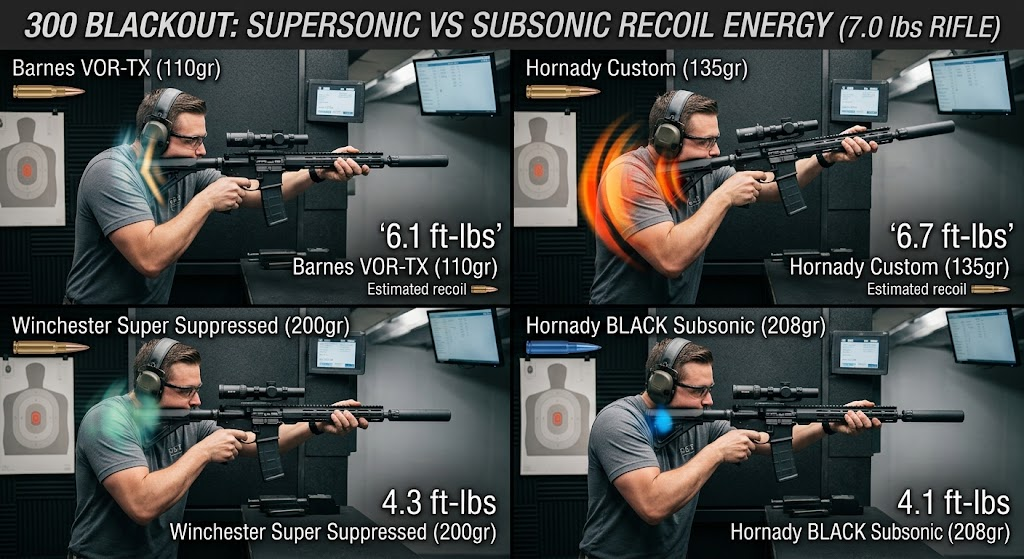
The following table displays estimated free recoil energy for popular 300 Blackout factory loads. Because the 300 Blackout is predominantly chambered in AR-15 platforms and compact bolt-action rifles, these calculations use a baseline 7.0-pound rifle weight for consistency.
| Factory Load | Bullet Weight | Muzzle Velocity | Rifle Weight | Estimated Recoil Energy |
| Barnes VOR-TX | 110 grains | 2,350 fps | 7.0 lbs | 6.1 ft-lbs |
| Hornady Custom | 135 grains | 2,085 fps | 7.0 lbs | 6.7 ft-lbs |
| Winchester Super Suppressed | 200 grains | 1,060 fps | 7.0 lbs | 4.3 ft-lbs |
| Hornady BLACK Subsonic | 208 grains | 1,020 fps | 7.0 lbs | 4.1 ft-lbs |
How Much Recoil Does 300 Blackout Have?
In practical terms, a standard supersonic 300 Blackout load generates an average of 6.5 foot-pounds of free recoil energy and a recoil velocity of roughly 7.5 feet per second in a 7-pound rifle. Heavy subsonic loads generate even less, hovering around 4 foot-pounds of energy. Recoil energy dictates the physical rearward force delivered to the shoulder, while recoil velocity determines how fast or sharp that impact feels.
Because both of these numbers are remarkably low, the 300 Blackout generates very little rearward force. The low recoil velocity means the kick completely lacks the sharp snap associated with high-pressure magnums, resulting in a smooth shooting experience.
What Does 300 Blackout Recoil Feel Like?
During a hunt, the recoil of a 300 Blackout is virtually unnoticeable. It is universally classified as a mild-recoiling cartridge. Firing a supersonic hunting load feels like a gentle nudge backward. Firing a heavy subsonic load, especially suppressed, feels closer to shooting a rimfire rifle than a centerfire centerfire cartridge.
At the shooting range, the 300 Blackout is an absolute pleasure to shoot. A shooter can easily fire hundreds of rounds from an AR-15 without experiencing any shoulder discomfort or developing a flinch. The minimal recoil impulse allows shooters to keep their eyes on the target through the optic, making spotting impacts and executing fast follow-up shots incredibly easy.
300 Blackout Recoil Compared To Other Cartridges
To understand how mild the 300 Blackout truly is, it helps to compare it to other popular tactical and hunting cartridges. The data below assumes a standard rifle weight of 7.0 pounds across all chamberings to ensure an accurate comparison.
| Cartridge | Common Bullet Weight | Muzzle Velocity | Estimated Recoil Energy |
| .223 Rem / 5.56 NATO | 55 grains | 3,200 fps | 3.5 ft-lbs |
| 300 BLK (Subsonic) | 208 grains | 1,020 fps | 4.1 ft-lbs |
| 300 BLK (Supersonic) | 125 grains | 2,175 fps | 6.5 ft-lbs |
| 7.62x39mm | 123 grains | 2,350 fps | 7.5 ft-lbs |
| .30-30 Winchester | 150 grains | 2,390 fps | 14.1 ft-lbs |
| .308 Winchester | 150 grains | 2,820 fps | 16.5 ft-lbs |
What Affects 300 Blackout Recoil?
While the recoil is inherently minimal, several physical and mechanical factors determine exactly how much kick the rifle will produce.
- Ammunition Type: Supersonic loads push lighter bullets (110 to 135 grains) at high velocities, generating about 6 to 7 foot-pounds of recoil. Subsonic loads push heavy bullets (200 to 220 grains) at very low velocities, dropping recoil to roughly 4 foot-pounds.
- Rifle Weight: A heavier rifle absorbs more rearward momentum. A heavy AR-15 setup with a full magazine and optics will kick slightly less than a stripped-down personal defense weapon.
- Powder Charge: The 300 Blackout uses very small powder charges, typically ranging from 10 to 20 grains depending on the load. This small volume of burning gas limits the rocket effect at the muzzle, which keeps recoil low.
- Rifle Action: In semi-automatic AR-15 platforms, the moving bolt carrier group and buffer spring soak up a portion of the recoil energy, making felt recoil even lower than in a rigid bolt-action or single-shot rifle.
- Suppressors: The 300 Blackout was designed from the ground up for use with silencers. A suppressor traps escaping gases and adds weight to the muzzle, severely reducing the already mild rearward kick.
How To Reduce 300 Blackout Recoil
Because the 300 Blackout produces under 7 foot-pounds of recoil energy, mitigation is rarely necessary. However, if you are setting up a rifle for a very young child or a highly recoil-sensitive shooter, you can reduce it further.
The easiest method is to utilize subsonic ammunition and attach a suppressor. A suppressed 300 Blackout firing subsonic rounds produces a recoil impulse so light it is comparable to a .22 Magnum. If you are using an AR-15, you can also tune your gas block and install an adjustable buffer weight to ensure the bolt carrier group cycles as smoothly as possible, taking away any jerky mechanical movement that contributes to felt recoil.
Is 300 Blackout Recoil Too Much For Hunting?
The 300 Blackout recoil is absolutely not too much for hunting. In fact, its exceptionally low recoil is one of its greatest assets for certain types of hunting.
Because the kick is so mild, the 300 Blackout is a premier choice for youth hunters, small-framed shooters, and beginners pursuing deer or feral hogs within 150 yards. It allows new hunters to practice proper marksmanship fundamentals without developing a flinch. It is crucial to note that for ethical hunting on medium game, hunters should strictly use supersonic expanding bullets (like the 110-grain Barnes TSX) rather than subsonic loads, which often fail to expand properly at low velocities.
Frequently Asked Questions
Does the 300 Blackout kick more than a 5.56 NATO?
Yes. The 300 Blackout generates roughly 3 foot-pounds more free recoil energy than a standard 5.56 NATO or .223 Remington. While the 300 Blackout does have more kick, the difference is very small and both are considered extremely mild-recoiling cartridges.
How does 300 Blackout recoil compare to 7.62x39mm?
The recoil is very similar, but the 7.62x39mm typically kicks slightly harder. The 7.62x39mm has a larger case capacity and uses more powder to drive a 123-grain bullet to around 2,350 fps, resulting in about 1 foot-pound more free recoil energy than a comparable supersonic 300 Blackout load.
Do subsonic 300 Blackout rounds kick less?
Yes. Despite using much heavier bullets, subsonic 300 Blackout rounds generate roughly 30 to 40 percent less recoil energy than supersonic rounds. This is because they use very small amounts of powder and leave the barrel at speeds under 1,100 feet per second.