The .357 Magnum utilizes slow-burning handgun powders that generate drastically different muzzle velocities depending on whether it is fired from a short revolver or a closed-breech carbine.
When firing a standard 158-grain load, muzzle velocities average approximately 1,120 fps from a 2-inch snub-nose revolver and 1,270 fps from a 4-inch duty barrel.
Extending the barrel to a 6-inch hunting revolver pushes speeds to roughly 1,390 fps, while a 16-inch lever-action carbine maximizes the cartridge at an explosive 1,750 fps.
It is critical to note that exact velocity varies significantly based on cylinder gap, ammunition pressure ratings, bullet weight, and environmental test conditions.
Analyzing these chronograph statistics allows shooters to select the optimal barrel length for concealed carry, handgun hunting, or leveraging the massive energy gains of a rifle platform.
357 Magnum Velocity Chart
| Barrel Length | Load | Bullet Weight | Muzzle Velocity | Velocity Difference |
| 2 inches | Hornady XTP | 158 grain | 1,120 fps | – |
| 4 inches | Hornady XTP | 158 grain | 1,270 fps | +150 fps |
| 6 inches | Hornady XTP | 158 grain | 1,390 fps | +120 fps |
| 16 inches | Hornady XTP | 158 grain | 1,750 fps | +360 fps |
| 18 inches | Hornady XTP | 158 grain | 1,780 fps | +30 fps |
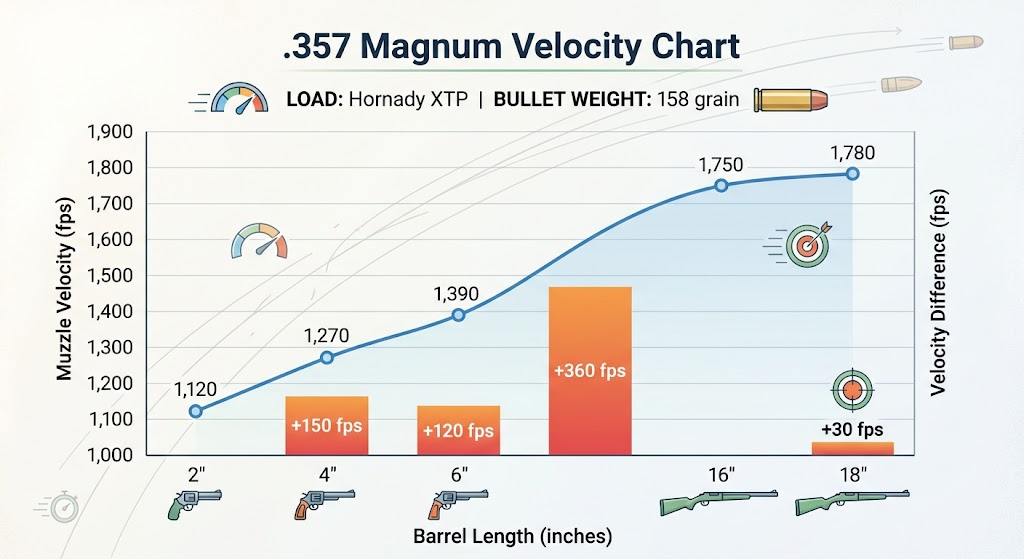
How Much Velocity Does 357 Magnum Gain From Barrel Length?
Chronograph testing proves that the .357 Magnum is one of the most barrel-length-dependent handgun cartridges in the world. Because it was designed to handle large charges of slow-burning powder (like H110 or W296), short barrels simply do not provide enough time for full combustion.
Between 2-inch and 6-inch revolver barrels, the cartridge gains an average of 65 to 75 fps per inch. The most dramatic shift occurs when transitioning from a revolver to a carbine rifle. Jumping from a 6-inch revolver to a 16-inch carbine adds an incredible 360 fps (averaging 36 fps per inch). However, after 16 to 18 inches, the powder is entirely consumed, and the velocity curve flattens drastically, with 20-inch barrels rarely showing more than a 10 to 15 fps advantage over 18-inch barrels.
Does Barrel Length Affect 357 Magnum Velocity?
Yes, barrel length and firearm action type drastically affect .357 Magnum velocity.
In revolvers, a small portion of the expanding gas escapes through the “cylinder gap” (the microscopic space between the cylinder and the barrel). This pressure bleed-off limits velocity. When the same cartridge is chambered in a closed-breech lever-action or single-shot rifle, 100% of the gas pressure is directed into pushing the bullet forward through a much longer bore. This turns the .357 Magnum from a 500 ft-lb handgun round into a 1,100+ ft-lb rifle round capable of taking medium game like whitetail deer at 100 yards.
357 Magnum Supersonic Velocity By Barrel Length
The .357 Magnum is inherently designed as a high-pressure, supersonic cartridge (exceeding ,125 fps at sea level).
- 125 Grain (Hyper-Velocity): This weight is legendary for self-defense. Out of a 4-inch revolver, it averages a screaming 1,450 fps. When fired from a 16-inch carbine, these lightweight bullets regularly shatter the 2,100 fps mark, mimicking true rifle cartridges.
- 158 Grain (Standard): The benchmark weight. It achieves roughly 1,270 fps in 4-inch revolvers and scales to 1,750 fps in a 16-inch carbine.
- 180 Grain (Heavyweight): Hardcast 180-grain loads are favored for bear defense and deep penetration. They typically leave a 4-inch barrel at 1,150 fps and a 16-inch carbine at roughly 1,500 fps.
357 Magnum Subsonic Velocity By Barrel Length
True subsonic .357 Magnum ammunition is incredibly rare because downloading the cartridge defeats its magnum design.
A heavy 180-grain bullet fired from a 2-inch snub-nose revolver will often fall to roughly 1,000 fps, technically making it subsonic due to the severe barrel handicap. However, for shooters utilizing suppressors on lever-action rifles, the standard practice is to simply load and fire .38 Special ammunition. Because a .357 Magnum chamber safely accepts .38 Special, shooters can fire standard 158-grain .38 Special loads (which travel at a naturally subsonic 850 fps) to achieve whisper-quiet performance without relying on specialty downloaded .357 Magnum ammo.
357 Magnum 2 Inch Barrel Velocity
A 2-inch snub-nose revolver (like the Ruger SP101) is strictly designed for extreme close-range concealed carry.
- 158-Grain Load: Averages approximately 1,120 fps.
- Considerations: The short barrel robs the cartridge of its magnum potential. A massive amount of unburnt powder violently ignites outside the barrel, causing concussive muzzle blast, severe recoil, and blinding flash while delivering ballistics only slightly superior to a 9mm +P.
357 Magnum 4 Inch Barrel Velocity
The 4-inch barrel is the undisputed standard for duty and all-purpose revolvers like the Smith & Wesson 686.
- 158-Grain Load: Yields approximately 1,270 fps.
- Considerations: This length offers the perfect balance. It provides a complete enough powder burn to extract true magnum velocities (over 560 ft-lbs of energy) while remaining comfortable enough to carry in a belt holster.
357 Magnum 6 Inch Barrel Velocity
A 6-inch barrel is traditionally utilized for target shooting and dedicated handgun hunting.
- 158-Grain Load: Achieves roughly 1,390 fps.
- Considerations: The extra 2 inches of steel add significant front-weight, which heavily dampens recoil. It extracts nearly 680 ft-lbs of energy, ensuring reliable expansion on thick-skinned game.
357 Magnum 16 Inch Barrel Velocity
A 16-inch lever-action carbine completely transforms the ballistic profile of the .357 Magnum.
- 158-Grain Load: Explodes to approximately 1,750 fps.
- Considerations: Firing this cartridge in a closed breech with 16 inches of bore time nearly doubles the kinetic energy compared to a 4-inch revolver, pushing it past 1,000 ft-lbs and turning it into a highly capable brush-hunting rifle.
357 Magnum Velocity And Energy By Barrel Length
The following table calculates muzzle energy based on tested velocity averages for a standard 158-grain Hornady XTP load.
| Barrel Length | Bullet Weight | Velocity | Muzzle Energy |
| 2 inches | 158 grain | 1,120 fps | 440 ft-lbs |
| 4 inches | 158 grain | 1,270 fps | 566 ft-lbs |
| 6 inches | 158 grain | 1,390 fps | 678 ft-lbs |
| 16 inches | 158 grain | 1,750 fps | 1,074 ft-lbs |
| 18 inches | 158 grain | 1,780 fps | 1,111 ft-lbs |
Practical Applications
Muzzle velocity dictates how the .357 Magnum should be deployed:
- Concealed Carry & Self-Defense: A 2-inch to 4-inch revolver firing 125-grain to 158-grain bullets provides devastating stopping power inside 15 yards. The 4-inch barrel is vastly superior for controlling recoil and maximizing terminal performance.
- Handgun Hunting: A 6-inch revolver is ideal for hunting hogs or deer at close range (under 50 yards), as the 1,390 fps velocity guarantees the deep penetration and expansion required for ethical kills.
- Brush Hunting (Rifles): A 16 to 18-inch lever-action carbine effectively doubles the cartridge’s energy output. At 1,750 fps, the 158-grain bullet shoots flat out to 100 yards and hits with the force of an intermediate rifle cartridge, with practically zero recoil.
What Is The Best Barrel Length For 357 Magnum?
Because the cartridge is used in entirely different firearm platforms, there are two distinct “best” barrel lengths.
For a revolver, the 4-inch barrel is universally considered the best. It tames the brutal muzzle blast of the 2-inch snub-nose, achieves genuine magnum velocity (1,270+ fps), and remains perfectly balanced for a belt holster.
For a rifle, the 16-inch to 18-inch barrel is the ballistic sweet spot. The cartridge’s powder is 100% consumed within 16 to 18 inches. Selecting a 20-inch or 24-inch barrel on a .357 Magnum rifle adds unnecessary weight and provides heavily diminishing returns, often gaining fewer than 10 fps over an 18-inch barrel.
Pros and Cons
Short Barrel Pros (2-4 Inches)
- 2-inch models are exceptionally easy to conceal for self-defense.
- 4-inch models offer the perfect ratio of packability to ballistic performance.
- Fast draw times and excellent maneuverability in confined spaces.
Short Barrel Cons (2-4 Inches)
- 2-inch barrels suffer extreme velocity loss (dropping near 9mm ballistics).
- Severe recoil, deafening muzzle blast, and blinding flash in low-light environments.
Long Barrel Pros (6-18 Inches)
- 6-inch revolvers maximize sight radius for precision target shooting.
- 16-inch carbines double the kinetic energy (1,000+ ft-lbs) for medium game hunting.
- Drastically reduced recoil and muzzle report due to complete powder combustion.
- Extends the ethical hunting range out to 100+ yards.
Long Barrel Cons (6-18 Inches)
- 6-inch revolvers are difficult to carry seated or concealed.
- Rifle barrels longer than 18 inches yield no practical velocity gains due to internal friction.
357 Magnum Velocity: What The Data Shows
Chronograph testing proves that the .357 Magnum is a masterclass in versatility, shifting identities based on the barrel it is fired through. A 16 to 18-inch carbine produces the absolute highest practical velocity, launching 158-grain bullets at nearly 1,780 fps and achieving rifle-class energy transfer.
By analyzing the data curve, shooters can see exactly how heavily short barrels penalize the cartridge. Dropping from a 4-inch duty barrel to a 2-inch snub-nose sacrifices 150 fps, stripping away over 120 ft-lbs of kinetic energy and turning unburnt powder into a punishing muzzle blast. Ultimately, the data confirms that to truly harness the “Magnum” in .357 Magnum, a minimum of a 4-inch barrel is required for handguns, while a 16-inch barrel reigns supreme for hunting carbines.
FAQs
How fast is 357 Magnum from a 2-inch barrel?
From a 2-inch snub-nose revolver, a standard 158-grain load averages roughly 1,120 fps. Lighter 125-grain loads will clock closer to 1,250 fps.
How fast is 357 Magnum from a 4-inch barrel?
A 4-inch revolver extracts true magnum ballistics, pushing a 158-grain bullet to approximately 1,270 fps and generating over 560 ft-lbs of energy.
How fast is 357 Magnum from a 16-inch barrel?
A 16-inch lever-action carbine maximizes the cartridge, achieving roughly 1,750 fps with a 158-grain bullet and crossing the 1,000 ft-lb energy threshold.
Does barrel length affect 357 Magnum velocity?
Yes, drastically. The cartridge utilizes slow-burning powders that require longer barrels to fully combust. It also gains massive velocity when fired from closed-breech rifles instead of revolvers.
How much velocity does 357 Magnum lose per inch?
In revolvers (between 2 and 6 inches), it loses an average of 65 to 75 fps per inch of barrel reduced.
What is the fastest 357 Magnum barrel length?
Chronograph testing universally shows that 16-inch to 18-inch closed-breech rifle barrels produce the absolute fastest velocities for the .357 Magnum.
What is the best barrel length for 357 Magnum?
For revolvers, the 4-inch barrel is the best balance of velocity, recoil mitigation, and portability. For rifles, the 16-inch to 18-inch barrel is the ballistic optimal length.
Does 357 Magnum gain velocity from a longer barrel?
Yes. It gains massive amounts of speed up to 18 inches. However, extending a rifle barrel past 18 or 20 inches provides virtually no extra velocity.
How fast is subsonic 357 Magnum?
Heavy 180-grain loads fired from 2-inch barrels can dip below the 1,125 fps sound barrier. However, shooters wanting subsonic performance standardly shoot .38 Special ammo (850 fps) out of their .357 Magnum firearms.
How fast is supersonic 357 Magnum?
Standard supersonic .357 Magnum travels anywhere from 1,120 fps (in short revolvers) up to a blistering 2,100+ fps (firing lightweight 125-grain bullets in rifles).
What is the velocity difference between a 4 and 16 inch 357 Magnum barrel?
For a 158-grain load, the velocity difference is roughly 480 fps (1,270 fps vs. 1,750 fps). This translates to an incredible 90% increase in kinetic energy when switching from a duty revolver to a carbine.