The .44 Magnum is a legendary big-bore cartridge that utilizes slow-burning pistol and magnum powders, requiring adequate barrel length to achieve its full ballistic potential.
When firing a standard 240-grain jacketed hollow point (JHP), muzzle velocities average approximately 1,180 fps from a 4-inch revolver and 1,350 fps from a 6-inch hunting revolver.
Stepping up to a closed-breech 16-inch lever-action carbine pushes speeds to an explosive 1,750 fps, while a 20-inch rifle maximizes the cartridge at roughly 1,820 fps.
It is critical to note that exact muzzle velocity varies significantly based on cylinder gap, ammunition pressure ratings, bullet weight, and environmental test conditions.
Analyzing these chronograph statistics allows shooters to choose the optimal barrel length for personal defense, handgun hunting, or leveraging the rifle-class energy of a carbine.
44 Magnum Velocity Chart
| Barrel Length | Load | Bullet Weight | Muzzle Velocity | Velocity Difference |
| 4 inches | Hornady XTP | 240 grain | 1,180 fps | – |
| 6 inches | Hornady XTP | 240 grain | 1,350 fps | +170 fps |
| 8 inches | Hornady XTP | 240 grain | 1,430 fps | +80 fps |
| 16 inches | Hornady XTP | 240 grain | 1,750 fps | +320 fps |
| 20 inches | Hornady XTP | 240 grain | 1,820 fps | +70 fps |
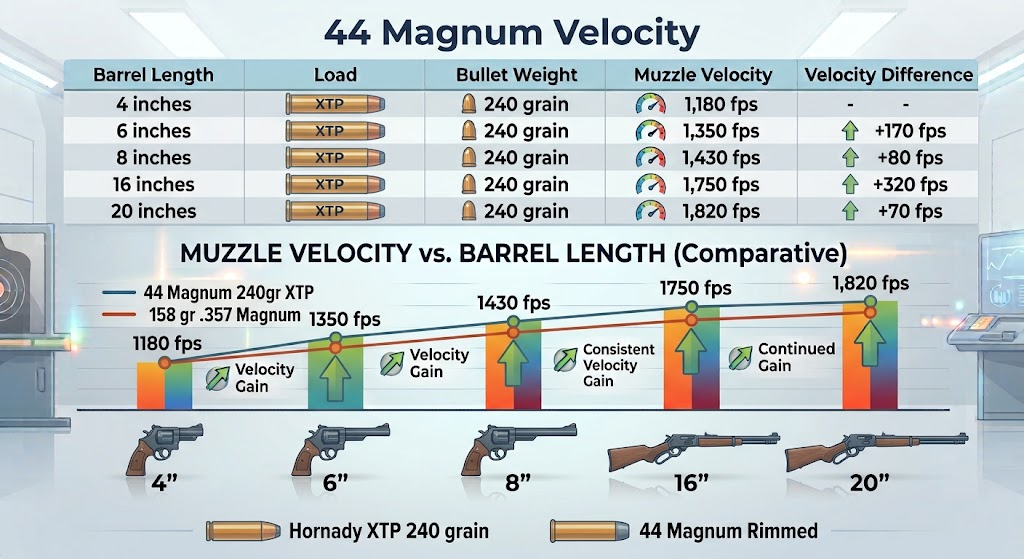
How Much Velocity Does 44 Magnum Gain From Barrel Length?
Chronograph testing proves that the .44 Magnum is heavily dependent on barrel length because it utilizes large charges of slow-burning powder (such as H110 or W296). In revolvers, the cartridge gains an average of 40 to 85 fps per inch of barrel added between 4 and 8 inches.
The most dramatic performance shift occurs when transitioning from an open-cylinder revolver to a closed-breech carbine. Jumping from an 8-inch revolver to a 16-inch lever-action rifle adds an incredible 320 fps of speed. However, once the barrel reaches 20 inches, the powder is entirely consumed, and the velocity curve begins to flatten rapidly.
Does Barrel Length Affect 44 Magnum Velocity?
Yes, barrel length and firearm action type drastically affect .44 Magnum velocity and terminal energy.
In revolvers, a small amount of high-pressure gas escapes through the “cylinder gap” (the microscopic clearance between the rear of the barrel and the revolving cylinder), slightly limiting initial velocity. When the same round is fired from a closed-breech rifle, 100% of the expanding gas is trapped behind the bullet. This transforms the .44 Magnum from a heavy-hitting handgun cartridge into a short-range rifle capable of ethically taking large game like elk, black bear, and whitetail deer out to 150 yards.
44 Magnum Supersonic Velocity By Barrel Length
The .44 Magnum is designed primarily as a high-pressure, supersonic cartridge that easily clears the 1,125 fps sound barrier across almost all standard platform lengths.
- 200 Grain (Lightweight / High Speed): Lighter bullets maximize flat trajectories and high initial impact speeds. Out of a 4-inch revolver, a 200-grain load averages roughly 1,300 fps, while a 16-inch carbine can push these projectiles past 1,900 fps.
- 240 Grain (Standard Benchmark): The definitive standard weight for the cartridge. It achieves approximately 1,180 fps in a 4-inch revolver, scales to 1,350 fps in a 6-inch revolver, and rockets to 1,750 fps in a 16-inch carbine.
- 300 Grain (Heavyweight / Hardcast): Favored for deep-penetrating bear defense and heavy game. These slow-steppers typically leave a 4-inch revolver around 1,050 fps (hovering near subsonic) and a 16-inch rifle at roughly 1,450 fps.
44 Magnum Subsonic Velocity By Barrel Length
True factory subsonic .44 Magnum ammunition is rare because the cartridge’s design intent relies heavily on high supersonic speeds for expansion and hydraulic shock.
However, because heavy 300-grain bullets require large amounts of inertia, firing heavy hardcast loads out of very short 3-inch or 4-inch snub-nose revolvers will sometimes dip velocities near the 1,050 to 1,100 fps range. For suppressed lever-action shooters wanting true whisper-quiet performance, the standard practice is to use specially downloaded handloads or leverage heavy .44 Special ammunition, which naturally stays subsonic in nearly all barrel configurations.
44 Magnum 4 Inch Barrel Velocity
A 4-inch barrel is common on duty revolvers like the Smith & Wesson Model 29 or Ruger Redhawk, offering a compromise between packability and power.
- 240-Grain Load: Averages approximately 1,180 fps.
- Considerations: While it surrenders significant velocity compared to longer hunting revolvers, it still produces a formidable 740 ft-lbs of muzzle energy, making it an exceptional sidearm for self-defense against large predators.
44 Magnum 6 Inch To 8 Inch Barrel Velocity
Longer 6-inch and 8-inch barrels are traditional choices for handgun hunters and target shooters.
- 240-Grain Load: Yields roughly 1,350 fps (6-inch) up to 1,430 fps (8-inch).
- Considerations: The added barrel length extracts true magnum velocity and energy (970+ ft-lbs), while the extra front-weight of the firearm helps absorb heavy felt recoil.
44 Magnum 16 Inch Barrel Velocity
A 16-inch lever-action carbine completely alters the ballistic performance and effective range of the .44 Magnum.
- 240-Grain Load: Explodes to approximately 1,750 fps.
- Considerations: Nearly doubles the muzzle energy of a 4-inch revolver (pushing past 1,600 ft-lbs), providing clean, flat-shooting rifle ballistics with minimal felt recoil.
44 Magnum 20 Inch Barrel Velocity
A 20-inch rifle barrel represents the maximum practical length for traditional tubular-magazine lever-action rifles chambered in .44 Magnum.
- 240-Grain Load: Reaches roughly 1,820 fps.
- Considerations: Captures the absolute peak velocity of the cartridge, offering complete powder combustion and maximum downrange momentum.
44 Magnum Velocity And Energy By Barrel Length
The following table calculates muzzle energy based on tested velocity averages for a standard 240-grain Hornady XTP load.
| Barrel Length | Bullet Weight | Velocity | Muzzle Energy |
| 4 inches | 240 grain | 1,180 fps | 741 ft-lbs |
| 6 inches | 240 grain | 1,350 fps | 971 ft-lbs |
| 8 inches | 240 grain | 1,430 fps | 1,090 ft-lbs |
| 16 inches | 240 grain | 1,750 fps | 1,632 ft-lbs |
| 20 inches | 240 grain | 1,820 fps | 1,765 ft-lbs |
Practical Applications
Muzzle velocity dictates how the .44 Magnum should be deployed in the field:
- Handgun Hunting (Revolvers): A 6-inch or 8-inch revolver firing 240-grain to 300-grain bullets delivers reliable expansion and deep tissue penetration on deer or hogs inside 75 yards.
- Carbine Timber Hunting: A 16-inch lever-action carbine elevates the cartridge into a powerhouse short-range rifle. At 1,750 fps, it hits with greater kinetic energy than a standard .30-30 Winchester inside 100 yards, with zero recoil.
- Bear Defense: A 4-inch or 5-inch revolver loaded with heavy hardcast bullets provides a fast-handling, packable line of defense against aggressive wildlife in bear country.
What Is The Best Barrel Length For 44 Magnum?
Because the .44 Magnum bridges the gap between powerful handguns and utility carbines, the “best” barrel length depends entirely on your firearm platform:
For a revolver, the 6-inch barrel is widely considered the optimal sweet spot. It delivers authentic magnum velocities (1,350+ fps) and heavy energy without making the gun excessively front-heavy or difficult to holster.
For a rifle, the 16-inch to 18-inch barrel is ideal. It captures nearly all of the cartridge’s velocity potential (1,750+ fps) while keeping the lever-action carbine fast-handling and lightweight.
Pros and Cons
Short Barrel Pros (3-4 Inches)
- Exceptional portability for hip holsters or backcountry trail carry.
- Faster draw times and easier maneuverability in tight quarters or vehicles.
Short Barrel Cons (3-4 Inches)
- Noticeable velocity penalty compared to long barrels.
- Severe muzzle blast, blinding flash, and sharp recoil due to unburnt powder escaping the cylinder.
Long Barrel Pros (6-20 Inches)
- 6 to 8-inch revolvers maximize sight radius and hunting energy.
- 16 to 20-inch carbines double the energy output (1,600+ ft-lbs) for mid-range big game hunting.
- Complete powder combustion dramatically reduces muzzle flash and perceived recoil.
Long Barrel Cons (6-20 Inches)
- Long revolvers are heavy to carry all day.
- Rifle barrels past 20 inches offer minimal velocity returns due to complete powder exhaustion.
44 Magnum Velocity: What The Data Shows
Chronograph testing proves that the .44 Magnum is an exceptionally versatile big-bore cartridge that scales drastically with barrel length. A 16 to 20-inch lever-action rifle yields the highest practical velocities, pushing heavy 240-grain bullets up to 1,820 fps and generating rifle-class energy well past 1,700 ft-lbs.
By analyzing the data curve, shooters can see that shortening the barrel to a compact 4-inch revolver drops speeds into the upper 1,100 fps range, reducing overall kinetic energy by more than half compared to a carbine. Ultimately, the data confirms that matching your barrel length to your intended application—whether a 4-inch sidearm or a 16-inch deer rifle—ensures optimal performance.
FAQs
How fast is 44 Magnum from a 4-inch barrel?
From a 4-inch revolver, a standard 240-grain JHP load averages approximately 1,180 fps muzzle velocity.
How fast is 44 Magnum from a 6-inch barrel?
A 6-inch revolver pushes a standard 240-grain bullet to roughly 1,350 fps, generating nearly 970 ft-lbs of kinetic energy.
How fast is 44 Magnum from a 16-inch barrel?
Fired from a 16-inch lever-action carbine, a 240-grain load reaches an explosive 1,750 fps, crossing the 1,600 ft-lb energy threshold.
Does barrel length affect 44 Magnum velocity?
Yes, drastically. The cartridge utilizes heavy charges of slow-burning powder that require substantial bore length and cylinder containment to fully combust.
How much velocity does 44 Magnum lose per inch?
In revolvers (between 8 inches and 4 inches), the cartridge loses an average of roughly 50 to 60 fps per inch of barrel reduced.
What is the best barrel length for 44 Magnum?
For revolvers, a 6-inch barrel is ideal for hunting and target shooting, while a 4-inch barrel is best for carry. For rifles, a 16-inch carbine offers the best balance of speed and handling.
Does 44 Magnum gain velocity from a longer barrel?
Yes. It gains meaningful speed all the way up to 20 inches, after which velocity gains flatten out completely due to complete powder burn.
How fast is subsonic 44 Magnum?
While most factory loads are supersonic, heavy 300-grain bullets fired from short 4-inch barrels can dip close to the 1,050 fps mark, though true subsonic loads usually require specialized handloads.