The most appropriate starting buffer weight for a typical .338 ARC rifle is a standard carbine (3.0 oz) or an H1 (3.8 oz) buffer.
There is no single universal buffer weight for this caliber because the correct choice depends heavily on barrel length, the gas system, subsonic vs supersonic ammunition, suppressed vs unsuppressed use, and your specific gas port configuration.
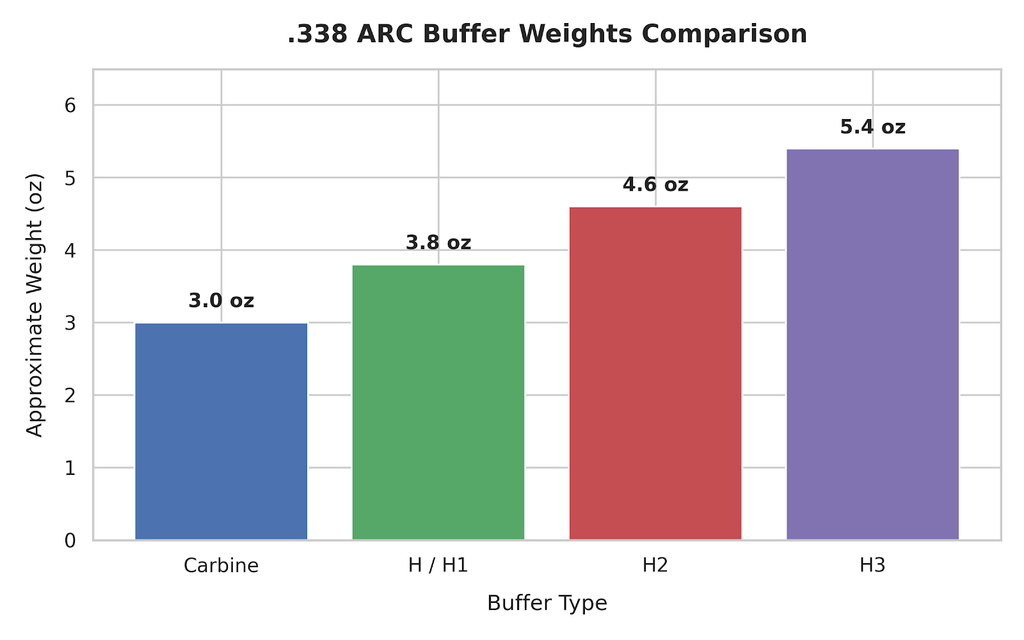
Commonly used buffer weights for the AR-15 platform include the standard Carbine (~3.0 oz), H1 (~3.8 oz), H2 (~4.6 oz), and H3 (~5.4 oz).
Because the .338 ARC utilizes pistol length gas systems to push massive 307 grain subsonic projectiles, standard carbine weights often provide the reliability needed for lower pressure loads.
Conversely, suppressed setups firing high pressure supersonic loads generally demand heavier H2 or H3 buffers to slow down the violent action.
Table of Contents [Click to minimize]
338 ARC Buffer Weight
| Buffer Type | Approx. Weight | Common Configuration | 338 ARC Use |
| Carbine | ~3.0 oz | 3 steel weights | Unsuppressed subsonic, short barrels |
| H / H1 | ~3.8 oz | 1 tungsten, 2 steel | Standard starting point, unsuppressed supers |
| H2 | ~4.6 oz | 2 tungsten, 1 steel | Suppressed setups, 16 inch pistol gas barrels |
| H3 | ~5.4 oz | 3 tungsten | Heavily overgassed suppressed supers |
Understanding your 338 arc buffer weight is critical because the buffer acts as the primary delay mechanism for your rifle’s operating cycle. The buffer weight dictates how quickly the bolt carrier group moves backward after a round is fired. This mechanical timing matters immensely. If the bolt unlocks too quickly, chamber pressures are still dangerously high, leading to harsh recoil and excessive parts wear on your 6.5 Grendel style bolt face.
Heavier buffers add mass to the system, which slows down the operating cycle. This is highly beneficial for taming the violent extraction caused by overgassed setups or high pressure supersonic rounds. On the other hand, lighter buffers are often necessary for weaker subsonic loads. Because subsonic rounds operate at a much lower pressure near 30,000 PSI, a heavy buffer can prevent the bolt from traveling far enough backward to eject the spent casing and load the next round.Ultimately, there is no universal best buffer because the .338 ARC was designed to fire wildly different types of ammunition, from 307 grain subsonics to 175 grain supersonics, often through varying barrel lengths and suppressors.
Buffer Weight By Configuration
Review this 338 arc buffer weight chart to identify optimal starting points based on your specific setup:
| 338 ARC Setup | Starting Buffer Weight | Key Consideration |
| Short Barrel + Pistol Gas | Carbine or H1 | Very common; port size dictates the final need |
| 8.5 to 9 Inch + Pistol Gas | Carbine or H1 | Often perfectly gassed for standard weights |
| 12.5 Inch + Pistol Gas | H1 or H2 | Increased dwell time may require slightly heavier buffers |
| 16 Inch + Pistol Gas | H2 or H3 | Extremely long dwell time often creates overgassing |
| Subsonic (307gr) | Carbine | Low gas pressure needs lighter weight to cycle |
| Supersonic (175gr) | H1 or H2 | Higher pressure requires heavier mass to delay unlocking |
| Suppressed | H2 or H3 | Suppressor adds backpressure and speeds up the bolt |
| Unsuppressed | Carbine or H1 | Less backpressure means less mass is needed to cycle |
These recommendations are researched starting points rather than universal rules. Your specific barrel manufacturer’s gas port size and whether you utilize an adjustable gas block will ultimately dictate how much mass your operating system can handle.
Buffer Weight Specifications
The exact weights of AR-15 buffers can vary slightly depending on the manufacturer. The specifications below reflect standard mil-spec configurations typically produced by reputable industry leaders.
| Buffer | Weight In Ounces | Weight In Grams | Typical Internal Weight Configuration |
| Carbine | 3.0 oz | 85 g | 3 steel weights |
| H | 3.8 oz | 108 g | 1 tungsten, 2 steel weights |
| H2 | 4.6 oz | 130 g | 2 tungsten, 1 steel weights |
| H3 | 5.4 oz | 153 g | 3 tungsten weights |
Different manufacturers may use slightly different weights, so always verify with the specific brand if you are fine tuning on a scale.
Subsonic vs Supersonic
Subsonic .338 ARC
Subsonic ammunition, such as the Hornady 307 grain Sub-X, is loaded with massive bullets and a smaller powder charge to keep the velocity below the speed of sound. This smaller powder charge inherently produces a much lower gas impulse at approximately 30,000 PSI. As a result, the 338 arc buffer weight for subs generally needs to be lighter. If the 338 ARC buffer is too heavy, the low pressure gas will not have enough force to push the bolt carrier group fully to the rear, causing failures to cycle or lock back on an empty magazine.
Supersonic .338 ARC
Supersonic ammunition, such as the 175 grain HP Match, uses lighter bullets and full powder charges that generate significantly higher chamber pressures near 52,000 PSI. Supersonic loads place much more bolt thrust on the operating system. Because of this higher pressure, supersonic .338 ARC can tolerate and highly benefit from a heavier 338 arc buffer weight for supers. Depending on the gas system, stepping up to an H1 or H2 buffer delays unlocking, smooths out the felt recoil, and reduces mechanical stress on the extractor. Keep in mind that no single buffer weight works flawlessly for both unsuppressed subsonics and suppressed supersonics without some mechanical compromise.
Suppressed vs Unsuppressed
Adding a suppressor fundamentally changes your gas system’s behavior. A suppressor acts as a gas trap at the end of the muzzle, forcing excess gas back down the barrel and into the gas tube. This drastically increases the speed and violence of the bolt carrier group’s rearward travel.
| Configuration | Gas Behavior | Buffer Weight Consideration |
| Subsonic + Suppressed | Added backpressure helps cycle heavy subs | Carbine or H1 usually cycles flawlessly |
| Subsonic + Unsuppressed | Very low backpressure with shortest gas impulse | Carbine or specialized lightweight buffers needed |
| Supersonic + Suppressed | Extreme backpressure and violent cycling | H2 or H3 required to prevent excessive wear |
| Supersonic + Unsuppressed | Standard high pressure backpressure | H1 usually provides the smoothest recoil impulse |
The suppressor, gas port size, ammunition type, and barrel length all interact simultaneously. A 338 arc buffer weight suppressed setup will almost always require a step up in weight to counter the artificial overgassing created by the silencer. Because the .338 ARC requires a .338 caliber, .36 caliber, or .45 caliber suppressor, backpressure levels can vary widely based on the internal volume of your specific can.
Barrel Length
Buffer selection can change drastically depending on barrel length. In .338 ARC, manufacturers frequently utilize a pistol length gas system to ensure the 307 grain subsonic ammunition can cycle.
- 8.5 inches to 9 inches: These are very common lengths for the .338 ARC. Because the muzzle is close to the gas port, there is minimal dwell time. A standard 338 arc carbine buffer or H1 usually works best here.
- 12.5 inches: The increased barrel length adds more dwell time, pushing more gas volume back into the receiver. An H1 or H2 buffer is often required to tame the slightly longer gas impulse.
- 16 inches: A 16 inch barrel with a pistol length gas system has a massive amount of dwell time. This setup is notorious for being heavily overgassed when firing supersonic ammunition, often requiring an H2 or even an H3 buffer to prevent the rifle from suffering premature wear.
Remember that the 338 arc buffer weight barrel length correlation alone does not determine the correct buffer. It is the specific combination of barrel length, gas port diameter, and gas system length.
H vs H2 vs H3
| Buffer | Approx. Weight | Advantages | Potential Issue |
| H | 3.8 oz | Excellent middle ground for mixed unsuppressed use | May be too light for suppressed supersonic loads |
| H2 | 4.6 oz | Tames recoil and wear on suppressed or 16 inch setups | Can cause short stroking with unsuppressed subsonics |
| H3 | 5.4 oz | Maximum delay for heavily overgassed or suppressed setups | Too heavy for most unsuppressed applications |
Shooters should move from a lighter buffer toward a heavier one if their brass is ejecting too far forward at the 1 o’clock or 2 o’clock position, if the felt recoil is uncomfortably sharp, or if the bolt carrier group is outrunning the magazine spring.
Signs Of Incorrect Buffer Weight
An improperly tuned AR-15 will communicate its issues clearly. Symptoms that indicate a setup may not be properly tuned include:
- Short stroking: The bolt moves back far enough to eject the spent case but not far enough to strip a new round from the magazine. The buffer is too heavy.
- Failure to lock back: The bolt fails to catch on the bolt catch after the last round is fired. The buffer is too heavy.
- Failure to feed: The bolt travels too fast and outruns the magazine, crushing the next round. The buffer is too light.
- Excessive cycling speed: The rifle feels violently snappy and aggressive. The buffer is too light.
- Excessive felt recoil: The buffer bottoms out hard against the rear of the buffer tube. The buffer is too light.
- Ejection pattern changes: Brass ejecting forward of the 3 o’clock position usually indicates an overgassed gun where the buffer is too light, while brass weakly ejecting behind 4 o’clock indicates an undergassed gun where the buffer is too heavy.
It is crucial to understand that these symptoms can also be caused by gas system blockages, underpowered ammunition, weak magazine springs, compromised buffer springs, or mechanical friction. Buffer weight should not automatically be blamed for every malfunction.
What Is The Best Buffer Weight For 338 ARC?
The best buffer weight for 338 arc is the one that allows your specific rifle configuration to eject brass smoothly between the 3 o’clock and 4 o’clock positions while reliably locking the bolt back on an empty magazine.
For a general purpose short barrel between 8.5 and 9 inches, an H1 buffer is widely considered the best starting point because it balances the demands of both 52,000 PSI supersonic and 30,000 PSI subsonic loads. If you are running a 16 inch barrel with a pistol gas system, an H2 buffer is usually a better starting point due to the extreme dwell time forcing excess gas into the receiver.
Dedicated subsonic shooters running unsuppressed should always start with a standard carbine buffer (3.0 oz) to ensure the weapon cycles reliably with low pressure 307 grain ammunition. Conversely, a dedicated supersonic shooter will find that an H1 or H2 buffer provides a much smoother shooting experience.
If your rifle is strictly suppressed, you will almost certainly benefit from an H2 buffer to mitigate the harsh backpressure. For unsuppressed rifles, stick to Carbine or H1. For mixed ammunition use where you switch between subs and supers without changing parts, an H1 buffer is generally the most forgiving compromise. Disagreements among reputable sources usually stem from variations in manufacturer gas port sizes. A barrel with a massive gas port will require a heavier buffer than a barrel with a conservatively drilled port, even if both barrels are the exact same length.
Final Comparison
| Use Case | Most Appropriate Starting Point | Why |
| General 338 ARC | H1 | Strikes the best balance for mixed unsuppressed use |
| Subsonic | Carbine | Minimum mass required to cycle lower pressure 30,000 PSI loads |
| Supersonic | H1 or H2 | Higher pressure 52,000 PSI requires more mass to delay unlocking |
| Suppressed | H2 | Suppressors drastically increase backpressure and bolt speed |
| Unsuppressed | Carbine or H1 | Relies purely on barrel gas without backpressure assistance |
| Short Barrel | Carbine or H1 | Shorter dwell time means less gas volume entering the system |
| 16 Inch Barrel | H2 or H3 | Pistol gas on a 16 inch barrel creates massive dwell time |
| Mixed Loads | H1 | The safest middle ground if you refuse to swap buffers at the range |
These recommendations clearly serve as starting points rather than universal specifications.
FAQs
What buffer weight is best for 338 ARC?
The best starting point is an H1 buffer for mixed use, a standard carbine buffer for dedicated unsuppressed subsonics, and an H2 buffer for dedicated suppressed supersonics.
What is the standard 338 ARC buffer weight?
Many .338 ARC builds function perfectly with a standard Carbine (3.0 oz) buffer, though an H1 (3.8 oz) is often used to smooth out the recoil impulse of supersonic loads.
Is H2 a good buffer for 338 ARC?
Yes, a 338 arc H2 buffer is excellent for suppressed configurations, 16 inch pistol gassed barrels, or any setup firing exclusively high pressure supersonic ammunition.
Is H3 too heavy for 338 ARC?
A 338 arc H3 buffer is usually too heavy for unsuppressed setups, especially with heavy 307 grain subsonics, but it can be the perfect solution for heavily overgassed suppressed supersonic rifles.
What buffer weight should I use for 338 ARC subs?
The best 338 arc buffer weight for subs is typically a standard carbine buffer (3.0 oz), as subsonic rounds produce significantly less gas pressure to push the bolt rearward.
What buffer weight should I use for 338 ARC supers?
The ideal 338 arc buffer weight for supers is usually an H1 or H2, which adds enough mass to delay the unlocking of the bolt under higher 52,000 PSI chamber pressures.
Does a suppressor affect 338 ARC buffer weight?
Yes, a suppressor acts as a gas trap and increases backpressure. A 338 arc buffer weight suppressed configuration generally requires a heavier buffer like an H2 or H3 compared to an unsuppressed rifle.
Does barrel length affect 338 ARC buffer weight?
Yes, 338 arc buffer weight barrel length correlation is based on dwell time. Longer barrels with pistol gas systems have more dwell time, meaning more gas enters the system, which often requires heavier buffers.
What is the difference between H, H2 and H3 buffers?
The difference lies in the internal weights. H or H1 has one tungsten and two steel weights, H2 has two tungsten and one steel, and H3 contains three tungsten weights.
How much does an H2 buffer weigh?
An H2 buffer typically weighs around 4.6 to 4.7 ounces depending on the specific manufacturer.
How much does an H3 buffer weigh?
An H3 buffer typically weighs 5.4 ounces. Exact 338 arc buffer ounces vary slightly by brand, but 5.4 oz is the mil-spec standard.
Can a buffer be too heavy for 338 ARC?
Yes. If the buffer is too heavy, the rifle will short stroke, fail to feed the next round, or fail to lock back on an empty magazine.
Can a buffer be too light for 338 ARC?
Yes. If the buffer is too light, the bolt will unlock too quickly, causing excessive felt recoil, aggressive parts wear on the 6.5 Grendel bolt face, and forward brass ejection.