The main difference between the .32 Winchester Special and the .30-30 Winchester is that the .30-30 fires a .308 caliber bullet and successfully transitioned entirely to smokeless powder to become the universal standard for lever action deer rifles, while the .32 Winchester Special fires a slightly larger .321 caliber bullet and was originally designed with a slower rifling twist to allow handloaders to continue using traditional black powder and cast lead bullets during the transitional era. Choosing between these two classic Winchester Model 1894 cartridges comes down to understanding their historical context and modern ammunition availability. In this comprehensive guide, we compare velocity, muzzle energy, recoil, trajectory, bullet drop, penetration, expansion, effective range, hunting capability, and ammunition cost to help you understand which of these legendary lever action cartridges belongs in your collection.
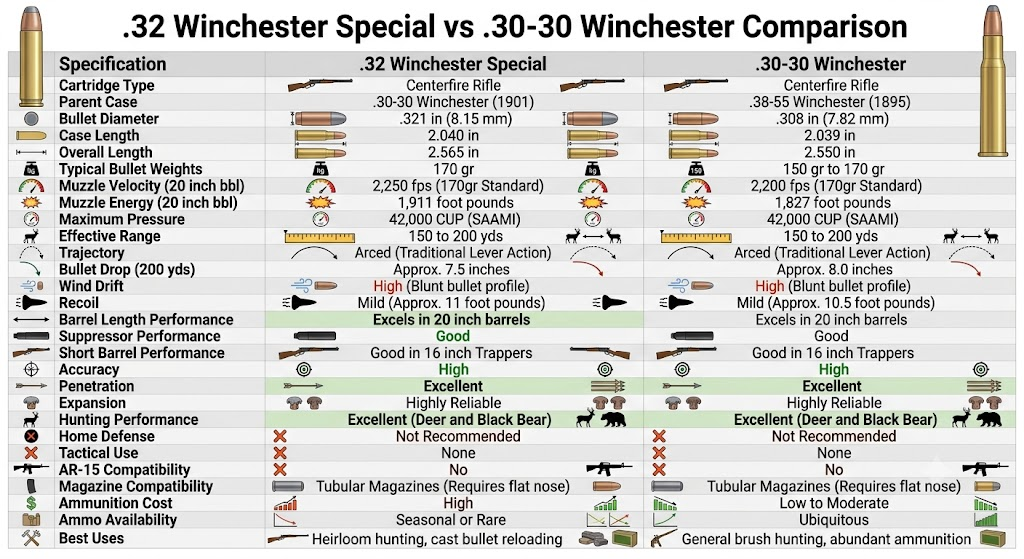
.32 Winchester Special vs .30-30 Winchester Comparison Table
To accurately compare these two legendary brush guns, we must examine their physical dimensions and baseline ballistic performance. The data below represents standard traditional factory loads firing 170 grain flat nose bullets out of classic 20 inch lever action barrels.
| Specification | .32 Winchester Special | .30-30 Winchester |
| Cartridge Type | Centerfire Rifle | Centerfire Rifle |
| Parent Case | .30-30 Winchester (1901) | .38-55 Winchester (1895) |
| Bullet Diameter | .321 in (8.15 mm) | .308 in (7.82 mm) |
| Case Length | 2.040 in | 2.039 in |
| Overall Length | 2.565 in | 2.550 in |
| Typical Bullet Weights | 170 gr | 150 gr to 170 gr |
| Muzzle Velocity (20 inch bbl) | 2,250 fps (170gr Standard) | 2,200 fps (170gr Standard) |
| Muzzle Energy (20 inch bbl) | 1,911 foot pounds | 1,827 foot pounds |
| Maximum Pressure | 42,000 CUP (SAAMI) | 42,000 CUP (SAAMI) |
| Effective Range | 150 to 200 yds | 150 to 200 yds |
| Trajectory | Arced (Traditional Lever Action) | Arced (Traditional Lever Action) |
| Bullet Drop (200 yds) | Approx. 7.5 inches | Approx. 8.0 inches |
| Wind Drift | High (Blunt bullet profile) | High (Blunt bullet profile) |
| Recoil | Mild (Approx. 11 foot pounds) | Mild (Approx. 10.5 foot pounds) |
| Barrel Length Performance | Excels in 20 inch barrels | Excels in 20 inch barrels |
| Suppressor Performance | Good | Good |
| Short Barrel Performance | Good in 16 inch Trappers | Good in 16 inch Trappers |
| Accuracy | High | High |
| Penetration | Excellent | Excellent |
| Expansion | Highly Reliable | Highly Reliable |
| Hunting Performance | Excellent (Deer and Black Bear) | Excellent (Deer and Black Bear) |
| Home Defense | Not Recommended | Not Recommended |
| Tactical Use | None | None |
| AR-15 Compatibility | No | No |
| Magazine Compatibility | Tubular Magazines (Requires flat nose) | Tubular Magazines (Requires flat nose) |
| Ammunition Cost | High | Low to Moderate |
| Ammo Availability | Seasonal or Rare | Ubiquitous |
| Best Uses | Heirloom hunting, cast bullet reloading | General brush hunting, abundant ammunition |
Understanding the Numbers
The technical differences between these cartridges are deeply rooted in the transition from black powder to smokeless powder at the turn of the 20th century. When Winchester introduced the .30-30 in 1895, it was the first small bore sporting rifle cartridge designed exclusively for smokeless powder. However, many hunters at the time did not trust the new smokeless powder or could not find it locally. Furthermore, the fast 1:12 rifling twist of the .30-30 barrel stripped the traditional cast lead bullets that handloaders preferred to use.
To solve this problem, Winchester released the .32 Winchester Special in 1901. They simply necked up the .30-30 case to accept a .321 caliber bullet and used a much slower 1:16 rifling twist in the barrel. This slower twist allowed hunters to safely handload their own cast lead bullets with traditional black powder if they desired, while still offering excellent smokeless powder performance from the factory.
Velocity Comparison
Velocity dictates the trajectory and kinetic energy of these traditional brush guns.
Muzzle Velocity Data (20 inch barrel):
- .32 Winchester Special (170gr Soft Point): 2,250 fps
- .30-30 Winchester (170gr Soft Point): 2,200 fps
When comparing identical 170 grain bullet weights, the .32 Winchester Special actually possesses a slight velocity advantage. Because the bullet is slightly wider (.321 inches compared to .308 inches), the expanding gases have a larger base area to push against. This allows the .32 Winchester Special to achieve roughly 50 feet per second more velocity than the .30-30 Winchester.
Muzzle Energy Comparison
Muzzle energy measures the kinetic force transferred to the target upon impact.
Muzzle Energy Data (20 inch barrel):
- .32 Winchester Special (170gr Soft Point): 1,911 foot pounds
- .30-30 Winchester (170gr Soft Point): 1,827 foot pounds
Thanks to its slight velocity advantage, the .32 Winchester Special generates roughly 80 to 90 foot pounds more kinetic energy at the muzzle. While this is a mathematical victory for the .32 Special on paper, no deer or black bear in the woods will ever feel the difference between these two loads. Both deliver excellent, reliable energy for medium game hunting at close ranges.
Trajectory Comparison
A flat trajectory minimizes the margin of error when estimating range in the field.
Both cartridges were designed for tubular magazines, which means they must utilize flat nosed or round nosed bullets. These blunt bullets have terrible aerodynamics (low Ballistic Coefficients) and shed velocity very quickly. Consequently, both cartridges share a nearly identical, steep arced trajectory. They are both designed to be zeroed at 100 yards and utilized primarily inside the thick timber.
Bullet Drop Comparison
Assuming a standard 100 yard zero, the mathematical bullet drop illustrates how similar these cartridges truly are.
| Distance | .30-30 Winchester (170gr Flat Nose) | .32 Winchester Special (170gr Flat Nose) |
| 100 Yards | 0 inches | 0 inches |
| 150 Yards | -2.5 inches | -2.3 inches |
| 200 Yards | -8.0 inches | -7.5 inches |
| 250 Yards | -17.5 inches | -16.5 inches |
The .32 Winchester Special drops about half an inch less at 200 yards due to its slightly higher starting velocity. Practically speaking, a hunter can use the exact same holdover data for both rifles in the field.
Wind Drift Comparison
Wind deflection is mitigated by a bullet’s velocity and its aerodynamic profile.
Because both cartridges fire heavy, blunt nosed bullets at relatively modest speeds, wind drift is a significant factor past 100 yards. The .32 Winchester Special reaches the target a fraction of a second faster, but its wider bullet profile catches slightly more wind. They perform identically poorly in heavy crosswinds, reminding the hunter that these are short range timber cartridges.
Recoil Comparison
Recoil dictates a shooter’s ability to fire rapid and accurate follow up shots.
Both of these cartridges are famous for their mild, pleasant recoil impulses. Fired from a standard 7 pound lever action rifle (like the Winchester Model 94 or Marlin 336), both cartridges generate around 10 to 11 foot pounds of free recoil. It is a gentle push rather than a sharp sting, making both cartridges absolutely perfect for young hunters, beginners, and anyone sensitive to heavy recoil.
Stopping Power Comparison
Stopping power on medium game requires reliable energy transfer and wide bullet expansion.
The .32 Winchester Special has a distinct but minor advantage here. It starts at a wider diameter (.321 inches) than the .30-30 (.308 inches) and carries slightly more kinetic energy. When loaded with traditional soft point ammunition, the .32 Special will technically crush a slightly wider initial wound channel. However, the .30-30 Winchester has dropped millions of deer over the last century, proving that its stopping power is perfectly adequate for the task.
Penetration Comparison
Deep penetration ensures the bullet reaches vital organs, especially on quartering shots.
Sectional Density (SD) measures a bullet’s weight relative to its diameter. A higher sectional density allows the bullet to penetrate deeper.
- The 170 grain .30-30 bullet has an SD of .256.
- The 170 grain .32 Special bullet has an SD of .236.
Because the .30-30 bullet is narrower and relatively longer for its weight, it has a higher sectional density. This allows the .30-30 Winchester to penetrate slightly deeper than the .32 Winchester Special, making it a marginally better choice if a heavy bone is struck.
Expansion Comparison
If a bullet fails to expand, it acts like an ice pick and slips through the lungs without causing enough tissue damage.
Both cartridges utilize soft point bullets engineered specifically to expand reliably at velocities between 1,500 and 2,200 feet per second. Because both cartridges operate exactly within this velocity window at typical hunting ranges, they both provide excellent, reliable expansion.
Accuracy Comparison
Both cartridges are capable of excellent mechanical accuracy at close ranges.
However, the .32 Winchester Special has a unique historical quirk. Because it was designed with a slow 1:16 rifling twist, the barrels can become finicky if they are heavily fouled or if the crown is worn. Many older .32 Special rifles require meticulous cleaning to maintain peak accuracy with modern smokeless powder loads, whereas the faster 1:12 twist of the .30-30 stabilizes bullets much more forgivingly over the lifespan of the rifle.
Effective Range Comparison
The effective range of a traditional lever action brush gun is limited by bullet drop and retained energy.
When loaded with traditional flat nosed ammunition, both cartridges are strict 150 yard to 200 yard hunting cartridges. Beyond 200 yards, their blunt bullets lose too much energy to guarantee an ethical, clean harvest on deer sized game.
Suppressor Performance Comparison
Suppressing a lever action rifle is incredibly effective because the manually operated action keeps all the gases trapped inside the barrel.
Both cartridges are entirely supersonic and perform identically well when suppressed. Adding a quality suppressor will tame the already mild recoil of both cartridges down to practically zero, making them incredibly pleasant to shoot.
Short Barrel Performance Comparison
Many lever action rifles are offered in compact Trapper configurations with 16 inch barrels to maximize maneuverability in dense timber.
Both cartridges use medium burn rate powders that perform excellently in 16 inch barrels. While you will lose roughly 100 to 150 feet per second compared to a 20 inch barrel, both cartridges retain plenty of lethal energy for close range brush hunting.
Home Defense Comparison
Neither cartridge is ideal for suburban home defense. While lever action rifles are incredibly reliable and easy to operate under stress, both of these cartridges fire heavy bullets at over 2,000 feet per second. If fired indoors, the extreme over penetration will easily punch through an intruder and through multiple interior walls, posing a lethal threat to bystanders.
Hunting Comparison
These cartridges were built specifically for harvesting deer and black bear in dense forests.
For a hunter sitting in a tree stand or stalking through thick brush where shots rarely exceed 75 yards, there is absolutely zero practical difference between the two. Both will cleanly and ethically harvest whitetail deer, feral hogs, and black bears. The decision relies entirely on which rifle you happen to own.
Tactical and Duty Use Comparison
Neither cartridge has any application in modern law enforcement or military roles. They are fired from manually operated, slow to reload lever action rifles, making them tactically obsolete compared to modern intermediate semi automatic rifles.
Action Length and Rifle Compatibility
Both cartridges were engineered specifically for the Winchester Model 1894 lever action rifle.
Because the .32 Winchester Special is essentially just a necked up .30-30 Winchester case, they share the exact same overall length (2.550 inches) and the exact same rim diameter. Any lever action rifle designed to feed the .30-30 Winchester can theoretically feed the .32 Winchester Special with only a barrel swap.
Ammo Cost Comparison
To become proficient with a hunting rifle, you must practice frequently.
The .30-30 Winchester is highly affordable. Because it is one of the most popular hunting cartridges in the world, ammunition is mass produced in massive quantities, driving the price down significantly.
The .32 Winchester Special is an obsolete, boutique cartridge. Standard practice ammunition is typically priced at a premium, often costing double the price of standard .30-30 Winchester loads.
Ammo Availability Comparison
Walk into any gun store, rural hardware store, or big box sporting goods retailer in North America, and you will find .30-30 Winchester ammunition sitting on the shelf.
The .32 Winchester Special is incredibly difficult to find. Major manufacturers only produce it in small, seasonal batches. You will almost certainly have to order .32 Winchester Special ammunition online, and during ammunition shortages, it completely disappears from the market.
Reloading Comparison
Both cartridges are excellent choices for handloaders.
The .30-30 Winchester has mountains of published load data, cheap brass, and infinite bullet choices.
The .32 Winchester Special is a handloader’s dream for a different reason. Because factory ammunition is so rare and expensive, reloading is practically mandatory to keep these heirloom rifles running. Furthermore, the slow 1:16 rifling twist of the .32 Special makes it one of the absolute best rifle cartridges in the world for shooters who want to cast their own lead bullets.
Pros and Cons
.32 Winchester Special
Pros
- Generates slightly more velocity and energy than the .30-30 Winchester.
- Wider bullet diameter creates a slightly larger initial wound channel.
- Slow rifling twist is absolutely perfect for shooting cast lead bullets.
- Deeply steeped in traditional American hunting history.
Cons
- Ammunition is incredibly expensive and very difficult to find.
- Modern rifle manufacturers no longer chamber new guns in this caliber.
- Lower sectional density reduces deep penetration on quartering shots.
.30-30 Winchester
Pros
- The undisputed gold standard for lever action deer hunting.
- Ammunition is highly affordable and available universally.
- Extremely mild recoil impulse.
- Massive ecosystem of modern ammunition choices (like Hornady LEVERevolution).
- Higher sectional density provides excellent penetration.
Cons
- Steep trajectory limits the ethical hunting range to 200 yards.
- Standard flat nosed bullets drift significantly in the wind.
- Fast rifling twist is not ideal for traditional cast lead bullets.
Final Verdict
Choosing between the .32 Winchester Special and the .30-30 Winchester is not a ballistic debate, but rather a logistical one.
- For the Practical Hunter: Choose the .30-30 Winchester. It provides the exact same hunting performance in the woods, but you can find the ammunition anywhere for half the price.
- For the Heirloom Collector: Choose the .32 Winchester Special. If you inherited your grandfather’s Model 94 chambered in .32 Special, it is a magnificent, highly capable piece of history that deserves to be taken into the woods every November.
- For Cast Bullet Handloaders: Choose the .32 Winchester Special. The slow 1:16 rifling twist was specifically engineered to stabilize unjacketed cast lead bullets without stripping them, making it a dream for traditional reloaders.
- For Modern Ammunition Upgrades: Choose the .30-30 Winchester. Ammunition companies continually develop modern loads (like polymer tipped FTX bullets) for the .30-30, whereas the .32 Special is strictly limited to traditional round nose soft points.
FAQ
Is the .32 Winchester Special more powerful than the .30-30?
Yes, but only slightly. Because it fires a bullet that is slightly wider out of the exact same case capacity, the .32 Winchester Special achieves roughly 50 feet per second more velocity, giving it a very marginal kinetic energy advantage over the .30-30 Winchester.
Can I shoot .30-30 ammo in a .32 Winchester Special rifle?
Absolutely not. Although the brass cases look nearly identical, the bullet diameters are different. Firing a .308 caliber bullet down a .321 caliber barrel will result in a dangerous lack of pressure seal, terrible accuracy, and potential damage to the firearm.
Why did Winchester create the .32 Special?
Winchester created the .32 Special in 1901 specifically for hunters who wanted to reload their own ammunition using traditional black powder and cast lead bullets. The .30-30 Winchester had a fast rifling twist that fouled easily with black powder and stripped lead bullets, so the .32 Special used a slow rifling twist to solve this issue.
Is the .32 Winchester Special obsolete?
Commercially, yes. No major rifle manufacturer currently produces new firearms chambered in .32 Winchester Special. However, ballistically it remains a highly effective deer cartridge, and ammunition manufacturers still produce seasonal batches to feed the hundreds of thousands of vintage rifles still in circulation.
Can I make .32 Winchester Special brass from .30-30 brass?
Yes. Because the .32 Special is just a necked up .30-30 case, a competent handloader can simply run a lubricated .30-30 Winchester brass case through a .32 Winchester Special sizing die to expand the neck and safely create usable brass.
What is the effective range of the .30-30 Winchester?
When loaded with traditional flat nosed ammunition, the .30-30 Winchester is a highly ethical 150 yard to 200 yard deer hunting cartridge. Modern polymer tipped ammunition can stretch that ethical range out to 250 yards in the hands of a skilled marksman.