The main difference between the 32 h&r vs 38 special and the 38 Special is that the 32 H&R Magnum is a narrower cartridge that allows for an extra round of capacity in compact snub nose revolvers while producing exceptionally light recoil, whereas the 38 Special fires a heavier and wider bullet that provides proven terminal stopping power and benefits from massive global ammunition availability.
32 H&R vs 38 Special Comparison Table
To accurately compare these two excellent revolver cartridges, we must examine their physical dimensions and baseline ballistic performance. The data below represents standard premium factory loads designed for personal defense, comparing the popular 85 grain jacketed hollow point for the 32 H&R Magnum against a standard pressure 125 grain jacketed hollow point for the 38 Special.
| Specification | 32 H&R Magnum | 38 Special |
| Cartridge Type | Centerfire Revolver | Centerfire Revolver |
| Parent Case | 32 S&W Long (1984) | 38 Long Colt (1898) |
| Bullet Diameter | .312 in (7.92 mm) | .357 in (9.07 mm) |
| Case Length | 1.075 in | 1.155 in |
| Overall Length | 1.350 in | 1.550 in |
| Typical Bullet Weights | 85 gr to 100 gr | 110 gr to 158 gr |
| Muzzle Velocity (Handgun bbl) | 1,120 fps (85gr JHP) | 865 fps (125gr JHP) |
| Muzzle Energy (Handgun bbl) | 235 foot pounds | 208 foot pounds |
| Maximum Pressure | 21,000 CUP (SAAMI) | 17,000 psi (SAAMI) |
| Effective Range | 25 to 50 yds | 25 to 50 yds |
| Trajectory | Flat | Arced |
| Bullet Drop (50 yds) | Approx. 2.5 inches | Approx. 4.0 inches |
| Wind Drift | High (Lightweight bullet) | Moderate (Heavier bullet) |
| Recoil | Extremely Light | Mild to Moderate |
| Barrel Length Performance | Excels in 2 to 4 inch barrels | Excels in 2 to 6 inch barrels |
| Suppressor Performance | Poor (Revolver cylinder gap) | Poor (Revolver cylinder gap) |
| Short Barrel Performance | Excellent | Heavy velocity loss |
| Cylinder Capacity (Snub Nose) | 6 Rounds | 5 Rounds |
| Accuracy | High | Extremely High |
| Penetration | Moderate | Deep |
| Expansion | Highly Reliable | Reliable |
| Hunting Performance | Small game and varmints | Small game |
| Home Defense | Excellent (Low recoil) | Elite (Proven stopping power) |
| Tactical Use | None | Historical Police Standard |
| AR-15 Compatibility | No | No |
| Magazine Compatibility | None (Uses revolver cylinders) | None (Uses revolver cylinders) |
| Ammunition Cost | High | Moderate |
| Ammo Availability | Moderate (Specialty or Online) | Ubiquitous |
| Best Uses | Recoil sensitive shooters, concealed carry | Concealed carry, home defense |
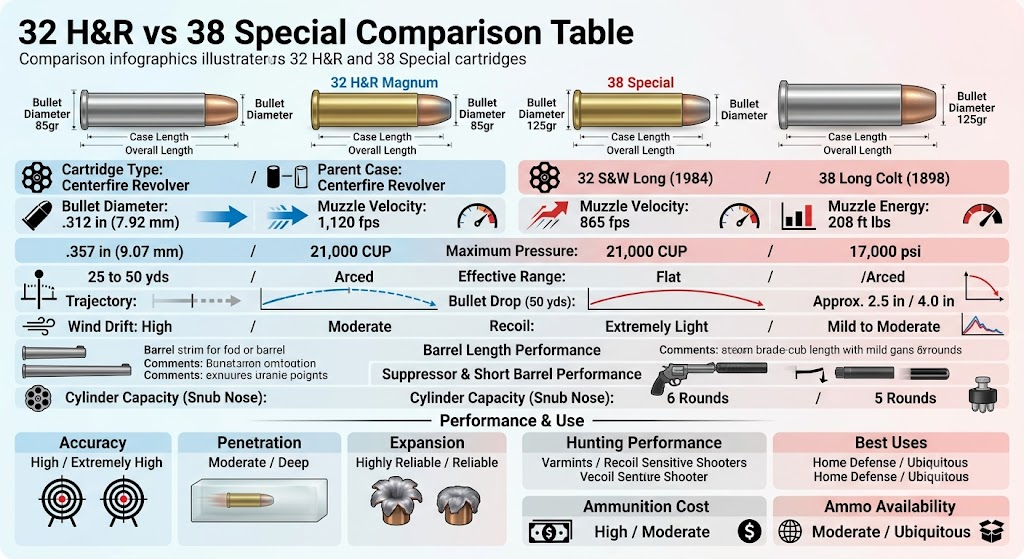
Understanding the Numbers
The technical differences between these cartridges reflect two completely different eras of firearms engineering. The 38 Special was introduced in 1898 originally as a black powder cartridge. Because it was designed for older metallurgy, the Sporting Arms and Ammunition Manufacturers Institute restricts standard pressure 38 Special ammunition to a very low 17,000 psi.
The 32 H&R Magnum was introduced in 1984 as a joint venture between Harrington & Richardson and Federal Premium ammunition. The engineers wanted to modernize the older 32 S&W Long cartridge by lengthening the case and increasing the pressure to 21,000 CUP. This allowed the relatively small 312 caliber bullet to achieve modern defensive velocities while keeping the recoil incredibly manageable.
Velocity Comparison
Velocity dictates how reliably a hollow point bullet expands upon entering soft tissue.
Federal loads their 85 grain 32 H&R Magnum Jacketed Hollow Point to a blistering 1,120 feet per second.The 38 Special, loaded with a 125 grain Speer Gold Dot hollow point, travels at approximately 865 feet per second.
The 32 H&R Magnum is significantly faster because it operates at a higher pressure limit and pushes a much lighter projectile. This extra speed is highly beneficial for ensuring the hollow point cavity forces itself open during a defensive engagement.
Muzzle Energy Comparison
Muzzle energy measures the kinetic force transferred to the target upon impact.
Despite having a smaller diameter bullet, the extreme velocity of the 32 H&R Magnum actually gives it a mathematical edge in kinetic energy with certain loads. The 85 grain Federal load generates 235 foot pounds of energy at the muzzle. The standard pressure 125 grain 38 Special load generates roughly 208 foot pounds of energy. Both are perfectly adequate for stopping a threat, but the 32 H&R punches slightly above its weight class.
Trajectory Comparison
A flat trajectory makes hitting targets at unknown distances much easier.
Because the 32 H&R Magnum drives its bullets nearly 300 feet per second faster than the standard 38 Special, it shoots noticeably flatter. The bullet reaches the target faster, giving gravity less time to pull the projectile toward the earth.
Bullet Drop Comparison
Assuming a standard 25 yard zero, the mathematical drop at 50 yards illustrates the trajectory difference. The 32 H&R Magnum will drop approximately 2.5 inches at 50 yards, while the slower 38 Special will drop roughly 4.0 inches. In a practical self defense scenario inside 10 yards, this difference is completely irrelevant, but it gives the 32 caliber an edge for target shooting at the range.
Wind Drift Comparison
Wind deflection is mitigated by a bullet’s velocity and its aerodynamic profile.
The 38 Special fires a heavier projectile that inherently resists being pushed by the wind better than the lightweight 85 grain bullet of the 32 H&R Magnum. While the 32 H&R is faster, in a strong crosswind at 50 yards, the heavier mass of the 38 Special will keep it flying slightly truer.
Recoil Comparison
Recoil dictates a shooter’s ability to fire rapid and accurate follow up shots.
This is the single greatest advantage of the 32 H&R Magnum. It possesses a Relative Recoil Factor of just 0.42, compared to the 0.53 rating of the 38 Special. The 32 H&R Magnum feels practically like shooting a 22 Long Rifle cartridge, making it an absolute joy to shoot. The 38 Special, particularly in a lightweight aluminum revolver, produces a snappy and sometimes painful recoil impulse that can cause shooters to develop a flinch.
Stopping Power Comparison
Stopping power against an attacker requires reliable energy transfer and wide bullet expansion.
The 38 Special has a century of proven law enforcement history backing its stopping power. Starting at a wider 357 inch diameter, a high quality 38 Special hollow point will expand massively and cause significant tissue disruption. The 32 H&R Magnum is highly effective, but its narrower 312 inch diameter simply creates a slightly smaller wound channel, forcing the shooter to rely more heavily on precise shot placement.
Penetration Comparison
Penetration is critical for ensuring the bullet reaches vital organs.
Both cartridges easily meet defensive penetration standards when using high quality ammunition. The 38 Special, utilizing heavier bullets ranging from 110 grains up to 158 grains, generally penetrates deeper than the lightweight 85 grain bullets of the 32 H&R Magnum, especially if heavy bone is struck.
Expansion Comparison
To test expansion, the industry relies on calibrated ballistic gelatin.
Because the 32 H&R Magnum travels over 1,100 feet per second, its hollow point bullets open violently and reliably. Standard pressure 38 Special ammunition occasionally struggles to expand perfectly because it travels below 900 feet per second, which is near the minimum velocity threshold required for most hollow points to mushroom.
Accuracy Comparison
Both cartridges are capable of elite mechanical accuracy.
However, practical accuracy favors the 32 H&R Magnum for the average shooter. The extremely light recoil impulse allows the shooter to focus entirely on maintaining a steady sight picture and a smooth trigger pull without anticipating a sharp kick.
Effective Range Comparison
Both cartridges are strictly designed for close quarters defensive engagements. The effective range of a small snub nose revolver is generally limited to 25 yards for most shooters. At that distance, both cartridges carry plenty of lethal energy and accuracy to stop a threat.
Suppressor Performance Comparison
Suppressing a revolver is largely ineffective due to the cylinder gap. High pressure gases and noise escape from the small space between the cylinder and the barrel before ever reaching the suppressor. Therefore, neither cartridge is a good candidate for suppressed shooting in a revolver platform.
Short Barrel Performance Comparison
Modern concealed carry revolvers typically feature ultra short 1.8 inch barrels.
The 38 Special loses a massive amount of its velocity when fired from a snub nose barrel because the powder does not have enough time to burn completely. This velocity loss severely handicaps its terminal performance. The 32 H&R Magnum uses very fast burning pistol powders and retains a much higher percentage of its velocity in tiny pocket revolvers.
Cylinder Capacity Comparison
Revolver cylinders are limited by the physical diameter of the cartridges they hold.
Because the 38 Special is a wide cartridge, a standard small frame snub nose revolver can only safely hold five rounds. The 32 H&R Magnum is much narrower. Gunsmiths can easily drill six holes into the exact same size cylinder. Gaining a 20 percent increase in ammunition capacity without increasing the size of the concealed carry weapon is an unparalleled tactical advantage.
Home Defense Comparison
Inside the home, you must balance stopping power against weapon control and capacity.
A six shot 32 H&R Magnum is an exceptional home defense tool, particularly for elderly shooters or anyone with weak grip strength who struggles to rack the slide of a semi automatic pistol. The low recoil ensures accurate follow up shots. The 38 Special is also excellent, but the limited five round capacity and heavier recoil make it slightly harder to run rapidly under extreme stress.
Hunting Comparison
Neither cartridge is recommended for hunting medium game like deer. They simply lack the kinetic energy and heavy bullet mass required for ethical harvests. Both can be used very successfully for pest control or dispatching small varmints at close ranges.
Tactical and Duty Use Comparison
The 38 Special was the gold standard for American law enforcement for nearly 70 years. Millions of police officers carried 38 Special revolvers on duty. Today, both cartridges are tactically obsolete for primary duty use, having been completely replaced by high capacity 9mm semi automatic pistols.
Action Length and Rifle Compatibility
Both cartridges are occasionally chambered in lever action carbines.
A lever action rifle chambered in 38 Special or 357 Magnum is a highly versatile brush gun. The sealed breech of the rifle adds hundreds of feet per second to the 38 Special, transforming it into a capable small game tool. Lever action rifles chambered in 32 H&R Magnum are exceedingly rare and generally only used by niche Cowboy Action Shooting competitors.
Ammo Cost Comparison
To become proficient with a defensive handgun, you must practice frequently.
The 38 Special is a global standard. You can find cheap, full metal jacket practice ammunition in every sporting goods store in America for moderate prices. The 32 H&R Magnum is a specialty cartridge. Standard practice ammunition is typically priced at a premium, often costing double the price of standard 38 Special target loads.
Ammo Availability Comparison
Walk into any gun store in the world, and you will find 38 Special ammunition sitting on the shelf. The 32 H&R Magnum is significantly harder to find. While most large sporting goods retailers carry a few boxes, it is frequently absent from the shelves of small, rural hardware stores, meaning you must often order it online.
Reloading Comparison
Both cartridges are straight walled, making them incredibly easy and fast to reload using carbide dies. The 38 Special is arguably the most versatile reloading cartridge in existence, offering infinite load data and bullet choices. The 32 H&R Magnum is also a joy to reload, allowing shooters to craft exceptionally quiet, low recoil target loads for practice.
FAQs
Is the 32 H&R Magnum more powerful than the 38 Special?
When comparing standard factory ammunition, the 32 H&R Magnum often generates slightly more kinetic energy at the muzzle because of its extreme velocity advantage. However, the 38 Special fires a heavier and wider bullet, which many experts argue provides superior practical stopping power on human targets.
Can a 32 H&R Magnum shoot 32 S&W Long?
Yes. Because the 32 H&R Magnum is simply a lengthened version of the older cartridge, every 32 H&R Magnum revolver can safely chamber and fire 32 S&W Long and 32 S&W Short ammunition. This is excellent for finding cheap, low recoil practice ammunition.
Can a 38 Special shoot 357 Magnum?
No. The 357 Magnum cartridge is longer and operates at double the pressure of the 38 Special. Firing a 357 Magnum in a 38 Special revolver will cause a catastrophic explosion. However, every 357 Magnum revolver can safely fire 38 Special ammunition.
Why do people choose the 32 H&R Magnum over the 38 Special?
The primary reasons are cylinder capacity and recoil management. The 32 H&R Magnum allows a standard five shot snub nose revolver to hold six rounds instead. Additionally, the recoil impulse is incredibly mild, making it much easier to shoot accurately compared to a lightweight 38 Special.
Can a 327 Federal Magnum shoot 32 H&R Magnum?
Yes. The 327 Federal Magnum is a lengthened, much higher pressure version of the 32 H&R Magnum. Any revolver chambered in 327 Federal Magnum can safely fire 32 H&R Magnum ammunition, similar to how a 357 Magnum can fire 38 Special.