The main difference between the cartridges is that there is absolutely no physical or dimensional difference between them; .22 Magnum and .22 WMR are simply two different names for the exact same cartridge, officially designated as the .22 Winchester Magnum Rimfire. Introduced by Winchester in 1959, the cartridge was designed to offer significantly higher velocities and greater kinetic energy than the standard .22 Long Rifle by utilizing a wider, longer case that holds more smokeless powder. The term .22 WMR is the official technical designation recognized by the Sporting Arms and Ammunition Manufacturers Institute, commonly printed on rifle barrels and technical specification sheets. The term .22 Magnum or .22 Mag is the colloquial shorthand adopted by hunters, shooters, and ammunition manufacturers for marketing purposes, particularly when branding ammunition for defensive handguns and concealed carry revolvers. Consumers purchasing ammunition can safely load boxes labeled .22 Magnum into firearms chambered for .22 WMR, as they are completely identical in every physical measurement.
22 Magnum vs 22 WMR Comparison
| Feature | .22 Magnum | .22 WMR |
| Bullet Diameter | 0.224 inches (5.7 mm) | 0.224 inches (5.7 mm) |
| Typical Bullet Weight | 30 gr to 50 gr (typically 40 gr) | 30 gr to 50 gr (typically 40 gr) |
| Muzzle Velocity | 1,800 to 2,200 fps (24-inch barrel) | 1,800 to 2,200 fps (24-inch barrel) |
| Muzzle Energy | 300 to 325 ft-lbs | 300 to 325 ft-lbs |
| Momentum | ~10 to ~12 lb-fps (depending on load) | ~10 to ~12 lb-fps (depending on load) |
| Maximum Pressure | 24,000 psi (SAAMI) | 24,000 psi (SAAMI) |
| Ballistic Coefficient | Low (~0.095 to 0.115) | Low (~0.095 to 0.115) |
| Penetration | 9 to 16 inches (Gelatin depending on bullet) | 9 to 16 inches (Gelatin depending on bullet) |
| Expansion | 0.35 to 0.40 inches | 0.35 to 0.40 inches |
| Trajectory | Flat out to 100 yards | Flat out to 100 yards |
| Recoil | Extremely low (~0.2 ft-lbs in a rifle) | Extremely low (~0.2 ft-lbs in a rifle) |
| Effective Range | 125 to 150 yards (Hunting) | 125 to 150 yards (Hunting) |
| Ammo Availability | Extremely High (Global rimfire standard) | Extremely High (Global rimfire standard) |
| Ammo Cost | Cheap ($0.20 to $0.40 per round) | Cheap ($0.20 to $0.40 per round) |
| Best Use | Varmint hunting, pest control, backup defense | Varmint hunting, pest control, backup defense |
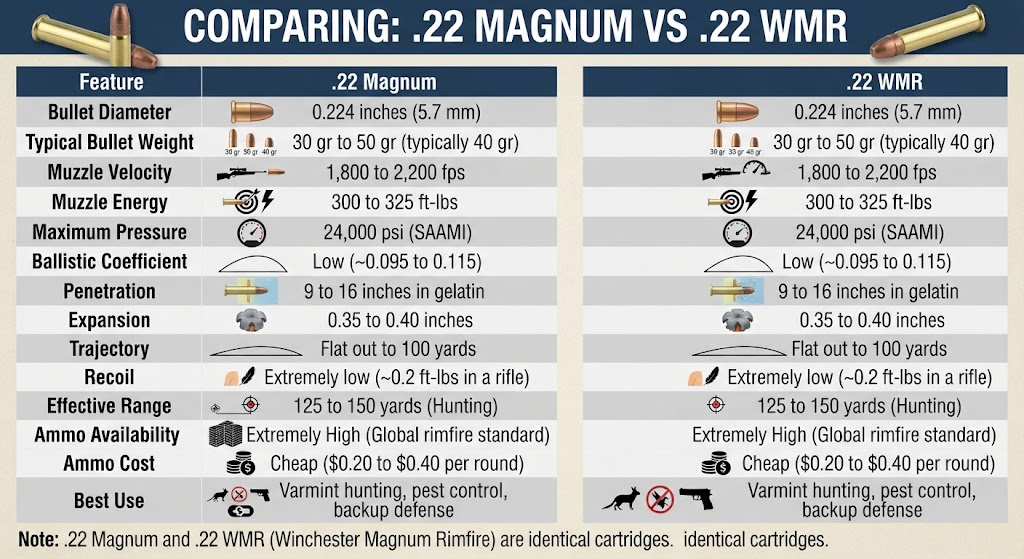
The table above illustrates that the 22 Magnum vs 22 WMR comparison is an exercise in terminology rather than ballistics. However, to truly understand the capability of this famous rimfire cartridge, we must dive deeply into the ballistic performance of different load types available on the market. The cartridge has evolved massively since 1959. Originally designed as a rifle cartridge for hunting medium-sized pests like foxes and coyotes, the ammunition industry has recently pivoted to creating specialized loads optimized for short-barreled defensive handguns.
22 Magnum vs 22 WMR Ballistics
To objectively evaluate the ballistic capabilities of the .22 Winchester Magnum Rimfire, we must examine real-world factory ammunition across its two primary applications. These applications include rifle hunting (typically utilizing 20-inch to 24-inch barrels) and handgun self defense (typically utilizing 2-inch to 4-inch barrels). The length of the barrel drastically alters the ballistic profile of this cartridge because it relies on slow-burning powders to achieve its magnum velocity.
For this highly researched comparison, we will examine four premium factory loads. We will look at traditional hunting loads fired from a standard 24-inch test barrel and specialized defensive loads fired from a 2-inch snub-nose revolver barrel.
- Load A (.22 WMR Rifle Varmint Load): Hornady 30-grain V-MAX Polymer Tip. Tested from a 24-inch barrel. Muzzle velocity is 2,200 feet per second. Muzzle energy is 322 foot-pounds. Ballistic Coefficient is 0.095.
- Load B (.22 WMR Rifle Standard Load): CCI 40-grain Maxi-Mag Jacketed Hollow Point. Tested from a 24-inch barrel. Muzzle velocity is 1,875 feet per second. Muzzle energy is 312 foot-pounds.
- Load C (.22 Magnum Handgun Defense Load): Speer 40-grain Gold Dot Short Barrel Personal Protection. Tested from a 2-inch barrel. Muzzle velocity is 1,050 feet per second. Muzzle energy is 99 foot-pounds.
- Load D (.22 Magnum Handgun Defense Load): Hornady 45-grain Critical Defense. Tested from a 2-inch barrel. Muzzle velocity is 1,000 feet per second. Muzzle energy is 100 foot-pounds.
The data reveals a critical characteristic of the cartridge. When fired from a rifle, the .22 WMR is a hyper-velocity powerhouse that triples the kinetic energy of a standard .22 Long Rifle. When fired from a 2-inch concealed carry revolver, the powder does not have time to burn. Consequently, the muzzle velocity is cut in half, and the kinetic energy drops to a level lower than a standard .32 ACP pocket pistol.
22 Magnum vs 22 WMR Velocity
Velocity is a critical metric for rimfire ammunition. It determines how flat a projectile shoots across long distances and serves as the mechanical catalyst that forces lightweight hollow points to expand upon striking soft tissue.
When analyzing 22 Magnum vs 22 WMR velocity, the true comparison lies between the lightweight polymer-tipped modern loads and the traditional heavy jacketed loads. A 30-grain Hornady V-MAX bullet fired from a 24-inch rifle barrel achieves an astonishing 2,200 feet per second. This extreme speed places it firmly in the centerfire velocity spectrum, allowing the bullet to cross a 100-yard field almost instantaneously. This high velocity creates explosive fragmentation upon impact, which is highly desirable for pest control operators shooting prairie dogs or ground squirrels.
Traditional 40-grain jacketed hollow points generally exit a 24-inch barrel between 1,875 and 1,910 feet per second. While slower than the 30-grain offerings, this velocity is still exceptionally fast for a rimfire cartridge.
The velocity narrative changes entirely when discussing handguns. Handguns chambered in .22 Magnum are extremely popular, but shooters must understand the ballistic compromise. A 2-inch barrel simply cannot process the slow-burning powder designed for rifle barrels. Standard 40-grain ammunition often struggles to break 900 feet per second from a short revolver, which can lead to expansion failures. Ammunition manufacturers responded by creating short-barrel specific loads. Products like the Speer Gold Dot Short Barrel utilize faster burning powders to push a 40-grain bullet slightly over 1,000 feet per second from a 2-inch barrel, ensuring the bullet has enough speed to mushroom correctly upon impact.
22 Magnum vs 22 WMR Muzzle Energy
Muzzle energy represents the kinetic work capacity of a projectile. Because the physical dimensions of 22 Magnum vs 22 WMR are identical, we evaluate muzzle energy based on the firearm platform utilized.
Fired from a standard hunting rifle, the cartridge produces remarkably consistent muzzle energy regardless of bullet weight. A 30-grain bullet traveling at 2,200 feet per second produces roughly 322 foot-pounds of kinetic energy. A 40-grain bullet traveling at 1,910 feet per second produces roughly 324 foot-pounds of kinetic energy. This energy level is devastating on small game and perfectly adequate for ethically harvesting animals up to the size of coyotes at reasonable distances.
The kinetic energy output plummets when the cartridge is fired from a small concealed carry handgun. A premium 45-grain defensive bullet traveling at 1,000 feet per second from a 2-inch barrel produces only 100 foot-pounds of muzzle energy. To put this into perspective, a standard 9mm Luger defensive handgun produces nearly 400 foot-pounds of muzzle energy. A shooter relying on a .22 Magnum revolver for personal protection must recognize that the kinetic energy is severely limited, meaning the cartridge relies entirely on deep penetration and precise shot placement to stop a threat rather than blunt force hydrostatic shock.
22 Magnum vs 22 WMR Momentum
Momentum is a linear measurement calculating mass in motion. In terminal ballistics, high momentum correlates closely with the ability of a bullet to crush through dense bone, thick hides, and intermediate barriers without being deflected or stopping prematurely inside the target.
Because rimfire projectiles are inherently lightweight, they possess very low momentum compared to centerfire handgun or rifle cartridges. However, comparing different loads within the .22 WMR family reveals important strategic choices for hunters.
A 30-grain bullet traveling at 2,200 feet per second yields roughly 9.4 pound-feet per second of linear momentum.
A heavier 40-grain bullet traveling at 1,910 feet per second yields roughly 10.9 pound-feet per second of linear momentum.
A 50-grain Federal Game-Shok bullet traveling at 1,530 feet per second yields roughly 10.9 pound-feet per second of linear momentum.
If a hunter is targeting thick-skinned animals like wild hogs or large coyotes at close ranges, utilizing heavier 40-grain or 50-grain bullets provides better momentum. This increased momentum helps the bullet push through the heavy shoulder bone and reach the vital organs, whereas a fast 30-grain bullet might fragment on the surface bone due to its lack of driving mass.
22 Magnum vs 22 WMR Trajectory
Understanding external ballistics and bullet drop is critical for varmint hunters attempting to hit very small targets at distances exceeding 100 yards. The trajectory of a bullet is dictated by its initial velocity, gravity, and the aerodynamic efficiency of the projectile.
The calculations below assume a standard rifle optic height of 1.5 inches above the bore and a clearly stated zero distance of 100 yards. We will compare a lightweight 30-grain modern polymer load against a traditional 40-grain jacketed hollow point load to demonstrate their flight paths.
| Distance | .22 WMR (30 gr V-MAX at 2,200 fps) Drop | .22 WMR (40 gr JHP at 1,875 fps) Drop |
| Muzzle | -1.5 inches | -1.5 inches |
| 50 Yards | +0.6 inches | +0.8 inches |
| 100 Yards | 0.0 inches (Zero) | 0.0 inches (Zero) |
| 150 Yards | -3.5 inches | -4.8 inches |
| 200 Yards | -11.2 inches | -14.6 inches |
The data confirms that the .22 WMR is a highly capable intermediate range cartridge. The high-velocity 30-grain load shoots incredibly flat, dropping only 3.5 inches at 150 yards. A hunter aiming at a groundhog can place the crosshairs directly on the top edge of the target at 150 yards and guarantee a clean hit. The heavier 40-grain bullet drops nearly 5 inches at the same distance, requiring slightly more holdover calculation. Beyond 150 yards, the poor aerodynamic shape of the small rimfire bullets causes them to bleed velocity rapidly, resulting in severe bullet drop and extreme susceptibility to wind deflection.
22 Magnum vs 22 WMR Recoil
Recoil management is a major factor in rapid and accurate shooting. The physical recoil generated by a firearm is governed by the conservation of momentum and is heavily influenced by the weight of the rifle, the mass of the powder charge, and the weight of the bullet.
Fired from a standard 6-pound bolt-action rimfire rifle, the .22 WMR generates roughly 0.2 to 0.3 foot-pounds of free recoil energy. This recoil is virtually non-existent. It is completely imperceptible to the shoulder, allowing shooters to watch their bullet impacts through a magnified scope without the crosshairs bouncing off the target. This zero-recoil characteristic makes the cartridge an exceptional training tool for introducing youth shooters and beginners to the sport of rifle marksmanship without inducing flinch habits.
Fired from an ultra-lightweight 11-ounce concealed carry revolver (such as the Smith and Wesson 351PD), the recoil energy increases slightly but remains remarkably low compared to centerfire defensive handguns. A .22 Magnum pocket revolver generates less than half the felt recoil of a standard .38 Special, making it highly desirable for elderly shooters or individuals with compromised hand strength who cannot tolerate the violent snap of a lightweight centerfire pocket gun.
22 Magnum vs 22 WMR Penetration
Terminal penetration is rigorously evaluated to ensure the ethical harvesting of game animals and the effective neutralization of threats in defensive environments. A bullet must penetrate deep enough into soft tissue to reach critical cardiovascular structures regardless of the angle the target presents.
When fired from a rifle, penetration relies entirely on bullet construction. A 30-grain polymer-tipped bullet is designed for explosive fragmentation. Upon striking ballistic gelatin, it will typically penetrate only 5 to 7 inches while creating a massive, wide temporary stretch cavity. This shallow penetration is perfect for small rodents but inadequate for larger predators. A traditional 40-grain full metal jacket bullet will completely ignore expansion and punch straight through tissue, often penetrating 14 to 18 inches. This deep penetration is preferred by hunters who wish to harvest furbearing animals without destroying the valuable pelt with a massive exit wound.
When fired from a short-barreled defensive handgun, penetration is heavily scrutinized. Because the muzzle energy is very low, the bullet must rely on retaining its mass to reach vital organs. Premium short-barrel loads like the Hornady Critical Defense typically penetrate 9 to 11 inches in bare ballistic gelatin. While this sits slightly below the Federal Bureau of Investigation minimum protocol of 12 inches, it is widely considered highly lethal and fully capable of stopping a threat during a direct frontal engagement.
22 Magnum vs 22 WMR Expansion
Bullet expansion dictates the diameter of the permanent wound channel inside the target. Wide expansion increases the likelihood of severing major arteries and causing rapid incapacitation through blood loss.
When analyzing 22 Magnum vs 22 WMR expansion, velocity is the primary catalyst. Out of a 24-inch rifle barrel, expansion is violent and immediate. A 40-grain jacketed hollow point striking a target at 1,900 feet per second will peel back into a textbook mushroom shape, expanding from 0.224 inches to roughly 0.35 or 0.40 inches. This near doubling of diameter transfers the entire 300 foot-pounds of kinetic energy directly into the animal.
Expansion from a handgun is much more challenging. Because the velocity out of a 2-inch barrel drops to roughly 1,000 feet per second, traditional hollow points simply do not have the speed required to force fluid into the cavity. They frequently plug with clothing and act like solid drill bits. Specialized defensive loads utilize deep skives cut into the copper jacket and soft lead cores to artificially force expansion at these low velocities. When using proper defensive ammunition like the Speer Gold Dot, a .22 Magnum bullet fired from a snub-nose revolver will reliably expand to roughly 0.33 inches while maintaining its forward momentum.
22 Magnum vs 22 WMR Effective Range
The effective range of a cartridge is determined by the intersection of velocity retention, bullet drop predictability, and the mechanical accuracy of the firearm platform.
For rifle applications, the .22 WMR is a highly effective 125-yard to 150-yard cartridge. Within this envelope, the bullet remains completely supersonic, retains enough kinetic energy to ensure reliable expansion, and requires very little trajectory holdover. While highly skilled marksmen can successfully take prairie dogs at 200 yards on completely calm days, the tiny 40-grain bullet is easily blown off course by subtle crosswinds at that distance.
For defensive handgun applications, the effective range is practically limited to extreme close quarters. The very short sight radius of pocket revolvers, the heavy double-action trigger pulls, and the rapidly dropping kinetic energy limit the ethical defensive range to roughly 0 to 15 yards. At 25 yards and beyond, the cartridge sheds too much velocity from a short barrel to guarantee any form of reliable terminal expansion.
22 Magnum vs 22 WMR Self Defense
When discussing self defense with rimfire cartridges, the conversation revolves around reliability and platform utility. Because 22 Magnum vs 22 WMR is simply a naming convention, selecting this cartridge for personal protection requires understanding its inherent limitations.
Rimfire ignition is inherently less reliable than centerfire ignition. Centerfire cartridges utilize a replaceable primer seated in the center of the brass case. Rimfire cartridges rely on a priming compound spun into the outer rim of the thin brass case during the manufacturing process. Occasionally, a firing pin will strike a portion of the rim where the priming compound failed to settle, resulting in a dead click. In a life-or-death defensive scenario, a failure to fire is catastrophic.
To mitigate this risk, the vast majority of shooters carrying a .22 Magnum for self defense utilize revolvers rather than semi-automatic pistols. If a rimfire cartridge fails to detonate in a semi-automatic pistol, the shooter must manually rack the slide to clear the malfunction, which requires two hands and fine motor skills. If a rimfire cartridge fails to detonate in a double-action revolver, the shooter simply pulls the heavy trigger a second time, instantly bypassing the dead round and firing the next chamber.
Furthermore, semi-automatic pistols chambered in .22 Magnum (such as the Kel-Tec PMR-30) often suffer from a phenomenon called rim lock, where the protruding rim of the top cartridge catches behind the rim of the cartridge below it in the magazine, causing a severe feeding jam. Revolvers completely eliminate this feeding issue, making them the preferred platform for rimfire self defense.
22 Magnum vs 22 WMR Concealed Carry
Concealed carry is a massive market for the .22 Magnum. Despite its low kinetic energy from short barrels, the cartridge offers unique advantages that make it highly appealing to specific demographics.
Revolvers chambered in .22 Magnum are incredibly lightweight. The Smith and Wesson Model 351PD weighs an astonishing 11.2 ounces unloaded and holds seven rounds in the cylinder. This ultra-lightweight profile allows the firearm to be carried comfortably in athletic shorts, ankle holsters, or deep concealment belly bands without sagging or printing through clothing.
More importantly, the recoil is exceptionally mild. For elderly shooters, individuals with severe arthritis, or citizens with compromised hand strength, racking the slide of a modern 9mm pistol or enduring the painful recoil of a .38 Special pocket revolver is physically impossible. The .22 Magnum offers these individuals a reliable, easy-to-manage defensive tool. While seven rounds of .22 Magnum is not ballistically equivalent to seven rounds of 9mm, having a mild-recoiling firearm that a defender can shoot accurately is vastly superior to carrying a powerful firearm that the defender is terrified to shoot.
Which Has More Stopping Power: 22 Magnum or 22 WMR?
Stopping power is a non-scientific term generally used to describe the ability of a cartridge to quickly incapacitate a biological target through blood loss or central nervous system disruption.
Because the .22 Magnum and the .22 WMR are exactly the same cartridge firing identical bullets at identical velocities, their physiological stopping power on a target is exactly the same. The true variable in stopping power relies entirely on the firearm platform chosen.
When fired from a 24-inch rifle, the cartridge delivers immense hydrostatic shock and reliable tissue destruction capable of anchoring coyotes and heavy pests instantly. When fired from a 2-inch concealed carry revolver, the stopping power is severely reduced. Handgun stopping power relies on deep penetration and perfect shot placement into vital organs, as the low-velocity impact does not generate enough kinetic energy to tear tissue beyond the physical diameter of the small bullet.
Which Is More Powerful: 22 Magnum or 22 WMR?
Power is defined quantitatively by kinetic energy and linear momentum. Based on the laws of physics and the raw data, the .22 Magnum and the .22 WMR are equally powerful because they are the same cartridge.
Both names represent a cartridge capable of generating roughly 325 foot-pounds of muzzle energy and 11 pound-feet per second of linear momentum when fired from a standard rifle barrel. The decision on power rests entirely on the specific grain weight and bullet construction chosen by the shooter at the retail counter. A 40-grain jacketed hollow point will deliver more overall penetration power than a lightweight 30-grain polymer-tipped bullet.
.22 Magnum Pros and Cons
Pros
- Exceptional option for recoil-sensitive shooters requiring a lightweight, low-recoil concealed carry revolver
- High cylinder capacity in small pocket revolvers, often holding seven or eight rounds compared to five rounds for a .38 Special
- Minimal muzzle blast and low noise when fired indoors compared to centerfire defensive cartridges
- Ammunition is highly affordable and widely available at all sporting goods retailers
Cons
- Drastically reduced muzzle velocity and kinetic energy when fired from short 2-inch revolver barrels
- Rimfire primer ignition is inherently less reliable than centerfire ignition for self defense applications
- Tiny lightweight bullets struggle to defeat heavy winter clothing or intermediate barriers in a defensive scenario
.22 WMR Pros and Cons
Pros
- Outstanding flat-shooting trajectory out to 150 yards for precision varmint and small game hunting
- Produces nearly three times the kinetic energy of a standard .22 Long Rifle cartridge
- Virtually zero felt recoil when fired from a standard sporting rifle, making it perfect for youth training
- Does not destroy the edible meat or valuable pelts of small game when utilizing solid full metal jacket bullets
Cons
- Ammunition is slightly more expensive than standard .22 Long Rifle bulk packs
- Lightweight bullets are highly susceptible to wind deflection at distances exceeding 100 yards
- Cannot be legally or ethically used for hunting medium game like whitetail deer in the vast majority of jurisdictions
Final Comparison
| Category | Winner | Reason |
| Velocity | Tie | Identical cartridge; velocity depends entirely on barrel length |
| Muzzle Energy | Tie | Both generate roughly 325 ft-lbs from a rifle |
| Momentum | Tie | Identical bullet weights yield identical linear momentum |
| Penetration | Tie | Bullet construction dictates penetration, not the cartridge name |
| Expansion | Tie | High-velocity rifle impacts force massive expansion for both labels |
| Trajectory | Tie | Bullet drop is indistinguishable out to 150 yards |
| Recoil Control | Tie | Both produce virtually zero recoil in rifles and minimal recoil in handguns |
| Effective Range | Tie | Both comfortably reach 150 yards for ethical hunting |
| Self Defense | Tie | Defensive capability relies heavily on load selection and barrel length |
| Concealed Carry | Tie | Both fit into ultra-lightweight high-capacity pocket revolvers |
| Ammo Cost | Tie | Represents the exact same box of ammunition on the retail shelf |
| Ammo Availability | Tie | Found in massive quantities in every sporting goods store globally |
| Overall Performance | Tie | The names are completely interchangeable for the exact same brass case |
22 Magnum vs 22 WMR: Which Should You Choose?
Selecting between the .22 Magnum and the .22 WMR is a trick question. You are choosing the exact same cartridge. The decision you must make is what specific load you require for your intended application and whether you need a rifle or a handgun.
Choose specialized defensive loads branded as .22 Magnum (such as the Hornady Critical Defense or Speer Gold Dot Short Barrel) if you are carrying a small pocket revolver for personal protection. These loads are chemically engineered with fast-burning powders to maximize velocity out of a two-inch barrel, ensuring the bullet penetrates deeply and expands reliably to stop a threat.
Choose traditional high-velocity loads branded as .22 WMR (such as the Hornady V-MAX or CCI Maxi-Mag) if you are utilizing a bolt-action or semi-automatic hunting rifle. These loads leverage slow-burning powders and aerodynamic projectiles to maximize kinetic energy out to 150 yards, making them the ultimate pest control and varmint hunting tool for rural properties.
FAQs
Is 22 Magnum more powerful than 22 WMR?
No. The .22 Magnum and the .22 WMR are the exact same cartridge. They produce identical power when fired from the exact same firearm.
Which has more muzzle energy?
They have identical muzzle energy capabilities. Both easily exceed 300 foot-pounds of energy when fired from a standard rifle barrel.
Which has more stopping power?
Because they are identical cartridges, their physiological stopping power on a target is exactly the same. Stopping power depends on whether you are using a short-barreled handgun or a long-barreled rifle.
Which has more recoil?
Recoil is identical. When fired from a rifle, the free recoil energy is almost imperceptible. When fired from a lightweight pocket revolver, the recoil is slightly snappy but remains much milder than centerfire cartridges.
Which has better penetration?
Penetration is identical and depends entirely on the specific bullet construction. Solid non-expanding bullets will penetrate deeply, while thin-jacketed polymer-tipped bullets will fragment quickly on the surface.
Which expands more?
Both labels expand incredibly well when fired from a rifle. Striking a target at over 1,900 feet per second forces massive, violent expansion for any hollow point bullet.
Which has a flatter trajectory?
The trajectory is functionally identical. When zeroed at 100 yards, standard 40-grain bullets from both labels will drop roughly 4.5 inches at 150 yards.
Which is better for self defense?
Both names refer to the same cartridge, which is highly popular for self defense among individuals who cannot tolerate heavy recoil. A lightweight revolver loaded with premium short-barrel ammunition is an excellent defensive tool.
Which is better for concealed carry?
The cartridge is identical. Small frame revolvers chambered for this round are excellent for deep concealment in pockets or ankle holsters.
Is 22 Magnum faster than 22 WMR?
No, their velocities are identical. A 30-grain bullet from either box will exit a 24-inch rifle barrel at roughly 2,200 feet per second.
Is 22 WMR stronger than 22 Magnum?
No. They operate at the exact same SAAMI maximum pressure limit of 24,000 psi because they are the same brass case.
Which is cheaper to shoot?
They cost exactly the same because they are the exact same ammunition. Prices generally range from twenty to forty cents per round depending on bullet quality.
Can a 22 Magnum shoot 22 WMR?
Yes. Any firearm chambered for .22 Magnum can safely chamber and fire .22 WMR ammunition because they are two names for the same physical cartridge.
Which is easier to shoot?
Both are considered extremely easy to shoot due to their minimal recoil and low muzzle blast, making them perfect for beginners and youths.
Which should you choose?
You do not have to choose. If you own a firearm chambered in .22 WMR, you can safely buy boxes labeled .22 Magnum, and vice versa. Always select the specific bullet weight and design that matches your hunting or defensive needs.