The .308 Winchester is a widely used rifle cartridge known for its versatility and availability in different bullet weights. Its ballistic characteristics vary according to projectile design, muzzle velocity, barrel length, ballistic coefficient, and zero distance.
This guide brings together .308 Winchester ballistic data for several configurations, including 25-yard, 50-yard, 100-yard, and 1,000-yard zero references. It also covers bullet drop, trajectory, ammunition comparisons, barrel length, and subsonic performance.
Table of Contents [Click to minimize]
.308 Ballistic Chart
The primary .308 ballistic chart below uses a 168-grain polymer-tip boat-tail projectile. Its listed G1 ballistic coefficient is 0.462, with a muzzle velocity of 2,680 FPS and muzzle energy of 2,680 ft-lbs. The reference sight height is 1.5 inches.
| Range (Yards) | Velocity (FPS) | Energy (ft-lbs) | Trajectory (Inches) | Wind Drift (10 mph) |
|---|---|---|---|---|
| 0 | 2,680 | 2,680 | -1.50 | 0.00 |
| 100 | 2,485 | 2,305 | +1.95 | 0.76 |
| 200 | 2,298 | 1,971 | 0.00 | 3.14 |
| 300 | 2,118 | 1,676 | -7.95 | 7.30 |
| 400 | 1,947 | 1,417 | -23.10 | 13.50 |
| 500 | 1,786 | 1,192 | -46.51 | 22.01 |
| 600 | 1,635 | 1,000 | -80.11 | 33.15 |
This reference uses a 200-yard zero. The trajectory measurements describe the bullet’s position in relation to the line of sight. A positive number represents a position above that reference, whereas a negative number indicates a position below it.
Velocity and energy gradually decrease as the projectile travels through the air. The amount of change depends on the bullet’s aerodynamic characteristics and environmental conditions.
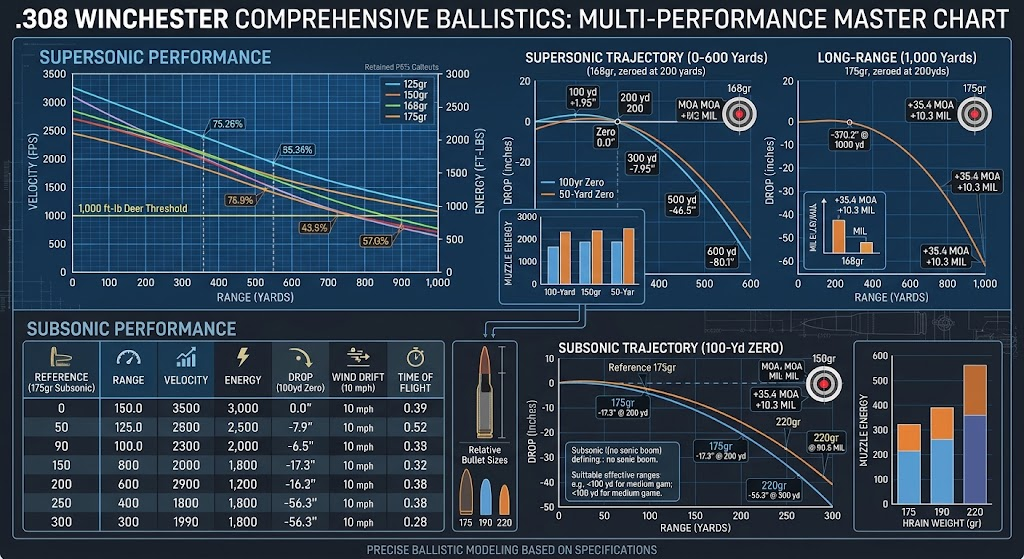
.308 Ammo Ballistics
Different .308 Winchester loads can produce noticeably different ballistic results. Bullet weight is one important factor, but muzzle velocity, bullet construction, and ballistic coefficient also contribute to overall performance.
The following table compares five commonly discussed bullet weights using the supplied 200-yard-zero reference data.
| Bullet Weight | Typical Muzzle Velocity | Muzzle Energy | Energy at 300 Yards | Drop at 500 Yards | Wind Drift at 500 Yards (10 mph) | Typical Application |
|---|---|---|---|---|---|---|
| 125 gr | 3,100 FPS | 2,668 ft-lbs | 1,167 ft-lbs | -45.5 in | 28.1 in | Varmints and predators |
| 150 gr | 2,820 FPS | 2,648 ft-lbs | 1,393 ft-lbs | -45.2 in | 22.8 in | Whitetail and mule deer |
| 165 gr | 2,750 FPS | 2,771 ft-lbs | 1,595 ft-lbs | -45.0 in | 20.8 in | Hunting and target shooting |
| 168 gr | 2,680 FPS | 2,680 ft-lbs | 1,676 ft-lbs | -46.5 in | 22.0 in | Precision target shooting |
| 175 gr | 2,620 FPS | 2,669 ft-lbs | 1,747 ft-lbs | -47.0 in | 19.5 in | Long-range target shooting |
Lighter bullets typically have higher initial velocities in these example loads. Heavier bullets may retain energy differently, particularly when their designs provide a higher ballistic coefficient. The figures are representative reference values, not guaranteed specifications for every manufacturer or ammunition product.
.308 Trajectory Chart
A .308 trajectory chart shows how the bullet’s path changes relative to the line of sight over increasing distances. This dataset uses a 168-grain projectile with a 200-yard zero.
| Range (Yards) | Trajectory (Inches) | MOA | MIL | Time of Flight (Seconds) |
|---|---|---|---|---|
| 0 | -1.50 | — | — | 0.000 |
| 50 | +0.65 | — | — | 0.057 |
| 100 | +1.95 | -1.9 | -0.6 | 0.117 |
| 150 | +1.72 | — | — | 0.180 |
| 200 | 0.00 | 0 | 0 | 0.245 |
| 250 | -3.15 | — | — | 0.312 |
| 300 | -7.95 | +2.5 | +0.7 | 0.383 |
| 350 | -14.51 | — | — | 0.456 |
| 400 | -23.10 | +5.5 | +1.6 | 0.533 |
The trajectory is influenced by gravity and aerodynamic drag. As velocity decreases, the projectile spends more time in flight over additional distance, and its vertical position changes relative to the line of sight.
.308 Bullet Drop Chart
The bullet drop chart below uses a 168-grain .308 Winchester load with a 100-yard zero. It shows the listed velocity, vertical displacement, and angular measurements at different distances.
| Range (Yards) | Velocity (FPS) | Drop (Inches) | MOA | MIL |
|---|---|---|---|---|
| 0 | 2,680 | -1.50 | — | — |
| 100 | 2,485 | 0.00 | 0 | 0 |
| 200 | 2,298 | -3.90 | +1.9 | +0.6 |
| 300 | 2,118 | -13.80 | +4.4 | +1.3 |
| 400 | 1,947 | -30.91 | +7.4 | +2.2 |
| 500 | 1,786 | -56.28 | +10.7 | +3.1 |
| 600 | 1,635 | -91.81 | +14.6 | +4.3 |
The table illustrates how vertical displacement increases as the distance grows. The 100-yard zero provides the baseline for the listed measurements, while the remaining rows show the trajectory farther downrange.
308 Ballistics Chart 100 Yard Zero
A 100-yard zero establishes the reference point at 100 yards. The following chart uses the 168-grain polymer-tip reference load, with the same listed muzzle velocity and energy as the main ballistic chart.
| Range (Yards) | Velocity (FPS) | Energy (ft-lbs) | Trajectory (100-Yard Zero) | Wind Drift (10 mph) | Time of Flight |
|---|---|---|---|---|---|
| 0 | 2,680 | 2,680 | -1.50 in | 0.00 in | 0.000 s |
| 100 | 2,485 | 2,305 | 0.00 in | 0.76 in | 0.117 s |
| 200 | 2,298 | 1,971 | -3.90 in | 3.14 in | 0.245 s |
| 300 | 2,118 | 1,676 | -13.80 in | 7.30 in | 0.383 s |
| 400 | 1,947 | 1,417 | -30.91 in | 13.50 in | 0.533 s |
| 500 | 1,786 | 1,192 | -56.28 in | 22.01 in | 0.693 s |
| 600 | 1,635 | 1,000 | -91.81 in | 33.15 in | 0.893 s |
The 100-yard reference makes it easier to compare the listed trajectory and retained energy across the chart. These values are specific to the stated projectile and ballistic assumptions. Other factory loads may produce different results.
308 Ballistics Chart 50 Yard Zero
The 50-yard-zero chart provides another trajectory reference for the same 168-grain load. It includes the supplied drop-from-muzzle measurements separately from the trajectory values.
| Range (Yards) | Velocity (FPS) | Energy (ft-lbs) | Drop from Muzzle | Trajectory (50-Yard Zero) | Reference Note |
|---|---|---|---|---|---|
| 0 | 2,680 | 2,680 | 0.00 in | -1.50 in | Bore offset |
| 50 | 2,582 | 2,488 | -0.65 in | 0.00 in | Zero |
| 100 | 2,485 | 2,305 | -2.60 in | +0.65 in | Above line of sight |
| 150 | 2,391 | 2,133 | -5.92 in | +0.61 in | Above line of sight |
| 200 | 2,298 | 1,971 | -10.60 in | -0.67 in | Below line of sight |
| 250 | 2,207 | 1,819 | -16.85 in | -3.07 in | Below line of sight |
| 300 | 2,118 | 1,676 | -24.80 in | -6.72 in | Below line of sight |
The two vertical measurements represent different reference points. Drop from the muzzle and trajectory relative to the line of sight should not be interpreted as identical measurements.
308 25 Yard Zero Chart
This chart presents the supplied .308 Winchester figures for a 25-yard zero. It uses the 168-grain reference projectile and includes velocity, energy, trajectory, and the original hold-reference descriptions.
| Range (Yards) | Velocity (FPS) | Energy (ft-lbs) | Drop from Muzzle | Trajectory (25-Yard Zero) | Supplied Hold Reference |
|---|---|---|---|---|---|
| 0 | 2,680 | 2,680 | 0.00 in | -1.50 in | Hold High (+1.5 in) |
| 25 | 2,631 | 2,583 | -0.16 in | 0.00 in | Dead-on |
| 50 | 2,582 | 2,488 | -0.65 in | +1.16 in | Hold Low (-1.2 in) |
| 100 | 2,485 | 2,305 | -2.60 in | +2.36 in | Hold Low (-2.4 in) |
| 150 | 2,391 | 2,133 | -5.92 in | +2.19 in | Hold Low (-2.2 in) |
| 200 | 2,298 | 1,971 | -10.60 in | +0.66 in | Dead-on (approx.) |
| 250 | 2,207 | 1,819 | -16.85 in | -2.43 in | Hold High (+2.4 in) |
| 300 | 2,118 | 1,676 | -24.80 in | -7.23 in | Hold High (+7.2 in) |
The trajectory and hold-reference columns are reproduced from the supplied dataset. They should be treated as reference figures rather than verified universal values for every rifle and ammunition combination.
308 Ballistics Chart 1000 Yards
The 1,000-yard reference uses a different projectile from the main chart: a 175-grain Sierra MatchKing boat-tail hollow-point. Its listed G1 ballistic coefficient is 0.496, and its muzzle velocity is 2,620 FPS.
| Distance (Yards) | Velocity (FPS) | Energy (ft-lbs) | Trajectory (1000-Yard Zero) | Correction (MOA) | Correction (MIL) | Time of Flight |
|---|---|---|---|---|---|---|
| 200 | 2,333 | 2,113 | +25.4 in | +12.1 | +3.5 | 0.247 s |
| 400 | 2,063 | 1,652 | +50.8 in | +12.1 | +3.5 | 0.521 s |
| 600 | 1,812 | 1,271 | +68.8 in | +11.0 | +3.2 | 0.835 s |
| 800 | 1,582 | 970 | +65.0 in | +7.8 | +2.3 | 1.192 s |
| 1,000 | 1,377 | 736 | 0.00 in | 0.0 | 0.0 | 1.599 s |
This is a separate long-range reference profile for the 175-grain projectile. Its ballistic coefficient and muzzle velocity differ from the 168-grain load used in the standard charts. The listed figures should not be mixed with the other projectile’s data.
.308 Ballistics by the Inch
Barrel length is one of several factors that can influence .308 Winchester muzzle velocity. The comparison below uses the supplied figures for 168-grain Federal Gold Medal Match ammunition.
| Barrel Length | Muzzle Velocity (FPS) | Difference vs. 24-Inch Barrel | Muzzle Energy (ft-lbs) | Listed Transonic Threshold | Typical Application |
|---|---|---|---|---|---|
| 26 in | 2,735 | +55 FPS | 2,791 | ~1,100 yd | ELR and F-Class competition |
| 24 in | 2,680 | Baseline | 2,680 | ~1,070 yd | Standard-length rifles |
| 22 in | 2,630 | -50 FPS | 2,581 | ~1,040 yd | Hunting and general-purpose rifles |
| 20 in | 2,580 | -100 FPS | 2,483 | ~1,010 yd | Tactical and compact rifles |
| 18 in | 2,525 | -155 FPS | 2,378 | ~980 yd | Compact carbines |
| 16.5 in | 2,470 | -210 FPS | 2,275 | ~950 yd | Short-barrel carbines |
The comparison shows a gradual reduction in listed muzzle velocity as barrel length decreases. The approximate 20–25 FPS-per-inch figure is only a broad estimate and should not be treated as a fixed relationship. Actual results depend on the ammunition, powder, barrel, and test conditions.
308 150 Grain Ballistics
The 150-grain .308 Winchester load in this dataset uses a pointed soft-point projectile with a G1 ballistic coefficient of 0.338. Its listed muzzle velocity is 2,820 FPS, with muzzle energy of 2,648 ft-lbs and a 200-yard zero.
| Range (Yards) | Velocity (FPS) | Energy (ft-lbs) | Trajectory | Wind Drift | Time of Flight | Mach |
|---|---|---|---|---|---|---|
| 0 | 2,820 | 2,648 | -1.50 in | 0.00 in | 0.000 s | 2.53 |
| 100 | 2,558 | 2,179 | +1.98 in | 1.12 in | 0.111 s | 2.29 |
| 200 | 2,314 | 1,783 | 0.00 in | 4.65 in | 0.235 s | 2.07 |
| 300 | 2,084 | 1,446 | -8.51 in | 11.23 in | 0.372 s | 1.86 |
| 400 | 1,869 | 1,163 | -25.68 in | 21.60 in | 0.523 s | 1.67 |
| 500 | 1,668 | 927 | -53.71 in | 36.52 in | 0.693 s | 1.49 |
The 150-grain profile differs from the 168-grain reference load in both bullet weight and ballistic coefficient. These characteristics contribute to its own velocity-retention and trajectory pattern.
.308 Subsonic Ballistics Chart
Subsonic .308 ammunition uses a lower velocity profile than standard supersonic loads. This reference table uses a 175-grain subsonic boat-tail hollow-point projectile, with a listed muzzle velocity of 1,050 FPS, muzzle energy of 428 ft-lbs, and a 100-yard zero.
| Range (Yards) | Velocity (FPS) | Energy (ft-lbs) | Trajectory (100-Yard Zero) | Time of Flight | Wind Drift (10 mph) |
|---|---|---|---|---|---|
| 0 | 1,050 | 428 | -1.50 in | 0.000 s | 0.00 in |
| 25 | 1,032 | 414 | +0.85 in | 0.072 s | 0.28 in |
| 50 | 1,015 | 400 | +1.62 in | 0.145 s | 1.10 in |
| 100 | 983 | 375 | 0.00 in | 0.295 s | 4.32 in |
| 150 | 953 | 353 | -6.08 in | 0.449 s | 9.60 in |
| 200 | 925 | 332 | -17.28 in | 0.608 s | 16.92 in |
| 250 | 898 | 313 | -33.92 in | 0.772 s | 26.21 in |
| 300 | 872 | 295 | -56.32 in | 0.941 s | 37.45 in |
Subsonic ammunition has a substantially different velocity and trajectory profile from standard .308 Winchester loads. Its actual performance depends on projectile design and atmospheric conditions. The speed of sound changes with temperature and other environmental factors, so the listed velocity should not be considered a universal threshold for every condition.
.308 Subsonic Grain Weight Comparison
Different subsonic bullet weights can produce different muzzle energy and downrange performance. The following table retains the supplied comparison for 175-, 190-, and 220-grain loads.
| Subsonic Load | Muzzle Velocity | Muzzle Energy | Energy at 100 Yards | Drop at 200 Yards (100-Yard Zero) | Wind Drift at 200 Yards (10 mph) |
|---|---|---|---|---|---|
| 175 gr Subsonic | 1,050 FPS | 428 ft-lbs | 375 ft-lbs | -17.28 in | 16.92 in |
| 190 gr Subsonic Sub-X | 1,050 FPS | 465 ft-lbs | 412 ft-lbs | -16.85 in | 15.80 in |
| 220 gr Subsonic OTM | 1,020 FPS | 508 ft-lbs | 458 ft-lbs | -18.22 in | 14.10 in |
The heavier projectiles in this comparison have higher listed muzzle energy, although velocity, projectile construction, and ballistic coefficient also affect the overall ballistic profile. These are supplied comparison values rather than specifications for every product in each weight category.
Frequently Asked Questions
What is the typical muzzle velocity of .308 Winchester?
Muzzle velocity varies by ammunition and bullet weight. The reference data in this guide lists 2,680 FPS for the 168-grain load and 2,820 FPS for the 150-grain load.
What is the difference between a 50-yard and 100-yard zero?
The two zero distances establish different points where the bullet’s trajectory intersects the line of sight. Consequently, the trajectory measurements at other distances will differ. Actual results depend on the ammunition and sight configuration.
How does bullet weight influence .308 ballistics?
Bullet weight affects muzzle velocity and energy. However, projectile shape, construction, and ballistic coefficient also influence velocity retention and trajectory. Two bullets with the same weight can produce different ballistic results.
Does barrel length change .308 Winchester ballistics?
Yes. Barrel length can influence muzzle velocity and muzzle energy. The extent of the difference depends on the ammunition and individual rifle. The barrel-length comparison in this guide uses one supplied 168-grain ammunition profile.
Are .308 Winchester and 7.62×51mm NATO the same?
They are closely related cartridges, but their specifications and pressure standards are not identical. They should not automatically be considered interchangeable. Always follow the rifle manufacturer’s chambering guidance and ammunition specifications.
What does subsonic .308 mean?
Subsonic .308 refers to ammunition designed to remain below the speed of sound under specified conditions. It has a different velocity, energy, and trajectory profile from standard supersonic ammunition.
Does .308 Winchester lose velocity over distance?
Yes. Air resistance gradually reduces a projectile’s velocity as it travels. The rate of reduction depends on its starting velocity, shape, ballistic coefficient, and atmospheric conditions.
What is the ballistic coefficient of a .308 bullet?
Ballistic coefficient describes a projectile’s aerodynamic efficiency relative to a standard reference projectile. The main 168-grain chart in this guide uses a G1 ballistic coefficient of 0.462, while the 175-grain long-range reference uses 0.496.
What information is included in a .308 ballistic chart?
A typical chart may include range, velocity, energy, trajectory, bullet drop, wind drift, and time of flight. Some extended charts also provide angular measurements such as MOA and MIL.