When selecting a rifle or aftermarket barrel, understanding the 300 Win Mag twist rate chart is critical for pairing your firearm with the correct ammunition. The industry standard SAAMI .300 Winchester Magnum twist rate is 1:10, which flawlessly stabilizes the most popular 150-grain to 210-grain projectiles. A barrel’s twist rate dictates gyroscopic stability, meaning longer and heavier projectiles like modern 225-grain match bullets require a faster twist, such as 1:9 or 1:8.Conversely, some legacy rifles utilize a slower 1:12 twist optimized strictly for shorter 150-grain to 180-grain hunting loads. Ultimately, different rifles and ammunition types will always produce different downrange results based on projectile length, weight, and velocity.
Table of Contents [Click to open]
300 Win Mag Twist Rate Chart
| Twist Rate | Common .300 Win Mag Bullet Weights | Typical Bullet Type | General Suitability |
| 1:8 / 1:8.5 | 215 – 230 grain | Ultra-Heavy Match / VLD | Extreme long-range and ultra-high BC projectiles |
| 1:9 / 1:9.5 | 200 – 225 grain | Heavy Long-Range / Monolithic | Modern precision target shooting and heavy hunting |
| 1:10 | 150 – 210 grain | Standard Hunting / Target | The universal SAAMI standard for general purpose use |
| 1:11 / 1:12 | 150 – 180 grain | Lightweight Hunting | Older rifles and dedicated lightweight predator/deer hunting |
Explaining The Chart
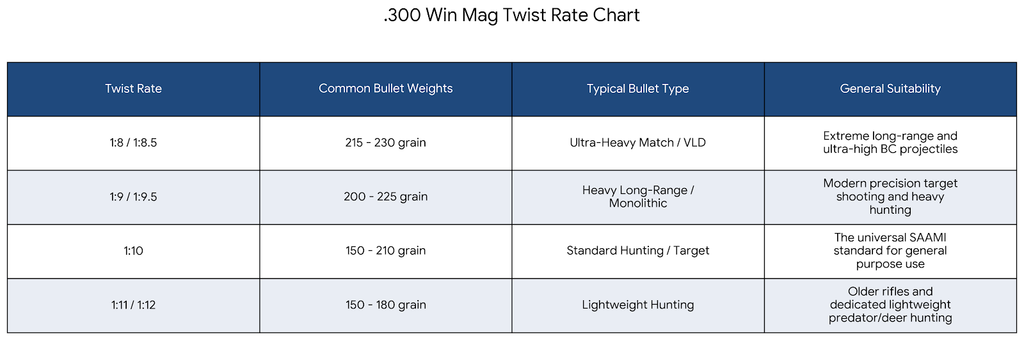
A .300 win mag twist rate chart illustrates the ratio of barrel length needed for the rifling to complete one full rotation.
- What a 1:10 twist means: The bullet completes one 360-degree rotation for every 10 inches it travels down the barrel. This is the time-tested standard that balances most hunting and target loads.
- What a 1:9 or 1:8.5 twist means: This is a “fast” twist rate. The bullet rotates every 9 (or 8.5) inches. It spins the bullet significantly faster, which is required to stabilize modern, ultra-long, high-Ballistic Coefficient (BC) bullets.
- What a 1:11 or 1:12 twist means:This is a “slow” twist rate, rotating the bullet once every 11 or 12 inches. It was more common decades ago when heavy magnum bullets were less popular.
Twist rate stabilizes the projectile by giving it gyroscopic stability.Without enough spin, the bullet will wobble or tumble (keyhole) in the air, ruining accuracy.
Today’s shooters are transitioning to high-BC, Very Low Drag (VLD) bullets to defeat wind over long distances. Because these bullets are highly aerodynamic, they are extremely long for their weight. Bullet length matters just as much as weight in this equation.A long 220-grain bullet creates a shift in the center of gravity and aerodynamic pressure center, demanding a faster 1:9 or 1:8 twist to stay stable.
Bullet Weight Comparison
| Bullet Weight | Typical .300 Win Mag Load | Recommended Twist | Stability |
| 150 grain | Copper Solid / Soft Point | 1:10 to 1:12 | Excellent |
| 165 – 168 grain | Polymer Tip / Target | 1:10 to 1:12 | Excellent |
| 180 grain | Standard Hunting / Partition | 1:10 | Excellent |
| 190 – 200 grain | Heavy Hunting / Match | 1:10 or 1:9 | Excellent |
| 210 – 215 grain | VLD Match / Hybrid | 1:10 or 1:9 | Excellent (1:9 preferred for ELD/VLD) |
| 220 – 230 grain | Ultra-Heavy Match (ELD-M) | 1:9 or 1:8 | Good (Requires faster twist to avoid yaw) |
Do not assume bullet weight alone determines the required twist rate. Monolithic copper bullets are lighter than lead but physically longer, meaning a 180-grain solid copper bullet might require the same twist rate as a 210-grain lead-core bullet.
What Is The Best Twist Rate For 300 Win Mag?
For the vast majority of hunters and casual target shooters, the 1:10 twist is the best twist rate for 300 Win Mag. It perfectly handles the legendary 180-grain hunting loads that made the cartridge famous, while still stabilizing most modern 200-grain to 210-grain target bullets. However, if your primary focus is Extreme Long Range (ELR) shooting with 225-grain or 230-grain monolithic or VLD bullets, a custom 1:9 twist is superior.
300 Win Mag 1:10 Twist Rate
The 300 Win Mag 1:10 twist is the SAAMI specification and the industry standard. Manufacturers like Ruger, Winchester, Browning, and Tikka have utilized this twist for decades. It imparts the ideal amount of spin to stabilize traditional cup-and-core bullets weighing between 150 and 210 grains without over-spinning them. If you walk into a store and buy a factory .300 Winchester Magnum, it almost certainly has a 1:10 twist.
300 Win Mag 1:9 And 1:8.5 Twist Rate
As the long-range shooting community pushes the boundaries of the .300 Win Mag, the 1:9 twist and 1:8.5 twist have become incredibly popular in custom rifle builds (like Proof Research or Bartlein barrels). These fast twist rates are purpose-built to handle long, heavy-for-caliber projectiles like the 215-grain Berger Hybrid, 225-grain Hornady ELD-M, or 230-grain Sierra MatchKing.
300 Win Mag 1:11 And 1:12 Twist Rate
While uncommon today, the 300 Win Mag 1:11 and 1:12 twist rates were sometimes used in legacy target rifles or custom hunting rigs strictly meant to shoot lighter 150-grain to 165-grain projectiles at blistering speeds (exceeding 3,200 fps). While a 1:12 twist will shoot a 150-grain bullet accurately, it will violently fail to stabilize modern heavy target bullets.
300 Win Mag Twist Rate For 200-225 Grain Bullets
When shooting heavy 200-grain to 225-grain bullets, you are pushing the envelope of the cartridge. A 1:10 twist will reliably stabilize a standard 200-grain bullet and often a 210-grain bullet, provided the velocity is high enough. However, for 215-grain, 220-grain, and 225-grain VLD or monolithic projectiles, a 1:9 twist is heavily recommended to ensure maximum ballistic coefficient and stability over extended distances.
300 Win Mag Twist Rate For 180 Grain Bullets
The 180-grain bullet is the undisputed king of the .300 Winchester Magnum for big game hunting. The absolute best 300 Win Mag twist rate for 180 grain bullets is 1:10. This combination provides devastating terminal performance, deep penetration, and sub-MOA accuracy in almost any quality factory rifle.
300 Win Mag Twist Rate For 150-165 Grain Bullets
For lighter 150-grain and 165-grain bullets, a standard 1:10 twist works beautifully.While you technically could use a slower 1:11 or 1:12 twist, the 1:10 standard will comfortably stabilize these lighter bullets without degrading accuracy, making it the most versatile choice.
300 Win Mag Bullet Types
Understanding your projectile type is just as important as knowing its weight:
- Standard Cup-and-Core (Soft Point): Traditional lead core with a copper jacket. These are relatively short and stabilize perfectly in a 1:10 twist.
- Polymer Tip Hunting: Aerodynamic but standard length. Excellent in 1:10 barrels.
- Monolithic Solid (Copper): 100% copper bullets like the Barnes TSX. Because copper is less dense than lead, a 180-grain monolithic is significantly longer than a 180-grain lead bullet, meaning it requires a faster twist to stabilize.
- Match / VLD (Very Low Drag): Characterized by long, sleek ogives and boat tails to cheat the wind. These require 1:10, 1:9, or even 1:8.5 twists depending on their extreme length.
300 Win Mag Twist Rate And Bullet Stability
Gyroscopic stability is determined by the Miller Twist Rule. A bullet requires a stability factor (Sg) of at least 1.5 to fly optimally. This is governed by:
- Twist Rate:Faster twists increase RPMs and stability.
- Bullet Length: The longer the projectile, the more aggressively aerodynamic forces try to flip it. Longer bullets need more spin.
- Velocity: Higher velocities naturally generate higher RPMs. A bullet fired at 3,000 fps from a 1:10 barrel spins faster than the same bullet fired at 2,700 fps from the same barrel.
- Atmosphere: Dense, cold air at sea level is harder to shoot through, requiring more stability than thin, hot air at high altitudes.
Do not claim that every .300 Win Mag bullet of the same weight requires exactly the same twist rate. A long copper bullet will need a faster twist than a short lead round-nose bullet of identical weight.
Barrel Length
A frequent misconception is that barrel length changes the actual twist rate. It does not.
Twist rate is a fixed mechanical specification cut into the steel (e.g., one rotation every 10 inches). Barrel length only determines how long the bullet remains inside the bore, which directly impacts velocity. A 24-inch barrel with a 1:10 twist imparts the exact same rate of spin relative to distance traveled as a 26-inch barrel with a 1:10 twist. Do not confuse barrel length with twist rate.
Accuracy
Twist rate drastically affects 300 Win Mag accuracy.
If a bullet is insufficiently stabilized (shot through too slow of a twist), it will yaw in flight, opening up group sizes before eventually keyholing (striking the target sideways).
If a bullet is excessively stabilized (spun far faster than necessary), any microscopic imperfections in the bullet’s center of mass or jacket thickness are magnified. This can cause the bullet to wobble off its axis, theoretically degrading extreme long-range accuracy, though high-quality modern bullets are built well enough that mild over-stabilization is rarely a practical issue.
Best Twist Rate By Use
| Use Case | Recommended Twist Rate | Typical Bullet Weight |
| General .300 Win Mag | 1:10 | 150 – 200 grain |
| Deer & Elk Hunting | 1:10 | 165 – 180 grain |
| Long-Range Match (PRS) | 1:9 | 200 – 225 grain |
| Extreme Long Range (ELR) | 1:8 or 1:8.5 | 220 – 230 grain |
| Lightweight Monolithics | 1:10 or 1:11 | 150 – 165 grain |
Pros And Cons
Slower Twist Rates
(Examples: 1:10, 1:11)
- Pros: The 1:10 is universally available in all factory rifles; highly accurate with the vast majority of traditional hunting ammunition (150gr to 180gr); prevents over-spinning lightweight varmint/deer loads.
- Cons: Cannot consistently stabilize ultra-heavy (215gr+) or unusually long specialized monolithic projectiles, especially in cold, dense air.
Faster Twist Rates
(Examples: 1:9, 1:8.5)
- Pros: Safely and accurately stabilizes long, heavy, high-BC projectiles; ideal for dedicated long-range precision shooters looking to cheat wind deflection out to 1,500+ yards.
- Cons: Can over-stabilize lightweight hunting bullets, potentially magnifying projectile imperfections; less common and almost always requires purchasing a custom aftermarket barrel.
300 Win Mag Twist Rate Chart: Which Twist Rate Is Best?
When consulting a .300 Win Mag twist rate chart, the final verdict is that the 1:10 twist is commonly used for .300 Win Mag and remains the best choice for 90% of shooters. The cartridge built its legendary reputation on the 180-grain bullet, and the 1:10 twist handles everything from 150-grain to 210-grain projectiles beautifully.
However, specialized shooting demands specialized gear. Here are the final recommendations:
- General shooting & Hunting: Stick with 1:10. It will reliably shoot all standard factory hunting ammunition.
- Lightweight bullets: Use 1:10. It provides plenty of stability without detrimental over-spinning.
- Target shooting & Match ammunition: Use 1:10 for standard 190gr to 200gr match bullets, but upgrade to a 1:9 if you plan to shoot 215gr+ VLDs.
- Heavier bullets (220gr+): If you regularly shoot ultra-heavy, high-BC ELD-M or monolithic solids, you must invest in a 1:9 or 1:8.5 twist barrel to ensure adequate gyroscopic stability at extreme ranges.
FAQs
What is the standard 300 Win Mag twist rate?
The industry and SAAMI standard 300 Win Mag twist rate is 1:10, meaning the bullet completes one full rotation every 10 inches of barrel length.
What is the best twist rate for 300 Win Mag?
For general use and big game hunting with 150-grain to 200-grain ammunition, the best twist rate is 1:10. For extreme long-range target shooting with heavy bullets, 1:9 is best.
What does a 1:10 twist mean?
A 1:10 twist means that the rifling grooves inside the barrel force the projectile to make one complete 360-degree rotation every 10 inches of forward travel.
What is a 1:9 twist good for in 300 Win Mag?
A 1:9 twist is excellent for stabilizing heavy, modern 300 Win Mag bullets, usually in the 215-grain to 230-grain range, making it highly effective for dedicated long-range precision rifles.
Can a 1:10 twist shoot 220 grain bullets?
A 1:10 twist can sometimes shoot a traditional 220-grain round-nose lead bullet accurately, but it will frequently struggle to stabilize modern, long 220-grain VLD or monolithic match bullets.
What twist rate is best for 180 grain 300 Win Mag?
The 1:10 twist rate is considered mathematically perfect for standard 180-grain .300 Win Mag hunting bullets, providing optimal gyroscopic stability and accuracy.
What twist rate is best for 215 grain 300 Win Mag?
While some shooters successfully use a 1:10 twist for 215-grain bullets in favorable conditions, a 1:9 twist is highly recommended to guarantee absolute stability across all environmental conditions.
Does 300 Win Mag bullet weight affect twist rate?
Yes. Heavier bullets typically require a faster twist rate (like 1:9) to stabilize, while lighter hunting bullets perform flawlessly with standard twist rates (1:10).
Does bullet length affect 300 Win Mag twist rate?
Absolutely. Bullet length is the primary aerodynamic factor in stabilization. Longer bullets require a faster spin to remain stable in flight, regardless of their total weight.
Does barrel length affect twist rate?
No. Twist rate is the fixed mechanical ratio of the rifling. Barrel length only dictates how much time the bullet spends inside the bore, which influences velocity, not the mechanical rate of twist itself.
What twist rate do custom 300 Win Mag barrels use?
Custom long-range 300 Win Mag barrels frequently utilize 1:9, 1:8.5, or 1:8 twists to optimize performance with heavy, high-BC projectiles designed to cheat the wind.
Why do monolithic copper bullets need a faster twist?
Because copper is lighter and less dense than lead, a copper bullet must be physically longer to achieve the same weight as a lead bullet. This added length requires a faster twist to properly stabilize.
Does twist rate affect 300 Win Mag accuracy?
Yes. If the twist is too slow, the bullet will tumble and keyhole. If properly matched, a bullet achieves peak gyroscopic stability, ensuring a true flight path and maximum 300 Win Mag bullet stability.