A 300 Savage Trajectory Chart is a technical reference guide that illustrates the predictable flight path and vertical drop of various factory ammunition loads for the 300 Savage cartridge across distances ranging from 100 to 500 yards. By utilizing this data, shooters can determine the precise holdover required to compensate for gravity and environmental factors when engaging targets at traditional hunting ranges. This essential resource relies on variables like muzzle velocity and ballistic coefficients to provide a standardized expectation of how different bullet weights perform in the field. Mastering this chart allows for significantly improved accuracy and consistent shot placement in classic medium game hunting applications.
Table of Contents [Click to open]
300 Savage Trajectory Chart
| Manufacturer | Load Name | Weight (gr) | Type | BC | MV (fps) | 100y Drop | 200y Drop | 300y Drop | 400y Drop | 500y Drop | Zero (y) |
| Remington | Core-Lokt | 150 | PSP | 0.286 | 2630 | 0.0 | -2.7 | -9.6 | -21.8 | -40.5 | 200 |
| Federal | Power-Shok | 150 | SP | 0.286 | 2630 | 0.0 | -2.7 | -9.6 | -21.8 | -40.5 | 200 |
| Winchester | Super-X | 150 | PP | 0.282 | 2630 | 0.0 | -2.7 | -9.7 | -22.1 | -41.2 | 200 |
| Remington | Core-Lokt | 180 | SP | 0.276 | 2350 | 0.0 | -3.6 | -12.4 | -28.1 | -52.6 | 200 |
| Federal | Power-Shok | 180 | SP | 0.276 | 2350 | 0.0 | -3.6 | -12.4 | -28.1 | -52.6 | 200 |
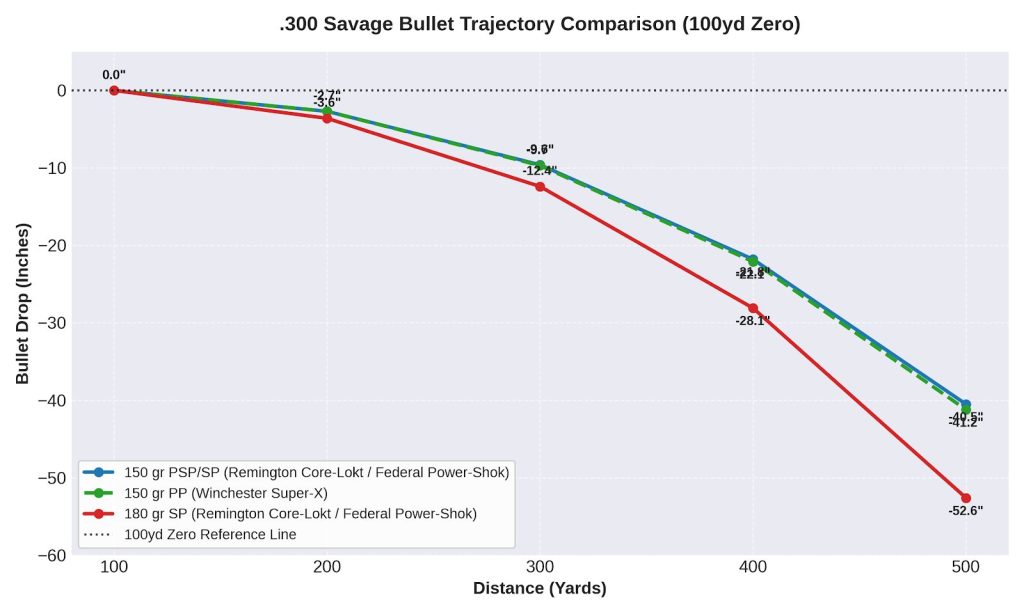
Readers should use this trajectory chart by first identifying their specific ammunition load and verifying the muzzle velocity matches their rifle’s performance. By selecting the recommended 200 yard zero, you can easily calculate the necessary elevation adjustments for various distances by observing the drop values listed in inches. Always cross-reference your rangefinder readings with these drop figures to ensure your point of aim compensates correctly for the bullet arc.
Understanding The 300 Savage Trajectory Chart
The data provided in the table serves as the foundation for your ballistic calculations in the field. Understanding these values helps you anticipate how different bullet weights react to gravity as they travel downrange.
Trajectory Analysis
Comparing the 150 grain Remington Core-Lokt against the 180 grain Remington Core-Lokt shows a clear distinction in long-range performance. At 400 yards, the 150 grain load drops approximately 21.8 inches, whereas the heavier 180 grain load drops significantly more at 28.1 inches. This demonstrates that lighter bullets, like the 150 grain offerings from Federal, maintain a flatter flight path.
Velocity Analysis
Muzzle velocity is the primary driver of the 300 Savage’s trajectory. The 150 grain loads hit an impressive 2630 fps, which results in less drop across all distances measured in our table. In contrast, the 180 grain load at 2350 fps exhibits a steeper arc, requiring more precise compensation as the distance increases toward 500 yards.
Ballistic Coefficient Analysis
The ballistic coefficient (BC) is a measure of a bullet’s ability to overcome air resistance. The 150 grain loads boast a BC of 0.286, which helps them retain energy and fight drag more effectively than the 180 grain loads, which have a lower BC of 0.276. Even though the 180 grain loads are heavier, the superior BC of the 150 grain loads allows them to maintain their velocity and trajectory profile better at distances beyond 300 yards.
Best Factory Loads Based On The Chart
For general deer hunting at ranges up to 300 yards, the 150 grain Remington Core-Lokt or Federal Power-Shok are excellent choices, combining sufficient velocity with a manageable drop profile. For larger game where penetration is the primary concern, the 180 grain loads are often preferred, though the shooter must account for the additional 2.8 inches of drop at 300 yards. The 150 grain load remains the most versatile recommendation for general-purpose shooting.
Key Takeaways From The Chart
The 150 grain loads are the fastest factory offerings in our table at 2630 fps, resulting in the flattest trajectory. The 150 grain loads also maintain a higher ballistic coefficient, making them the most efficient loads for retaining velocity downrange. The 180 grain loads, while having the most drop, are the most robust options for hunting where terminal energy retention at close to mid-range distances is a priority.
Common 300 Savage Bullet Weights
The 300 Savage is most effective when loaded with specific bullet weights designed for medium-range performance, typically ranging from 150 to 180 grains.
150 Grain
These bullets are the most common choice for the 300 Savage, offering a balance of high velocity and flat trajectory. Their primary advantage is their ability to perform well on deer-sized game out to 300 yards. The downside is that they may not offer the deep penetration required for larger, heavier animals.
180 Grain
The 180 grain bullet is the heavy hitter for this cartridge. Its primary advantage is its increased sectional density, which allows for deeper penetration on larger game species. The disadvantage is its steeper trajectory and increased bullet drop, necessitating more precise ranging and elevation adjustments at distances beyond 200 yards.
Effective Range
Deer Hunting
For deer, the 300 Savage is effectively a 300-yard cartridge when using 150 grain loads. The trajectory data confirms that drop remains manageable within this range, allowing for minimal holdover adjustments on targets.
Predator Hunting
When hunting predators, the effective range is roughly 250 yards, provided the shooter accounts for the ~12 inch drop shown in our chart. Beyond this distance, bullet energy may begin to drop below the threshold for consistent accuracy on smaller animals.
Long Range Shooting
Long-range shooting beyond 400 yards is possible with the 300 Savage, but it requires precise ballistic software and consistent ammunition. The velocity loss of these bullet designs means that environmental variables have a greater impact at these distances.
Factors That Affect 300 Savage Trajectory
Bullet Weight
Lighter bullets accelerate faster but lose energy and velocity more quickly. Heavier bullets retain energy better, as seen in the comparison between the 150 and 180 grain loads in our table.
Muzzle Velocity
Higher muzzle velocity directly correlates to a flatter trajectory. Every increase in velocity reduces the time of flight, which leaves gravity with less time to pull the bullet down before it hits the target.
Ballistic Coefficient
A higher BC allows a bullet to cut through the air more efficiently. A higher BC leads to less velocity loss over distance, which ultimately results in less vertical drop at long ranges.
Wind
The 300 Savage’s velocity helps mitigate wind drift, but it does not eliminate it. A strong crosswind will push the bullet off course, making higher BC bullets preferable on windy days.
Zero Distance
Selecting a 200-yard zero is the industry standard for the 300 Savage, as it creates a manageable arc that stays relatively close to the line of sight from 100 to 300 yards.
Best Zero Distance
100 Yard Zero
A 100-yard zero is perfect for dedicated short-range precision. However, it results in more significant holdover requirements once you extend your range, making it less convenient for the 300-yard capabilities of the 300 Savage.
200 Yard Zero
This is the most recommended zero for the 300 Savage. It aligns perfectly with the trajectory of the cartridge, allowing the shooter to aim point-blank for most hunting scenarios out to roughly 250 yards.
300 Savage Compared To Similar Cartridges
| Cartridge | Trajectory | Velocity | BC | Effective Range | Wind Drift |
| 300 Savage | Moderate | Moderate | Low | 300y+ | Moderate |
| 308 Winchester | Flat | High | Moderate | 400y+ | Low |
| 30-06 Springfield | Flat | High | Moderate | 400y+ | Low |
The 300 Savage occupies a unique space, offering power similar to the 308 Winchester but in a shorter case design. While the 308 Winchester and 30-06 Springfield offer higher velocities and flatter trajectories, the 300 Savage remains a highly effective and capable cartridge for medium game hunting within its effective range.
Frequently Asked Questions
Is the 300 Savage still a good round for hunting?
Yes, the 300 Savage remains an excellent hunting round for deer and other medium-sized game due to its balance of power and manageable recoil.
What is the best bullet weight for 300 Savage?
For most hunters, the 150 grain bullet is considered the sweet spot, offering the best balance between velocity and ballistic stability.
Can I use 308 Winchester data for my 300 Savage?
No, you should never use ballistic or load data from a 308 Winchester for a 300 Savage, as the case capacities and pressure levels are different.
What is the effective range of the 300 Savage on deer?
With proper shot placement, the 300 Savage is highly effective on deer out to 300 yards.
Why do my 300 Savage shots drop more than the chart says?
If your shots are dropping more than expected, check your barrel length against the manufacturer’s test barrel length, as a shorter barrel will result in lower muzzle velocity.
Is the 300 Savage considered a match-grade cartridge?
While not traditionally designed for precision matches, the 300 Savage’s inherent accuracy makes it very popular for vintage rifle competitions.
What zero distance should I use for general deer hunting?
A 200-yard zero is widely considered the best setup for general deer hunting, providing the most versatile point-blank range.
Are there any factory loads available for the 300 Savage?
Yes, several manufacturers offer high-quality loads, such as the Remington Core-Lokt or Federal Power-Shok lines.
How does the 300 Savage compare to the 308 Winchester?
The 308 Winchester generally offers higher velocity and flatter trajectories than the 300 Savage, but the 300 Savage remains a proven performer.
Is the 300 Savage capable of taking larger game?
Yes, the 300 Savage is capable of taking larger game at moderate ranges when using heavy, well-constructed bullets.
How would you like to proceed with your ballistic website development, or is there another cartridge trajectory chart you would like me to generate for your database?