The main difference between the 12.7x108mm and the .50 BMG is that the 12.7x108mm features a slightly longer cartridge case originally designed by the Soviet Union to maximize powder capacity for heavy armor piercing projectiles in heavy machine guns, while the .50 BMG is a slightly shorter NATO standard cartridge developed in the United States that offers unparalleled global logistical support, superior match grade ammunition options, and a massive variety of specialized anti materiel loads. When comparing these two behemoth fifty caliber cartridges, you are looking at the absolute pinnacle of modern infantry anti armor capabilities. In this comprehensive guide, we compare velocity, muzzle energy, trajectory, bullet drop, wind drift, recoil, penetration, accuracy, effective range, and tactical applications to help you thoroughly understand which of these massive rounds dominates the modern battlefield.
12.7x108mm vs .50 BMG Comparison Table
To accurately compare these two anti materiel cartridges, we must examine their physical dimensions and baseline ballistic performance. The data below represents standard military specification factory loads, comparing the American standard M33 Ball ammunition for the .50 BMG against the traditional Soviet B 32 Armor Piercing Incendiary load for the 12.7x108mm.
| Specification | 12.7x108mm (Soviet Standard) | .50 BMG (12.7x99mm NATO) |
| Cartridge Type | Heavy Machine Gun / Anti Materiel | Heavy Machine Gun / Anti Materiel |
| Parent Case | Original Soviet Design (1934) | .30 06 Springfield (Scaled Up, 1921) |
| Bullet Diameter | .511 in (13.0 mm) | .510 in (13.0 mm) |
| Case Length | 4.25 in (108.0 mm) | 3.91 in (99.3 mm) |
| Overall Length | 5.81 in (147.5 mm) | 5.45 in (138.4 mm) |
| Typical Bullet Weights | 665 gr to 833 gr | 647 gr to 800 gr |
| Muzzle Velocity (45 inch bbl) | 2,750 fps (745gr B 32 API) | 2,910 fps (660gr M33 Ball) |
| Muzzle Energy (45 inch bbl) | 12,508 foot pounds | 12,413 foot pounds |
| Maximum Pressure | 52,200 psi (CIP Specification) | 54,000 psi (SAAMI Specification) |
| Effective Range (Point Target) | 1,600 yds | 1,600 yds |
| Effective Range (Area Target) | 2,200+ yds | 2,200+ yds |
| Trajectory | Flat | Extremely Flat |
| Bullet Drop (1000 yds) | Approx. 310 inches | Approx. 280 inches |
| Wind Drift (1000 yds, 10mph) | Approx. 65 inches | Approx. 70 inches |
| Recoil | Extreme (Approx. 120 foot pounds) | Extreme (Approx. 115 foot pounds) |
| Barrel Length Performance | Excels in 29 to 45 inch barrels | Excels in 29 to 45 inch barrels |
| Suppressor Performance | Good (Requires massive suppressors) | Good (Requires massive suppressors) |
| Accuracy (Standard Military) | 2 to 3 MOA | 2 to 3 MOA |
| Accuracy (Match Grade) | 1 MOA | Sub MOA |
| Penetration | Extreme (20mm of steel at 500 yds) | Extreme (22mm of steel at 500 yds) |
| Expansion | Zero (Relies on fragmentation and incendiary) | Zero (Relies on fragmentation and incendiary) |
| Hunting Performance | Massive Overkill | Massive Overkill |
| Home Defense | Absolutely Not Recommended | Absolutely Not Recommended |
| Tactical Use | Russian and Eastern Bloc Heavy Support | Global NATO Heavy Support and Sniper |
| Magazine Compatibility | Dedicated Anti Materiel Box Magazines | Dedicated Anti Materiel Box Magazines |
| Ammunition Cost | Astronomical | Extremely High |
| Ammo Availability | Rare in the Civilian Market | Good in the Civilian Market |
| Reloading | Difficult (Components are scarce) | Excellent (Massive commercial support) |
| Best Uses | Light vehicle destruction, material denial | Long range sniper operations, anti armor |
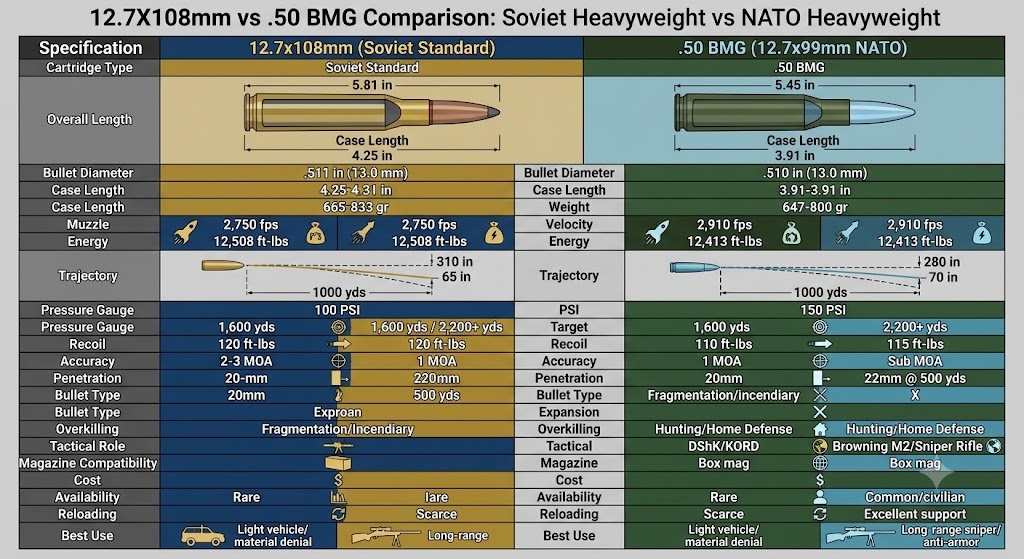
Understanding the Numbers
The technical differences between these cartridges are rooted entirely in the geopolitical arms race of the twentieth century. John Browning developed the .50 BMG (Browning Machine Gun) in the aftermath of World War I. At the request of the United States military, Browning essentially scaled up the .30 06 Springfield cartridge to accommodate a massive half inch diameter bullet. The goal was to create a heavy machine gun cartridge capable of destroying early armored vehicles and aircraft. Standardized as the 12.7x99mm NATO, it operates at 54,000 psi and remains the heavy support standard for Western forces.
The Soviet Union observed the effectiveness of the .50 BMG and sought to create a cartridge that would outperform it. Introduced in 1934 for the DShK heavy machine gun, the 12.7x108mm utilizes a case that is 9 millimeters longer than the American design. This increased case capacity theoretically allows for larger powder charges to drive heavier bullets. Furthermore, the Soviet bullet is technically slightly wider, measuring .511 inches compared to the .510 inch diameter of the American bullet. Despite these geometric differences, the internal ballistics and maximum chamber pressures are remarkably similar.
Velocity Comparison
Velocity dictates the trajectory flatness and the kinetic energy delivered to an armored target.
Using standard military specification ammunition fired from full length heavy machine gun barrels:
- .50 BMG (660gr M33 Ball): 2,910 fps
- .50 BMG (671gr Mk211 Raufoss): 2,850 fps
- 12.7x108mm (745gr B 32 API): 2,750 fps
The .50 BMG is generally the faster cartridge when comparing standard ball ammunition. By utilizing a slightly lighter 660 grain bullet, the NATO standard cartridge easily breaks the 2,900 feet per second threshold. This blistering speed helps the .50 BMG maintain a perfectly flat trajectory across vast battlefield distances.
The Soviet 12.7x108mm takes a different approach. Soviet doctrine prioritized barrier penetration over raw speed, leading them to standardize much heavier projectiles. The standard B 32 Armor Piercing Incendiary load weighs a massive 745 grains. Pushing this immense mass drops the muzzle velocity to approximately 2,750 feet per second. While slower at the muzzle, the heavier bullet retains its momentum exceptionally well at extended ranges.
Winner: .50 BMG (For raw muzzle velocity with standard loads).
Muzzle Energy Comparison
Muzzle energy measures the absolute kinetic force transferred to a target, which is the primary metric for destroying engine blocks and light armored vehicles.
- 12.7x108mm (745gr B 32 API): 12,508 foot pounds
- .50 BMG (660gr M33 Ball): 12,413 foot pounds
- .50 BMG (750gr Hornady A MAX Match): 13,241 foot pounds (At 2,820 fps)
When comparing standard military issue ball and armor piercing ammunition, the two cartridges are practically identical in kinetic output, both hovering around 12,500 foot pounds of energy. To put this into perspective, this is roughly four times the kinetic energy of a standard .308 Winchester sniper rifle.
However, because the .50 BMG has immense commercial support in the United States, civilian manufacturers produce specialized match grade ammunition that pushes the absolute limits of the cartridge. A 750 grain Hornady A MAX bullet fired from a .50 BMG can generate over 13,200 foot pounds of energy, completely eclipsing standard military issue 12.7x108mm loads.
Winner: .50 BMG (Due to the availability of commercial high energy match loads).
Trajectory Comparison
A flat trajectory minimizes the margin of error when estimating range for a sniper or machine gunner.
Because the .50 BMG drives lighter bullets much faster out of the muzzle, it shoots noticeably flatter inside the first 1,000 yards. The NATO cartridge reaches the target faster, giving gravity less time to pull the massive projectile downward. A sniper using a .50 BMG has a larger margin of error if their laser rangefinder gives a reading that is off by ten or twenty yards. The 12.7x108mm, lobbing a heavier 745 grain bullet at a slower initial velocity, arches slightly more and requires more precise holdover estimation at mid range distances.
Winner: .50 BMG
Bullet Drop Comparison
Assuming a 500 yard zero, the mathematical bullet drop at 1,000 yards illustrates the trajectory differences clearly between these two heavyweights.
- .50 BMG (660gr M33 Ball): Drops approximately 280 inches at 1,000 yards.
- 12.7x108mm (745gr B 32 API): Drops approximately 310 inches at 1,000 yards.
The 12.7x108mm drops roughly 30 inches more than the .50 BMG at a distance of 1,000 yards. When attempting to disable an enemy vehicle or neutralize a high value target at over half a mile, minimizing vertical drop is a massive ballistic advantage for the shooter.
Winner: .50 BMG
Wind Drift Comparison
Wind deflection is the absolute greatest enemy of the extreme long range shooter. Wind drift is mitigated strictly by a bullet’s velocity and its aerodynamic profile (Ballistic Coefficient).
The 12.7x108mm possesses a distinct advantage in this category. Because standard Soviet bullets weigh roughly 85 grains more than standard NATO bullets, they boast a superior Sectional Density and a slightly higher Ballistic Coefficient. Once the bullets pass the 1,000 yard mark, the heavier 12.7x108mm projectile carries more forward momentum and resists crosswinds better than the lighter .50 BMG M33 Ball. At 1,500 yards in a 10 mph crosswind, the Soviet cartridge will drift noticeably less, resulting in a higher hit probability on area targets.
Winner: 12.7x108mm (When comparing standard military ammunition).
Recoil Comparison
You cannot generate 12,000 foot pounds of kinetic energy without paying a violent price in physical recoil.
Both cartridges produce extreme recoil that will physically punish the shooter if not properly mitigated. In a standard 30 pound anti materiel rifle, both cartridges generate roughly 115 to 125 foot pounds of free recoil. To make these weapons man portable and safe to fire from the shoulder, manufacturers utilize massive multi baffle muzzle brakes and complex internal recoil reduction systems (such as the reciprocating barrel found on the Barrett M82).
Because the 12.7x108mm pushes a heavier bullet, physics dictates it will result in slightly heavier rearward force. However, the difference is practically imperceptible to the human shoulder. Both require exceptional marksmanship fundamentals to control.
Winner: Tie
Stopping Power Comparison
For anti materiel rifles, stopping power refers to the ability to destroy engine blocks, penetrate concrete bunkers, and disable communication arrays.
Both cartridges provide absolute, unquestionable stopping power on human targets and light material. The .50 BMG relies on slightly higher velocity to create massive hydrostatic shock upon impact. The 12.7x108mm relies on the sheer momentum of its heavier mass to crush heavy steel plating. Against light vehicles, neither the driver nor the engine block will ever notice the difference between the two cartridges.
Winner: Tie
Penetration Comparison
Deep penetration is required to punch through the heavy steel armor of personnel carriers or the reinforced concrete of urban sniper hides.
The 12.7x108mm was engineered specifically to defeat light armor. The standard B 32 Armor Piercing Incendiary round features a hardened steel core that will penetrate approximately 20 millimeters of rolled homogeneous armor at 500 meters.
The .50 BMG matches this capability perfectly. The American M8 Armor Piercing round features a manganese molybdenum steel core that will reliably penetrate 22 millimeters of face hardened steel armor at 500 meters. Furthermore, the modern Mk211 Raufoss round utilized by NATO forces combines a tungsten penetrator with explosive and incendiary components, allowing it to blast entirely through concrete walls and detonate inside the structure.
Winner: .50 BMG (Due to the advanced technology of modern NATO penetrators).
Expansion Comparison
If a standard rifle bullet fails to expand, it acts like an ice pick. However, fifty caliber anti materiel rounds do not rely on expansion.
Neither militaries nor civilians utilize traditional hollow point expanding ammunition in these cartridges. Expanding a half inch bullet is completely unnecessary. Instead, these cartridges rely on explosive fragmentation. When a Mk211 Raufoss .50 BMG round strikes a hard target, the incendiary tip ignites a small explosive charge that blasts the tungsten core forward while showering the immediate area in burning zirconium. The 12.7x108mm B 32 utilizes a similar mechanical process to ignite fuel tanks upon penetration.
Winner: Tie
Accuracy Comparison
This is a category where modern commercial manufacturing creates a massive divide between the two cartridges.
Standard military machine gun ammunition for both the 12.7x108mm and the .50 BMG is manufactured for reliable feeding and area suppression, not precision. Standard ball ammunition for both cartridges will typically print 2 to 3 MOA groups, meaning the bullets will land within a 30 inch circle at 1,000 yards.
However, because the .50 BMG is highly popular in the American civilian and competitive shooting markets, manufacturers like Hornady and Barnes produce ultra precision match grade ammunition. A skilled marksman firing match grade .50 BMG ammunition out of a bolt action precision rifle (like the McMillan TAC 50) can routinely shoot sub MOA groups, placing rounds inside a 10 inch circle at 1,000 yards. No such commercial match grade ammunition exists in mass quantities for the 12.7x108mm.
Winner: .50 BMG
Effective Range Comparison
The effective range of these cartridges is dictated by the platform firing them and the skill of the operator.
Fired from a heavy machine gun on a tripod, both the 12.7x108mm and the .50 BMG can provide highly effective area suppression out to 2,200 yards. They will easily deny enemy infantry movement and shred unarmored convoys at this extreme distance.
Fired from a dedicated sniper rifle, the .50 BMG holds a significant advantage. The longest confirmed sniper kill in military history was made by a Canadian Special Operations sniper using a McMillan TAC 50 chambered in .50 BMG, striking an insurgent target at a staggering distance of 3,871 yards. The availability of perfectly machined, high ballistic coefficient match bullets gives the .50 BMG the ultimate edge in extreme long range precision.
Winner: .50 BMG
Suppressor Performance Comparison
Suppressors are highly recommended for both of these cartridges to mitigate their massive concussive blast, which can kick up dust and reveal a sniper’s position.
Both cartridges are entirely supersonic and push immense volumes of expanding powder gases. Adding a quality titanium or steel suppressor will tame the concussive blast and reduce the visual muzzle flash, but neither cartridge can be made completely silent. The supersonic crack of a 700 grain bullet breaking the sound barrier will always be violently loud.
Winner: Tie
Short Barrel Performance Comparison
Anti materiel rifles are meant to be fired from fixed positions, but urban combat requires maneuverability.
Standard barrels for these cartridges range from 29 to 45 inches. If you cut a .50 BMG barrel down to 20 inches (such as the Barrett M107A1 CQB variant), a massive amount of unburnt powder blasts out of the muzzle. This results in a blinding fireball, deafening concussion, and severe velocity loss. The muzzle velocity often drops from 2,900 fps down to 2,500 fps. The 12.7x108mm suffers the exact same catastrophic velocity loss and muzzle blast if fired from a short barrel. Neither cartridge is efficient in short configurations.
Winner: Tie
Home Defense Comparison
Neither cartridge should ever be used for home defense in a suburban or urban environment. Both fire massive projectiles with immense kinetic energy. If fired indoors, the extreme over penetration will easily punch through the target, multiple interior walls, the exterior brick of your home, and easily penetrate the exterior of several neighboring houses. Furthermore, the indoor concussive blast of a fifty caliber rifle will cause immediate and permanent hearing damage, while the muzzle flash will permanently blind the shooter in low light conditions.
Winner: Tie (Absolutely not recommended).
Hunting Comparison
These cartridges were built specifically for war, not for harvesting game animals.
Firing a .50 BMG or 12.7x108mm at a whitetail deer or an elk is considered massive, unethical overkill. The kinetic energy destroys an excessive amount of meat and ruins the animal. However, some extreme long range hunters utilize custom bolt action .50 BMG rifles to ethically harvest large game at distances exceeding 1,500 yards, where the velocity has dropped enough to prevent excessive meat damage. Still, standard hunting cartridges are vastly preferred.
Winner: Tie
Tactical and Duty Use Comparison
The tactical deployment of these cartridges defines the modern battlefield.
The 12.7x108mm is the standard heavy support cartridge for the Russian military and numerous Eastern Bloc and Middle Eastern nations. It is fired primarily from the DShK, NSV, and modern Kord heavy machine guns mounted on tanks and armored personnel carriers.
The .50 BMG is the undisputed global standard for NATO forces. The legendary M2 Browning machine gun has been in continuous military service for over a century. Furthermore, the .50 BMG completely dominates the anti materiel sniper rifle market, utilized by Special Operations forces globally to disable explosive devices, destroy parked aircraft, and eliminate high value targets through reinforced barriers.
Winner: .50 BMG (Wider global adoption and versatility).
Action Length and Rifle Compatibility
This is a massive logistical advantage for the American cartridge.
Because the .50 BMG is a NATO standard, dozens of rifle manufacturers across the globe build weapon systems around it. You can purchase semi automatic rifles like the Barrett M82, bolt action precision rifles like the Steyr HS .50, or single shot budget rifles like the Serbu RN 50. The commercial market is flooded with options.
The 12.7x108mm requires a specialized, slightly longer action to accommodate its larger case length. Very few manufacturers produce rifles chambered in 12.7x108mm outside of state owned Russian armories. For a civilian or independent contractor, sourcing a rifle chambered in the Soviet cartridge is incredibly difficult.
Winner: .50 BMG
Ammo Cost Comparison
Both cartridges are considered heavy artillery, and ammunition is priced accordingly.
You will not find cheap target practice ammunition for either caliber. A single round of standard .50 BMG ball ammunition typically costs between three to five dollars. If you purchase premium match grade ammunition, the cost easily exceeds eight dollars per trigger pull.
The 12.7x108mm is practically non existent on the commercial market. When surplus crates do appear, they are sold as rare collector items, driving the cost up to astronomical levels.
Winner: .50 BMG
Ammo Availability Comparison
Availability depends entirely on your geography and your profession.
In North America and Western Europe, the .50 BMG is incredibly easy to find. Most large sporting goods stores and online retailers stock large quantities of bulk .50 BMG ammunition.
Finding 12.7x108mm ammunition anywhere in the Western hemisphere is virtually impossible. Unless you are purchasing munitions for a foreign military through international arms dealers, you will not have access to a steady supply of the Soviet cartridge.
Winner: .50 BMG
Reloading Comparison
Both cartridges require massive, specialized reloading presses to handle their immense physical dimensions.
The .50 BMG is a handloader’s dream for extreme long range precision. Because it is so popular in the civilian market, companies like RCBS and Hornady sell dedicated .50 BMG reloading kits. You can easily purchase high quality brass, specialized slow burning powders, and perfect match grade bullets.
Reloading the 12.7x108mm is incredibly difficult. Brass cases are exceptionally rare, and sourcing the correct .511 inch diameter bullets requires custom manufacturing. Furthermore, load data is scarce and highly guarded.
Winner: .50 BMG
Pros and Cons
12.7x108mm
Pros
- Generates immense kinetic energy for armored vehicle destruction.
- Fires a heavier standard bullet that resists wind drift at extreme ranges.
- Proven reliability in harsh desert and arctic environments.
- Massive case capacity offers excellent potential for specialized payloads.
Cons
- Ammunition is incredibly scarce and expensive in the civilian market.
- Rifles chambered in this caliber are nearly impossible to source.
- Lacks the availability of precision match grade ammunition.
- Drops significantly more at long range compared to lighter NATO rounds.
.50 BMG
Pros
- The undisputed global NATO standard for heavy machine guns.
- Shoots incredibly flat with standard military ammunition.
- Massive commercial support provides unlimited rifle and ammunition choices.
- Match grade ammunition allows for precision sniper engagements past a mile.
- Highly accessible for civilian reloaders and competitive shooters.
Cons
- Extremely expensive to shoot on a regular basis.
- Generates punishing recoil that requires massive muzzle brakes to tame.
- Standard military ball ammunition drifts slightly more in heavy crosswinds.
Final Verdict
Choosing between the 12.7x108mm and the .50 BMG is not a debate over kinetic energy, but rather a conclusion dictated entirely by logistics and commercial availability.
- For the Precision Sniper: Choose the .50 BMG. The availability of perfectly machined match grade ammunition and highly accurate bolt action rifles allows the shooter to engage targets precisely at distances that the Soviet cartridge simply cannot match with standard factory loads.
- For the Civilian Shooter: Choose the .50 BMG. You can easily purchase rifles, spare parts, reloading components, and bulk ammunition from countless retailers. The Soviet cartridge is nothing more than a rare collector’s item in the Western world.
- For Maximum Armor Penetration: Choose the .50 BMG. While the Soviet round is devastating, the modern development of specialized NATO armor piercing incendiary rounds (like the Mk211) gives the American cartridge the ultimate technological edge against hardened targets.
- For Extreme Wind Conditions: Choose the 12.7x108mm. If you are providing suppressive area fire at 1,500 yards in a heavy crosswind, the heavier 745 grain Soviet bullet will maintain its forward momentum and resist wind deflection better than standard NATO ball ammunition.
FAQ
Is the 12.7x108mm more powerful than the .50 BMG?
No. While the 12.7x108mm has a slightly larger case capacity and fires a heavier bullet, both cartridges generate roughly 12,500 foot pounds of kinetic energy with standard military ammunition. They are practically identical in raw power.
Can you shoot .50 BMG in a 12.7x108mm rifle?
Absolutely not. The cartridges have completely different case dimensions, shoulder angles, and overall lengths. Furthermore, the Soviet bullet is slightly wider (.511 inches) than the American bullet (.510 inches). Attempting to fire the wrong ammunition will cause a catastrophic firearm failure and likely kill the operator.
Which cartridge is more accurate?
The .50 BMG is vastly more accurate simply because of the ammunition available for it. The civilian commercial market produces ultra precise match grade bullets and meticulously loaded ammunition for the .50 BMG, allowing it to achieve sub MOA accuracy. Standard military issue ammunition for both cartridges is equally inaccurate.
Why did the Soviets make the 12.7x108mm longer?
The Soviet Union wanted a cartridge that could outperform the American .50 BMG in anti armor roles. By making the brass case 9 millimeters longer, they increased the internal case volume, allowing them to use larger powder charges to propel heavier armor piercing projectiles.
Does the .50 BMG have more recoil?
Both cartridges generate practically identical recoil forces. Pushing a half inch diameter bullet at nearly 3,000 feet per second generates over 115 foot pounds of free recoil. Managing this force requires heavy rifles equipped with highly engineered muzzle brakes.
Can civilians buy a .50 BMG rifle?
In most parts of the United States, yes. Civilians can legally purchase and own rifles chambered in .50 BMG, ranging from single shot rifles to semi automatic Barretts. However, certain states have implemented specific bans on fifty caliber rifles, so you must check your local laws before purchasing.
What is the effective range of the .50 BMG?
When fired from a precision sniper rifle using match grade ammunition, the effective point target range is roughly 1,600 to 2,000 yards. However, the bullet remains lethal at distances exceeding four miles if fired at an optimal upward angle.
Why do they not use hollow points in the .50 BMG?
Hollow points are designed to expand in soft tissue to prevent over penetration and maximize energy transfer. When firing a bullet that weighs nearly 700 grains and measures a half inch across, expansion is entirely unnecessary. A solid ball or armor piercing round will cause catastrophic damage without needing to expand.