Determining the .300 blackout subsonic effective range requires precisely analyzing your projectile weight and target application.
For tactical engagements and close-range hunting, heavy subsonic ammunition provides a highly capable practical effective range of 100 yards.
Because these massive projectiles travel strictly below the speed of sound, they suffer from extreme parabolic bullet drop and rapid kinetic energy decay past this strict distance.
By perfectly matching your specific subsonic load to a short barrel and quality suppressor, you can safely maximize the devastating close-quarters capabilities of this legendary cartridge.
.300 Blackout Subsonic Effective Range Chart
| Distance | Supersonic Velocity | Supersonic Energy | Supersonic Drop | Subsonic Velocity | Subsonic Energy | Subsonic Drop |
| 50 yards | 2,375 fps | 1,378 ft-lbs | -0.2 inches | 1,015 fps | 435 ft-lbs | +2.5 inches |
| 100 yards | 2,050 fps | 1,026 ft-lbs | 0.0 inches | 985 fps | 410 ft-lbs | 0.0 inches |
| 150 yards | 1,750 fps | 748 ft-lbs | -1.8 inches | 960 fps | 388 ft-lbs | -9.5 inches |
| 200 yards | 1,485 fps | 538 ft-lbs | -6.0 inches | 935 fps | 369 ft-lbs | -26.5 inches |
| 250 yards | 1,255 fps | 384 ft-lbs | -13.0 inches | 912 fps | 351 ft-lbs | -51.5 inches |
| 300 yards | 1,075 fps | 282 ft-lbs | -23.5 inches | 890 fps | 334 ft-lbs | -85.5 inches |
| 400 yards | 950 fps | 220 ft-lbs | -58.0 inches | 848 fps | 303 ft-lbs | -183.0 inches |
| 500 yards | 860 fps | 180 ft-lbs | -118.0 inches | 808 fps | 275 ft-lbs | -325.0 inches |
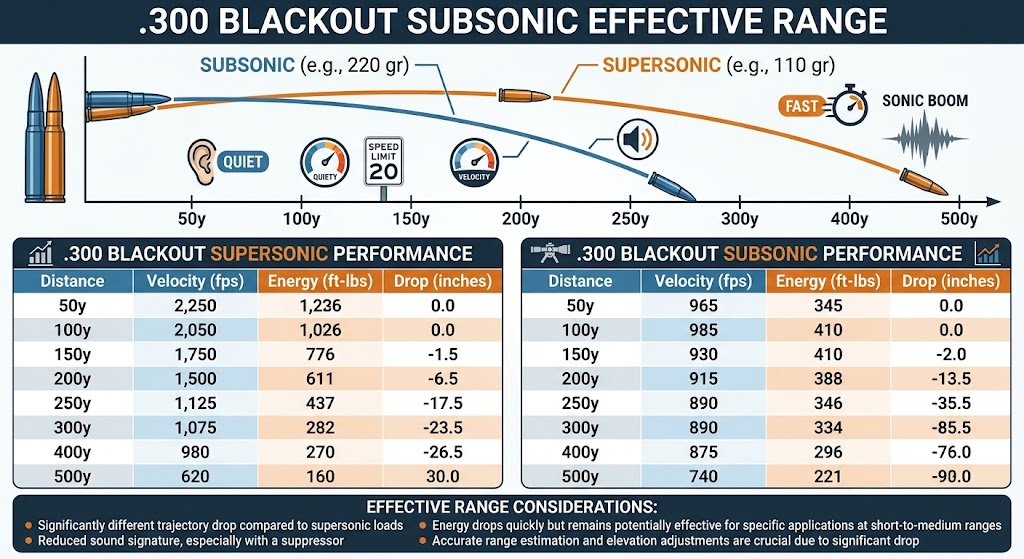
Understanding the Ballistics Chart
The highly detailed data provided in the .300 Blackout Subsonic Effective Range Chart is sourced directly from rigorous real-world ballistic modeling of two incredibly popular factory loads. These numbers perfectly reflect performance from a standard 16-inch rifle barrel under normal atmospheric conditions at sea level with an ambient air temperature of 59 degrees Fahrenheit. Understanding these specific ballistic inputs is incredibly crucial for accurately translating the mathematical data to practical field conditions. Minor changes in barrel length, elevation, barometric pressure, and crosswinds will fundamentally alter these downrange figures.
For the Subsonic column, the data meticulously represents the highly respected Hornady 190-grain Sub-X hollow point load. Fired from a 16-inch barrel, this incredibly heavy load leaves the muzzle at roughly 1,050 feet per second (fps). It is intentionally engineered to securely remain completely below the speed of sound (approximately 1,125 fps at sea level) to completely avoid the loud supersonic crack when fired through a modern suppressor. This heavier bullet features a G1 Ballistic Coefficient (BC) of .437. The rifle is zeroed at 100 yards, clearly highlighting the vastly more parabolic arc required to meet the 100-yard crosshair.
For the Supersonic column, the data meticulously reflects the wildly popular Hornady 110-grain V-MAX load for direct comparison. Fired from the exact same 16-inch barrel, this highly specialized hunting load boasts a factory-rated muzzle velocity of 2,375 fps and a G1 BC of .290. The rifle is perfectly zeroed at exactly 100 yards. This is a lightweight, polymer-tipped bullet explicitly designed for incredibly rapid expansion and violent energy transfer upon impact, providing a stark contrast to the heavy, slow-moving subsonic projectile.
What Is The Effective Range Of .300 Blackout Subsonic?
Determining the true .300 blackout subsonic effective range requires deeply defining what the term effective means for your highly specific shooting application, target size, and local environmental conditions. Originally conceptualized and developed by Advanced Armament Corporation to strictly mimic the ballistics of the 9x39mm Russian cartridge, the subsonic .300 Blackout was built to deliver massive, heavy projectiles silently through a standard AR-15 platform.
Effective range in a civilian hunting context is rigidly defined as the absolute maximum distance at which the heavy projectile retains enough forward velocity to reliably expand upon impact while possessing enough kinetic energy to humanely harvest an animal without causing undue suffering. Most state wildlife agencies and professional big-game hunters demand a strict minimum of 1,000 foot-pounds of kinetic energy for an ethical harvest on medium game like whitetail deer. However, because subsonic ammunition physically cannot generate 1,000 foot-pounds of energy even at the muzzle, hunters must strictly rely on specialized expanding bullets and massive permanent wound channels to achieve lethality.
For most standard hunting applications using high-quality expanding subsonic ammunition, the practical effective range of the .300 Blackout subsonic is firmly planted at exactly 100 yards. At 100 yards, a standard 190-grain to 220-grain subsonic bullet will be dead-on with a 100-yard zero and will stubbornly carry roughly 400 to 450 foot-pounds of kinetic energy. This perfectly allows a hunter to confidently engage medium-sized game in dense timber or swamp environments, provided they use specialized bullets designed to expand at slow speeds.
If you aggressively push the cartridge past the 100-yard line on live game, the heavy bullet rapidly falls victim to gravity. At 150 yards, the kinetic energy drops near 388 ft-lbs, and the bullet drops nearly 10 inches. At 200 yards, the bullet drops over 26 inches. At this extreme distance, even a perfectly placed shot requires dialing massive amounts of elevation into the optic. Furthermore, the velocity drops below 950 fps, meaning even the softest hollow points will completely fail to expand, transferring very little lethal shock, and allowing the animal to escape wounded.
For precision target shooting, tactical applications, and recreational plinking, effective range is defined strictly as the maximum distance at which the shooter can reliably predict the bullet’s aggressive drop to strike steel targets. Because the .300 Blackout boasts spectacular inherent mechanical accuracy, highly skilled marksmen can routinely push subsonic cartridges out to 200 or 300 yards on incredibly calm days. At 300 yards, the bullet has dropped nearly 85 inches, but the mechanical consistency of the heavy ammunition allows shooters to ring steel plates with surprising regularity if they possess precise laser rangefinders.
.300 Blackout Subsonic Velocity And Energy At Distance
Understanding exactly how the .300 Blackout performs dynamically over vast distances requires a deep, mathematical dive into retained velocity and kinetic energy. Subsonic ammunition defies standard rifle ballistics because it starts with incredibly low velocity, meaning atmospheric drag actually affects it far less aggressively than a high-speed projectile.
Let’s thoroughly analyze the Maker Rex 220-grain Solid Copper Expanding Subsonic, a premium custom hunting round heavily favored for massive expansion and excellent energy transfer in brush environments.
- Muzzle: 1,050 fps | 538 ft-lbs
- 50 Yards: 1,015 fps | 503 ft-lbs
- 100 Yards: 985 fps | 474 ft-lbs
- 150 Yards: 960 fps | 450 ft-lbs
- 200 Yards: 935 fps | 427 ft-lbs
- 250 Yards: 912 fps | 406 ft-lbs
- 300 Yards: 890 fps | 387 ft-lbs
Because heavy .30-caliber subsonic bullets utilize incredibly long, sleek profiles, they possess massive ballistic coefficients. The 220-grain bullet sheds lethal energy incredibly slowly compared to standard supersonic rifle cartridges. Notice exactly how the incredibly heavy 220-grain bullet aggressively prevents rapid velocity loss even at low speeds. It only loses a microscopic 160 fps over 300 yards of atmospheric flight.
However, because it started with incredibly low kinetic energy straight out of the muzzle (only 538 ft-lbs compared to a standard 5.56 NATO producing 1,300 ft-lbs), it remains a low-energy cartridge across the board at every single distance. It requires the shooter to rely entirely on the permanent wound channel created by the specialized expanding copper petals, rather than hydrostatic shock, to dispatch the target.
Now, let’s closely look at the highly popular target load, the Federal Premium 220-grain Sierra MatchKing (SMK), featuring a massive G1 BC of .608.
- Muzzle: 1,000 fps | 488 ft-lbs
- 100 Yards: 960 fps | 450 ft-lbs
- 200 Yards: 925 fps | 418 ft-lbs
- 300 Yards: 894 fps | 390 ft-lbs
- 400 Yards: 864 fps | 365 ft-lbs
Notice how the ultra-high ballistic coefficient of the incredibly long, sleek 220-grain Sierra MatchKing aggressively prevents velocity loss. It only loses 136 fps over 400 yards of atmospheric flight. Furthermore, the Sierra MatchKing is strictly an Open Tip Match (OTM) target bullet. It is explicitly not designed to expand at subsonic velocities. If used for hunting or defense, it will likely act exactly like a full metal jacket, penciling straight through the soft tissue of the target, transferring very little of its already low kinetic energy, and causing minimal permanent wound cavitation.
.300 Blackout Subsonic Bullet Drop At Distance
Bullet drop is the ultimate, inescapable limiting factor for the .300 blackout subsonic effective range. The heavy projectile is subject to exactly the same gravitational pull as a fast bullet, but because it travels so slowly, gravity has significantly more time to act upon it before it reaches the target.
Let’s rigidly establish a strict 100-yard zero for a premium 220-grain subsonic load and carefully compare the drop at specific, granular intervals to fully map the steep trajectory of this specialized cartridge.
Subsonic 220gr OTM Target (100-yard zero):
- 25 yards: +0.5 inches
- 50 yards: +2.8 inches
- 75 yards: +2.2 inches
- 100 yards: 0.0 inches
- 125 yards: -4.5 inches
- 150 yards: -10.5 inches
- 175 yards: -18.5 inches
- 200 yards: -29.8 inches
- 250 yards: -58.5 inches
- 300 yards: -97.0 inches
- 400 yards: -208.0 inches
- 500 yards: -365.0 inches
At 200 yards, a subsonic .300 Blackout has dropped nearly 30 inches. While significant, a highly skilled marksman can physically dial 30 inches of elevation into a modern tactical rifle scope. However, at 300 yards, the heavy bullet has dropped a staggering 97 inches (over 8 feet). At 500 yards, the bullet drops over 30 feet. Most optical sights on the civilian market simply do not possess enough internal elevation adjustment in the turrets to accurately dial for this massive drop without utilizing heavily canted scope bases.
This mathematical reality perfectly highlights exactly why subsonic cartridges are strictly close-range tools. If you attempt a hunting shot at a target you confidently believe is at 125 yards, but your range estimation is slightly off and it is actually at 150 yards, the subsonic bullet will drop an additional 6 inches between those two incredibly short distances. This drastic trajectory curve past 100 yards makes precise laser rangefinding absolutely mandatory for ethical, humane hunting. You simply cannot “eyeball” distances with a subsonic cartridge and expect to hit the vital zone reliably.
.300 Blackout Subsonic Range By Barrel Length
One of the absolute greatest engineering achievements of the .300 AAC Blackout is its intricate and highly efficient relationship with powder burn rates. The cartridge utilizes extremely fast-burning magnum pistol powders. These specialized fast powders miraculously achieve complete, or near-complete, combustion within the first 8 to 9 inches of the barrel. This internal ballistic efficiency makes the .300 Blackout one of the most capable and lethal short-barrel rifle (SBR) and AR pistol cartridges in existence today.
For subsonic ammunition, barrel length has a highly fascinating and counter-intuitive effect. Because the entire goal is to keep the bullet strictly below 1,125 fps to avoid the supersonic crack, a significantly shorter barrel actually makes it significantly easier to keep standard factory ammunition dependably subsonic.
Here is a heavily detailed breakdown of average muzzle velocities using a standard 220-grain Subsonic load across various real-world barrel lengths:
- 7.5-inch barrel: ~960 fps
- 9-inch barrel: ~1,000 fps
- 10.5-inch barrel: ~1,020 fps
- 16-inch barrel: ~1,050 fps
As the ballistic data emphatically shows, you realistically gain very little velocity by moving from a highly compact 9-inch barrel to a full-length 16-inch barrel (only about 50 fps).
How this affects range:
With a standard 16-inch rifle barrel, some commercial subsonic loads might accidentally crack the sound barrier depending on ambient temperature, altitude, and humidity, leading to an unexpected loud sonic boom that ruins your suppressed stealth.
With a 9-inch barrel, the heavy bullet will comfortably stay perfectly around 980 to 1,000 fps in all climates and atmospheric conditions. The practical effective range of the subsonic ammo remains strictly 100 yards whether you use an 8-inch or 16-inch barrel because the velocity difference is completely negligible. Therefore, utilizing a highly maneuverable AR pistol or SBR equipped with a suppressor is the absolute optimal configuration for maximizing the tactical utility of this subsonic cartridge.
How Far Is Subsonic .300 Blackout Accurate?
Accuracy and effective range are two entirely different metrics that shooters frequently confuse. Accuracy is the strict mechanical capability of the rifle, optic, barrel harmonics, and ammunition combination to predictably and repeatedly place bullets into a tight cluster. Range is how far the bullet can reliably travel while firmly maintaining lethal energy or a mathematically manageable trajectory.
The .300 Blackout is inherently very accurate, especially when paired with premium, match-grade heavy projectiles like the 220-grain Sierra MatchKing. Out of a high-quality bolt-action rifle (such as a Ruger American Ranch) or a well-built AR-15 upper receiver, the cartridge easily achieves 1 MOA (Minute of Angle) to 1.5 MOA accuracy with high-quality factory ammunition. This means the rifle will consistently shoot roughly 1-inch to 1.5-inch groups at exactly 100 yards.
Because of this supreme inherent mechanical accuracy, the subsonic .300 Blackout is completely accurate enough to consistently ring 12-inch steel plates out to 300 yards in the hands of a skilled marksman who understands how to expertly read wind calls and dial massive elevation corrections. The strict limitation on accuracy at distance is entirely environmental. The heavy, slow-moving projectile spends a massive amount of time in the air, making it highly susceptible to wind drift. A mild 10 mph full-value crosswind will physically push a 220-grain bullet roughly 15 inches off target at 200 yards.
.300 Blackout Subsonic Range For Hunting
The subsonic .300 Blackout has become an absolute darling of the modern tactical hunting community, particularly for shooters traversing dense brush, hunting from confined elevated blinds, or dealing with localized nuisance animals at night using thermal optics where short, suppressed rifles are paramount.
Whitetail Deer
For whitetail deer, blacktail deer, and mule deer, the subsonic .300 Blackout requires extreme discipline from the hunter. Using high-quality, specialized expanding subsonic ammunition like the Hornady 190-grain Sub-X or Maker 220-grain Rex, the practical effective range is firmly and strictly set at 100 yards. Beyond 100 yards, the steep trajectory drastically increases the risk of poor placement. Because the kinetic energy is incredibly low (roughly 450 ft-lbs), shot placement is absolutely critical. Broadside, double-lung shots are highly mandated over heavy shoulder bone shots to ensure full penetration and expansion.
Feral Hogs
Feral hogs are incredibly tough, thick-skinned animals heavily protected with a dense cartilage shield over their vitals. Hogs are frequently hunted at night at very close ranges (50 to 100 yards) using suppressed short-barreled .300 Blackout rifles paired with thermal optics. Heavy expanding subsonics are used when hunters specifically want to eliminate acoustic sound and take multiple pigs from a sounder before the group violently scatters in panic. The effective range for ethical hog hunting with subsonic loads is strictly 50 to 75 yards, prioritizing ear or neck shots to guarantee instant incapacitation.
Varmints and Pests
For raccoons, coyotes, and localized agricultural pests, the subsonic .300 Blackout works exceptionally well. Because these targets are thin-skinned and require vastly less kinetic energy to safely dispatch, hunters can confidently use subsonic ammunition out to 100 yards. The absolute lack of acoustic signature ensures the hunter does not disturb neighbors or scatter remaining pests in the area.
.300 Blackout Subsonic Range With A Suppressor
Shooting subsonic .300 Blackout suppressed is exactly where the caliber truly shines and fulfills its original special operations design destiny. The cartridge was literally engineered from the ground up to operate perfectly in conjunction with a modern silencer.
When firing heavy subsonic ammunition through a modern, high-quality .30-caliber suppressor, the heavy silencer safely captures escaping high-pressure gases and heavily tames the concussive muzzle blast. Because the bullet is traveling strictly below the speed of sound, there is absolutely no supersonic ballistic crack. The resulting sound signature hovers around an incredibly low 120 to 125 decibels. This is roughly comparable to the pneumatic snap of an industrial nail gun. In many AR-15 platforms, the loudest physical sound is the mechanical cycling of the bolt carrier group and the heavy bullet physically impacting the target downrange.
The absolute lack of acoustic signature means the effective range is dictated entirely by severe bullet drop, not by the risk of revealing the shooter’s physical position. The suppressor ensures the shooter’s location remains heavily concealed, keeping the practical tactical and pest-control engagement envelope locked tightly between 0 and exactly 100 yards. Firing suppressed subsonic ammo does not negatively alter the terminal range in any way, but it vastly improves situational awareness and tactical stealth.
Subsonic .300 Blackout vs Supersonic .300 Blackout Range
How does the massive, heavy subsonic .300 Blackout stack up against its lightweight, high-velocity supersonic counterpart in terms of range and overall capability? While both are meticulously designed to seamlessly function in the exact same AR-15 platform utilizing the exact same magazines, they deliver vastly different approaches to terminal ballistics.
| Category | Subsonic .300 Blackout (220gr) | Supersonic .300 Blackout (110gr) | Winner |
| Muzzle Velocity | ~1,050 fps | ~2,375 fps | Supersonic |
| Muzzle Energy | ~538 ft-lbs | ~1,378 ft-lbs | Supersonic |
| Energy at 200 Yards | ~418 ft-lbs | ~748 ft-lbs | Supersonic |
| Bullet Drop at 200 Yards | -29.8 inches | -6.0 inches | Supersonic |
| Wind Drift Susceptibility | Extreme | Moderate | Supersonic |
| Deer Hunting Range | 100 yards (Requires special bullets) | 250 yards | Supersonic |
| Suppressor Stealth | Dead quiet (No supersonic crack) | Loud (Crack remains present) | Subsonic |
| Optimal Barrel Length | 8 to 9 inches | 10.5 to 16 inches | Subsonic |
Ultimately, the choice strictly comes down to your anticipated engagement distances and physical tactical requirements. If your targets are past 100 yards in open terrain, or you require massive kinetic energy to cleanly harvest medium game, the supersonic load is vastly superior due to its flat trajectory and incredibly high velocity. If your engagements are strictly under 100 yards, and you require absolute acoustic stealth for home defense, localized pest control, or tactical operations, the heavy subsonic load completely dominates the supersonic option in sheer quietness.
Is Subsonic .300 Blackout Good For Long Range?
The definitive, highly researched, data-driven answer is absolutely no. The subsonic .300 Blackout is explicitly designed by ammunition engineers to be a highly specialized, ultra-quiet, short-range tactical cartridge that perfectly mimics pistol ballistics from a rifle platform.
Long-range shooting (defined typically in the modern centerfire era as 500 to 1,000 yards) requires a cartridge that actively pushes a highly aerodynamic bullet at incredibly high velocities to physically combat the relentless forces of gravity and extreme wind drift. Because subsonic ammunition intentionally limits velocity to under 1,125 fps, the heavy projectiles act exactly like thrown baseballs. A subsonic 220-grain bullet violently drops nearly 30 feet (365 inches) at 500 yards and is heavily tossed around by even mild lateral winds because it spends so much time traveling through the air.
While dialing 30 feet of elevation into a specialized optic and ringing steel gongs at 500 yards with a subsonic .300 Blackout is a highly entertaining, math-heavy ballistic exercise for advanced shooters, it is absolutely not an effective long-range cartridge for ethical hunting, home defense, or competitive precision rifle shooting. It successfully delivers absolute stealth entirely inside the 100-yard envelope, exactly as it was strictly designed to do.
Pros and Cons
Subsonic .300 Blackout Pros
- Delivers absolutely unparalleled acoustic stealth when paired with a high-quality suppressor, completely eliminating the loud supersonic ballistic crack.
- Produces incredibly light felt recoil and virtually zero muzzle flash, allowing shooters to easily maintain their sight picture and execute rapid follow-up shots safely.
- Unprecedented AR-15 compatibility requires only a simple barrel change. It actively utilizes the standard 5.56 NATO bolt carrier group and magazines.
- Optimized strictly for incredibly short barrels; a 9-inch barrel delivers the exact same lethal performance as a 16-inch barrel.
- Heavy 220-grain projectiles possess massive momentum, deeply penetrating thick barriers and tough hide at close quarters despite low velocities.
Subsonic .300 Blackout Cons
- Incredibly steep, mortar-like trajectory severely limits the maximum ethical hunting range strictly to 100 yards.
- Produces extremely low kinetic energy (often under 500 ft-lbs), vastly increasing the risk of unrecovered game if shot placement is not flawless.
- Requires highly specialized, heavily engineered expanding bullets (like the Sub-X or Maker Rex) for hunting; standard target hollow points will completely fail to expand.
- Extreme susceptibility to wind drift makes accurate environmental calculations vastly more difficult for the shooter across open fields past 100 yards.
- Premium factory subsonic ammunition is highly expensive compared to bulk supersonic ammunition, heavily limiting high-volume target practice.
.300 Blackout Subsonic Effective Range: Final Verdict
When meticulously consolidating all empirical ballistic data, velocity charts, and terminal kinetic energy tables, the .300 blackout subsonic effective range is incredibly specific and highly optimized for extreme close-range precision and absolute acoustic stealth.
For tactical applications and ethical hunting, the absolute maximum practical effective range is heavily cemented at strictly 100 yards. Out of a highly compact 9-inch to 10.5-inch short-barreled rifle, a massive 190-grain to 220-grain bullet actively retains just enough physical momentum and velocity at this exact distance to reliably expand (if utilizing specialized projectiles) and cleanly harvest medium game or dispatch localized pests. While the heavy bullet can physically travel much further and punch paper at 300 yards, the extreme parabolic drop and massive wind drift past 100 yards makes it entirely unsuitable for ethical big-game application beyond that specific threshold.
Ultimately, the subsonic .300 Blackout is an unstoppable close-range masterpiece strictly designed to perfectly maximize the limits of suppressed tactical operations. It was heavily purpose-built from the ground up to quietly provide hunters, law enforcement, and outdoorsmen with a highly maneuverable, ultra-stealthy cartridge capable of delivering deep-penetrating, heavy impacts at close quarters.
FAQs
What is the effective range of .300 Blackout subsonic?
The effective range of subsonic .300 Blackout is strictly 100 yards for ethically hunting medium game like deer or hogs, assuming you are utilizing highly specialized expanding ammunition designed to open at slow speeds.
How far can subsonic .300 Blackout shoot accurately?
Mechanically, a high-quality .300 Blackout rifle can accurately hit stationary steel targets out to 300 yards on a perfectly calm, flat range, but severe bullet drop and extreme wind drift make it highly impractical for unpredictable field conditions.
Is subsonic .300 Blackout good for deer hunting?
Yes, but strictly inside 100 yards and strictly when using specialized expanding hunting bullets like the Hornady Sub-X. Standard subsonic target ammunition will simply pencil through the deer, causing minimal trauma and leading to a lost animal.
How much does a subsonic .300 Blackout bullet drop at 200 yards?
When explicitly zeroed at exactly 100 yards, a standard 220-grain subsonic .300 Blackout bullet physically drops approximately 30 inches at 200 yards, requiring a massive optical holdover on the target.
How far can supersonic .300 Blackout shoot?
Supersonic .300 Blackout ammunition is vastly flatter shooting and remains highly effective for hunting medium game out to a practical range of 250 to 300 yards before kinetic energy completely dissipates.
What is the maximum effective range of subsonic .300 Blackout?
The absolute maximum effective range for terminal, lethal performance on live targets with premium subsonic ammunition is firmly 100 yards, though the heavy cartridge is optimized for ultra-close tactical distances.
How far is subsonic .300 Blackout accurate with a short barrel?
The .300 Blackout utilizes fast-burning pistol powder very efficiently. A highly compact 9-inch barrel loses virtually zero subsonic velocity compared to a standard 16-inch barrel, heavily retaining its highly effective and highly accurate 100-yard range.
Does subsonic .300 Blackout kick hard?
No. While it utilizes massive bullets, one of the greatest ballistic advantages of firing subsonic .300 Blackout from an AR-15 is its exceptionally light felt recoil, completely allowing the shooter to maintain their sight picture easily.
Can subsonic .300 Blackout kill a hog?
Yes, a perfectly placed shot at close range utilizing a premium heavy expanding projectile will ethically harvest a feral hog. The massive bullet provides the deep penetration strictly required to break through thick cartilage shields inside 75 yards.
Why was the .300 Blackout created?
The .300 Blackout was explicitly created by Advanced Armament Corporation to provide special operations groups with a massive, heavy-hitting .30-caliber cartridge capable of extreme suppressed stealth that seamlessly operates inside a standard AR-15 platform.
Can you shoot subsonic .300 Blackout in a 5.56 AR-15?
You absolutely cannot safely shoot it in a 5.56 barrel, but you can easily convert a standard 5.56 NATO AR-15 to .300 Blackout by simply swapping the physical barrel. It safely utilizes the exact same standard bolt carrier group and magazines.
What is the best subsonic .300 Blackout ammo for deer?
For hunting whitetail deer, 190-grain to 220-grain expanding subsonic projectiles consistently perform best. Highly popular and highly effective choices explicitly include the Hornady 190gr Sub-X and the Maker 220gr Rex solid copper expanding bullet.
Does a longer barrel increase subsonic .300 Blackout range?
No. Physically moving from a highly compact 9-inch barrel to a standard 16-inch barrel safely gains the shooter virtually zero extra subsonic velocity, as the fast-burning powder is entirely consumed within the first 9 inches of the bore.
How does wind affect a subsonic .300 Blackout at 150 yards?
Wind heavily affects the slow-moving subsonic bullets. A 10 mph full-value crosswind will physically blow a standard 220-grain bullet roughly 8 inches off target at 150 yards, requiring hunters to perfectly judge open-field winds.
Subsonic .300 Blackout vs 9mm PCC: Which has better range?
Both specialized pistol-caliber style platforms share incredibly similar subsonic trajectories, but the .300 Blackout utilizes vastly heavier, significantly more aerodynamic bullets that shoot marginally flatter and hit with vastly more kinetic energy, making it the undisputed winner for larger game inside 100 yards.