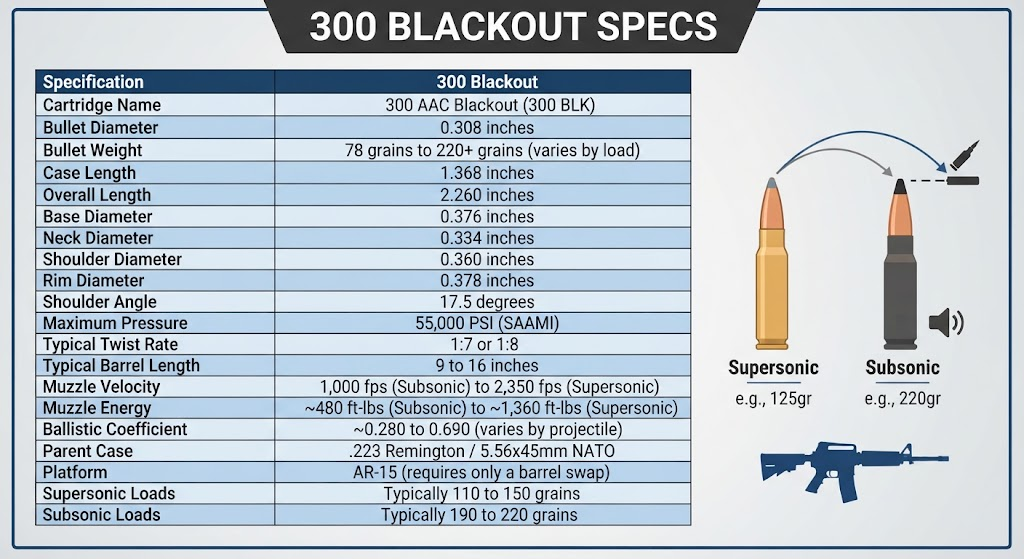
The 300 Blackout utilizes a 0.308-inch bullet diameter seated in a 1.368-inch case, bringing the maximum overall length to 2.260 inches.Typical bullet weights span from lightweight 110-grain supersonic rounds to heavy 220-grain subsonic loads.Muzzle velocities average between 2,100 and 2,350 fps for supersonic ammunition, while muzzle energy peaks around 1,360 ft-lbs. Subsonic variants are purposefully regulated to approximately 1,000 fps to remain below the sound barrier. The cartridge is optimized for 9-inch to 10.5-inch barrels with 1:7 or 1:8 twist rates, running at a SAAMI maximum pressure of 55,000 PSI.
300 Blackout Specs
| Specification | 300 Blackout |
| Cartridge Name | 300 AAC Blackout (300 BLK) |
| Bullet Diameter | 0.308 inches |
| Bullet Weight | 78 grains to 220+ grains (varies by load) |
| Case Length | 1.368 inches |
| Overall Length | 2.260 inches |
| Base Diameter | 0.376 inches |
| Neck Diameter | 0.334 inches |
| Shoulder Diameter | 0.360 inches |
| Rim Diameter | 0.378 inches |
| Shoulder Angle | 17.5 degrees |
| Maximum Pressure | 55,000 PSI (SAAMI) |
| Typical Twist Rate | 1:7 or 1:8 |
| Typical Barrel Length | 9 to 16 inches |
| Muzzle Velocity | 1,000 fps (Subsonic) to 2,350 fps (Supersonic) |
| Muzzle Energy | ~480 ft-lbs (Subsonic) to ~1,360 ft-lbs (Supersonic) |
| Ballistic Coefficient | ~0.280 to 0.690 (varies by projectile) |
| Parent Case | .223 Remington / 5.56x45mm NATO |
| Platform | AR-15 (requires only a barrel swap) |
| Supersonic Loads | Typically 110 to 150 grains |
| Subsonic Loads | Typically 190 to 220 grains |
300 Blackout Bullet Diameter
The 300 Blackout bullet diameter is precisely 0.308 inches. This allows the cartridge to utilize a vast array of established .30 caliber projectiles initially designed for rounds like the .308 Winchester, granting immense versatility in bullet selection.
300 Blackout Case Length
The 300 Blackout case length is capped at 1.368 inches. Because the parent case is the .223 Remington, this shortened brass accommodates a much larger .30 caliber bullet without altering the original footprint required to fit inside standard AR-15 magazines.
300 Blackout Overall Length
According to SAAMI standards, the maximum 300 Blackout overall length is 2.260 inches. This is the exact same overall length as the 5.56x45mm NATO, guaranteeing that the ammunition flawlessly loads and feeds from standard mil-spec AR-15 magazines without modification.
300 Blackout Bullet Weights
A defining characteristic of these 300 BLK specs is the massive range in 300 Blackout bullet weight. Standard supersonic loads use lighter projectiles between 110 and 150 grains, while subsonic rounds depend on heavier 190 to 220-grain bullets to provide sufficient terminal energy without breaking the sound barrier.
300 Blackout Muzzle Velocity
Because the cartridge serves two distinct purposes, 300 Blackout muzzle velocity is heavily dependent on the ammunition. Supersonic factory loads leave the barrel at approximately 2,100 to 2,350 fps (from a 16-inch barrel), whereas subsonic loads intentionally restrict velocities to around 1,000 fps.
300 Blackout Muzzle Energy
The 300 Blackout muzzle energy varies significantly between load types. High-velocity 110-grain loads can produce up to 1,360 foot-pounds of energy. Conversely, the slower, heavier 220-grain subsonic loads generate around 480 to 500 foot-pounds of energy.
300 Blackout Maximum Pressure
The 300 Blackout maximum average pressure established by SAAMI is 55,000 PSI. This operating pressure ensures consistent cycling and safe extraction within the standard AR-15 gas system, sitting slightly lower than the 62,000 PSI maximum of the 5.56 NATO.
300 Blackout Twist Rate
The most common 300 Blackout twist rate is 1:7 or 1:8 inches. A fast twist rate is absolutely critical to properly stabilize the exceptionally long, heavy 220-grain bullets traveling at low subsonic speeds.
300 Blackout Barrel Length
Unlike most rifle cartridges, the 300 Blackout barrel length does not need to be long to achieve full powder burn. The powder is formulated to reach peak efficiency in 9 to 10.5-inch barrels, making it one of the premier short-barreled rifle (SBR) cartridges on the market.
300 Blackout Ballistic Coefficient
The 300 Blackout ballistic coefficient (BC) depends entirely on the bullet profile. Lighter 110-grain supersonic bullets typically have a G1 BC around 0.280 to 0.312, while the heavy, elongated 220-grain match bullets can achieve an impressive BC exceeding 0.690.
Supersonic vs Subsonic
The primary draw of the 300 AAC Blackout is its dual-purpose capability. Swapping between 300 Blackout supersonic and 300 Blackout subsonic ammunition dramatically changes the performance profile of the firearm without needing to adjust the gas block or change parts.
| Load Type | Typical Bullet Weight | Velocity | Muzzle Energy | Main Characteristic |
| Supersonic | 110 – 150 grains | 2,100 – 2,350 fps | 1,200 – 1,360 ft-lbs | Flatter trajectory, expansion, longer effective range (up to 300 yards) |
| Subsonic | 190 – 220 grains | ~1,000 fps | ~480 – 500 ft-lbs | Ultra-quiet when suppressed, heavy bullet, short-range (under 150 yards) |
Subsonic loads completely eliminate the miniature sonic boom (“crack”) created when a bullet breaks the sound barrier. However, by removing velocity from the kinetic energy equation, subsonic rounds must rely on heavy projectile weight to deliver force on target.
Factory Load Specifications
When analyzing 300 Blackout cartridge specs, reviewing verified manufacturer data provides the clearest picture of actual field performance. Below are representative loads across the most common bullet weights (velocities based on 16-inch test barrels):
- 110 grain: Barnes VOR-TX TAC-TX (Supersonic). Velocity: 2,350 fps. Muzzle Energy: 1,349 ft-lbs.
- 115 grain: Remington UMC CTFB (Supersonic). Velocity: 2,295 fps. Muzzle Energy: 1,344 ft-lbs.
- 125 grain: Hornady HP (Supersonic). Velocity: 2,175 fps. Muzzle Energy: 1,313 ft-lbs.
- 150 grain: Federal FMJBT (Supersonic). Velocity: 1,900 fps. Muzzle Energy: 1,202 ft-lbs.
- 220 grain: Hornady Ballistic Tip (Subsonic). Velocity: 1,020 fps. Muzzle Energy: 508 ft-lbs. BC: 0.693.
Cartridge Dimensions
The 300 Blackout dimensions were explicitly engineered to mirror the external limits of the 5.56 NATO case head, ensuring magazine and bolt carrier group compatibility.
| Dimension | Measurement |
| Bullet Diameter | 0.308 inches |
| Case Length | 1.368 inches |
| Overall Length | 2.260 inches |
| Base Diameter | 0.376 inches |
| Neck Diameter | 0.334 inches |
| Shoulder Diameter | 0.360 inches |
| Rim Diameter | 0.378 inches |
| Shoulder Angle | 17.5 degrees |
Barrel Length
One of the most frequently discussed 300 Blackout specifications is how it responds to different barrel lengths. Fast-burning powders allow the 300 BLK to achieve full combustion quickly, meaning velocity loss in short barrels is minimal compared to other intermediate rifle rounds.
Chronograph testing with a standard 110-grain supersonic load demonstrates this efficiency:
- 7.5 inches:2,050 fps
- 8 inches:2,080 fps
- 9 inches:2,120 fps
- 10.5 inches:2,175 fps
- 12.5 inches:2,230 fps
- 16 inches:2,350 fps
Going from a 16-inch barrel down to a highly maneuverable 10.5-inch barrel only sacrifices about 175 fps (an 8% velocity loss). In contrast, a 5.56 NATO loses nearly 20% of its velocity in the same reduction.
Ballistics
Understanding 300 Blackout ballistics requires evaluating exact loads, as supersonic and subsonic rounds fly on vastly different trajectories.
Load: Hornady 110gr CX (Supersonic, 16-inch barrel, G1 BC: 0.312)
- Muzzle: 2,285 fps | 1,276 ft-lbs | Drop: -1.5 in
- 100-yard: 2,029 fps | 1,006 ft-lbs | Drop: +3.5 in
- 200-yard: 1,791 fps | 784 ft-lbs | Drop: 0.0 in (Zero)
Load: Hornady 220gr Ballistic Tip (Subsonic, 16-inch barrel, G1 BC: 0.693)
- Muzzle: 1,020 fps | 508 ft-lbs | Drop: -1.5 in
- 100-yard: 989 fps | 478 ft-lbs | Drop: +17.1 in
- 200-yard: 962 fps | 452 ft-lbs | Drop: 0.0 in (Zero)
(Note: The heavy bullet drop on subsonic ammunition requires distinct optics or holdovers if zeroed at the same distance as supersonic ammunition.)
Platform And Compatibility
The 300 Blackout was engineered with a strict mandate: it must work flawlessly in the M4/AR-15 ecosystem.
- AR-15 Compatibility: Unparalleled. You only need to change the barrel to convert a standard 5.56 AR-15 to 300 Blackout.
- Magazine Compatibility:It uses standard 5.56 NATO magazines at their full capacity.
- Bolt Requirements:It utilizes the exact same AR-15 bolt carrier group and bolt face as the 5.56.
- Gas System:Usually pistol-length to allow reliable cycling of both super and subsonic rounds.
300 Blackout vs 5.56
While they share a platform, these cartridges serve completely different tactical and practical purposes.
| Specification | 300 Blackout | 5.56 NATO |
| Bullet Diameter | 0.308 inches | 0.224 inches |
| Typical Bullet Weight | 110 gr – 220 gr | 55 gr – 77 gr |
| Muzzle Velocity (16″ Bbl) | ~2,350 fps (110gr) | ~3,150 fps (55gr) |
| Muzzle Energy (16″ Bbl) | ~1,349 ft-lbs | ~1,223 ft-lbs |
| Subsonic Capability | Excellent (purpose-built) | Very Poor (requires unreliably light powder charges) |
| Typical Barrel Length | 9 – 10.5 inches | 14.5 – 20 inches |
| Twist Rate | 1:7 or 1:8 | 1:7, 1:8, or 1:9 |
| Primary Design Focus | Short barrels, suppressed fire, larger bore | High velocity, flat trajectory, long range |
Pros And Cons
300 Blackout Pros
- Exceptional short-barrel performance with minimal velocity loss.
- Integrates seamlessly into AR-15 platforms (only requires a barrel swap).
- World-class subsonic performance makes it one of the best rounds to suppress.
- Massive ammunition variety from 110-grain varmint rounds to 220-grain defensive loads.
- Heavier projectile mass translates to excellent barrier penetration and hunting utility inside 150 yards.
300 Blackout Cons
- Much steeper trajectory and bullet drop past 200 yards compared to 5.56.
- Lower velocity means less hydrostatic shock and less reliable bullet expansion at extended ranges.
- Ammunition is typically more expensive and heavier to carry than standard 5.56 NATO.
- Accidental chambering of a 300 BLK round into a 5.56 rifle can cause a catastrophic firearm failure.
FAQs
What are the specifications of 300 Blackout?
The 300 Blackout fires a 0.308-inch bullet from a 1.368-inch case, with an overall length of 2.260 inches.It is designed to operate safely in standard AR-15 platforms with a maximum SAAMI pressure of 55,000 PSI.
What is the bullet diameter of 300 Blackout?
The true 300 Blackout bullet diameter is 0.308 inches, matching standard .30 caliber projectiles like the .308 Winchester.
What is the case length of 300 Blackout?
The official SAAMI 300 Blackout case length is 1.368 inches (34.7mm).
What is the overall length of 300 Blackout?
The 300 Blackout overall length is 2.260 inches. This dimension is intentional, as it allows the cartridge to feed reliably from standard 5.56 NATO AR-15 magazines.
What bullet weights are available for 300 Blackout?
You will typically find a 300 Blackout bullet weight ranging from 110 to 150 grains for supersonic loads, and 190 to 220 grains for subsonic loads.
What is the muzzle velocity of 300 Blackout?
The 300 Blackout muzzle velocity depends heavily on the load and barrel length. Supersonic rounds (like a 110-grain bullet from a 16-inch barrel) can reach 2,350 fps, while subsonic rounds are loaded to stay around 1,000 fps.
What is the muzzle energy of 300 Blackout?
Supersonic 300 Blackout muzzle energy generally peaks between 1,200 and 1,360 foot-pounds.Subsonic loads produce significantly less energy, usually hovering around 480 to 500 foot-pounds.
What is the maximum pressure of 300 Blackout?
According to SAAMI specs, the 300 Blackout maximum average pressure is 55,000 PSI.
What is the twist rate for 300 Blackout?
A 1:7 or 1:8 inch twist rate is standard for the 300 Blackout. These fast twist rates are necessary to stabilize long, heavy 220-grain subsonic bullets.
What is the heaviest 300 Blackout bullet?
While custom loaders occasionally experiment with heavier projectiles, 220 grains to 226 grains is generally the heaviest commercially available factory bullet weight.
Is 300 Blackout subsonic?
Yes, there is dedicated 300 Blackout subsonic ammunition. These loads utilize heavy bullets (usually 190-220 grains) and reduced powder charges to keep velocities around 1,000 fps, completely avoiding the sonic crack.
Is 300 Blackout supersonic?
Yes, 300 Blackout supersonic ammunition uses lighter bullets (110-150 grains) loaded to velocities between 1,900 and 2,350 fps, making them excellent for hunting and self-defense within 300 yards.
What barrel length is best for 300 Blackout?
The cartridge is highly efficient. A barrel between 9 and 10.5 inches provides the optimal balance of velocity, maneuverability, and full powder burn for the 300 BLK specs.
Is 300 Blackout compatible with an AR-15?
Yes, completely compatible. To fire 300 Blackout from a standard 5.56 AR-15, all you have to do is change the barrel. The bolt carrier group, lower receiver, and magazines are identical.
How does 300 Blackout compare with 5.56?
The 5.56 NATO is a high-velocity, small-caliber round (.224) meant for flat trajectories and long-range effectiveness.The 300 Blackout is a slower, larger-caliber round (.308) optimized for short barrels, heavy barrier penetration, and suppressed subsonic fire.