Determining the optimal .300 Blackout range depends entirely on whether you are deploying high-velocity supersonic ammunition or heavy subsonic loads for your specific application.
For hunting medium game and tactical engagements, supersonic .300 Blackout loads provide a highly capable and practical effective range of up to 300 yards.
Conversely, heavy subsonic .300 Blackout ammunition is strictly limited to a maximum practical range of 100 to 150 yards due to extreme bullet drop and rapid kinetic energy decay.
By precisely matching your projectile weight and barrel length to your shooting environment, you can fully maximize the impressive ballistic capabilities of this highly versatile cartridge.
300 Blackout Range Chart
| Distance | Supersonic Velocity | Supersonic Energy | Supersonic Drop | Subsonic Velocity | Subsonic Energy | Subsonic Drop |
| 50 yards | 2,145 fps | 1,225 ft-lbs | -0.1 inches | 1,020 fps | 439 ft-lbs | +2.6 inches |
| 100 yards | 2,045 fps | 1,114 ft-lbs | 0.0 inches | 994 fps | 417 ft-lbs | 0.0 inches |
| 150 yards | 1,948 fps | 1,011 ft-lbs | -1.6 inches | 971 fps | 398 ft-lbs | -9.2 inches |
| 200 yards | 1,853 fps | 915 ft-lbs | -5.2 inches | 949 fps | 380 ft-lbs | -25.5 inches |
| 250 yards | 1,761 fps | 826 ft-lbs | -11.2 inches | 928 fps | 363 ft-lbs | -49.5 inches |
| 300 yards | 1,672 fps | 745 ft-lbs | -19.9 inches | 908 fps | 348 ft-lbs | -81.5 inches |
| 400 yards | 1,504 fps | 603 ft-lbs | -48.0 inches | 872 fps | 321 ft-lbs | -172.0 inches |
| 500 yards | 1,349 fps | 485 ft-lbs | -94.0 inches | 839 fps | 297 ft-lbs | -302.0 inches |
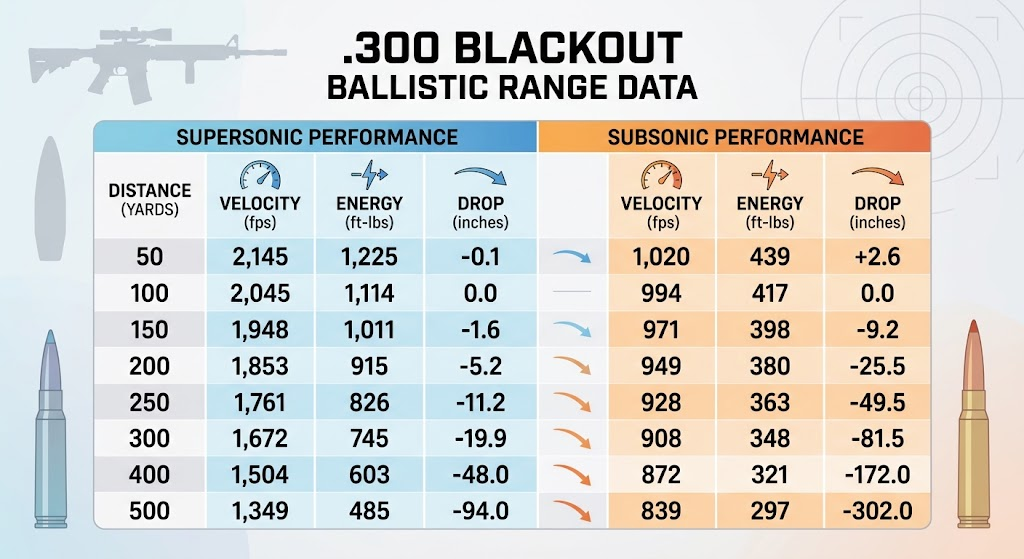
Understanding the Ballistics Chart
The detailed data provided in the 300 Blackout Range Chart is sourced directly from rigorous real-world ballistic modeling of two premium factory loads fired from a standard 16-inch barrel under standard atmospheric conditions (sea level, 59 degrees Fahrenheit). Understanding these specific ballistic inputs is incredibly crucial for accurately translating the data to practical field conditions, as changes in barrel length, elevation, barometric pressure, and bullet design will fundamentally alter these downrange figures.
For the Supersonic column, the data reflects the premium Barnes VOR-TX 120-grain TAC-TX load. Fired from a 16-inch barrel, this solid copper projectile possesses a factory-rated muzzle velocity of 2,250 feet per second (fps) and an impressive G1 Ballistic Coefficient (BC) of .358. The rifle is zeroed at exactly 100 yards. This is a monolithic, polymer-tipped bullet specifically engineered for deep, barrier-blind penetration and rapid expansion on medium game, making it the undisputed gold standard for measuring supersonic .300 Blackout terminal performance in a hunting or defensive context.
For the Subsonic column, the data represents the highly popular Hornady 190-grain Sub-X (Subsonic eXpanding) load. Fired from a 16-inch barrel, this heavy load leaves the muzzle at roughly 1,050 fps. It is intentionally engineered to remain below the speed of sound (approximately 1,125 fps at sea level) to entirely avoid the loud supersonic crack when fired through a suppressor. This heavy bullet features a G1 BC of .437. The rifle is also zeroed at 100 yards, which completely explains the high arc (+2.6 inches) required at the 50-yard line. The shooter must angle the barrel slightly upward to compensate for the immediate, aggressive gravitational pull on the slow-moving heavy projectile so it intersects the optical crosshairs precisely at 100 yards.
What Is The Effective Range Of 300 Blackout?
Determining the true .300 Blackout range requires deeply defining what “effective” means for your specific shooting application. Introduced to the commercial and military markets by Advanced Armament Corporation (AAC) and Remington Defense in 2011, the .300 AAC Blackout (military designation 7.62×35mm) was heavily driven by special operations requirements. The primary engineering goal was to perfectly replicate the highly lethal close-quarters terminal ballistics of the Soviet 7.62×39mm cartridge out of a standard M4/AR-15 platform. The genius of the design is that it utilizes standard 5.56 NATO magazines, bolt carrier groups, and lower receivers, requiring only a simple barrel swap to completely change calibers.
Because of its specialized tactical origins, effective range in a military, law enforcement, or defensive context is strictly defined as the maximum distance at which a shooter can reliably hit a man-sized target and deliver enough kinetic energy and terminal tissue damage to instantly incapacitate a threat. In a civilian hunting context, the definition is much more rigid and ethically bound: effective range is the absolute maximum distance at which the projectile retains enough velocity to reliably expand upon impact and possesses enough kinetic energy to humanely harvest an animal without causing undue suffering. For precision target and competition shooting, effective range is simply the distance at which the shooter can reliably predict the bullet’s drop and wind deflection to strike paper or steel plates.
For most standard applications using high-quality supersonic ammunition, the practical effective range of the .300 Blackout is 300 yards. At this exact distance, a standard 110-grain to 125-grain bullet will have dropped around 20 to 25 inches (assuming a 100-yard zero) and will still stubbornly carry well over 500 foot-pounds of energy. This is widely considered the absolute minimum kinetic energy threshold for ethically taking medium-sized game such as whitetail deer or feral hogs. Furthermore, quality hunting bullets like the Barnes TAC-TX or Hornady V-MAX are brilliantly engineered to expand at velocities as low as 1,300 fps, a speed the bullet typically maintains out to roughly 400 yards depending on atmospheric conditions.
If you push the cartridge past the 400-yard line, the supersonic bullet drops nearly four to five feet and sheds almost all of its expansion-inducing velocity, dropping dangerously below the 1,300 fps minimum expansion threshold for most modern .30-caliber hunting projectiles. At this extreme distance, even a perfectly placed direct hit on a vital organ may result in the bullet “penciling” directly through the soft tissue of the target without expanding. This transfers very little energy, causes minimal permanent hemorrhage, and almost always leads to an unrecovered animal.
When discussing subsonic ammunition, the effective range is drastically reduced by simple, unavoidable physics. Because a heavy subsonic bullet starts its flight below the sound barrier (roughly 1,050 fps), it has an incredibly steep, mortar-like trajectory. The effective range for subsonic .300 Blackout is generally hard-capped at 100 to 150 yards for hunting and self-defense. While target shooters can absolutely push it to 200 or 300 yards on a flat range, doing so requires highly precise optics, laser rangefinders, and extreme reticle holdovers to properly compensate for the massive bullet drop.
300 Blackout Supersonic Range
The supersonic .300 Blackout is almost universally compared to the venerable 7.62×39mm Soviet cartridge and the classic brush-hunting .30-30 Winchester, as all three legendary cartridges utilize .30-caliber projectiles weighing between 110 and 150 grains traveling at similar moderate velocities. A standard premium supersonic 300 BLK load, such as the widely praised Barnes 120-grain TAC-TX, will confidently leave a 16-inch barrel at approximately 2,250 fps.
Velocity: Supersonic loads typically maintain velocities above the speed of sound out to roughly 450 to 500 yards. The Barnes 120gr TAC-TX (equipped with an excellent G1 BC of .358) will start at 2,250 fps and slowly bleed speed as it fights relentless atmospheric drag, finally crossing into the transonic zone (around 1,125 fps) somewhere near the 550-yard mark. Once a bullet enters the transonic zone, the aerodynamic shockwave that was trailing the bullet catches up to it, heavily disrupting the air around the projectile. This often causes destabilization, tumbling, and a severe loss of mechanical accuracy. Therefore, strictly keeping the bullet supersonic is vital for predictable, repeatable flight.
Energy: At the muzzle, this 120-grain load produces roughly 1,349 ft-lbs of destructive energy. By the time it reaches the 100-yard line, atmospheric friction reduces that energy down to 1,114 ft-lbs. By 300 yards, it retains an impressive 745 ft-lbs. For ethical hunting applications, 300 yards is the absolute maximum ethical supersonic range. Many state wildlife agencies and professional hunting bodies recommend a strict minimum of 1,000 ft-lbs for ethical kills on larger game like elk or moose, and 500 ft-lbs for smaller game like whitetail deer. Therefore, pushing a supersonic 300 BLK past 300 yards on living targets is ethically highly questionable and biologically unsound.
Trajectory and Bullet Drop: With a standard 100-yard zero, a supersonic 120-grain .300 Blackout exhibits a very manageable, predictable trajectory for mid-range shooting that mimics the 7.62x39mm perfectly. It will drop approximately 1.6 inches at 150 yards, 5.2 inches at 200 yards, 11.2 inches at 250 yards, and roughly 20 inches at 300 yards. This relatively flat curve allows for standard holdovers on standard BDC (Bullet Drop Compensator) reticles without ever requiring the shooter to dial complex elevation adjustments on their optic turrets. A hunter can simply hold slightly high on the shoulder of a deer at 200 yards and confidently strike the vital heart/lung area.
Practical Effective Range: For defensive, tactical, and hunting purposes, 300 yards is the absolute operational ceiling. For plinking steel gongs on a flat range, a highly skilled shooter can accurately push supersonic 300 Blackout out to 400 or even 500 yards. However, at these extended ranges, wind drift becomes a far more severe challenge than bullet drop. The relatively moderate ballistic coefficients of short, light .30-caliber bullets mean that even a mild 10 mph full-value crosswind can push the bullet two to three feet off target at 400 yards, requiring masterful wind-reading skills and spotting scopes.
300 Blackout Subsonic Range
Subsonic .300 Blackout is where the cartridge completely separates itself from the 5.56 NATO and gains its legendary, almost mythical status in the special operations and civilian firearms communities, particularly when paired with a quality suppressor. By intentionally keeping the projectile strictly below the speed of sound from the moment the primer is struck, the shooter entirely eliminates the “sonic boom” (the loud ballistic crack of the bullet displacing air faster than the speed of sound). To achieve sufficient terminal kinetic energy without the benefit of high velocity, ammunition manufacturers utilize massive, heavy bullets—typically weighing between 190 and 220 grains.
Velocity: A standard, heavy 220-grain subsonic load, such as the highly accurate Federal Premium Sierra MatchKing (SMK), is engineered to leave the muzzle at roughly 1,000 to 1,050 fps depending on specific atmospheric conditions. Because the bullet is incredibly heavy and possesses a massive ballistic coefficient (often over .600), it overcomes air resistance efficiently and loses velocity incredibly slowly. At 100 yards, it is still traveling at 960 fps. At 300 yards, it is moving at 894 fps.
Energy: The heavy mass of the bullet compensates for the drastic lack of speed, utilizing the sheer weight of the projectile to maintain forward momentum. At the muzzle, a 220-grain bullet moving at 1,000 fps generates 488 ft-lbs of energy. At 100 yards, it retains 450 ft-lbs. Because it doesn’t lose speed quickly, it doesn’t shed energy quickly. However, 488 ft-lbs is roughly equivalent to the kinetic energy of a standard .45 ACP +P pistol round at point-blank range. This means terminal performance cannot rely on hydrostatic shock or massive temporary cavitation; it relies heavily on specialized, rapidly expanding projectiles like the Hornady Sub-X, Maker Rex, or Lehigh Defense Maximum Expansion bullets. If standard target bullets are used for hunting, the energy transfer will be practically non-existent, resulting in a pencil-like wound channel.
Trajectory and Bullet Drop: The trajectory of a subsonic 300 Blackout is best described mathematically as a mortar arc. It is not flat; it is a steep parabola dictated entirely by gravity. With a 100-yard zero, a heavy 220-grain subsonic bullet will drop about 10.5 inches at 150 yards, 30 inches at 200 yards, and over 95 inches (nearly 8 feet) at 300 yards.
Practical Effective Range: Due entirely to the extreme bullet drop, the practical effective range of subsonic .300 Blackout is strictly 100 yards. If a target is at 150 yards, a misestimation of just 15 yards by the shooter will result in a clean miss or a wounded animal due to the remarkably steep angle of descent. If you think a feral hog is at 150 yards, but it is actually at 165 yards, the bullet drops an additional 5 to 6 inches in that short 15-yard span. For this reason, subsonic 300 BLK is strictly a close-quarters, short-range tool that requires immense distance-judging discipline and spatial awareness from the shooter.
300 Blackout Velocity And Energy At Distance
Understanding how the 300 AAC Blackout performs dynamically over distance requires a deep, mathematical dive into retained velocity and kinetic energy. Let’s look at the highly popular Hornady 110-grain V-MAX, a premium supersonic varmint round heavily favored for massive fragmentation and rapid energy transfer, fired from a standard 16-inch barrel with a G1 BC of .290.
• Muzzle: 2,375 fps | 1,378 ft-lbs
• 100 Yards: 2,050 fps | 1,026 ft-lbs
• 200 Yards: 1,750 fps | 748 ft-lbs
• 300 Yards: 1,485 fps | 538 ft-lbs
• 400 Yards: 1,255 fps | 384 ft-lbs
• 500 Yards: 1,075 fps | 282 ft-lbs
Even with a highly frangible, lightweight 110-grain bullet, the 300 Blackout sheds energy rapidly compared to full-power, short-action rifle cartridges like the .308 Winchester or 6.5 Creedmoor. However, it holds its own brilliantly within that critical 300-yard envelope. The 110-grain V-MAX polymer-tipped projectile is specifically designed by Hornady to reliably expand and violently fragment upon impact, creating devastating terminal trauma on thin-skinned targets. Looking at the exact data above, the bullet amazingly stays above 1,300 fps just past the 350-yard mark, meaning if you can correctly calculate the drop and hit the target, the bullet will technically perform its explosive terminal duty.
Now, let’s heavily contrast this with a highly popular subsonic target load: the Federal Premium 220-grain Sierra MatchKing (SMK) (featuring a massive G1 BC of .608).
• Muzzle: 1,000 fps | 488 ft-lbs
• 100 Yards: 960 fps | 450 ft-lbs
• 200 Yards: 925 fps | 418 ft-lbs
• 300 Yards: 894 fps | 390 ft-lbs
• 400 Yards: 864 fps | 365 ft-lbs
Notice how the ultra-high ballistic coefficient of the incredibly long, sleek 220-grain Sierra MatchKing aggressively prevents velocity loss. It only loses a microscopic 136 fps over 400 yards of atmospheric flight. However, because it started with incredibly low energy out of the muzzle, it remains a low-energy cartridge across the board at every distance. Furthermore, the Sierra MatchKing is strictly an Open Tip Match (OTM) target bullet; it is explicitly not designed to expand at subsonic velocities. If used for hunting or defense, it will likely act exactly like a full metal jacket, penciling straight through the soft tissue of the target, transferring very little of its already low kinetic energy, and causing minimal permanent wound cavitation.
300 Blackout Bullet Drop At Distance
Bullet drop is the ultimate, inescapable limiting factor for the .300 blackout range, particularly when dealing with subsonic ammunition. Let’s establish a strict 100-yard zero for both a 110-grain supersonic load and a heavy 220-grain subsonic load and compare the drop at specific, granular intervals to fully understand the trajectories of this dynamic cartridge.
Supersonic 110gr V-MAX (100-yard zero):
• 50 yards: -0.2″
• 100 yards: 0.0″
• 150 yards: -1.8″
• 200 yards: -6.0″
• 250 yards: -13.0″
• 300 yards: -23.5″
• 400 yards: -58.0″
• 500 yards: -118.0″
Subsonic 220gr OTM (100-yard zero):
• 50 yards: +2.8″
• 100 yards: 0.0″
• 150 yards: -10.5″
• 200 yards: -29.8″
• 250 yards: -58.5″
• 300 yards: -97.0″
• 400 yards: -208.0″
• 500 yards: -365.0″
At 500 yards, a supersonic 300 Blackout has dropped almost 10 feet. While severe, a trained and skilled marksman can easily dial 10 feet of elevation into a modern tactical rifle scope. A subsonic 300 Blackout, on the other hand, has dropped a staggering 30 feet (365 inches) at 500 yards. Most optical sights on the civilian market do not even possess enough internal elevation adjustment in the turrets to dial for a 365-inch drop.
This mathematical reality highlights exactly why subsonic ammunition requires exact, laser-verified rangefinding. If you attempt a shot at a target you confidently believe is at 200 yards, but your range estimation is slightly off and it is actually at 225 yards, the subsonic bullet will drop an additional 13 inches between those two short distances. You will either shoot the dirt directly beneath the target, or vastly worse, strike a game animal in the legs, turning what should have been a vital hit into an unethical, non-fatal wound.
300 Blackout Range By Barrel Length
One of the greatest engineering achievements of the .300 AAC Blackout is its intricate and highly efficient relationship with powder burn rates. The cartridge utilizes extremely fast-burning magnum pistol powders (such as Hodgdon H110, Winchester 296, CFE BLK, or Lil’ Gun). These fast powders miraculously achieve complete, or near-complete, combustion within the first 9 inches of the barrel. This internal ballistic efficiency makes the 300 BLK one of the most capable and lethal short-barrel rifle (SBR) and AR pistol cartridges in existence today.
Unlike the 5.56 NATO, which relies almost entirely on blistering high velocity (3,000+ fps) from a 20-inch barrel for its terminal ballistics and suffers catastrophically in both velocity and terminal performance when chopped down to 7 or 8 inches, the 300 Blackout thrives in compact, highly maneuverable configurations.
Here is a heavily detailed breakdown of average muzzle velocities using a high-quality 110-grain Supersonic load across various real-world barrel lengths:
• 7.5-inch barrel: ~1,980 fps
• 9-inch barrel: ~2,120 fps
• 10.5-inch barrel: ~2,200 fps
• 16-inch barrel: ~2,375 fps
As the ballistic data emphatically shows, you only lose about 395 fps when chopping the barrel entirely in half—from 16 inches down to a highly concealable 7.5 inches.
How this affects range:
With a full 16-inch barrel, your supersonic bullet drops below the critical 1,300 fps expansion threshold at roughly 450 yards.
With a 9-inch barrel, because you are starting 250 fps slower right out of the muzzle, your bullet will cross the 1,300 fps threshold much earlier—at roughly 250 yards. Therefore, chopping the barrel in half only costs you about 150 yards of practical expansion range, a highly favorable tradeoff for close-quarters maneuverability, home defense, and suppressed tactical use.
For Subsonic ammunition, barrel length has an even more fascinating and counter-intuitive effect. Because the entire goal is to keep the bullet below 1,125 fps, a shorter barrel actually makes it significantly easier to keep standard factory ammunition dependably subsonic. In a 16-inch barrel, some commercial “subsonic” loads might accidentally crack the sound barrier depending on ambient temperature, humidity, and elevation, leading to an unexpected loud sonic boom. In an 8-inch or 9-inch barrel, they will comfortably stay around 950–1,000 fps in all climates. The practical range of subsonic ammo (100 yards) remains effectively unchanged whether you use an 8-inch or 16-inch barrel because the velocity difference is completely negligible.
How Far Is 300 Blackout Accurate?
Accuracy and effective range are two entirely different metrics that shooters frequently confuse. Accuracy is the mechanical capability of the rifle, optic, barrel harmonics, and ammunition combination to place bullets predictably and repeatedly into a tight cluster. Range is how far the bullet can travel while maintaining lethal energy or a manageable trajectory.
The 300 Blackout is inherently highly accurate, largely due to the excellent quality of .30-caliber projectiles currently on the market. Out of a quality AR-15 barrel from top-tier manufacturers (featuring fast twist rates of 1:5, 1:7, or 1:8 to stabilize heavy, long bullets), the cartridge easily achieves 1 MOA (Minute of Angle) to 1.5 MOA accuracy with high-quality, match-grade factory ammunition. This means the rifle will shoot roughly 1-inch to 1.5-inch groups at 100 yards consistently. Handloaders who meticulously tune their seating depth, neck tension, and powder charges often achieve sub-MOA (under 1 inch at 100 yards) results.
Because of this supreme inherent mechanical accuracy, supersonic 300 Blackout is accurate enough to consistently ring 12-inch steel plates out to 500 yards in the hands of a skilled marksman who understands how to read wind calls and dial elevation adjustments. Subsonic ammunition is also incredibly accurate—often producing touching holes on paper at 100 yards. However, the extreme bullet drop makes practically utilizing that accuracy past 150 yards incredibly difficult in unpredictable field conditions.
300 Blackout Range For Hunting
The .300 Blackout has become an absolute darling of the modern hunting community, particularly for shooters traversing dense brush, hunting from confined elevated blinds, or dealing with nuisance animals at night using thermal optics where short, suppressed rifles are paramount.
Whitetail Deer
For whitetail deer, blacktail deer, and mule deer, the .300 Blackout is an excellent, low-recoiling choice provided the hunter understands its strict ballistic limitations. Using quality supersonic expanding ammunition like the Barnes 110-grain TAC-TX, Hornady 110-grain GMX, or Federal Fusion 150-grain, the practical effective range is firmly set at 200 to 250 yards. Beyond 250 yards, kinetic energy drops rapidly toward the 500 ft-lb mark, drastically increasing the risk of poor penetration, lack of expansion, and unrecovered game. Shot placement is critical; behind-the-shoulder double-lung shots are highly recommended over high-shoulder heavy bone shots to ensure full penetration.
Feral Hogs
Feral hogs are incredibly tough, thick-skinned animals with a dense cartilage shield over their shoulders, but they are frequently hunted at night at very close ranges (50 to 100 yards) using suppressed short-barreled .300 Blackout rifles paired with night vision or thermal optics. Both supersonic and subsonic rounds are heavily utilized. Supersonic rounds (like 110gr or 125gr copper solids) are highly preferred for guaranteed deep penetration on large, heavily shielded boars. Heavy expanding subsonics (like the 190gr Sub-X or Maker Rex) are used when hunters want to eliminate sound and take multiple pigs from a sounder before the group scatters in panic. The effective range for ethical hog hunting is strictly 150 yards.
Varmints and Coyotes
For coyotes, bobcats, and other small-to-medium varmints, lighter, highly frangible supersonic bullets like the 110-grain V-MAX or 125-grain Speer TNT work exceptionally well. Because coyotes are thin-skinned and require vastly less kinetic energy to put down, hunters can confidently stretch the .300 Blackout range to 300 yards on varmints, provided they can properly compensate for bullet drop.
Note: Always rigorously check local hunting regulations. Some states mandate a minimum caliber, minimum case length, or minimum kinetic energy at the muzzle for deer. Furthermore, a few strict jurisdictions actively prohibit the use of suppressors or subsonic ammunition for hunting medium game due to concerns over ethical lethality.
300 Blackout Range With A Suppressor
Shooting .300 Blackout suppressed is where the caliber truly shines and fulfills its original special operations design destiny, but adding a suppressor alters the internal and external ballistic equation slightly.
When firing supersonic ammunition through a modern suppressor, the silencer’s internal baffles provide what is known as “free bore”—effectively acting as a slight extension of the barrel. This captures escaping high-pressure gases and can actually boost muzzle velocity by a marginal 15 to 30 fps. This very slightly flattens the trajectory, though the practical, terminal range remains completely maxed at 300 yards. The supersonic crack of the bullet breaking the sound barrier will still be exceptionally loud, meaning supersonic suppressed 300 BLK is not “movie quiet,” though the concussive blast at the muzzle is significantly tamed, saving the shooter’s hearing.
For subsonic .300 Blackout, the suppressor does not change the physical range, but it fundamentally changes the tactical utility. Fired from a 9-inch barrel through a high-quality .30-caliber suppressor, a 220-grain subsonic round produces a sound signature hovering around 125 decibels—comparable to the snap of a pneumatic nail gun or a heavy staple gun. The loudest sound is often the mechanical cycling of the AR-15 bolt carrier group and the heavy bullet impacting the target. The lack of acoustic signature means the effective range is dictated entirely by bullet drop, not by the risk of revealing the shooter’s position. The suppressor ensures the shooter’s location remains heavily concealed, keeping the practical tactical and pest-control engagement envelope locked tightly between 0 and 150 yards.
300 Blackout vs 5.56 Range
How does the .300 Blackout stack up against the military-standard 5.56×45mm NATO in terms of range and capability? They are diametrically opposed in their foundational design philosophies. 5.56 NATO relies heavily on a small, light bullet traveling at blistering speeds to cause hydrostatic shock, fragmentation, and massive temporary wound cavities. 300 Blackout relies on a much heavier, wider .30-caliber bullet traveling at moderate speeds to cause barrier-blind penetration, reliable mechanical expansion, and deep permanent wound channels.
| Category | .300 Blackout | 5.56 NATO | Winner |
| Short-Range CQB Performance | Exceptional energy transfer, larger wound channel | High fragmentation, excellent shock | .300 Blackout (Sub-200 yds) |
| Long-Range Performance | Drastic drop, low velocity past 300 yds | Stays supersonic past 600 yds | 5.56 NATO |
| Muzzle Velocity | ~2,350 fps (110gr) | ~3,000 fps (55gr) | 5.56 NATO |
| Muzzle Energy | ~1,350 ft-lbs | ~1,250 ft-lbs | .300 Blackout |
| Bullet Drop | Significant past 250 yards | Flatter trajectory out to 400+ yds | 5.56 NATO |
| Short-Barrel Performance (SBR) | Loses minimal velocity (Complete powder burn at 9″) | Loses massive velocity, immense muzzle flash | .300 Blackout |
| Suppressor Use | Purpose-built for subsonic, ultra-quiet | Supersonic crack always remains loud | .300 Blackout |
| Maximum Effective Range | 300 yards (Super) / 100 yards (Sub) | 500-600 yards | 5.56 NATO |
Ultimately, the choice strictly comes down to anticipated engagement distances and weapon platform size. If your engagements are past 300 yards in open terrain, the 5.56 NATO is vastly superior due to its flat trajectory and higher velocity. If your engagements are strictly under 300 yards, and specifically if you are utilizing an AR pistol or SBR with a barrel under 10.5 inches for home defense or dense brush hunting, the .300 Blackout completely dominates the 5.56 NATO in every measurable terminal metric.
Is 300 Blackout Good For Long Range?
The definitive, data-driven short answer is absolutely no. The .300 Blackout is explicitly designed for short-to-medium range superiority from highly compact weapon systems.
Long-range shooting (defined typically in the modern era as 500 to 1,000+ yards) requires a cartridge that pushes a high-BC (aerodynamic) bullet at incredibly high velocities to combat the relentless, constant forces of gravity and wind drift. The .300 Blackout completely lacks the internal case capacity to hold enough powder to generate those necessary high velocities. For example, a 6.5 Creedmoor firing a 140-grain bullet (BC .582) leaves the muzzle at 2,700 fps and remains supersonic out to roughly 1,200 yards. A 300 Blackout 110-grain bullet, by comparison, drops almost 10 feet at 500 yards and is heavily tossed around by even mild lateral winds.
While ringing steel gongs at 500 yards with a 300 Blackout is a fun ballistic exercise and a testament to shooter skill and optic quality, it is absolutely not an effective long-range cartridge for hunting, defense, or competitive precision rifle shooting (such as PRS).
Pros and Cons
300 Blackout Pros
• Unmatched ballistic performance in short-barreled rifles (SBRs) and AR pistols (down to 7.5 inches) with virtually no unburnt powder or muzzle flash.
• Unprecedented AR-15 parts compatibility: Uses the exact same bolt carrier group, magazine, and lower receiver as a standard 5.56 AR-15—only a barrel change is required to convert calibers.
• Unbeatable suppression capabilities when utilizing heavy subsonic ammunition, producing almost zero acoustic signature.
• Excellent terminal ballistics on medium game within 200 yards due to the heavy .30-caliber projectile and excellent bullet designs.
• Offers wildly diverse tactical applications simply by swapping a magazine from heavy subsonic loads to light supersonic rounds without adjusting the gas block.
300 Blackout Cons
• Ammunition is significantly more expensive and less universally available than bulk 5.56 NATO or 9mm.
• Severe bullet drop severely limits the practical, terminal range to 300 yards.
• Risk of catastrophic weapon failure: A .300 BLK round can physically chamber into a 5.56 NATO barrel. If fired, the larger .30 caliber bullet will violently strike the .22 caliber barrel, causing the weapon to instantly explode, risking severe injury or death.
• Subsonic ammunition completely lacks the kinetic energy and velocity required for long-range hunting or large game.
300 Blackout Range: Final Verdict
When you thoroughly consolidate all the empirical ballistic data, velocity charts, and energy tables, the .300 blackout range is incredibly well-defined and strictly regimented by the fundamental laws of physics.
For supersonic ammunition, the maximum practical effective range is heavily cemented at 300 yards. Out of a standard 16-inch barrel, a premium 110-grain to 125-grain bullet retains just enough kinetic energy and velocity at this exact distance to mechanically expand properly and cleanly take down deer, hogs, and two-legged threats. While the bullet can physically travel much further and accurately ring steel plates at 400 or 500 yards, the rapid energy decay and aggressive bullet drop make it wholly unsuitable for practical, lethal application beyond three football fields.
For subsonic ammunition, the practical effective range is strictly capped at 100 to 150 yards. The mortar-like, parabolic trajectory of a massive 220-grain bullet traveling at a slow 1,000 fps means that bullet drop becomes completely unmanageable for hunting or defensive applications much past 125 yards.
When factoring in short barrels, the .300 Blackout shows its true engineering genius. An 8-inch barrel only sacrifices about 100 to 150 yards of practical range compared to a full 16-inch barrel, easily maintaining a highly lethal 200-yard effective envelope with supersonic ammo.
Ultimately, the 300 Blackout is an absolute apex predator inside of 200 yards—especially when suppressed in a short-barreled platform. It was never intended to be a long-range sniper cartridge; it was purpose-built from the ground up to hit hard, burn fast, and run quietly at close quarters.
FAQs
What is the effective range of 300 Blackout?
The effective range of 300 Blackout is heavily dependent on ammunition type; it is 300 yards when using supersonic ammunition (110-125 grain) and strictly 100 to 150 yards when using heavy subsonic ammunition (190-220 grain).
How far can 300 Blackout shoot accurately?
Mechanically, a high-quality 300 Blackout rifle can accurately hit stationary targets out to 500 yards and beyond on a flat range. However, due to significant bullet drop and extreme wind drift, practical accuracy for most shooters in field conditions drops off sharply after 300 yards.
How far is 300 Blackout effective?
For hunting medium game like deer or feral hogs, it is highly effective up to 200-250 yards. For target shooting and defensive applications, supersonic loads remain highly effective out to 300 yards before kinetic energy completely dissipates.
How far can subsonic 300 Blackout shoot?
Subsonic 300 Blackout is strictly limited by its extreme, mortar-like trajectory. The practical range for subsonic 300 Blackout is 100 yards, as bullet drop becomes incredibly steep past this distance, dropping nearly 30 inches by 200 yards.
How far can supersonic 300 Blackout shoot?
Supersonic 300 Blackout, pushing a 110-grain bullet at around 2,350 fps, has a maximum practical range of 300 to 400 yards before kinetic energy dissipates below lethal thresholds and bullet drop becomes too difficult to manage without dialing optics.
How far is 300 Blackout effective for hunting?
For whitetail deer and feral hogs, supersonic 300 Blackout is highly effective out to 200-250 yards. Subsonic 300 Blackout should only be used on game inside of 100 yards using highly specialized, rapidly expanding bullets to ensure ethical kills.
What is the maximum effective range of 300 Blackout?
The absolute maximum effective range for terminal, lethal performance with premium supersonic ammunition is 400 yards, though 300 yards is the universally accepted maximum for ethical hunting of medium game.
How far is 300 Blackout accurate with a 16-inch barrel?
A 16-inch barrel yields the absolute maximum velocity for the cartridge. Supersonic ammunition fired from a 16-inch barrel is highly accurate and retains practical lethality and expansion out to 300-350 yards.
How far is 300 Blackout accurate with a short barrel?
The 300 Blackout powder burns almost completely within 9 inches. Therefore, a 9-inch short-barreled rifle (SBR) only loses about 250 fps compared to a 16-inch barrel, retaining a highly effective and highly accurate range out to 200-250 yards.
Does 300 Blackout have good range?
Compared to pistol calibers like 9mm or .45 ACP, yes, it has exceptional range. Compared to traditional rifle calibers like 5.56 NATO or .308 Winchester, no. It is a purpose-built close-quarters and mid-range cartridge designed to maximize efficiency in short barrels.
Is 300 Blackout good at 300 yards?
Yes, supersonic 300 Blackout is highly capable at 300 yards. A 110-grain bullet still carries over 500 ft-lbs of energy at this distance, which is sufficient for tactical applications and small-to-medium game hunting.
Is 300 Blackout good for long range?
No. The 300 Blackout has notoriously poor long-range performance. Past 400 yards, it suffers from severe bullet drop and extreme wind drift due to its relatively low velocity and moderate bullet weight.
How does 300 Blackout range compare with 5.56?
The 5.56 NATO has a significantly longer effective range. Because 5.56 bullets travel much faster (up to 3,000+ fps), they have a much flatter trajectory and remain highly effective out to 500-600 yards, effectively doubling the practical range of the 300 Blackout in open environments.