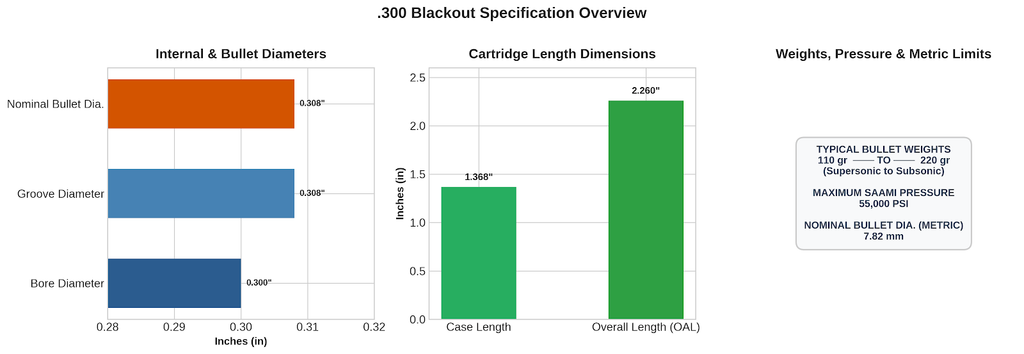
The exact .300 Blackout bullet diameter is 0.308 inches, which converts to 7.82 millimeters. While .300 Blackout ammunition is available with vastly different bullet weights for supersonic and subsonic use, the cartridge’s nominal projectile diameter remains exactly the same across all factory loads. This measurement refers specifically to the width of the bullet itself, which differs slightly from the internal dimensions of the barrel. Specifically, a standard .300 Blackout barrel utilizes a narrower bore diameter of 0.300 inches and a groove diameter of 0.308 inches to ensure a tight gas seal upon firing. The bullet is squeezed into these grooves as it travels down the barrel, trapping the high-pressure expanding gases behind it.
300 Blackout Bullet Diameter
| Specification | .300 Blackout |
| Nominal Bullet Diameter | 0.308 inches |
| Bullet Diameter In Inches | 0.308″ |
| Bullet Diameter In Millimeters | 7.82 mm |
| Groove Diameter | 0.308 inches |
| Bore Diameter | 0.300 inches |
| Typical Bullet Weights | 110 gr to 220 gr |
| Case Length | 1.368 inches |
| Overall Cartridge Length | 2.260 inches |
| Maximum Pressure | 55,000 PSI |
What Is The 300 Blackout Bullet Diameter?
The 300 Blackout bullet diameter is the physical width of the unfired projectile seated in the cartridge case. Developed by Advanced Armament Corporation (AAC) in cooperation with Remington, the cartridge was engineered to fire a .30-caliber bullet from a standard AR-15 platform while maintaining the same 30-round magazine capacity as a 5.56 NATO. The 0.308-inch bullet must be wide enough to securely engage the barrel’s rifling while feeding reliably through standard AR-15 magazines.
300 Blackout Bullet Diameter In Inches
According to the official Sporting Arms and Ammunition Manufacturers’ Institute (SAAMI) specifications, the 300 Blackout bullet diameter in inches is standard at 0.308 inches. SAAMI allows a strict manufacturing tolerance of -0.003″, meaning factory-loaded projectiles can technically measure between 0.305″ and 0.308″, though 0.308″ is the targeted nominal measurement for nearly all standard jacketed ammunition.
300 Blackout Bullet Diameter In Millimeters
For those using metric measurements, the 300 Blackout bullet diameter in mm is 7.82 mm. Because 1 inch equals 25.4 millimeters, multiplying a 0.308-inch bullet by 25.4 yields exactly 7.8232 mm, which rounds to 7.82 mm. The cartridge itself is also designated in metric terms as the 7.62×35mm.
300 Blackout Bullet vs Bore Diameter
A common point of confusion is the difference between the bullet’s width and the barrel’s internal dimensions. The 300 Blackout bore diameter is 0.300 inches. The bore diameter measures the distance across the “lands” (the raised portions of the rifling inside the barrel). The unfired 300 Blackout projectile diameter (0.308″) is deliberately 0.008 inches wider than the bore so the rifling can violently bite into the bullet jacket, imparting the stabilizing spin required for accuracy.
300 Blackout Groove Diameter
The 300 Blackout groove diameter measures exactly 0.308 inches. The groove diameter measures the distance across the deepest cuts inside the rifled barrel. When the 0.308-inch bullet is fired, it expands slightly to completely fill the 0.308-inch grooves. This creates a perfectly tight pressure seal that traps the expanding powder gases directly behind the bullet, preventing velocity loss.
300 Blackout Bullet Weights
While the cartridge diameter is fixed, you can select vastly different projectile masses depending on your application.The 300 Blackout bullet weight ranges from lightweight 110-grain supersonic rounds to heavy 220-grain subsonic rounds. The versatility to shoot heavy, long bullets quietly through a suppressor, or lighter bullets at supersonic speeds, is the hallmark of the cartridge. Changing the weight alters the bullet’s length and velocity, but the diameter remains completely fixed at 0.308 inches.
Bullet Diameter vs Other Cartridges
Shooters must be careful when comparing caliber names, as the mathematical name does not always reflect the exact physical measurement.
| Cartridge | Bullet Diameter | Diameter In mm |
| .300 Blackout | 0.308″ | 7.82 mm |
| .308 Winchester | 0.308″ | 7.82 mm |
| 7.62x39mm | 0.312″ | 7.92 mm |
| .30-30 Winchester | 0.308″ | 7.82 mm |
| 5.56x45mm NATO | 0.224″ | 5.70 mm |
| .300 Winchester Magnum | 0.308″ | 7.82 mm |
Notice that the Soviet 7.62x39mm actually fires a wider 0.312-inch bullet, despite being marketed as a “7.62mm” cartridge, while Western .30-caliber cartridges like the 300 Blackout and .308 Winchester utilize 0.308-inch projectiles.
Bullet Weight
Ammunition manufacturers have developed multiple specialized loads for the 300 Blackout, cleanly split into two distinct categories: supersonic (faster than sound, lighter bullets) and subsonic (slower than sound, heavier bullets).
| Bullet Weight | Example Load | Bullet Type | Advertised Velocity |
| 110 grain | Hornady V-MAX | Polymer Tip | 2,375 fps |
| 125 grain | Barnes TAC-TX | Solid Copper | 2,215 fps |
| 150 grain | Winchester Deer Season XP | Extreme Point | 1,900 fps |
| 200 grain | Sellier & Bellot | FMJ Subsonic | 1,060 fps |
| 220 grain | Remington UMC | OTM Subsonic | 1,015 fps |
Velocities represent typical factory test barrel data, generally from a 16-inch barrel.
Dimensions
To understand how the cartridge safely fits into the standard AR-15 platform alongside standard 5.56 NATO rounds, here are the complete SAAMI-verified 300 Blackout dimensions:
| Dimension | Measurement |
| Bullet Diameter | 0.308″ |
| Groove Diameter | 0.308″ |
| Bore Diameter | 0.300″ |
| Case Length | 1.368″ |
| Overall Length | 2.260″ |
| Base Diameter | 0.376″ |
| Neck Diameter | 0.334″ |
| Rim Diameter | 0.378″ |
| Maximum Pressure (SAAMI) | 55,000 PSI |
300 Blackout vs 308 Winchester
Because both cartridges share an exact 0.308-inch bullet diameter and are often used in modern sporting rifles, many shooters wonder how the 300 Blackout compares to the venerable .308 Winchester.
Despite sharing a bullet diameter, they are drastically different cartridge designs:
- Platform:The 300 Blackout was designed to fit inside an AR-15 platform utilizing standard 5.56 magazines. The .308 Winchester is a much larger, full-power rifle cartridge that requires the larger AR-10 platform (or standard long/short action bolt rifles).
- Case Dimensions:The .308 Winchester has a much longer case (2.015 inches) compared to the 300 Blackout’s highly compact case (1.368 inches).
- Powder and Velocity: Because of its massive case capacity, the .308 Winchester holds significantly more powder, driving the exact same 150-grain 0.308″ bullet roughly 900 feet-per-second faster than the 300 Blackout.
300 Blackout Bullet Diameter: Exact Measurement
The exact .300 Blackout bullet diameter is 0.308 inches, or 7.82 millimeters.
While the actual projectile measures 0.308 inches across, it is forcefully driven through a barrel with a 0.300-inch bore diameter and a 0.308-inch groove diameter. This intentional sizing discrepancy forces the copper jacket of the bullet to squeeze tightly into the barrel’s rifling grooves. This physical engagement creates a perfect pressure seal behind the bullet, preventing the 55,000 PSI of expanding gases from escaping past the projectile while simultaneously ensuring the bullet stabilizes in flight.
FAQs
What is the bullet diameter of 300 Blackout?
The nominal bullet diameter is 0.308 inches.
What is 300 Blackout bullet diameter in mm?
In metric measurements, the diameter translates to 7.82 mm.
Is 300 Blackout the same bullet as 308?
Yes. Both the 300 Blackout and the .308 Winchester utilize the exact same 0.308-inch diameter projectiles, though the brass casings that hold them are completely different sizes.
What is the bore diameter of 300 Blackout?
The barrel’s internal bore diameter (measured land-to-land) is 0.300 inches.
What is the groove diameter of 300 Blackout?
The barrel’s internal groove diameter (measured groove-to-groove) is 0.308 inches.
What bullet weights are available for 300 Blackout?
Factory loads typically range from lightweight 110-grain supersonic defense rounds up to extremely heavy 220-grain subsonic rounds built for suppressed shooting.
Can you use 5.56 magazines for 300 Blackout?
Yes. The 300 Blackout shares a base diameter (0.376″) and rim diameter (0.378″) identical to the 5.56 NATO. Because of this, it feeds perfectly from standard AR-15 magazines without any modification or loss in capacity.
Is 300 Blackout a 30 caliber?
Yes. The cartridge utilizes a standard .30-caliber (0.308″) bullet.
How does 300 Blackout bullet diameter compare with 7.62x39mm?
The 300 Blackout bullet diameter is 0.308 inches, making it slightly narrower than the traditional Soviet 7.62x39mm bullet, which measures 0.312 inches in diameter.