A Bullet Trajectory Chart By Caliber is a comprehensive data table that displays the exact vertical bullet drop of different ammunition types at various distances. Shooters use this precise ballistic information to understand how gravity affects their specific cartridge from the muzzle out to extended ranges. Comparing these trajectory values helps hunters and target shooters select the perfect caliber for their specific shooting needs. Understanding this data ensures better accuracy and ethical shot placement at unknown distances.
Table of Contents [Click to open]
Bullet Trajectory Chart By Caliber
| Caliber | Typical Bullet Weight | Muzzle Velocity | 100 Yard Drop | 200 Yard Drop | 300 Yard Drop | 400 Yard Drop | 500 Yard Drop | 600 Yard Drop | Typical Ballistic Coefficient | Recommended Zero Distance |
| 22 LR | 40 Grains | 1070 FPS | 5.5 Inches | 43.0 Inches | Not Applicable | Not Applicable | Not Applicable | Not Applicable | 0.120 | 50 Yards |
| 22 WMR | 40 Grains | 1910 FPS | 0.0 Inches | 16.5 Inches | 54.0 Inches | Not Applicable | Not Applicable | Not Applicable | 0.110 | 100 Yards |
| 204 Ruger | 32 Grains | 4225 FPS | 0.0 Inches | 1.4 Inches | 6.2 Inches | 15.5 Inches | 31.0 Inches | 56.0 Inches | 0.210 | 100 Yards |
| 223 Remington | 55 Grains | 3240 FPS | 0.0 Inches | 2.8 Inches | 11.5 Inches | 28.0 Inches | 55.0 Inches | 95.0 Inches | 0.255 | 100 Yards |
| 22 250 Remington | 50 Grains | 3800 FPS | 0.0 Inches | 1.8 Inches | 7.5 Inches | 18.0 Inches | 35.0 Inches | 60.0 Inches | 0.235 | 100 Yards |
| 243 Winchester | 95 Grains | 3100 FPS | 0.0 Inches | 2.4 Inches | 9.8 Inches | 23.0 Inches | 43.5 Inches | 73.0 Inches | 0.400 | 100 Yards |
| 25 06 Remington | 117 Grains | 2990 FPS | 0.0 Inches | 2.7 Inches | 11.0 Inches | 25.5 Inches | 47.0 Inches | 78.0 Inches | 0.390 | 100 Yards |
| 6.5 Creedmoor | 143 Grains | 2700 FPS | 0.0 Inches | 3.8 Inches | 13.5 Inches | 29.8 Inches | 53.5 Inches | 85.5 Inches | 0.625 | 100 Yards |
| 260 Remington | 130 Grains | 2820 FPS | 0.0 Inches | 3.2 Inches | 12.0 Inches | 26.5 Inches | 48.0 Inches | 76.5 Inches | 0.510 | 100 Yards |
| 270 Winchester | 130 Grains | 3060 FPS | 0.0 Inches | 2.6 Inches | 10.2 Inches | 23.5 Inches | 44.0 Inches | 73.5 Inches | 0.460 | 100 Yards |
| 280 Ackley Improved | 162 Grains | 2850 FPS | 0.0 Inches | 3.1 Inches | 11.4 Inches | 25.0 Inches | 44.5 Inches | 71.0 Inches | 0.615 | 100 Yards |
| 7mm 08 Remington | 140 Grains | 2800 FPS | 0.0 Inches | 3.4 Inches | 12.8 Inches | 28.5 Inches | 52.0 Inches | 84.5 Inches | 0.485 | 100 Yards |
| 7mm Remington Magnum | 162 Grains | 2950 FPS | 0.0 Inches | 2.8 Inches | 10.5 Inches | 23.2 Inches | 41.5 Inches | 66.5 Inches | 0.625 | 100 Yards |
| 308 Winchester | 168 Grains | 2650 FPS | 0.0 Inches | 4.5 Inches | 16.0 Inches | 35.5 Inches | 65.0 Inches | 105.0 Inches | 0.462 | 100 Yards |
| 30 06 Springfield | 180 Grains | 2700 FPS | 0.0 Inches | 4.2 Inches | 14.8 Inches | 32.5 Inches | 58.5 Inches | 93.5 Inches | 0.500 | 100 Yards |
| 300 Winchester Magnum | 180 Grains | 2960 FPS | 0.0 Inches | 3.0 Inches | 11.5 Inches | 25.0 Inches | 45.0 Inches | 72.0 Inches | 0.507 | 100 Yards |
| 300 PRC | 212 Grains | 2860 FPS | 0.0 Inches | 3.1 Inches | 11.2 Inches | 24.2 Inches | 42.5 Inches | 66.8 Inches | 0.673 | 100 Yards |
| 338 Lapua Magnum | 250 Grains | 2860 FPS | 0.0 Inches | 3.0 Inches | 11.0 Inches | 23.8 Inches | 42.0 Inches | 66.5 Inches | 0.648 | 100 Yards |
| 35 Whelen | 200 Grains | 2675 FPS | 0.0 Inches | 4.6 Inches | 16.5 Inches | 37.0 Inches | 68.0 Inches | 112.0 Inches | 0.300 | 100 Yards |
| 50 BMG | 750 Grains | 2820 FPS | 0.0 Inches | 2.8 Inches | 10.2 Inches | 22.0 Inches | 38.0 Inches | 59.5 Inches | 1.050 | 100 Yards |
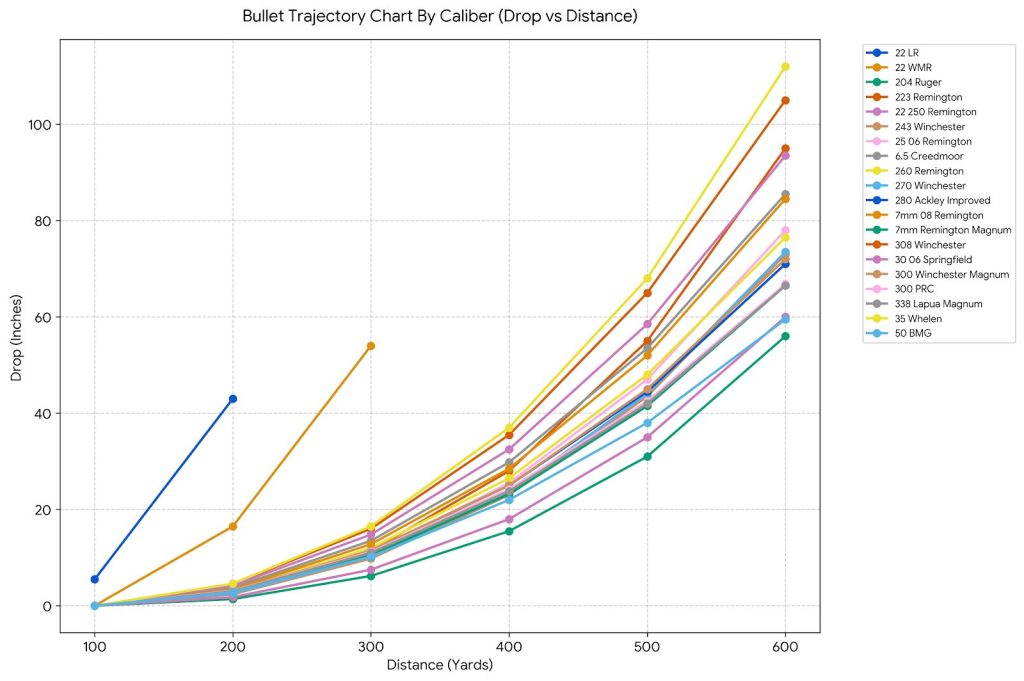
Readers should compare trajectory between calibers by examining the drop values at their maximum intended shooting distance to determine which cartridge requires the least elevation adjustment. A smaller number at six hundred yards indicates a flatter shooting cartridge that provides a wider margin for error when estimating range in the field.
Understanding The Bullet Trajectory Chart
Fastest Shooting Calibers
The fastest shooting calibers rely on light bullets pushed by massive powder charges to achieve extreme velocity. This combination creates a very flat Caliber Trajectory Comparison at normal hunting distances.
Looking at the data table above reveals that the 204 Ruger leads the pack in pure speed. It launches a thirty two grain bullet at over four thousand two hundred feet per second.
This incredible speed means the bullet reaches the target before gravity can pull it downward significantly. Target shooters love this performance because it requires almost zero holdover at three hundred yards.
The 22 250 Remington is another classic example of a blazing fast varmint cartridge. It sends a fifty grain projectile at three thousand eight hundred feet per second.
These hyper velocity cartridges are devastating on small game and coyotes. They offer the flattest trajectory inside four hundred yards compared to heavier hunting rounds.
Best Long Range Calibers
Identifying the best options for extended distances requires studying the Long Range Bullet Drop data carefully. Velocity alone cannot defeat gravity and wind over extreme distances.
The 300 PRC and 338 Lapua Magnum dominate the chart when looking past five hundred yards. These heavy projectiles retain their speed beautifully due to their massive aerodynamic efficiency.
While a 204 Ruger starts faster, it bleeds velocity quickly because of poor aerodynamics. A 300 PRC starts slower but cuts through the air like a needle.
By six hundred yards the 300 PRC only drops sixty six point eight inches. This outstanding performance makes it a favorite among competitive target shooters.
A proper Long Range Trajectory Chart proves that heavy and sleek bullets win the distance game. High ballistic coefficients matter much more than initial muzzle velocity at these ranges.
Best Hunting Calibers
Evaluating a Bullet Drop Chart By Caliber is crucial for hunters who want to ensure clean and ethical shots. Hunting environments rarely offer perfectly measured distances to the target.
The 270 Winchester has remained a premier hunting cartridge for decades precisely because of its predictable trajectory. Dropping only ten point two inches at three hundred yards allows hunters to hold dead on a deer chest cavity.
The 30 06 Springfield shows slightly more drop at the same distance with fourteen point eight inches. However it delivers significantly more energy upon impact than the lighter rounds.
Modern hunters often choose the 7mm Remington Magnum for its excellent balance of flat trajectory and hitting power. It beats the 30 06 Springfield by several inches at four hundred yards.
Choosing the right hunting caliber means finding the perfect intersection of bullet drop and retained energy. The trajectory chart proves that magnum calibers provide the largest margin of error for range estimation.
Bullet Drop Comparison
A direct Bullet Drop By Caliber comparison reveals fascinating differences between cartridge families. The data clearly shows how bullet weight and speed interact.
Compare the lightweight 223 Remington to the heavy 308 Winchester at four hundred yards. The 223 Remington drops twenty eight inches while the 308 Winchester drops thirty five point five inches.
The lighter bullet actually shoots flatter at medium ranges due to higher initial velocity. However the heavier bullet carries much more kinetic energy to the target.
When comparing magnum calibers the differences become even more apparent. The 300 Winchester Magnum shoots significantly flatter than the standard 308 Winchester across all distances.
Understanding these drop comparisons helps shooters set realistic expectations for their chosen rifle platform. The data prevents hunters from attempting shots beyond their cartridge capabilities.
Best Overall Trajectory
Finding the best overall trajectory requires balancing short range flatness with long range aerodynamic efficiency. The data points toward modern cartridge designs as the clear winners.
The 7mm Remington Magnum offers an incredible blend of speed and sleek bullet design. It shoots incredibly flat out to three hundred yards and maintains excellent performance out to six hundred yards.
Another fantastic option is the 280 Ackley Improved which rivals magnum performance without the heavy recoil. It only drops seventy one inches at six hundred yards.
For military and extreme long distance applications the 50 BMG possesses an almost unbelievable trajectory profile. Its massive seven hundred fifty grain bullet only drops fifty nine point five inches at six hundred yards.
The best overall trajectory ultimately depends on whether the shooter prioritizes zero recoil or maximum energy downrange. The trajectory table provides the objective truth needed to make that decision.
Trajectory By Popular Caliber
223 Remington Trajectory
The 223 Remington is the most popular centerfire rifle cartridge in America and serves primarily for target shooting and varmint hunting. Its trajectory is defined by high initial speed followed by rapid deceleration.
At two hundred yards the bullet only drops two point eight inches which makes it incredibly easy to shoot accurately. Varmint hunters can practically ignore bullet drop inside this distance.
However the light fifty five grain bullet loses steam quickly when pushed past three hundred yards. By five hundred yards the drop reaches a significant fifty five inches.
This steep drop curve at distance limits the 223 Remington for extreme long distance engagements. Wind also plays a major factor since the lightweight projectile gets pushed around easily.
Despite these limitations it remains an exceptionally flat shooting cartridge for typical practical distances. The low recoil makes spotting your own trace and impacts very easy.
243 Winchester Trajectory
The 243 Winchester represents the perfect bridge between a varmint cartridge and a medium game hunting round. It achieves impressive velocity while firing bullets heavy enough for deer hunting.
Looking at the Rifle Trajectory Chart shows a very forgiving curve inside three hundred yards. A drop of only nine point eight inches at three hundred yards is phenomenal for a standard short action cartridge.
This flat trajectory makes the 243 Winchester an excellent choice for youth hunters and beginners. It requires very little mental math or holdover when shooting across a typical field.
At five hundred yards the drop is forty three point five inches which is vastly superior to the 308 Winchester. The higher velocity pays massive dividends at these medium to long ranges.
Many experienced hunters consider the 243 Winchester to be one of the best point and shoot cartridges ever designed. The numbers completely validate this enduring reputation in the hunting community.
308 Winchester Trajectory
The 308 Winchester is legendary for its accuracy and barrel life but it is not known for being a flat shooting cartridge. Its trajectory is best described as an arched rainbow compared to modern high velocity rounds.
With a standard one hundred sixty eight grain bullet the drop at three hundred yards is sixteen inches. This requires a dedicated scope adjustment or a deliberate holdover technique.
At six hundred yards the bullet plummets one hundred five inches which is among the most severe drops on the chart. Engaging targets at this distance requires exact range estimation and precise dial adjustments.
Despite this plunging trajectory the 308 Winchester remains a favorite among police snipers and target shooters. Its predictability and consistency matter more than absolute flatness in many tactical scenarios.
Knowing your Rifle Bullet Drop Chart is absolutely mandatory if you intend to shoot a 308 Winchester past three hundred yards. Without precise data you will miss your target completely.
6.5 Creedmoor Trajectory
The 6.5 Creedmoor was specifically engineered to cheat the wind and defeat gravity over long distances. It accomplishes this by firing long and incredibly aerodynamic projectiles at moderate velocities.
Inside two hundred yards its trajectory is largely identical to older cartridges like the 308 Winchester. The real magic happens when the bullet travels past four hundred yards.
Because the bullet retains its velocity so well it actually overtakes faster cartridges at extreme distances. By six hundred yards it only drops eighty five point five inches compared to the one hundred five inches of the 308 Winchester.
This efficiency allows shooters to use less powder and experience less recoil while still achieving superior ballistic performance. It represents a paradigm shift in how modern shooters view trajectory.
The 6.5 Creedmoor proves that a high ballistic coefficient is the ultimate weapon against gravity. It has completely changed the landscape of precision rifle competition.
270 Winchester Trajectory
The 270 Winchester is a classic American hunting cartridge that built its reputation on shooting flat and hitting hard. Decades of field use have proven its effectiveness on medium to large game.
Its standard one hundred thirty grain load leaves the muzzle at over three thousand feet per second. This blistering speed results in a minuscule two point six inch drop at two hundred yards.
Hunters love this cartridge because they can zero their rifle and simply aim directly at the vitals out to three hundred yards. The ten point two inch drop at that distance easily keeps the bullet inside the kill zone of an elk or large deer.
At five hundred yards the bullet drops forty four inches which is still very manageable for experienced marksmen. It consistently outperforms heavier standard caliber rifles in the trajectory department.
The 270 Winchester remains the benchmark by which all other flat shooting hunting cartridges are judged. The math absolutely supports its legendary status among sportsmen.
300 Winchester Magnum Trajectory
The 300 Winchester Magnum is a powerhouse cartridge designed to deliver heavy bullets across vast canyons and clearcuts. It provides magnum velocity and exceptional terminal performance.
Pushing a one hundred eighty grain bullet at nearly three thousand feet per second generates a remarkably flat trajectory. The drop at four hundred yards is only twenty fifty inches.
This flat trajectory combined with massive retained energy makes it a premier cartridge for hunting dangerous game or tough animals like moose. It significantly reduces the guesswork during high stress shooting situations.
At six hundred yards the drop is seventy two inches which easily beats the standard calibers. Military snipers utilize this exact trajectory profile to engage targets far beyond the reach of standard infantry rifles.
Managing the recoil is the only real penalty for utilizing this fantastic trajectory curve. For those who can handle the kick it offers a nearly perfect hunting trajectory.
338 Lapua Magnum Trajectory
The 338 Lapua Magnum was developed from the ground up as a dedicated military long distance sniper cartridge. Its trajectory is optimized for engaging targets at one thousand yards and beyond.
Firing a massive two hundred fifty grain bullet it shrugs off wind deflection like a freight train. The initial trajectory is very flat with only eleven inches of drop at three hundred yards.
At six hundred yards the bullet drops sixty six point five inches which is remarkably similar to the brand new 300 PRC. The sheer mass of the bullet helps it maintain momentum through the atmosphere.
This cartridge requires specialized optics with massive amounts of internal elevation adjustment to take advantage of its range. A standard hunting scope cannot dial enough elevation for the distances this cartridge can reach.
The 338 Lapua Magnum demonstrates what happens when engineers prioritize absolute ballistic supremacy over cost and recoil. It is a true marvel of modern long range ballistics.
50 BMG Trajectory
The 50 BMG is an anti materiel cartridge that dwarfs every other round on the trajectory chart. Its ballistic performance is almost beyond the comprehension of standard rifle shooters.
Propelling a seven hundred fifty grain projectile at two thousand eight hundred feet per second generates terrifying kinetic energy. The bullet boasts a ballistic coefficient over one point zero zero zero.
This incredible aerodynamic efficiency results in the flattest drop at six hundred yards on our entire chart. Fifty nine point five inches of drop for a bullet this massive is simply spectacular.
The bullet is barely slowing down at distances where standard cartridges are falling out of the sky. It maintains supersonic flight well past one mile in typical atmospheric conditions.
While completely impractical for normal hunting applications the 50 BMG stands alone at the pinnacle of ballistic performance. Its trajectory chart reads like science fiction compared to normal rifles.
Factors That Affect Bullet Trajectory
Bullet Weight
Bullet weight plays a primary role in determining how quickly a projectile accelerates and decelerates. Lighter bullets achieve higher initial velocities which creates a very flat trajectory at short ranges.
Heavier bullets launch slower but possess greater momentum to push through air resistance. This momentum allows heavy bullets to shoot flatter at extreme long distances.
Shooters must balance bullet weight against their intended target distance to achieve the best trajectory. Selecting the wrong weight for the application guarantees poor ballistic performance.
A heavy bullet fired from a short barrel will have a completely different trajectory than the exact same bullet fired from a long barrel. Weight is just one piece of the ballistic puzzle.
Understanding this relationship helps shooters interpret a Bullet Drop Chart By Caliber accurately. No two bullet weights will ever share the exact same drop profile.
Muzzle Velocity
Muzzle velocity is the initial speed at which the bullet exits the rifle barrel. This speed determines how long the bullet is exposed to the downward pull of gravity before reaching the target.
Higher velocity strictly equals less time in flight which directly translates to less vertical drop. This is why hyper velocity varmint cartridges appear so impressive on short range charts.
However high velocity often comes at the cost of accelerated barrel wear and increased recoil. Pushing bullets too fast can also degrade accuracy and destroy the projectile in mid air.
Velocity is not a constant value and changes based on ammunition temperature and powder lot variations. Serious shooters use chronographs to measure their exact velocity rather than relying on box numbers.
Plugging your true muzzle velocity into a ballistic calculator is the only way to build an accurate personal trajectory chart. Factory numbers are only a starting point for real world application.
Ballistic Coefficient
The ballistic coefficient is a mathematical number that represents how efficiently a bullet cuts through the air. A higher number indicates superior aerodynamics and less drag during flight.
Bullets with high ballistic coefficients retain their velocity much better than blunt or flat nosed bullets. This velocity retention leads directly to a flatter trajectory at extended distances.
When comparing a 30 30 Winchester to a 6.5 Creedmoor the difference in aerodynamic efficiency is massive. The blunt hunting bullet loses speed rapidly and drops sharply past two hundred yards.
Modern bullet designers spend countless hours utilizing Doppler radar to perfect projectile shapes and improve these coefficients. The transition to long sleek bullets has revolutionized precision rifle shooting.
If your goal is hitting targets past five hundred yards a high ballistic coefficient is absolutely mandatory. It is the single most important factor for extreme long distance trajectory.
Wind
Wind is the invisible force that destroys perfectly calculated trajectory charts in the real world. While gravity is a constant downward force wind can push the bullet horizontally in any direction.
A strong headwind will actually increase atmospheric drag and cause the bullet to drop faster than the chart predicts. Conversely a strong tailwind can make a bullet strike higher than expected on the target.
Crosswinds are the most difficult environmental factor for a marksman to read and compensate for in the field. The wind speed can vary dramatically between the muzzle and the target hundreds of yards away.
High velocity bullets with high ballistic coefficients suffer less wind deflection because they reach the target faster. Minimizing time in flight is the best defense against unpredictable wind gusts.
No Bullet Trajectory Chart By Caliber is complete without a corresponding wind drift table. Ignoring the wind guarantees missed shots regardless of your elevation calculations.
Altitude
Altitude directly affects bullet trajectory by changing the density of the air the bullet must travel through. Higher altitudes feature thinner air which creates significantly less aerodynamic drag on the projectile.
A rifle zeroed at sea level will shoot noticeably higher when taken on an elk hunt in the high mountains. The bullet simply faces less resistance and retains its velocity longer.
This atmospheric change can alter your drop chart by several inches at four hundred yards. Long distance shooters must update their ballistic data when traveling to different elevations.
The exact same factory ammunition will display a flatter trajectory in Colorado than it will in Florida. Atmospheric pressure dictates performance just as much as muzzle velocity does.
Modern ballistic solvers use station pressure to constantly update trajectory profiles in real time. Entering the correct altitude is critical for first round impacts at distance.
Temperature
Temperature alters bullet trajectory through two distinct scientific mechanisms that shooters must account for. First the ambient air temperature changes the air density much like altitude does.
Hot air is less dense than cold air which allows the bullet to fly flatter and faster on a warm day. Firing a rifle in freezing conditions guarantees a steeper trajectory curve due to thicker air.
Second temperature directly affects the burn rate of the gunpowder inside the cartridge case. Hot powder burns faster and generates more pressure which creates higher muzzle velocities.
Leaving ammunition sitting in direct sunlight can spike chamber pressures and radically alter your zero. Consistency requires keeping your ammunition at a stable temperature before shooting.
Many modern powder manufacturers formulate their propellants to be temperature stable to mitigate this issue. However absolute immunity to temperature shifts does not exist in the world of ballistics.
Barrel Length
Barrel length dictates how long the expanding powder gases can push against the base of the bullet. Longer barrels generally produce higher muzzle velocities which results in a flatter trajectory.
Cutting a barrel down from twenty four inches to sixteen inches will significantly reduce the speed of the projectile. This velocity loss forces the shooter to dial more elevation to reach the same target.
Different calibers react to barrel length changes differently based on their specific case capacity and powder burn rates. A large magnum cartridge requires a long barrel to burn all of its powder efficiently.
Shortening a 308 Winchester has much less impact on trajectory than shortening a 300 Winchester Magnum. The magnum cartridge becomes horribly inefficient when fired from a compact rifle.
When reviewing factory ballistic data always note the test barrel length used by the manufacturer. If your rifle is shorter than the test barrel your actual bullet drop will be more severe.
Zero Distance
Your chosen zero distance serves as the baseline foundation for your entire trajectory chart. The zero distance is the exact yardage where the bullet intersects your line of sight perfectly.
If you change your zero distance every other number on your ballistic chart will immediately change. A Trajectory Chart 100 Yard Zero looks vastly different from a Trajectory Chart 200 Yard Zero.
A closer zero distance usually results in more pronounced bullet drop at extended ranges. A further zero distance requires the bullet to arc higher above your line of sight during mid range flight.
Selecting the optimal zero depends entirely on the size of your target and your typical shooting environment. There is no single perfect zero distance for every rifle and every caliber.
Understanding the geometry of your zero distance allows you to manipulate the trajectory curve to your advantage. It is the one variable the shooter has complete control over before pulling the trigger.
Best Zero Distance By Caliber
100 Yard Zero
A one hundred yard zero is the gold standard for precision rifle shooters and law enforcement snipers. This distance allows for absolute precision without worrying about the bullet striking high at closer ranges.
With a Trajectory Chart 100 Yard Zero the shooter knows the bullet will never travel above their line of sight. Every adjustment made for a further target requires dialing the scope up or holding above the target.
This zero is ideal for heavy calibers like the 308 Winchester or 6.5 Creedmoor used in target competitions. It simplifies the mental math required to engage targets at varying distances.
It is also the perfect zero distance for rimfire cartridges like the 22 WMR due to their limited effective range. Setting a further zero for these small calibers creates unacceptable mid range trajectory arcs.
Most modern ballistic calculator apps default to a one hundred yard zero because it is mathematically clean and easy to verify. It remains the most popular zero for anyone using exposed scope turrets.
200 Yard Zero
A two hundred yard zero is traditionally the most recommended setup for general purpose hunting rifles. This distance takes advantage of the natural flat shooting characteristics of modern hunting cartridges.
When using a Trajectory Chart 200 Yard Zero a fast cartridge like the 270 Winchester will strike about one point five inches high at one hundred yards. This minor mid range rise is completely negligible when aiming at the vital zone of a deer.
The primary benefit is that the hunter can hold perfectly dead center on a target anywhere from the muzzle out to nearly three hundred yards. This concept is known as Maximum Point Blank Range.
Calibers like the 30 06 Springfield and 7mm 08 Remington perform exceptionally well with this zero distance. It eliminates the need to adjust scope dials during a fast paced hunting encounter.
For hunters who refuse to twist scope turrets in the field the two hundred yard zero is undeniably the best option. It provides the perfect balance of confidence and simplicity in the woods.
300 Yard Zero
A three hundred yard zero is a specialized setup reserved almost exclusively for ultra magnum calibers and open country hunting. It is designed for situations where a close range shot is highly unlikely.
Using this zero with a cartridge like the 300 Winchester Magnum or 300 PRC pushes the Maximum Point Blank Range past four hundred yards. The bullet will arc several inches high at mid range distances.
Shooters must be acutely aware of this mid range rise to avoid shooting entirely over the back of a target at one hundred fifty yards. It requires extreme discipline and knowledge of the specific Caliber Trajectory Comparison.
This aggressive zero is popular among western sheep hunters and antelope hunters who face vast expanses of open prairie. It maximizes the flat shooting potential of heavy magnum cartridges.
Standard calibers like the 308 Winchester should never use a three hundred yard zero. The mid range trajectory arc becomes far too severe and causes missed shots at normal hunting distances.
Flattest Shooting Rifle Calibers
The title of Flattest Shooting Caliber depends entirely on the distance being measured. At short ranges hyper velocity varmint cartridges rule the world.
The 204 Ruger and 22 250 Remington offer the absolute flattest trajectory inside of three hundred yards. Their blazing speed defeats gravity effortlessly across typical farm fields.
However as the distance increases air resistance punishes these lightweight projectiles severely. For medium range performance the magnum hunting cartridges take over the top spots.
The 7mm Remington Magnum and 300 Winchester Magnum dominate the charts from three hundred to five hundred yards. Their heavier bullets retain enough energy to push through the atmosphere while still flying remarkably flat.
For extreme long range shooting beyond one thousand yards the 300 PRC and 338 Lapua Magnum are the undisputed champions. Their massive aerodynamic profiles allow them to glide through the air and deliver the flattest trajectory when it matters most.
Frequently Asked Questions
What is a bullet trajectory chart?
A bullet trajectory chart is a mathematical table that displays exactly how far a bullet drops over specific distances. It helps shooters visualize the arched path a projectile takes after leaving the rifle barrel.
Shooters use these charts to determine how much they need to adjust their aim to hit targets far away. Every caliber and specific bullet weight combination requires its own unique chart.
Why do heavier bullets drop less at long range?
Heavier bullets generally have higher ballistic coefficients which means they are more aerodynamic. They retain their initial velocity much better than lighter bullets as they travel through the air.
While a lighter bullet starts faster it slows down rapidly and allows gravity to pull it downward. The heavy bullet maintains its momentum and reaches distant targets faster resulting in less overall vertical drop.
Does a 223 shoot flatter than a 308?
Yes the 223 Remington shoots significantly flatter than the 308 Winchester at standard ranges. The much higher muzzle velocity of the 223 Remington gives it a major advantage out to about four hundred yards.
Past five hundred yards the 308 Winchester begins to show its strength as the lightweight 223 bullet loses its speed. However for typical applications the 223 Remington requires far less elevation adjustment.
How much does a 6.5 Creedmoor drop at 500 yards?
Using a standard one hundred forty three grain match bullet a 6.5 Creedmoor drops approximately fifty three point five inches at five hundred yards with a one hundred yard zero. This drop is incredibly consistent and easy to account for using a modern rifle scope.
This predictable trajectory is precisely why the cartridge dominates precision rifle competitions. It requires less vertical adjustment than older cartridges while producing very little recoil.
What is the best zero distance for deer hunting?
A two hundred yard zero is widely considered the best setup for most deer hunting situations. It allows the hunter to aim directly at the center of the chest from the muzzle out to about two hundred and fifty yards.
This eliminates the need to calculate bullet drop or adjust scope dials when an animal steps out unexpectedly. It relies on the concept of Maximum Point Blank Range to ensure vital hits with minimal thinking.
Does barrel length change the trajectory chart?
Yes barrel length has a major impact on your trajectory chart because it dictates muzzle velocity. A shorter barrel generates less speed which causes the bullet to drop faster over distance.
If your factory ammunition box states a certain trajectory it was likely tested in a twenty four inch barrel. Firing that same ammunition in an eighteen inch barrel will result in significantly more bullet drop.
What is the flattest shooting hunting caliber?
For standard medium game the 270 Winchester and 25 06 Remington are legendary for their flat trajectories. They offer blistering speed and minimal drop without punishing the shooter with heavy recoil.
For large game at extended distances magnum calibers like the 7mm Remington Magnum and 300 PRC shoot the flattest. They combine high velocity with heavy aerodynamic bullets to defeat wind and gravity.
How does wind affect vertical bullet drop?
Wind primarily pushes the bullet horizontally but aerodynamic drag from headwinds and tailwinds can alter vertical drop. A strong headwind slows the bullet down faster which exposes it to gravity longer resulting in more drop.
Additionally spin drift and aerodynamic jump can cause minor vertical shifts depending on wind direction. Precision shooters must account for these complex environmental variables when engaging targets past six hundred yards.
Can I trust the trajectory chart on my ammo box?
The chart printed on a factory ammunition box is only a general estimate and should never be trusted for precision shots. The manufacturer tests their ammunition in perfect laboratory conditions using specific test barrels.
Your exact rifle barrel atmospheric conditions and zero distance will create a completely different drop profile. You must physically shoot your rifle at distance to verify your true ballistic trajectory.
Why do some calibers cross the line of sight twice?
Bullets fire from a barrel that is angled slightly upward relative to the scope straight line of sight. The bullet arcs upward crossing the visual line once at short range before peaking and dropping back down.
It crosses the line of sight a second time on its downward path which is your actual zero distance. This arcing geometry is what allows shooters to hit targets hundreds of yards away.