The .30-06 Springfield, particularly when loaded with a modern 165-grain polymer-tipped boat tail bullet, is a remarkably versatile cartridge for North American big game. This standard factory hunting load produces a muzzle velocity of 2,800 fps and a muzzle energy of 2,871 ft-lbs. Offering an effective hunting range of up to 500 yards on medium game, it boasts the retained energy necessary to take down the best game animals for this caliber: whitetail deer, mule deer, elk, black bear, and wild hogs. With a 200-yard zero, shooters can expect a highly manageable trajectory that requires minimal holdovers at standard hunting distances. Ultimately, the .30-06 Springfield remains the quintessential hunting cartridge, delivering a proven balance of flat trajectory, massive terminal energy, and manageable recoil for hunters across the globe.
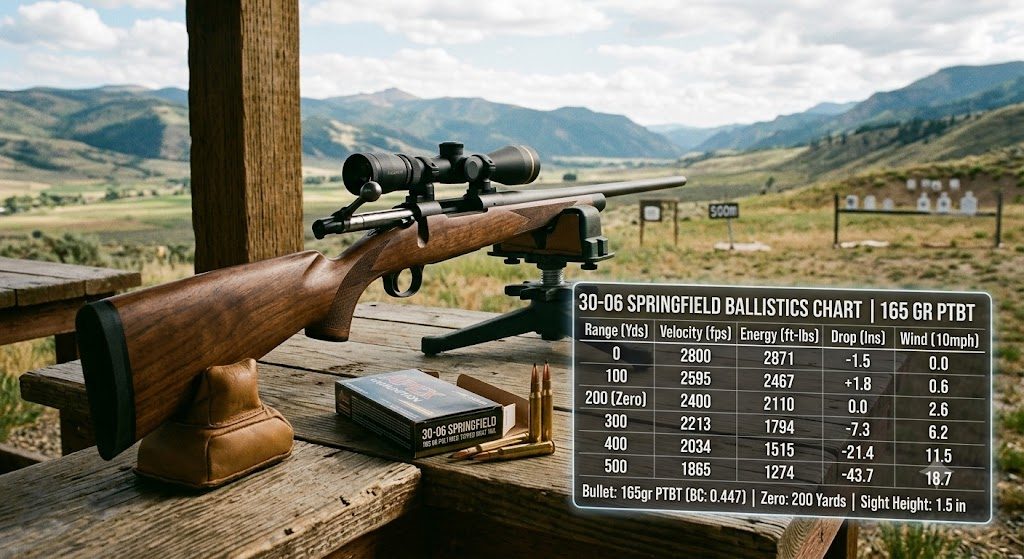
30-06 Ballistics Chart
| Range (Yards) | Velocity (fps) | Energy (ft-lbs) | Drop (inches) | Time of Flight (seconds) | Wind Drift (10 mph) | Remaining Velocity (%) | Remaining Energy (%) |
| Muzzle | 2800 | 2871 | -1.5 | 0.00 | 0.0 | 100% | 100% |
| 25 | 2748 | 2766 | -0.4 | 0.03 | 0.0 | 98% | 96% |
| 50 | 2696 | 2663 | 0.5 | 0.05 | 0.2 | 96% | 93% |
| 75 | 2645 | 2564 | 1.3 | 0.08 | 0.4 | 94% | 89% |
| 100 | 2595 | 2467 | 1.8 | 0.11 | 0.6 | 93% | 86% |
| 125 | 2545 | 2374 | 1.8 | 0.14 | 0.9 | 91% | 83% |
| 150 | 2496 | 2282 | 1.5 | 0.17 | 1.5 | 89% | 79% |
| 175 | 2448 | 2195 | 0.9 | 0.20 | 2.0 | 87% | 76% |
| 200 | 2400 | 2110 | 0.0 | 0.23 | 2.6 | 86% | 73% |
| 225 | 2352 | 2027 | -1.2 | 0.26 | 3.4 | 84% | 71% |
| 250 | 2305 | 1947 | -2.9 | 0.29 | 4.2 | 82% | 68% |
| 275 | 2259 | 1869 | -4.9 | 0.33 | 5.1 | 81% | 65% |
| 300 | 2213 | 1794 | -7.3 | 0.36 | 6.2 | 79% | 62% |
| 325 | 2167 | 1721 | -10.2 | 0.40 | 7.3 | 77% | 60% |
| 350 | 2122 | 1650 | -13.6 | 0.43 | 8.6 | 76% | 57% |
| 375 | 2078 | 1581 | -17.3 | 0.47 | 10.0 | 74% | 55% |
| 400 | 2034 | 1515 | -21.4 | 0.50 | 11.5 | 73% | 53% |
| 425 | 1991 | 1451 | -26.2 | 0.54 | 13.1 | 71% | 51% |
| 450 | 1948 | 1390 | -31.6 | 0.58 | 14.8 | 70% | 48% |
| 475 | 1906 | 1331 | -37.4 | 0.62 | 16.7 | 68% | 46% |
| 500 | 1865 | 1274 | -43.7 | 0.66 | 18.7 | 67% | 44% |
Ballistic Data Specifications:
- Zero distance: 200 Yards
- Bullet BC (G1): 0.447
- Bullet weight: 165 Grains
- Bullet type: Polymer-Tipped Boat Tail (e.g., SST / Ballistic Tip)
- Barrel length: 24 inches
- Sight height: 1.5 inches
1. Overview of the Ammunition
The 165-grain polymer-tipped boat tail .30-06 Springfield load represents the sweet spot for modern North American big game hunting. Sitting squarely between the lightweight 150-grain offerings designed for deer and the heavy 180-grain loads favored for large, tough game like moose, the 165-grain projectile offers unmatched versatility. This factory ammunition is specifically engineered to provide rapid, controlled expansion while maintaining sufficient mass for deep penetration through heavy bone and muscle tissue.
Bullet construction typically features a streamlined polymer tip that serves a dual purpose: increasing the aerodynamic profile to raise the ballistic coefficient and initiating violent expansion upon impact. Underneath the tip, a swaged lead core is often mechanically locked to a tapered copper jacket, ensuring high weight retention. This factory load information translates to a cartridge that can reliably anchor animals at varying distances without excessive meat damage.
Typical rifle platforms for this cartridge include standard long-action bolt rifles, pump-actions, and semi-automatics. Barrels measuring 22 to 24 inches are standard for the .30-06 Springfield, allowing the medium-to-slow burning propellants sufficient time to burn and reach the advertised muzzle velocities. Shooters employing short 20-inch barrels should expect a slight velocity penalty, though terminal performance remains excellent.
2. Understanding the Ballistics Chart
Interpreting the .30-06 ballistics chart is essential for maximizing first-round hits in the field. The table presents a granular look at the projectile’s flight path and energy dispersal from the muzzle out to 500 yards. The Range column provides distances in standard 25-yard increments, allowing hunters to pinpoint exactly what their bullet is doing at highly specific engagement distances.
The Velocity (fps) and Energy (ft-lbs) columns illustrate the raw power of the cartridge. Velocity dictates the shape of the trajectory and the functionality of the bullet upon impact, while energy quantifies the physical force delivered to the target. The Drop (inches) column is arguably the most referenced metric for field shooters, mapping the physical path of the bullet relative to the line of sight based on a 200-yard zero.
Further refining long-range accuracy, the Time of Flight metric helps hunters understand how much lead is required for a moving animal, while Wind Drift calculates lateral bullet displacement in a standard 10 mph full-value crosswind. Finally, the Remaining Velocity (%) and Remaining Energy (%) columns offer a quick reference for the cartridge’s efficiency, showing exactly how much of the original muzzle performance is retained at any given yardage, heavily influencing the effective range of the hunting ammunition.
3. Velocity Performance
Muzzle velocity is the driving force behind a cartridge’s trajectory and terminal ballistics. Launching a 165-grain projectile at 2,800 feet per second puts the .30-06 Springfield firmly in the category of flat-shooting hunting cartridges. This initial speed reduces the arc of the bullet path, making range estimation errors slightly more forgiving than they would be with slower, heavier calibers.
Velocity retention is heavily dependent on the aerodynamic efficiency of the bullet. Thanks to a G1 ballistic coefficient of 0.447, this sleek boat tail design cuts through the atmosphere effectively, retaining 79% of its original speed at 300 yards. Downrange speed directly affects how the bullet performs upon impact. Most modern hunting bullets, especially those with polymer tips, require an impact velocity of at least 1,800 fps to initiate reliable and devastating expansion.
Analyzing the chart reveals that the bullet stays above this critical 1,800 fps threshold out to slightly past 500 yards (1,865 fps at 500 yards). This sustained velocity means the hunter can expect proper terminal performance—mushrooming, energy dump, and wide wound channels—across the entire practical hunting envelope of the cartridge.
4. Energy Performance
Muzzle energy dictates the sheer knockdown capability of a rifle cartridge, and the .30-06 generates a formidable 2,871 foot-pounds (ft-lbs) at the barrel crown. While muzzle figures look impressive on paper, retained energy is the metric that truly defines a cartridge’s lethality at hunting distances. To ensure ethical, clean harvests, the general consensus among hunting professionals is that taking medium game like deer requires roughly 1,000 ft-lbs of energy, while large game like elk requires a minimum of 1,500 ft-lbs.
The .30-06 retains energy exceptionally well. At 200 yards, the projectile still carries over 2,100 ft-lbs—more than enough for any North American animal. At 400 yards, the bullet retains 1,515 ft-lbs, which is 53% of its original muzzle energy. This marks the maximum recommended ethical threshold for engaging elk-sized game with this specific load.
Terminal performance is a direct result of this retained energy combined with bullet construction. When a 165-grain bullet impacts an animal at 300 yards with 1,794 ft-lbs of force, it creates a massive temporary cavity and drives deep through the vitals. The high energy retention guarantees that the bullet will not simply slip through the animal, but will transfer its force destructively, resulting in short tracking jobs and humane harvests.
5. Trajectory and Bullet Drop
Bullet drop is an unavoidable physical reality, but the .30-06 Springfield’s trajectory allows hunters to largely ignore it at common hunting distances. By zeroing the rifle at 200 yards, the shooter maximizes the cartridge’s Point Blank Range. With a 1.5-inch scope height, the bullet rises to a maximum ordinate of just 1.8 inches above the line of sight between 100 and 125 yards before falling back to absolute zero at 200 yards.
This flat bullet path means a hunter can hold dead-center on the vitals of a deer or elk from the muzzle out to approximately 250 yards without needing to adjust the reticle or touch the elevation turret. The total bullet drop at 250 yards is only -2.9 inches, keeping the point of impact well within the 8-inch vital zone of large game.
Once the distance stretches past 300 yards, holdovers become necessary. At 300 yards, the bullet drops 7.3 inches, requiring a modest hold near the top of the animal’s back. At 400 yards, the bullet drops 21.4 inches, and at 500 yards, it plummets 43.7 inches. These long-range limitations demand the use of a laser rangefinder and a ballistic reticle or dialable turrets, as estimating holdovers visually becomes highly error-prone beyond 350 yards.
6. Wind Drift Performance
While many hunters obsess over bullet drop, wind drift often causes more missed shots and poor hits in the field. Gravity is a constant, but wind is highly variable and unpredictable. The ballistics chart calculates deflection based on a standard 10 mph full-value crosswind (blowing precisely at 90 degrees to the bullet’s flight path).
The 165-grain boat tail projectile is relatively sleek, but atmospheric displacement is unavoidable. At 100 yards, the wind effects are negligible, pushing the bullet a mere 0.6 inches off course. However, because wind drift increases exponentially rather than linearly, practical field implications change dramatically as distances stretch. By 300 yards, the drift jumps to 6.2 inches. If a hunter fails to account for a 10 mph crosswind at 300 yards, a perfectly aimed heart shot will land in the guts or miss entirely.
Long-range considerations require strict wind calls. At 500 yards, that same 10 mph breeze pushes the heavy .30 caliber bullet 18.7 inches off course. For hunters operating in open terrain like the American West, where winds frequently exceed 15 or 20 mph, mastering wind reading is critical. This load’s high ballistic coefficient provides an advantage over flat-base or round-nose bullets, but shooters must still rely on solid wind estimation to maintain ethical accuracy at long ranges.
7. Effective Hunting Range
The effective hunting range of the 165-grain .30-06 load is dictated by two factors: energy for terminal performance and velocity for bullet expansion. Because the cartridge maintains both 1,000 ft-lbs of energy and 1,800 fps of velocity past the 500-yard mark, it is mechanically capable of taking whitetail and mule deer at that distance.
For larger, tougher animals, the parameters shrink. When elk hunting, experts demand a minimum of 1,500 ft-lbs of energy to ensure the projectile can smash through heavy shoulders and deep chest cavities. The chart shows energy dropping below this 1,500 ft-lb threshold just past 400 yards, making 400 yards the maximum ethical range for elk. Black bear present similar physiological challenges, and hunters should restrict shots on large boars to the 350-400 yard window.
Feral hogs can be taken effectively out to 500 yards, provided the shooter does their part. However, a cartridge’s mechanical capability must never override the shooter’s maximum ethical range. The limiting factor in the field is rarely the .30-06 cartridge itself; it is the shooter’s ability to accurately place the bullet under field conditions, manage recoil, read the wind, and account for steep shot angles.
8. Accuracy and Real-World Performance
Modern factory ammunition has largely bridged the gap with hand-loaded cartridges, bringing exceptional accuracy to off-the-shelf purchases. High-quality .30-06 Springfield ammunition loaded with polymer-tipped bullets routinely delivers 1 MOA (Minute of Angle) accuracy—grouping under 1 inch at 100 yards—out of quality, modern rifles.
Rifle compatibility plays a major role in extracting this accuracy. The .30-06 is chambered in virtually every action type, but bolt-action rifles featuring free-floated barrels and crisp triggers will yield the tightest groups. The standard 22 to 24-inch barrel length ensures the powder column burns entirely before the bullet exits the muzzle, providing uniform velocities that minimize vertical stringing on the target at long range.
Shooter considerations are equally vital for real-world performance. The .30-06 generates approximately 20 ft-lbs of free recoil energy in an 8-pound rifle. While this is entirely manageable for experienced shooters, it can induce flinching in novices, degrading accuracy. Proper shooting fundamentals, combined with a recoil pad or muzzle brake, will ensure hunters can capitalize on the cartridge’s inherent precision from field shooting positions, where standard bench-rest stability is rarely available.
9. Advantages and Limitations
The primary advantage of the .30-06 Springfield is its unparalleled versatility. A single rifle can be utilized for every big game animal on the North American continent simply by selecting the appropriate bullet weight. The 165-grain load specifically shines by offering a flatter trajectory than the heavy 180-grain options and deeper penetration than the 150-grain offerings. Furthermore, the global ubiquity of the cartridge means hunters will easily find replacement boxes of factory ammunition at any sporting goods store if luggage gets lost during travel.
Despite its legendary status, the cartridge is not without limitations. Operating at long-action receiver lengths means the rifles are slightly heavier and have longer bolt throws than short-action counterparts like the .308 Winchester or 6.5 Creedmoor.
Additionally, the .30-06 cannot match the flat trajectories and wind-bucking capabilities of modern magnums like the .300 Winchester Magnum or fast 7mm cartridges at extreme distances (beyond 600 yards). In scenarios where shots regularly exceed a quarter-mile, a magnum caliber will provide a wider margin of error. However, for 95% of real-world hunting situations occurring inside 400 yards, the .30-06 is virtually impossible to outclass.
10. Who Should Choose This Ammunition?
This 165-grain .30-06 factory load is the ultimate choice for the pragmatic, one-rifle hunter. It caters to the individual who refuses to clutter their gun safe with niche calibers, instead opting for a single, reliable platform to handle everything from dense-woods whitetails to cross-canyon elk.
Ideal hunters for this cartridge are those who value consistent terminal ballistics and broad availability over trendy, modern cartridge releases. The recommended shooting distances are highly practical; it excels inside 300 yards where point-and-shoot simplicity dominates, yet it possesses the ballistic credentials to ethically stretch out to 400 or 500 yards if the situation demands.
The overall value of this ammunition lies in its proven track record. When compared to similar factory loads like the .308 Winchester, the .30-06 offers an additional 100 to 150 fps, translating to more energy and less bullet drop downrange. It represents the perfect marriage of power, accuracy, and manageable recoil, ensuring its status as a top-tier hunting cartridge will remain unchallenged for generations to come.