The main difference between the 20mm cannon cartridge and the .50 BMG (Browning Machine Gun) is their classification, physical scale, and intended application. The .50 BMG is an anti-material heavy machine gun and precision sniper cartridge firing a .510-inch solid metal projectile designed to pierce light armor and disable enemy equipment, while the 20mm is an explosive-payload autocannon round designed for fighter jets, anti-aircraft systems, and heavy military vehicles to destroy aircraft, fortifications, and hardened structures.
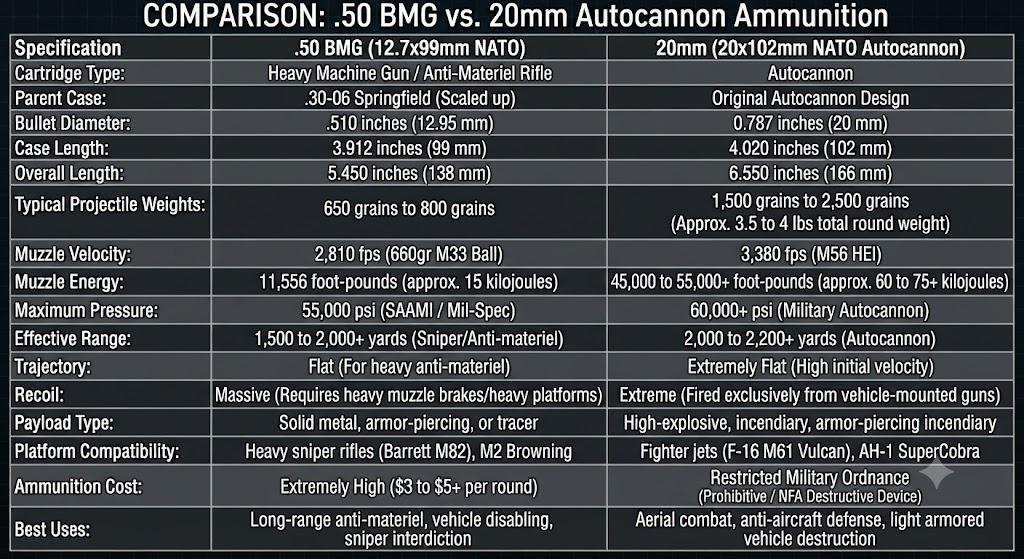
20mm vs .50 BMG Comparison Table
To accurately compare these two military powerhouses, we must examine their physical dimensions, pressure limits, and baseline performance. The data below represents standard military-issue capabilities, comparing the standard .50 BMG M33 ball load against a standard 20x102mm NATO high-explosive incendiary (HEI) autocannon round.
| Specification | .50 BMG (12.7x99mm NATO) | 20mm (20x102mm NATO Autocannon) |
| Cartridge Type | Heavy Machine Gun / Anti-Materiel Rifle | Autocannon |
| Parent Case | .30-06 Springfield (Scaled up) | Original Autocannon Design |
| Bullet Diameter | .510 inches (12.95 mm) | 0.787 inches (20 mm) |
| Case Length | 3.912 inches (99 mm) | 4.020 inches (102 mm) |
| Overall Length | 5.450 inches (138 mm) | 6.550 inches (166 mm) |
| Typical Projectile Weights | 650 grains to 800 grains | 1,500 grains to 2,500 grains (Approx. 3.5 to 4 lbs total round weight) |
| Muzzle Velocity | 2,810 fps (660gr M33 Ball) | 3,380 fps (M56 HEI) |
| Muzzle Energy | 11,556 foot-pounds (approx. 15 kilojoules) | 45,000 to 55,000+ foot-pounds (approx. 60 to 75+ kilojoules) |
| Maximum Pressure | 55,000 psi (SAAMI / Mil-Spec) | 60,000+ psi (Military Autocannon) |
| Effective Range | 1,500 to 2,000+ yards (Sniper/Anti-materiel) | 2,000 to 2,200+ yards (Autocannon) |
| Trajectory | Flat (For heavy anti-materiel) | Extremely Flat (High initial velocity) |
| Recoil | Massive (Requires heavy muzzle brakes/heavy platforms) | Extreme (Fired exclusively from vehicle-mounted guns) |
| Payload Type | Solid metal, armor-piercing, or tracer | High-explosive, incendiary, armor-piercing incendiary |
| Platform Compatibility | Heavy sniper rifles (Barrett M82), M2 Browning | Fighter jets (F-16 M61 Vulcan), AH-1 SuperCobra |
| Ammunition Cost | Extremely High ($3 to $5+ per round) | Restricted Military Ordnance (Prohibitive / NFA Destructive Device) |
| Best Uses | Long-range anti-materiel, vehicle disabling, sniper interdiction | Aerial combat, anti-aircraft defense, light armored vehicle destruction |
Understanding the Engineering
The technical differences between these rounds separate shoulder-fired anti-materiel systems from vehicle-mounted artillery.
The .50 BMG was developed by John Moses Browning during the tail end of World War I, requested by General John Pershing to create an anti-armor heavy machine gun. Browning effectively took his successful .30-06 Springfield cartridge and scaled it up mathematically. It fires a solid metal projectile (.510 inches in diameter) at high velocities, relying entirely on kinetic energy, mass, and hardened penetrator cores to punch through brick walls, engine blocks, and light armor.
The 20mm cartridge sits on an entirely different scale. While the .50 BMG is classified as a heavy machine gun round, the 20x102mm is legally and technically classified as an autocannon shell. Rather than relying solely on a solid chunk of metal, a 20mm projectile is a miniature artillery shell. It features a hollow cavity packed with high-explosive compounds and a contact detonation fuse, designed to detonate inside the target rather than just punching a clean hole through it.
Velocity Comparison
Velocity dictates how quickly the projectile reaches the target and its resistance to crosswinds.
Despite being massively larger, the standard 20mm NATO autocannon round actually achieves higher muzzle velocities than standard military .50 BMG ball ammunition. A standard 20mm round leaves the barrel of a multi-barrel Gatling gun (like the M61 Vulcan) at an incredible 3,380 feet per second.
A standard military .50 BMG round leaves a sniper rifle or heavy machine gun barrel at roughly 2,810 feet per second. The 20mm achieves this through massive powder capacity packed into its wide case, driving the heavy payload at hyper-velocity.
Muzzle Energy Comparison
Muzzle energy measures the absolute kinetic force transferred upon impact.
This is the category where the 20mm completely leaves the .50 BMG in the dust. A .50 BMG generates roughly 11,500 to 15,000 foot-pounds of energy at the muzzle. While staggering for a shoulder-fired weapon, it is dwarfed by the 20mm.
A 20mm autocannon round generates between 45,000 and 55,000+ foot-pounds of muzzle energy. The 20mm generates nearly four times the raw kinetic power of a .50 BMG, operating in the domain of heavy artillery.
Terminal Ballistics and Payload
The fundamental difference in lethality comes down to what happens when the bullet hits the target.
The .50 BMG is an inert projectile. Even when loaded with Armor-Piercing Incendiary (API) variants, it relies on kinetic energy and friction to spark a small incendiary charge or punch a hole. If you shoot a light brick wall with a .50 BMG, it drills a clean, destructive .50-inch hole straight through.
If you shoot that same brick wall with a 20mm High-Explosive Incendiary (HEI) shell, the contact fuse triggers upon impact, detonating the explosive payload inside the wall. The entire structure caves inward from the explosive blast wave. The 20mm destroys targets through absolute explosive fragmentation rather than just kinetic penetration.
Platform and Portability
You can carry a .50 BMG rifle on your back. The Barrett M82 or M107, while weighing around 30 pounds, is a shoulder-fired weapon system operated by a single sniper.
You cannot carry a 20mm weapon system. A 20mm cannon—such as the M61 Vulcan found on fighter jets or the M197 three-barrel cannon found on attack helicopters—weighs hundreds of pounds, requires an external power source or massive hydraulic/electric drives to cycle, and is exclusively mounted on aircraft, naval warships, or heavily armored military vehicles.
Legal Status and Civilian Ownership
In the United States, a civilian can legally purchase, own, and shoot a .50 BMG rifle and ammunition (in most states, subject to local laws), treating it as a standard title firearm.
A 20mm weapon and its high-explosive ammunition are classified under the National Firearms Act (NFA) as Destructive Devices. Furthermore, any projectile containing more than a quarter-ounce of explosive material is strictly regulated by the ATF as an explosive ordnance. While a wealthy civilian can occasionally own an inert-projectile 20mm anti-tank rifle (like a Solothurn S-18/1000) with proper tax stamps, live high-explosive 20mm ammunition is strictly restricted to military and government use.
Pros and Cons
.50 BMG
Pros
- Man-portable; can be carried and operated by a single sniper team.
- Universally available for civilian purchase in many regions.
- Devastating anti-materiel performance against vehicles and electronics out to 2,000 yards.
- Significantly cheaper and logistically simpler than autocannon ordnance.
Cons
- Lacks an explosive payload; relies entirely on kinetic energy.
- Outclassed by 20mm cannons against hardened bunkers or aircraft.
20mm
Pros
- High-explosive incendiary payloads destroy targets from the inside out.
- Generates up to 55,000 foot-pounds of kinetic energy.
- Hyper-velocity (3,380 fps) ensures instantaneous target delivery.
- Devastating anti-aircraft and light-armor weapon system.
Cons
- Extremely heavy; requires aircraft or heavy vehicle platforms.
- Highly restricted military ordnance (classified as a Destructive Device).
- Prohibitively expensive to manufacture, maintain, and fire.
Final Verdict
Comparing the .50 BMG and the 20mm is a comparison between the ultimate heavy infantry sniper round and a true military autocannon.
- For Long-Range Anti-Materiel Sniping: Choose the .50 BMG. It represents the absolute pinnacle of man-portable heavy firepower, allowing a two-man sniper team to disable vehicles and neutralize targets at extreme distances.
- For Destroying Aircraft and Fortifications: Choose the 20mm. When you need to shred incoming aircraft, rupture light armored personnel carriers, or detonate structures with high-explosive fury, a heavy autocannon is mandatory.