The .270 Winchester produces roughly 15 to 19 foot-pounds of free recoil energy in a standard hunting rifle, placing it squarely in the moderate recoil category. As one of the most beloved and historic deer cartridges in North America, its kick is remarkably manageable while still delivering impressive downrange power. The exact amount of .270 Winchester recoil you experience will always vary depending on your specific rifle weight, bullet weight, muzzle velocity, and powder load.
.270 Winchester Recoil Chart
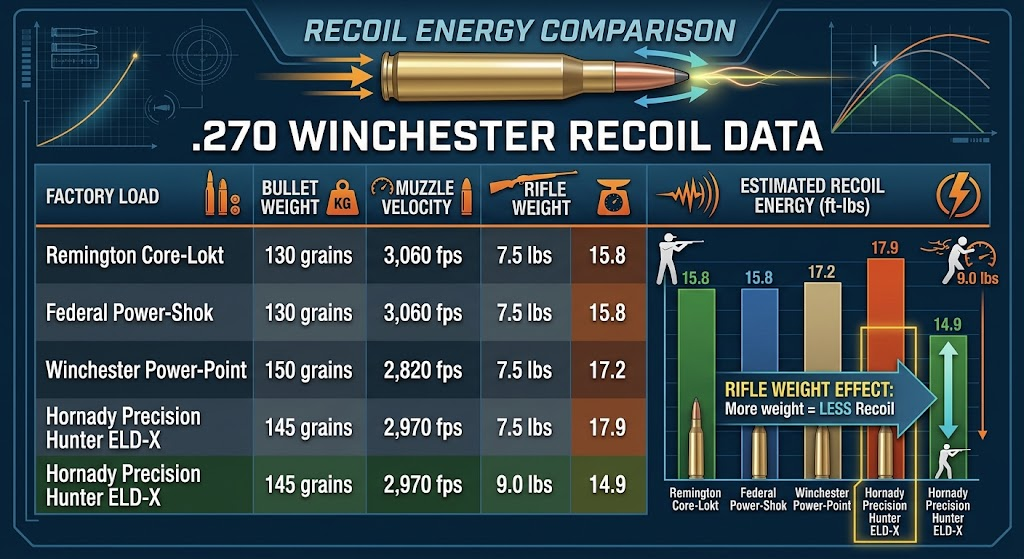
The following table displays estimated free recoil energy for popular .270 Winchester factory loads. Because this cartridge is predominantly chambered in traditional lightweight and medium-weight bolt-action hunting rifles, these calculations use a baseline 7.5-pound rifle weight for a consistent comparison.
| Factory Load | Bullet Weight | Muzzle Velocity | Rifle Weight | Estimated Recoil Energy |
| Remington Core-Lokt | 130 grains | 3,060 fps | 7.5 lbs | 15.8 ft-lbs |
| Federal Power-Shok | 130 grains | 3,060 fps | 7.5 lbs | 15.8 ft-lbs |
| Winchester Power-Point | 150 grains | 2,820 fps | 7.5 lbs | 17.2 ft-lbs |
| Hornady Precision Hunter ELD-X | 145 grains | 2,970 fps | 7.5 lbs | 17.9 ft-lbs |
| Hornady Precision Hunter ELD-X | 145 grains | 2,970 fps | 9.0 lbs | 14.9 ft-lbs |
How Much Recoil Does .270 Winchester Have?
In practical terms, a standard 130-grain .270 Winchester hunting load generates an average of 16 foot-pounds of free recoil energy and a recoil velocity of roughly 11.5 feet per second in a 7.5-pound rifle. Recoil energy dictates the physical rearward force delivered to the shoulder, while recoil velocity determines how fast or sharp that impact feels.
Because the .270 Winchester balances moderate bullet weights with efficient powder charges, its rearward force is well within comfortable limits for almost all adult shooters. The recoil velocity is low enough that the kick lacks a harsh, punishing snap, providing a smooth and predictable push.
What Does .270 Winchester Recoil Feel Like?
During a hunt, the recoil of a .270 Winchester is virtually unnoticeable due to adrenaline. Shooters typically describe it as a firm, polite nudge backward rather than a heavy blow. It is universally classified as a moderate recoiling cartridge that is very easy to manage from standard shooting positions.
At the shooting range, the .270 Winchester is comfortable for extended practice sessions. Unlike heavy magnums that cause shoulder fatigue or induce a flinch after a box of ammunition, you can easily shoot a .270 Winchester all afternoon without physical discomfort. The recoil impulse is mild enough that many experienced shooters can stay in the scope and spot their own impacts.
.270 Winchester Recoil Compared To Other Cartridges
To understand how the .270 Winchester fits into the broader hunting cartridge landscape, it helps to compare it directly to other popular chamberings. The data below assumes a standard rifle weight of 7.5 pounds across all rifles to ensure a fair, direct comparison.
| Cartridge | Common Bullet Weight | Muzzle Velocity | Estimated Recoil Energy |
| .243 Winchester | 100 grains | 2,960 fps | 10.0 ft-lbs |
| .308 Winchester | 150 grains | 2,820 fps | 17.5 ft-lbs |
| .270 Winchester | 130 grains | 3,060 fps | 15.8 ft-lbs |
| .30-06 Springfield | 180 grains | 2,700 fps | 21.5 ft-lbs |
| 7mm Rem Mag | 160 grains | 2,950 fps | 23.1 ft-lbs |
| 7mm PRC | 175 grains | 3,000 fps | 25.2 ft-lbs |
What Affects .270 Winchester Recoil?
While the recoil of a .270 Winchester is inherently manageable, several physical and mechanical factors determine exactly how much kick your specific rifle will produce.
- Rifle Weight: A heavier rifle absorbs more rearward momentum. A heavy-barreled target or modern precision rifle will kick noticeably less than a featherweight 6.5-pound mountain rifle.
- Bullet Weight: The .270 Winchester traditionally fires 130-grain bullets for flat-shooting deer hunting, but it also accommodates 150-grain bullets for larger game. Pushing heavier projectiles slightly increases the opposite rearward force.
- Muzzle Velocity: Faster bullets generate more recoil. The .270 Winchester is famous for driving 130-grain bullets at over 3,000 feet per second, yielding a flat trajectory paired with a slightly faster recoil impulse.
- Powder Charge: The mass of the burning powder leaving the barrel acts like a jet, adding to total recoil. The cartridge typically burns around 50 to 55 grains of powder, keeping the total energy well below magnum levels.
- Recoil Pads: A modern, thick rubber buttpad spreads the 16 foot-pounds of energy over a fraction of a second longer, softening the felt impact on your shoulder.
How To Reduce .270 Winchester Recoil
Because the .270 Winchester produces a modest 15 to 18 foot-pounds of recoil energy, mitigation is rarely necessary for adult hunters. However, if you are setting up a rifle for a youth shooter or want to minimize muzzle jump, you can easily soften the experience.
The most effective method is upgrading the stock’s buttpad to a modern, high-performance decelerator pad. If your rifle features a threaded barrel, you can also attach a modest muzzle brake or a suppressor. A suppressor is an exceptional upgrade for a .270 Winchester, as it absorbs the muzzle blast, adds stabilizing weight to the front of the rifle, and reduces felt recoil to levels comparable to a .243 Winchester.
Is .270 Winchester Recoil Too Much For Hunting?
The .270 Winchester recoil is definitely not too much for hunting. In fact, its near-perfect balance of mild recoil and devastating terminal ballistics on deer-sized game is the primary reason it has remained a legendary hunting cartridge for nearly a century.
Because the kick is easily managed by almost any adult or seasoned teen hunter, it encourages proper marksmanship without inducing a flinch. It delivers ample energy for whitetail deer, mule deer, pronghorn, and sheep out past 400 yards while remaining exceptionally pleasant to shoot both in the field and at the practice bench.
Frequently Asked Questions
Does the .270 Winchester kick more than the .308 Winchester?
No, they are very close, but the .270 Winchester typically kicks slightly less than a standard .308 Winchester when firing comparable loads in rifles of equal weight. The .308 Winchester fires a heavier bullet, which generally results in about 1 to 2 foot-pounds more free recoil energy.
Is .270 Winchester recoil worse than .30-06 Springfield?
Yes, but in the opposite direction—the .30-06 kicks noticeably harder than the .270 Winchester. A standard .30-06 Springfield firing a heavy 180-grain bullet generates roughly 20 to 25 percent more free recoil energy than a standard 130-grain .270 Winchester load.
Can a beginner handle .270 Winchester recoil?
Yes. While it is a full-power centerfire rifle cartridge rather than a youth-specific round, the moderate 16 foot-pounds of recoil is entirely manageable for beginners and teenagers who have received proper instruction on basic shooting posture and rifle fundamentals.