The main difference between the .243 Winchester and the .223 Remington is that the .243 Winchester fires a larger and heavier 6mm bullet that delivers significantly more kinetic energy for hunting medium game like deer, while the .223 Remington is a lighter recoiling and more affordable cartridge optimized for high volume target shooting and varmint control. By utilizing the larger .308 Winchester parent case, the .243 Winchester boasts a massive powder capacity advantage. This allows it to push heavy hunting bullets to blistering velocities, making it a highly capable big game round. The .223 Remington takes a different approach by focusing on efficiency. It offers exceptional barrel life, abundant ammunition options, and near zero recoil. Comparing these two hugely popular cartridges will help you decide if you need the heavy hitting power of a dedicated hunting rifle or the economical versatility of a general purpose platform.
Table of Contents [Click to open]
243 vs 223 ballistics chart
| Specification / Metric | .243 Winchester (95 gr SST) | .223 Remington (55 gr V-Max) |
| Cartridge | .243 Winchester | .223 Remington |
| Parent Case | .308 Winchester | .222 Remington |
| Bullet Diameter | .243 inches (6mm) | .224 inches |
| Typical Bullet Weight | 55 to 105 grains | 55 to 77 grains |
| Muzzle Velocity | 3,100 fps | 3,240 fps |
| Velocity at 100 Yards | 2,860 fps | 2,865 fps |
| Velocity at 200 Yards | 2,630 fps | 2,518 fps |
| Velocity at 300 Yards | 2,415 fps | 2,198 fps |
| Velocity at 500 Yards | 2,015 fps | 1,634 fps |
| Muzzle Energy | 2,027 ft-lbs | 1,282 ft-lbs |
| Energy at 100 Yards | 1,725 ft-lbs | 1,002 ft-lbs |
| Energy at 200 Yards | 1,460 ft-lbs | 774 ft-lbs |
| Energy at 300 Yards | 1,230 ft-lbs | 589 ft-lbs |
| Energy at 500 Yards | 855 ft-lbs | 326 ft-lbs |
| Bullet Drop (500 Yds, 200 Yd Zero) | -36.0 inches | -43.5 inches |
| Wind Drift (500 Yds, 10 mph Wind) | 23.5 inches | 35.0 inches |
| Ballistic Coefficient (G1) | 0.350 to 0.450 | 0.250 to 0.350 |
| Sectional Density | 0.133 to 0.254 | 0.157 to 0.219 |
| Effective Hunting Range | 400 yards (medium game) | 300 yards (varmints) |
| Maximum Effective Range | 800 yards | 600 yards |
| Typical Twist Rate | 1:9 to 1:10 | 1:7 to 1:12 |
| Recoil (Free Recoil Energy) | ~9.0 ft-lbs | ~4.5 ft-lbs |
| Trajectory | Very flat to 400 yds | Arcs moderately past 300 yds |
| Barrel Life | 2,000 to 3,000 rounds | 8,000 to 10,000+ rounds |
| Accuracy Potential | Excellent | Excellent |
| Hunting Performance | Deer, antelope, coyotes | Varmints and small pests |
| Target Shooting Performance | Great for long range steel | Excellent general purpose |
| Long-Range Performance | Supersonic past 800 yards | Supersonic past 600 yards |
| Ammunition Availability | High | Exceptionally high |
| Ammunition Cost | Moderate to high | Low to moderate |
| Rifle Availability | Common in bolt actions | Universal |
| Magazine Compatibility | Standard short action | Standard AR-15 / STANAG |
| Suppressor Compatibility | Excellent | Excellent |
| Best Use Cases | Deer hunting, predator control | Plinking, training, varmints |
| Main Advantages | Massive energy, versatile weights | Low recoil, cheap ammo |
| Main Disadvantages | Noticeably shorter barrel life | Lacks power for large game |
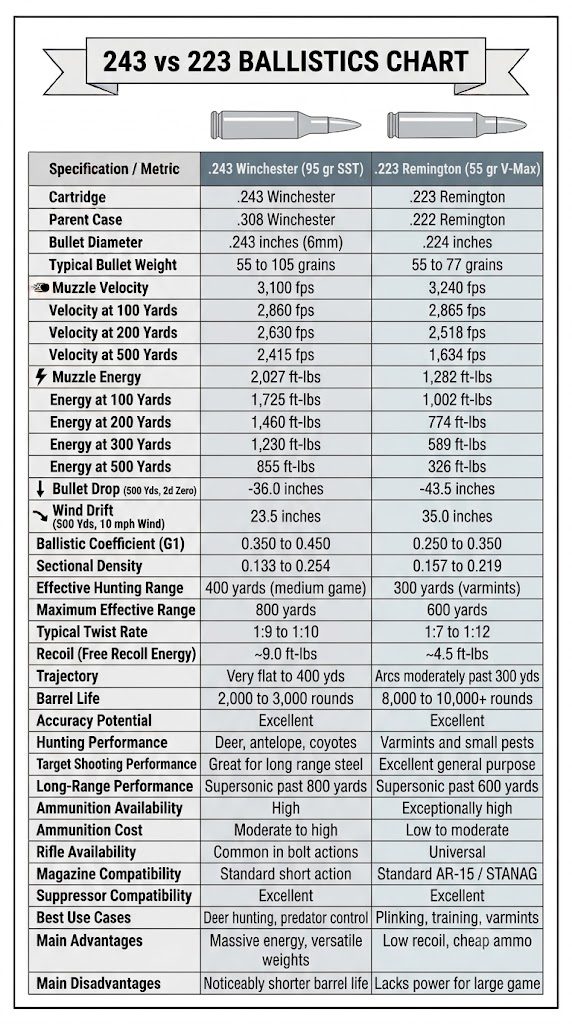
The comparison table above demonstrates the massive power gap between a true medium game hunting cartridge and a small caliber varmint round. While the .223 Remington launches its lighter 55 grain bullet at a slightly faster initial muzzle velocity, the .243 Winchester is pushing a much heavier 95 grain bullet right behind it. Because the 6mm bullet of the .243 Winchester is heavier and more aerodynamically efficient, it retains its speed much better downrange. By 200 yards, the .243 Winchester has actually overtaken the .223 Remington in velocity.
This retained speed and heavier mass result in vastly superior kinetic energy. At 300 yards, the .243 Winchester hits with more force than the .223 Remington generates at the muzzle. This makes the .243 Winchester a completely ethical and reliable choice for deer hunting, whereas the .223 Remington falls short. The higher ballistic coefficient of the 6mm bullets also allows the .243 Winchester to shoot flatter and cut through the wind much more effectively at 500 yards.
However, the .243 Winchester requires a larger rifle action, produces twice the felt recoil, and wears out barrels significantly faster. The .223 Remington remains the absolute best choice for shooters who want to practice affordably, shoot all day without shoulder fatigue, and hunt small varmints inside 300 yards.
Detailed Comparison Sections
Understanding the Comparison Chart
To truly understand the capabilities of these cartridges, you must look at their case capacities. The .243 Winchester is based on the .308 Winchester case necked down to accept a 6mm bullet. This gives it a massive boiler room for gunpowder. The .223 Remington has a much smaller case capacity designed for efficiency and high volume military applications rather than absolute hunting power.
How to Read the Ballistics Chart
When reading this chart, pay close attention to the energy at distance and the wind drift. Kinetic energy indicates stopping power, which is the most critical metric for ethical hunting. Wind drift indicates how well the bullet cuts through the air, which directly impacts your ability to hit targets at long ranges in real world weather conditions.
Velocity Comparison
The .223 Remington gets off the starting line faster. A standard 55 grain .223 bullet leaves the muzzle at 3,240 fps, while a heavy 95 grain .243 bullet leaves at 3,100 fps. However, lighter bullets shed their velocity much faster than heavier bullets. By the time they cross the 200 yard line, the heavier .243 Winchester bullet has conserved its momentum and is flying faster than the .223 Remington. At 500 yards, the .243 Winchester holds a massive 380 fps advantage.
Energy Comparison
The .243 Winchester is in a completely different weight class regarding kinetic energy. At the muzzle, it generates over 2,000 foot-pounds of energy compared to the 1,280 foot-pounds of the .223 Remington. This power gap ensures the .243 Winchester can drive deep into the vitals of medium game animals. At 500 yards, the .243 Winchester retains 855 ft-lbs of energy, easily outclassing the 326 ft-lbs retained by the .223 Remington.
Trajectory Comparison
Trajectory encompasses both gravity and wind resistance. Because the .243 Winchester retains its velocity better over long distances, it provides a much more forgiving flight path for the shooter.
Bullet Drop Comparison
With a 200 yard zero, both cartridges exhibit similar drop out to 300 yards. Once you stretch the distance to 500 yards, the ballistic efficiency of the .243 Winchester takes over. The .243 Winchester drops roughly 36 inches at 500 yards. The .223 Remington drops roughly 43.5 inches. That 7.5 inch difference makes long range target engagements noticeably easier with the 6mm cartridge.
Wind Drift Comparison
Wind is highly disruptive to the lightweight .22 caliber projectiles of the .223 Remington. In a 10 mph crosswind at 500 yards, the .223 Remington will drift 35 inches off target. The heavier, more aerodynamic .243 Winchester bullet will only drift 23.5 inches under the exact same conditions.
Ballistic Coefficient Comparison
Ballistic Coefficient (BC) measures the aerodynamic drag of a bullet. The long, sleek 6mm bullets utilized by the .243 Winchester boast excellent BC ratings, typically ranging from 0.350 to 0.450. The shorter .223 Remington bullets generally sit between 0.250 and 0.350. This superior BC is the exact reason the .243 Winchester dominates the wind and retains its energy so effectively.
Accuracy Comparison
Both cartridges are exceptionally accurate. The .223 Remington has dominated high power service rifle competitions for decades. The .243 Winchester is highly regarded by precision hunters and long range steel shooters. In a quality rifle with match grade ammunition, both will easily shoot sub-MOA groups at 100 yards.
Effective Range Comparison
For target shooting, the .223 Remington is a reliable performer out to 600 yards. The .243 Winchester can stretch that target range comfortably to 800 yards or further. For hunting, the .223 Remington is limited to about 300 yards on varmints. The .243 Winchester remains highly effective on deer and antelope out to 400 yards in the hands of a skilled marksman.
Hunting Performance Comparison
If your goal is hunting whitetail deer, mule deer, or antelope, the .243 Winchester is the clear winner. It delivers the penetration and hydrostatic shock required for quick, ethical kills. The .223 Remington is widely considered underpowered for deer. However, if your only goal is eradicating prairie dogs or coyotes, the .223 Remington is perfect because it does less damage to the pelt and costs much less to shoot.
Target Shooting Comparison
For a casual day at the range shooting paper at 100 yards, the .223 Remington is vastly superior due to cheap ammunition and non-existent recoil. If you are shooting steel targets across a windy canyon at 600 yards, the .243 Winchester provides the wind resistance and steel ringing impact energy you need to spot your hits.
Long-Range Performance Comparison
The .243 Winchester is a proven long range capable cartridge. It stays supersonic well past 800 yards and fights the wind efficiently. The .223 Remington begins to struggle significantly past 600 yards as its lightweight bullets are easily pushed off target by shifting crosswinds.
Recoil Comparison
Recoil is the biggest advantage for the .223 Remington. It generates a tiny 4.5 foot-pounds of free recoil energy, making it completely comfortable for children, beginners, and high volume shooters. The .243 Winchester generates roughly 9.0 foot-pounds of recoil. While still considered very mild compared to large magnum calibers, it is twice the felt recoil of a .223 Remington.
Barrel Life Comparison
The large powder charge pushing through the small 6mm bore of the .243 Winchester creates intense heat that accelerates barrel wear. You can expect a .243 Winchester to lose its peak accuracy after 2,000 to 3,000 rounds. The .223 Remington operates at much cooler temperatures and will easily last 8,000 to over 10,000 rounds before the barrel needs replacing.
Ammunition Cost Comparison
The .223 Remington is one of the most affordable centerfire rifle cartridges in the world. Bulk full metal jacket practice ammunition is incredibly cheap. The .243 Winchester is primarily a hunting cartridge, meaning the ammunition is loaded with premium expanding bullets that cost significantly more per round than bulk .223 ammo.
Ammunition Availability
You will find .223 Remington in endless quantities at every single store that sells ammunition. It is the most popular rifle round in America. The .243 Winchester is also incredibly popular and reliably stocked at most sporting goods stores, but you will not find the same massive bulk discounts that you find with the .223 Remington.
Rifle Compatibility
The .223 Remington is the gold standard for the AR-15 platform and is available in countless bolt action rifles. The .243 Winchester requires a short action length receiver. It is primarily chambered in bolt action hunting rifles, though it can be found in the larger AR-10 semi-automatic platform if you prefer a gas gun.
Pros and Cons of .243 Winchester
Pros:
- Outstanding terminal ballistics for deer hunting.
- Excellent wind resistance and flat trajectory.
- Can be loaded with light bullets for varmints or heavy bullets for big game.
- Mild recoil for a big game capable cartridge.
Cons:
- Accelerates barrel throat erosion.
- Ammunition is more expensive than standard target calibers.
Pros and Cons of .223 Remington
Pros:
- Incredibly cheap and easy to find ammunition.
- Exceptional barrel life.
- Virtually no felt recoil.
- Universal platform compatibility.
Cons:
- Lacks the necessary kinetic energy for big game hunting.
- Susceptible to heavy wind drift at extended ranges.
Which Cartridge Is Better for Beginners?
The .223 Remington is the ultimate beginner cartridge. The recoil is negligible, preventing the shooter from developing a flinch. More importantly, the low cost of ammunition allows a new shooter to afford the hundreds of rounds of practice required to build strong shooting fundamentals.
Which Cartridge Is Better for Hunting?
If you are hunting anything larger than a coyote, the .243 Winchester is the superior and more ethical choice. It offers the kinetic energy and penetration required to ensure a clean harvest on medium game animals. The .223 Remington should be strictly reserved for varmints and small predators.
Which Cartridge Is Better for Long-Range Shooting?
The .243 Winchester is the better tool for long range shooting. Its heavy 6mm bullets boast superior ballistic coefficients that slice through the wind and maintain a predictable trajectory far beyond the effective limits of a standard .223 Remington.
Which Cartridge Should You Choose?
Choose the .243 Winchester if you need a dedicated hunting rifle for whitetail deer or antelope that can also double as a long range target rifle. Choose the .223 Remington if you want a reliable, cost effective, and highly versatile rifle for range training, home defense, and varmint hunting.
Verdict
The .243 Winchester and the .223 Remington are two of the most successful cartridges in modern history, but they serve entirely different purposes. The .223 Remington is an unmatched utility cartridge. Its affordability, long barrel life, and widespread availability make it the perfect high volume training tool. However, it lacks the kinetic punch required for large game. The .243 Winchester bridges the gap perfectly between a fast varmint round and a capable big game cartridge. It hits with authority, defeats the wind at long range, and still offers manageable recoil. The correct choice simply depends on whether you plan to hunt deer or spend your weekends doing high volume target practice.
FAQs
Is a .243 bigger than a .223?
Yes. The bullet diameter of the .243 Winchester is .243 inches (6mm), while the .223 Remington fires a smaller .224 inch bullet. Additionally, the brass casing of the .243 Winchester is much larger and holds significantly more gunpowder.
Can a .243 kill a bear?
While a .243 Winchester can kill a black bear with perfect shot placement using heavy, deep penetrating bullets, it is generally considered too light for bear hunting. Most experienced hunters recommend using a larger caliber like the .308 Winchester or .30-06 for dangerous game.
Why is the .243 so popular for deer hunting?
The .243 Winchester is popular because it perfectly balances power and shootability. It provides plenty of kinetic energy to ethically harvest a deer, but it generates very mild recoil, making it highly accurate and pleasant to shoot for hunters of all ages and sizes.
Is .223 a good caliber for coyotes?
Yes, the .223 Remington is considered one of the absolute best coyote cartridges in the world. It shoots incredibly flat out to 300 yards and causes minimal damage to the pelt when used with proper hunting bullets.
Does a .243 kick hard?
No. The .243 Winchester is famous for its mild recoil. While it kicks about twice as much as a .223 Remington, it produces roughly half the recoil of a .30-06 Springfield. It is widely considered one of the most comfortable big game cartridges available.