The main difference between the .224 Valkyrie and the 6.5 Grendel is that the .224 Valkyrie is optimized for extreme long-range target shooting by pushing high-ballistic coefficient, lightweight .22 caliber bullets at blistering velocities to stay supersonic past 1,000 yards, while the 6.5 Grendel utilizes a heavier, wider 6.5mm bullet to deliver vastly superior kinetic energy and terminal stopping power for hunting medium game at extended ranges, with both cartridges designed to maximize the ballistic potential of the standard AR-15 platform.
.224 Valkyrie vs 6.5 Grendel Comparison Table
To accurately compare these two advanced AR-15 cartridges, we must examine their physical dimensions and baseline ballistic performance. The data below represents standard premium factory loads designed for long-range precision, comparing the 90-grain Match load for the .224 Valkyrie against the highly popular 123-grain Match load for the 6.5 Grendel.
| Specification | .224 Valkyrie | 6.5 Grendel |
| Cartridge Type | Intermediate Rifle | Intermediate Rifle |
| Parent Case | 6.8 SPC | .220 Russian (7.62x39mm family) |
| Bullet Diameter | .224 in (5.7 mm) | .264 in (6.5 mm) |
| Case Length | 1.600 in | 1.520 in |
| Overall Length | 2.260 in | 2.260 in |
| Typical Bullet Weights | 60 gr to 90 gr | 90 gr to 130 gr |
| Muzzle Velocity (20″ bbl) | 2,700 fps (90gr Match) | 2,500 fps (123gr Match) |
| Muzzle Energy (20″ bbl) | 1,457 ft-lbs | 1,707 ft-lbs |
| Maximum Pressure | 55,000 psi (SAAMI) | 52,000 psi (SAAMI) |
| Effective Range | 1,000+ yds (Target) / 400 yds (Hunting) | 800+ yds (Target) / 400 yds (Hunting) |
| Trajectory | Extremely Flat | Very Flat |
| Bullet Drop (500 yds) | Approx. 45 inches | Approx. 55 inches |
| Wind Drift | Exceptionally Low (High BC) | Low (High BC) |
| Recoil | Very Mild (Approx. 4.5 ft-lbs) | Mild (Approx. 8.5 ft-lbs) |
| Barrel Length Performance | Excels in 20 to 24-inch barrels | Excels in 18 to 20-inch barrels |
| Suppressor Performance | Good | Good |
| Short Barrel Performance | Poor (High velocity loss) | Moderate |
| Accuracy | Elite (Match grade precision) | Elite (Match grade precision) |
| Penetration | Moderate (High velocity) | Deep (Heavy mass) |
| Expansion | Reliable on small game | Devastating on medium game |
| Hunting Performance | Excellent (Varmints, coyotes) | Elite (Deer, hogs, antelope) |
| Home Defense | Not Recommended (Over-penetration risk) | Not Recommended (Over-penetration risk) |
| Tactical Use | None | Limited Special Operations |
| AR-15 Compatibility | Yes (Requires 6.8 SPC bolt and mag) | Yes (Requires 6.5 Grendel bolt and mag) |
| Magazine Compatibility | 6.8 SPC AR-15 magazines | 6.5 Grendel AR-15 magazines |
| Ammunition Cost | Moderate | Moderate |
| Ammo Availability | Specialty or Online | Good |
| Best Uses | Long-range target shooting | Medium game hunting, general purpose |
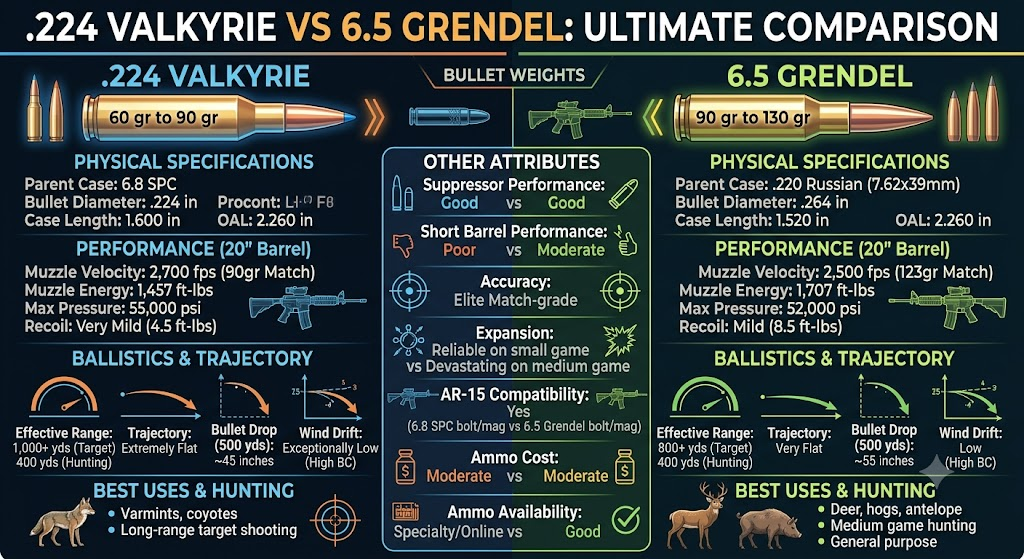
Understanding the Numbers
Both of these cartridges were explicitly engineered to stretch the ballistic limits of the standard AR-15 platform. Because an AR-15 magazine well is strictly limited to an overall cartridge length of 2.260 inches, designers have to utilize wider, fatter cases to hold enough powder to drive aerodynamic bullets to extreme distances.
The 6.5 Grendel, designed by Bill Alexander in 2003, achieves this by utilizing the fat .220 Russian (7.62x39mm) parent case. It revolutionized AR-15 hunting by offering kinetic energy that rivals the .308 Winchester at extended ranges while remaining in a small, lightweight rifle.
The .224 Valkyrie, introduced by Federal Premium in 2017, took the 6.8 SPC case and necked it down to accept long, slender .224 caliber bullets. Federal’s goal was to create the first AR-15 cartridge capable of staying supersonic past 1,300 yards, a feat traditionally reserved for heavy bolt-action magnum rifles.
Velocity Comparison
Velocity is the engine that drives a bullet’s trajectory and dictates its resistance to gravity over extended distances.
When firing long-range match ammunition out of a standard 20-inch barrel, the .224 Valkyrie holds a distinct advantage. Pushing a highly aerodynamic 90-grain bullet, the Valkyrie reaches a muzzle velocity of 2,700 fps. The 6.5 Grendel, saddled with a much heavier 123-grain projectile, launches at approximately 2,500 fps.
This 200 fps advantage at the muzzle is precisely what allows the .224 Valkyrie to remain supersonic (above 1,125 fps) well past 1,000 yards, ensuring the bullet does not destabilize as it drops into the transonic speed zone.
Muzzle Energy Comparison
Muzzle energy measures the absolute kinetic force transferred to a target upon impact.
Despite the .224 Valkyrie’s velocity advantage, the 6.5 Grendel completely dominates in kinetic energy due to its heavier bullet weight. The 123-grain Grendel generates roughly 1,707 ft-lbs of energy at the muzzle. The 90-grain Valkyrie generates approximately 1,457 ft-lbs.
The 6.5 Grendel delivers nearly 20 percent more kinetic energy. This massive energy advantage is why the Grendel is trusted for hunting deer and wild hogs, whereas the Valkyrie is generally restricted to coyotes and varmints.
Trajectory Comparison
A flat trajectory minimizes the margin of error when estimating range in the field.
Because the .224 Valkyrie launches at a much higher initial velocity and utilizes bullets with exceptionally high Ballistic Coefficients (BC), it shoots significantly flatter than the 6.5 Grendel. The Valkyrie reaches the target faster, giving gravity less time to pull the projectile downward. The 6.5 Grendel, while still impressively flat for an AR-15 cartridge, arches noticeably more as distances push past 400 yards.
Bullet Drop Comparison
Assuming a standard 100-yard zero for both rifles, the mathematical bullet drop at extended distances illustrates the aerodynamic superiority of the Valkyrie.
At 500 yards, the .224 Valkyrie (90gr) drops approximately 45 inches. The 6.5 Grendel (123gr) drops roughly 55 inches at the exact same distance.
If pushed to 1,000 yards, the .224 Valkyrie drops roughly 310 inches. The 6.5 Grendel drops a staggering 400 inches, making ethical hits on targets significantly more difficult without precise ballistic calculators.
Wind Drift Comparison
Wind deflection is the absolute greatest enemy of the precision long-range shooter. Wind drift is mitigated strictly by a bullet’s velocity and its aerodynamic profile (Ballistic Coefficient).
Both cartridges feature incredibly aerodynamic bullets, but the .224 Valkyrie edges out a victory. A 90-grain Sierra MatchKing bullet fired from the Valkyrie boasts a G1 BC of .563. The 123-grain Hornady ELD Match bullet fired from the Grendel has a G1 BC of .506.
Because the .224 Valkyrie is vastly more aerodynamic and reaches the target faster, it spends less time exposed to crosswinds. At 1,000 yards in a 10 mph crosswind, the Valkyrie will drift roughly 75 inches, while the Grendel will drift over 90 inches.
Recoil Comparison
Recoil dictates a shooter’s ability to spot their own impacts through a rifle scope and fire rapid follow-up shots.
The .224 Valkyrie produces exceptionally mild recoil. In a standard 8-pound AR-15, it generates roughly 4.5 ft-lbs of free recoil. It is completely pleasant to shoot all day and allows competitive shooters to easily watch their bullets impact steel targets at 1,000 yards.
The 6.5 Grendel generates noticeably more recoil due to the heavier powder charge and heavier bullet mass. It generates approximately 8.5 ft-lbs of free recoil. While this is still considered very mild compared to heavy .308 Winchester rifles, it produces slightly more muzzle flip than the Valkyrie.
Stopping Power Comparison
Stopping power on game animals requires massive energy transfer and deep tissue disruption.
The .224 Valkyrie delivers excellent stopping power on coyotes, prairie dogs, and small varmints. The .22 caliber bullets expand rapidly, creating devastating temporary wound cavities on small game. However, it lacks the sheer mass required for reliable stopping power on large, heavy-boned animals.
The 6.5 Grendel delivers vastly superior stopping power. The hydrostatic shock generated by a 123-grain bullet impacting at high velocities creates massive internal trauma that anchors deer and feral hogs rapidly.
Penetration Comparison
Penetration is critical for ensuring the bullet reaches the vital organs of heavily muscled animals on quartering angles.
Sectional Density (SD) measures a bullet’s weight relative to its diameter. A higher sectional density allows the bullet to penetrate deeper without losing momentum. The 123-grain 6.5mm bullet has a solid sectional density of .252. The 90-grain .224 caliber bullet boasts an impressive sectional density of .256.
While their sectional densities are nearly identical, the heavier raw mass of the 6.5 Grendel ensures it carries more forward momentum, allowing it to punch through heavy shoulder bones far more reliably than the lightweight Valkyrie.
Expansion Comparison
To accurately test bullet expansion, the ballistics industry relies on calibrated ordinance gel.
Both cartridges expand reliably when loaded with proper hunting ammunition, but their effective expansion ranges differ. Traditional hunting bullets require an impact velocity of at least 1,800 fps to reliably force the copper jacket open. Because the .224 Valkyrie retains its velocity much longer, it can theoretically expand at further distances than the 6.5 Grendel, though the lack of kinetic energy makes harvesting game at those extreme ranges highly unethical.
Accuracy Comparison
Both cartridges are capable of elite mechanical accuracy and were purpose-built for extreme precision.
When fired from high-quality AR-15 match barrels, both cartridges will easily shoot sub-MOA (Minute of Angle) groups at 100 yards. For competitive long-range precision rifle shooting, the .224 Valkyrie holds a distinct advantage due to its flatter trajectory and superior wind resistance.
Effective Range Comparison
The effective range of a rifle is severely limited by bullet drop, wind deflection, and retained energy.
For target shooting on steel plates, the .224 Valkyrie is highly effective out to 1,300 yards. The 6.5 Grendel struggles to hit targets consistently past 900 or 1,000 yards as it drops into the turbulent transonic speed zone.
For hunting, the 6.5 Grendel is a highly ethical 400-yard deer cartridge. The .224 Valkyrie should be restricted to hunting coyotes inside 400 yards.
Suppressor Performance Comparison
Suppressing a weapon protects the shooter’s hearing and provides a massive tactical advantage.
Both cartridges are strictly supersonic and push immense volumes of expanding powder gases. Adding a quality titanium or steel suppressor will tame the concussive blast and reduce the visual muzzle flash, but neither cartridge can be made completely silent. The supersonic crack of the bullet breaking the sound barrier will always remain loud.
Short Barrel Performance Comparison
Modern tactical and hunting applications frequently require maneuverable short-barreled rifles (SBRs).
The 6.5 Grendel performs surprisingly well in short 12.5-inch or 16-inch barrels. While you sacrifice some velocity, the heavy bullet mass ensures it still hits targets with massive kinetic energy, making short-barreled Grendels incredibly popular for hunting feral hogs in thick brush.
The .224 Valkyrie performs terribly in short barrels. It requires a massive column of slow-burning powder to achieve its advertised 2,700 fps velocity. If you chop a Valkyrie barrel down to 16 inches, a massive amount of unburnt powder blasts out of the muzzle, resulting in severe velocity loss and completely ruining its long-range capabilities. The Valkyrie requires a minimum of 20 to 24 inches to function as designed.
Home Defense Comparison
Inside the home, a defender must balance stopping power against over-penetration and auditory safety.
Neither cartridge is ideal for suburban home defense. Both fire high-velocity rifle projectiles that will easily blow clean through an intruder, through multiple interior drywall walls, and penetrate the exterior of a neighboring house. The 5.56 NATO or the .300 Blackout are vastly superior choices for close-quarters home defense in an AR-15.
Hunting Comparison
These cartridges were built for entirely different hunting environments.
The .224 Valkyrie is a dedicated varmint and predator cartridge. It is exceptional for hunting coyotes and prairie dogs across wide-open plains where long shots are mandatory and minimal pelt damage is desired.
The 6.5 Grendel is the ultimate AR-15 medium game cartridge. If you are hunting whitetail deer, feral hogs, or antelope, the 6.5 Grendel provides the deep penetration and high retained energy necessary to make clean, ethical kills at extended distances.
Tactical and Duty Use Comparison
Neither cartridge has seen widespread adoption in conventional military or law enforcement roles, primarily due to the massive logistical superiority of the 5.56 NATO.
However, the 6.5 Grendel has seen limited, classified use in specialized foreign military units and special operations forces seeking to increase the lethality of their standard-issue assault rifles without transitioning to the heavy AR-10 platform.
AR-15 Compatibility
Both cartridges fit perfectly into the standard AR-15 platform, utilizing a standard mil-spec upper and lower receiver.
However, neither cartridge can use a standard 5.56 NATO bolt carrier group.
- To shoot the .224 Valkyrie, you must purchase a dedicated 6.8 SPC bolt and a .224 Valkyrie barrel.
- To shoot the 6.5 Grendel, you must purchase a dedicated 6.5 Grendel (Type II) bolt and a 6.5 Grendel barrel.
Magazine Compatibility
Because both cartridges feature fat, bloated cases, standard 5.56 NATO magazines will not feed them reliably.
The .224 Valkyrie requires specialized 6.8 SPC magazines. The 6.5 Grendel requires dedicated 6.5 Grendel magazines. Both magazine types feature unique internal geometry and specialized followers to ensure the fat cases stack properly without jamming.
Ammo Cost Comparison
To become proficient with a precision rifle, you must practice frequently.
Both the .224 Valkyrie and the 6.5 Grendel are moderately priced, premium cartridges. Commercial practice ammunition is available for both, but it generally costs significantly more than bulk 5.56 NATO ammunition. Premium match-grade ammunition for long-range competitions can be quite expensive for both calibers.
Ammo Availability Comparison
Walk into a typical rural sporting goods store, and you are much more likely to find 6.5 Grendel on the shelf. The Grendel has established a massive following in the hunting community over the last two decades. The .224 Valkyrie is a newer, niche cartridge that is primarily purchased online by long-range shooting enthusiasts.
Reloading Comparison
Both cartridges are absolute favorites in the precision reloading community.
The .224 Valkyrie is a handloader’s dream for extreme long-range precision. The market is flooded with high-quality brass cases and the most aerodynamic .224 caliber bullets ever designed.
The 6.5 Grendel is also highly economical to reload, though handloaders must be incredibly careful to observe maximum pressure signs, as the weak AR-15 bolt lugs can shear off if the Grendel is loaded to excessive pressures.
Pros and Cons
.224 Valkyrie
Pros
- Extreme long-range accuracy capable of ringing steel past 1,000 yards.
- Exceptionally high Ballistic Coefficient bullets defeat wind drift.
- Practically zero recoil allows for easy impact spotting.
- Fits into a standard, lightweight AR-15 platform.
- Flattest trajectory available in a modern intermediate cartridge.
Cons
- Requires a long 20 to 24-inch barrel to achieve advertised velocities.
- Lacks the kinetic energy for hunting medium or large game animals.
- Ammunition is difficult to find in local sporting goods stores.
6.5 Grendel
Pros
- Elite stopping power and deep penetration on medium game animals.
- Outperforms .308 Winchester kinetic energy at extended ranges.
- Excellent performance in short-barreled hunting rifles.
- Fits into a standard, lightweight AR-15 platform.
- Massive ecosystem of premium factory hunting ammunition.
Cons
- Drops significantly more at long range compared to the Valkyrie.
- Heavier bullet mass generates slightly more recoil.
- AR-15 bolt lugs are prone to breaking if ammunition is loaded too hot.
Final Verdict
Choosing between the .224 Valkyrie and the 6.5 Grendel is an easy decision once you define your primary target.
- For Extreme Long-Range Target Shooting: Choose the .224 Valkyrie. The aerodynamic efficiency and flat trajectory will allow you to ring steel at 1,000 yards with far more consistency and less wind drift than the heavier Grendel.
- For Deer and Hog Hunting: Choose the 6.5 Grendel. The heavy 123-grain bullet provides the massive kinetic energy and deep penetration required to ethically harvest medium game, which the lightweight Valkyrie cannot guarantee.
- For Suppressed SBR Hunters: Choose the 6.5 Grendel. A 12.5-inch AR-15 chambered in 6.5 Grendel is highly maneuverable in a deer stand and burns its powder much more efficiently than a chopped-down Valkyrie barrel.
- For Coyote and Predator Hunting: Choose the .224 Valkyrie. If you are hunting across wide-open plains where shots frequently exceed 300 yards, the Valkyrie provides the flat trajectory necessary to anchor fast-moving predators.
FAQ
Is the 6.5 Grendel more powerful than the .224 Valkyrie?
Yes, significantly. Because the 6.5 Grendel pushes a much heavier bullet out of a larger powder column, it generates roughly 1,700 ft-lbs of kinetic energy at the muzzle. The .224 Valkyrie generates approximately 1,450 ft-lbs of energy.
Can I shoot .224 Valkyrie out of a 5.56 AR-15?
You can use the exact same upper and lower receiver, but you absolutely must change the barrel to a .224 Valkyrie barrel, change the bolt to a 6.8 SPC bolt, and utilize specialized 6.8 SPC magazines.
Why is the .224 Valkyrie so popular for long-range?
The .224 Valkyrie revolutionized long-range shooting by offering the supersonic ballistic performance of heavy bolt-action magnum cartridges but with practically zero recoil in a standard AR-15 platform. Its ability to stay supersonic past 1,300 yards is a massive technological achievement.
What is the effective range of the 6.5 Grendel?
When loaded with modern hunting ammunition, the 6.5 Grendel is highly ethical and effective on medium game out to 400 yards. Beyond that distance, the bullet sheds velocity rapidly, and the energy drops below ethical hunting thresholds.
Can a 6.5 Grendel kill an elk?
While the 6.5 Grendel has successfully taken elk with perfect shot placement at close ranges, it is universally considered underpowered for massive, heavy-boned animals. Hunters pursuing elk should strongly consider stepping up to a full-power short-action cartridge like the 6.5 Creedmoor or .308 Winchester.
Does the .224 Valkyrie have a lot of recoil?
No. Firing a .224 Valkyrie from a standard AR-15 generates very mild recoil, similar to a standard 5.56 NATO rifle. It feels like a light, gentle push, making it highly suitable for young shooters, beginners, and competitive marksmen who need to spot their own hits through a magnified optic.